
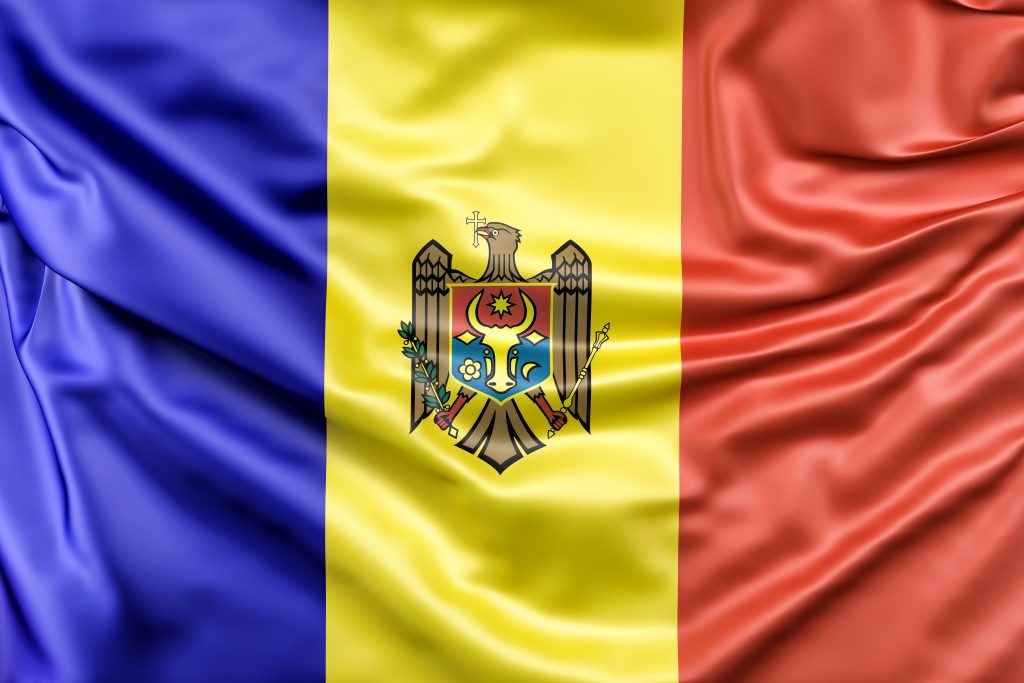
I am guessing that Moldova is the not first country that springs to mind when contemplating a trip to Europe. But I have just been visiting Romania, ergo, it is an easy step to cross its eastern border into this relatively unvisited country. It was, in fact, once part of Romania, and Romania still has a province called Moldavia. Their flags are made up of the same three broad vertical bands, except that Moldova’s has a coat of arms on the middle yellow band, showing an eagle bearing a shield with a yellow auroch’s head. It is a landlocked country and to its east and south lies Ukraine. The country was part of the USSR from 1944 until 1989.
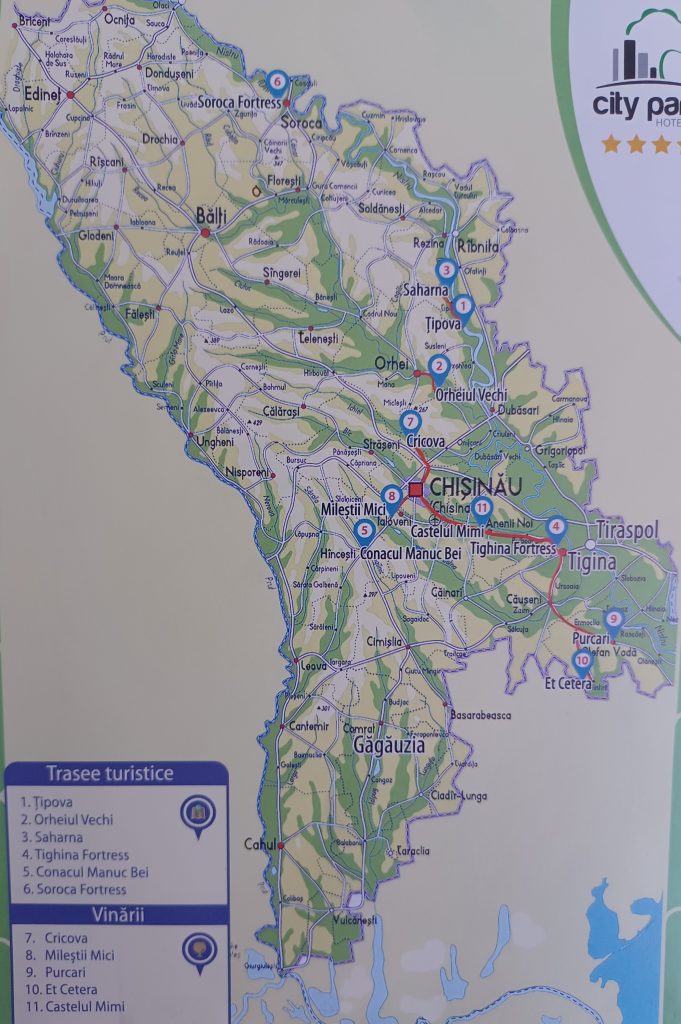
The first impressions of the country I get, whilst being driven by my hotel shuttle service from the airport, is of greenery. Forests of tall mature trees in full leaf. Sticking up like gross carbuncles in their midst are Soviet residential blocks. Some have broad brown stripes in the centre of their facades. To distinguish one from the other perhaps. Some of them are so wide they seem to match or even exceed the width of Ceaucescu’s Palace of the Parliament in Bucharest. There are a lot of them. Not Moldova’s fault probably. A devastating earthquake in 1940 was followed by German bombing before the Red Army marched in in 1944. Not a lot was left of the capital, Chișinău, which, during Soviet times, was called Kishinev. As we approach the city, my driver points out what he calls the ‘City Gates’. On either side of the main highway are enormous apartment complexes, rising from low to high, like a giant pyramid cut in half, in perfect symmetry.
Chișinău
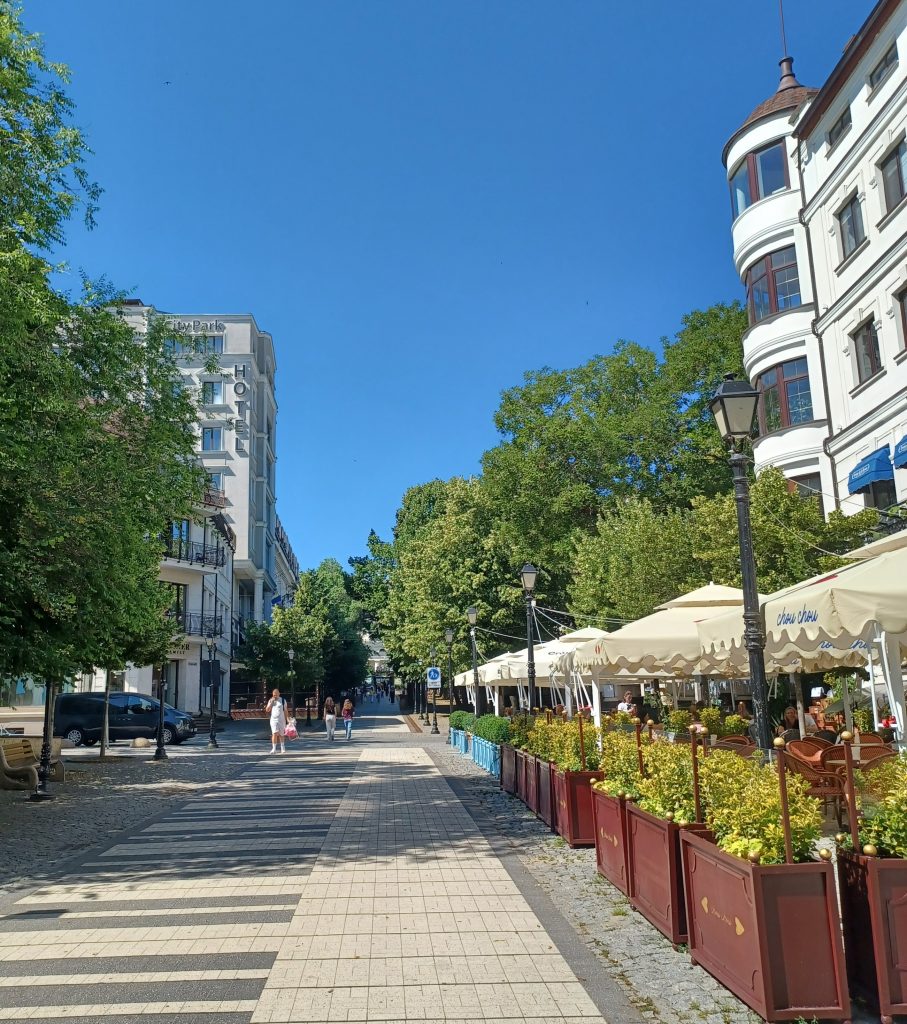
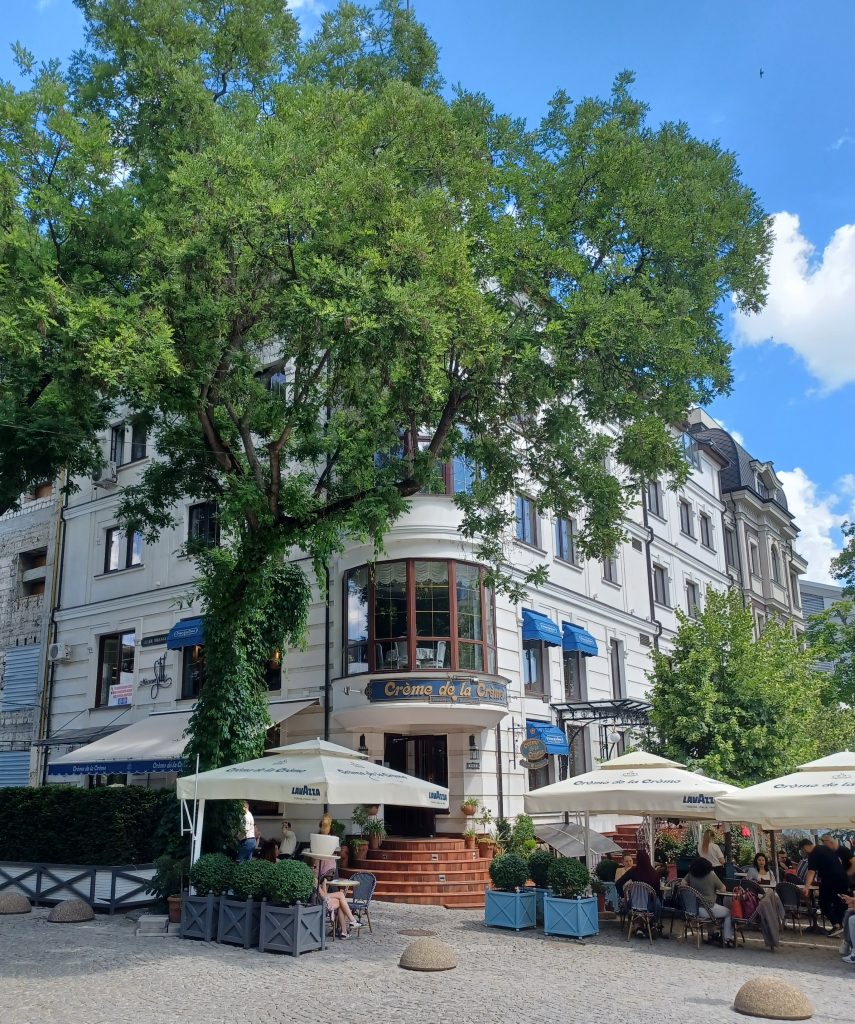
I reach the rather more attractive – to my eyes at least – area of my hotel in Chișinău. It is situated on a pedestrian street, which is painted with piano keys, and named after one of Moldova’s great composers, Eugen Doga. The street boasts cafés, restaurants, and shops in handsome buildings. Built before the Soviet era. It is too early to check in. The flight from Bucharest had arrived at 0900 after a one hour hop. But the obliging receptionist gets my room prepared early. And in the interim, I nip across the street and park myself at the Crème de la Crème café. Neatly dressed waitresses in pressed aprons and sparkling white shirts dart around serving the clientele, mostly locals, it seems: mums and babies, businessfolk and a couple of young elegant ladies with botox lips.
After check in, I set off to explore the surroundings.
The Cathedral of Christ’s Nativity
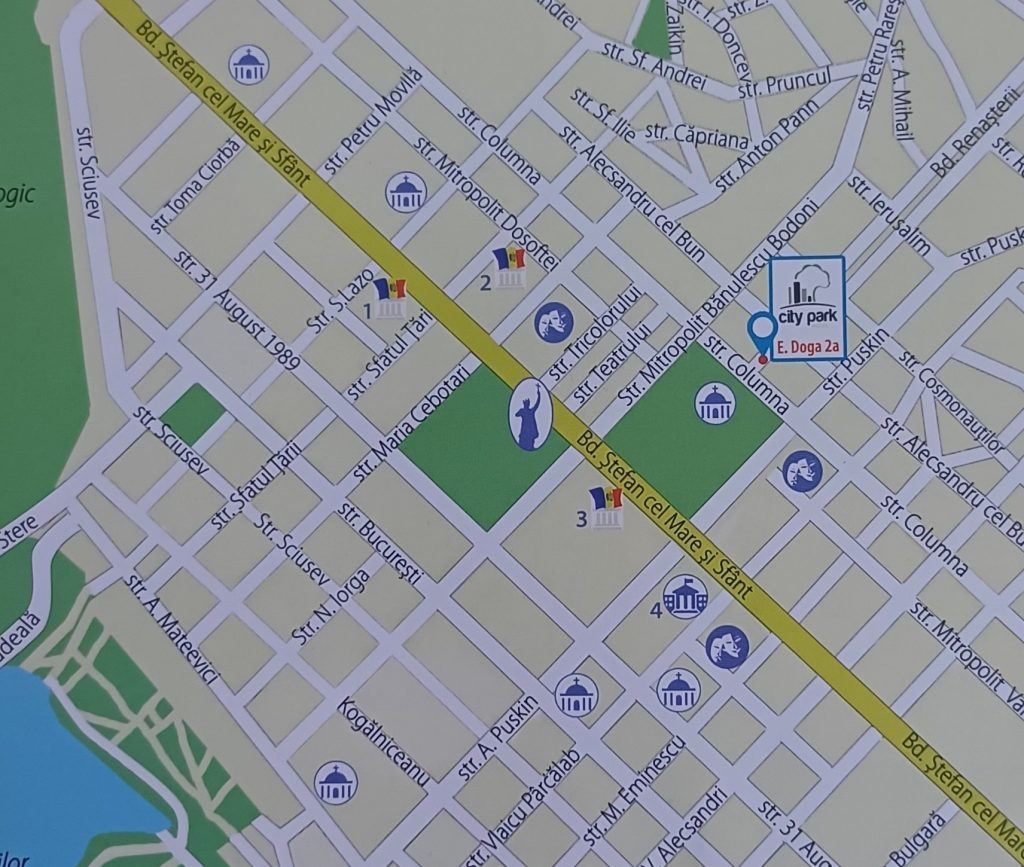
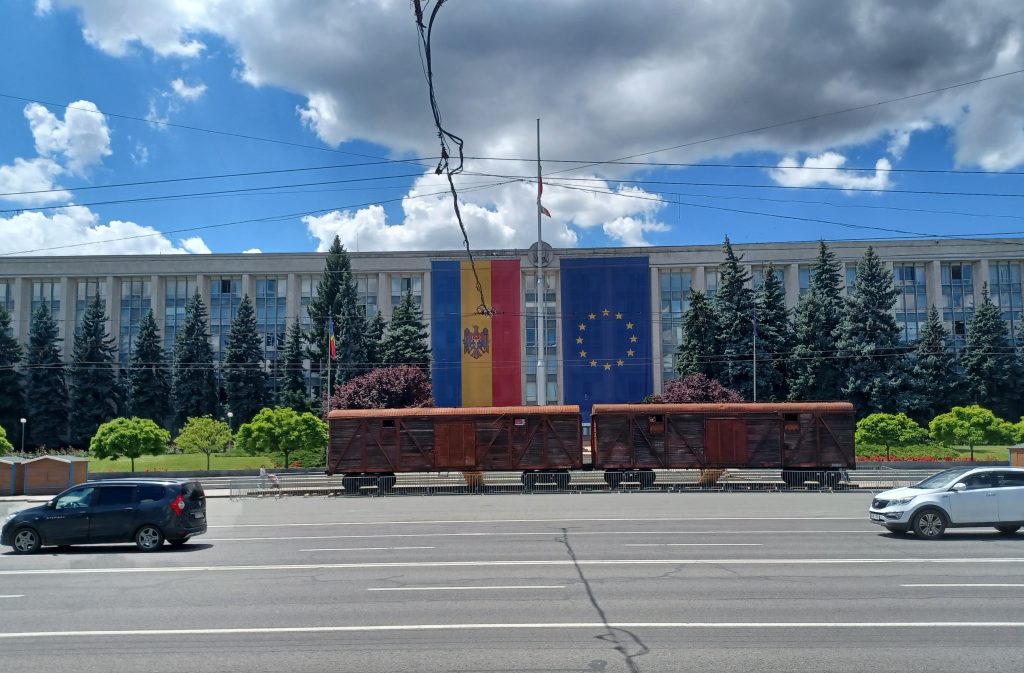
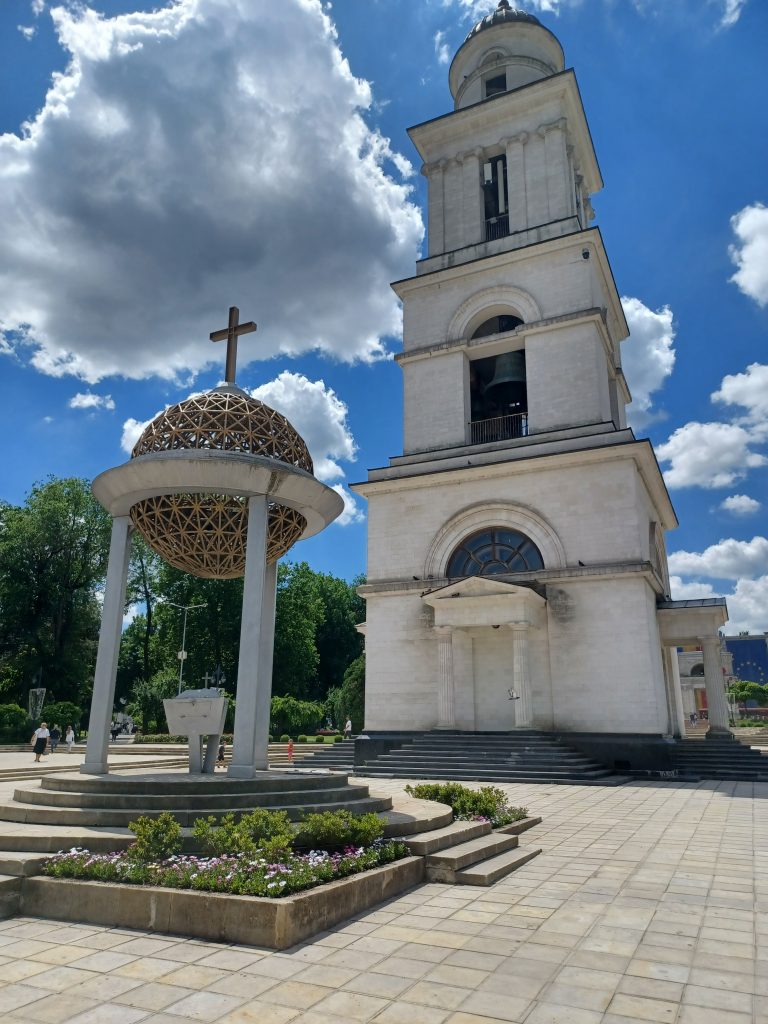
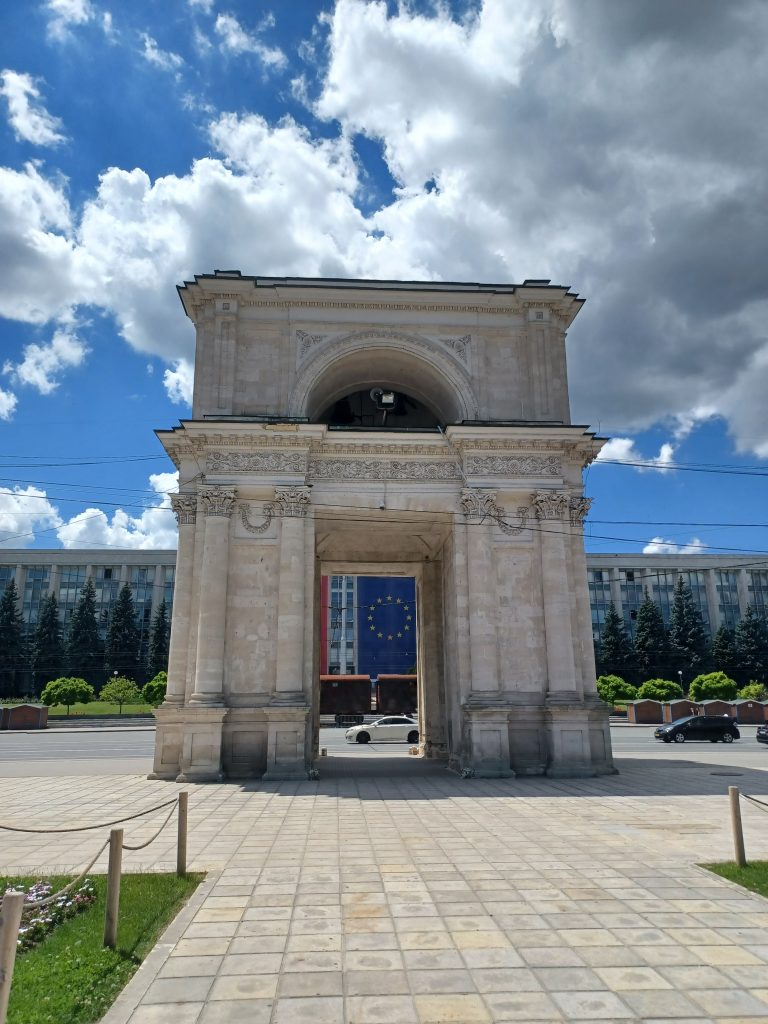
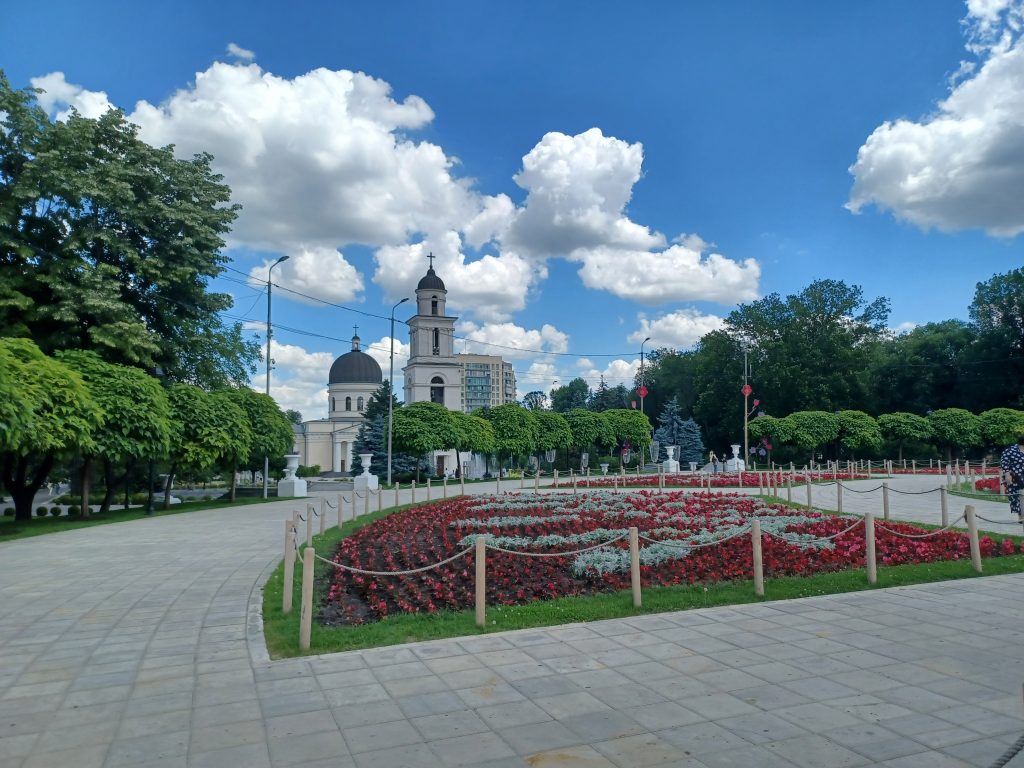
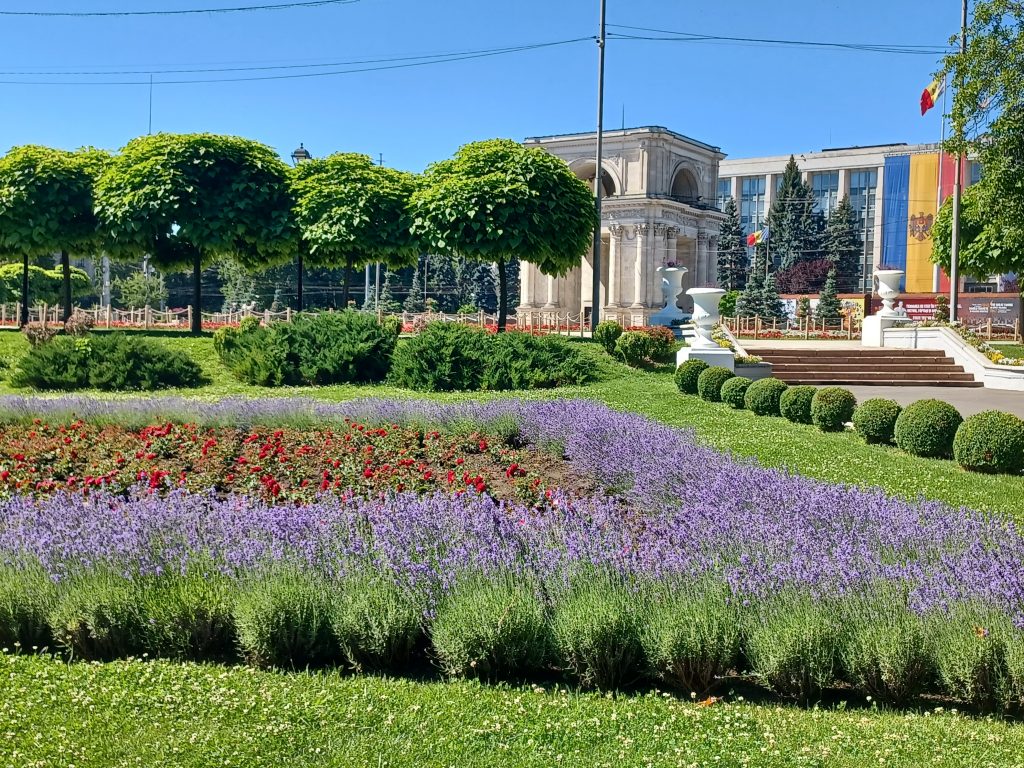
Close by is the highly visible Moldovan Orthodox Cathedral, the Cathedral of Christ’s Nativity, glistening white in the bright sunlight. I circle it and come across its bell tower and a triumphal arch, which is aligned with both structures. The arch commemorates the victory of the Russian empire over the Ottomans, and was erected in 1840. Aligned with the triumphal arch across the Stefan cel Mare Boulevard is the Soviet style Government House with two huge flags of the EU and Moldova draped down its gritty façade. They provide a bit of colour, I suppose. Not much else to recommend the building. A couple of old train wagons stand on the road in front of it, and unkempt cables strewn above spoil the photographs.
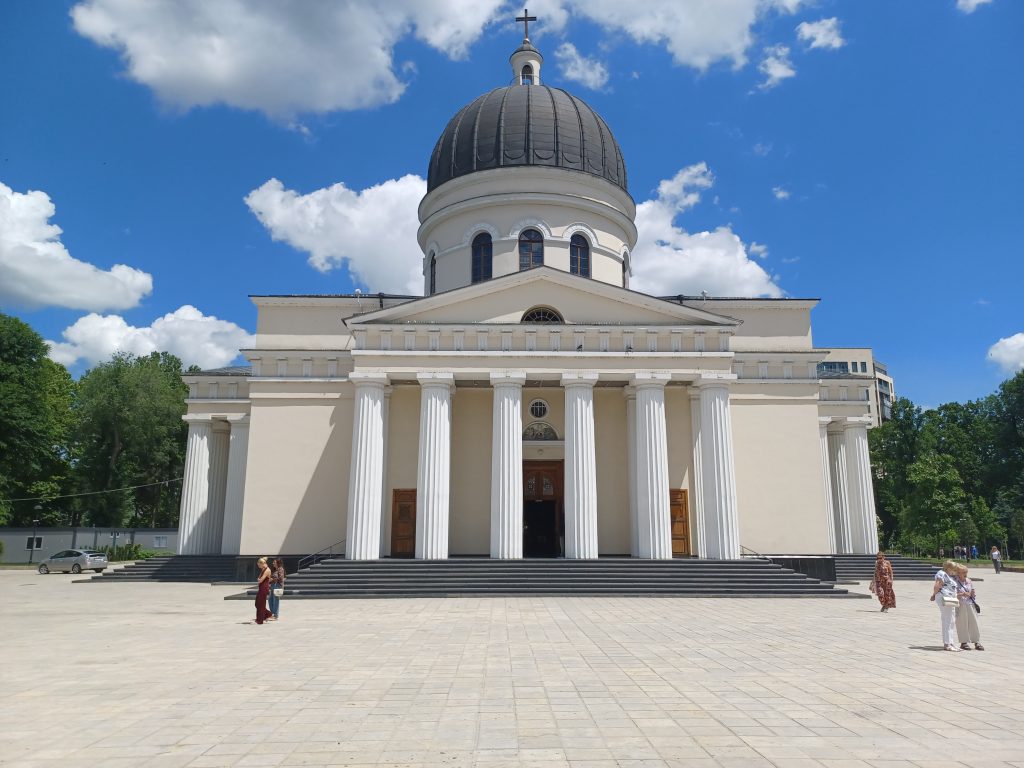
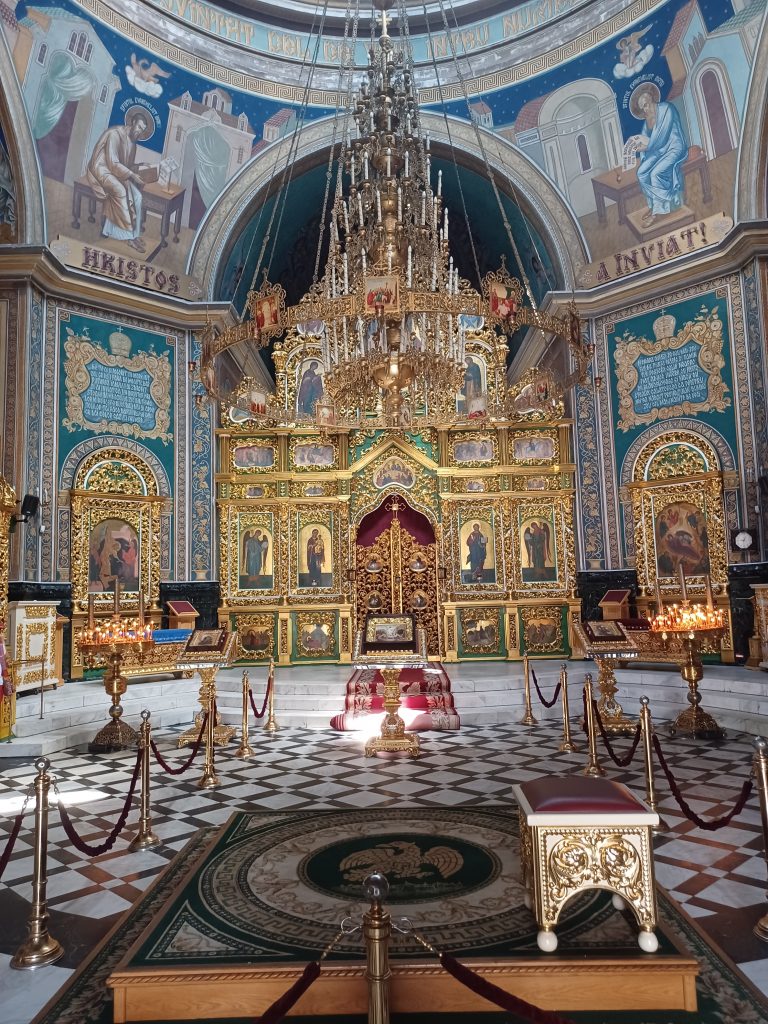
I about turn to relish the Neo-classical cathedral building with its fluted columns and capitals. Approach it. Lurking by a column is a skinny bare-footed young man with longish thick brown hair and cupped hands begging. People are filing in to the Cathedral, Orthodox Christians mostly, without a second glance. I always feel guilty passing a beggar. I enter, and gaze at the frescos and the gold and the beautiful gates. People cross themselves and mutter prayers. Outside again and I give the beggar a note. He seems grateful and I continue through the triumphal arch in front of which are pretty, well-kept gardens full of bright red geraniums.
Stefan cel Mare Park
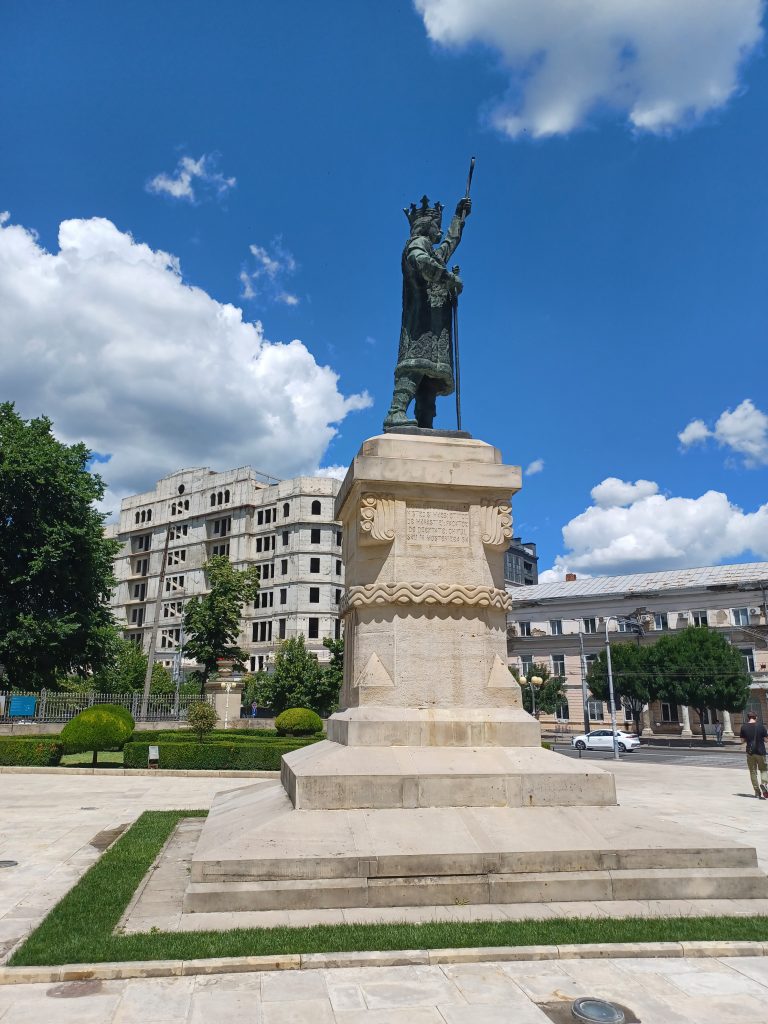
Diagonally opposite the arch and across the road is a statue of Stefan cel Mare (Stephen the Great), a renowned military commander in the 15th century, who defended Moldovia against the Ottomans. His statue stands at the entrance to a park named after him. Designed in 1818, apparently by Russian military engineers, the park was once named after Tsar Alexander II, later named after the poet Alexander Pushkin, then, merely, City Public Garden before receiving its current name. It is full of flower beds and shrubs and trees, some of the latter being 200 years old. Narrow paths criss-cross the park, one of which is lined with busts.
It is named ‘The Alley of the Classics’ and includes the great writers of Romania and Moldova. The oldest bust, pre-dating the alley in fact, is of the poet Pushkin, erected in 1885. Pushkin, considered by many to be Russia’s greatest writer, was exiled from Russia to Moldova (then Tsarist Bessarabia) in 1820 and, apparently, in his three years of exile produced some of his best poetry, including ‘To Ovid’. Ovid, like Pushkin, but centuries before, was exiled from the Roman empire to Tomis (see Romania, Part 3) and Pushkin seems highly aware of the sentiments expressed in Ovid’s ‘Tristia’ collection in his own works. He also wrote the first chapter of his novel ‘Eugene Onegin’ whilst in exile in Moldova.
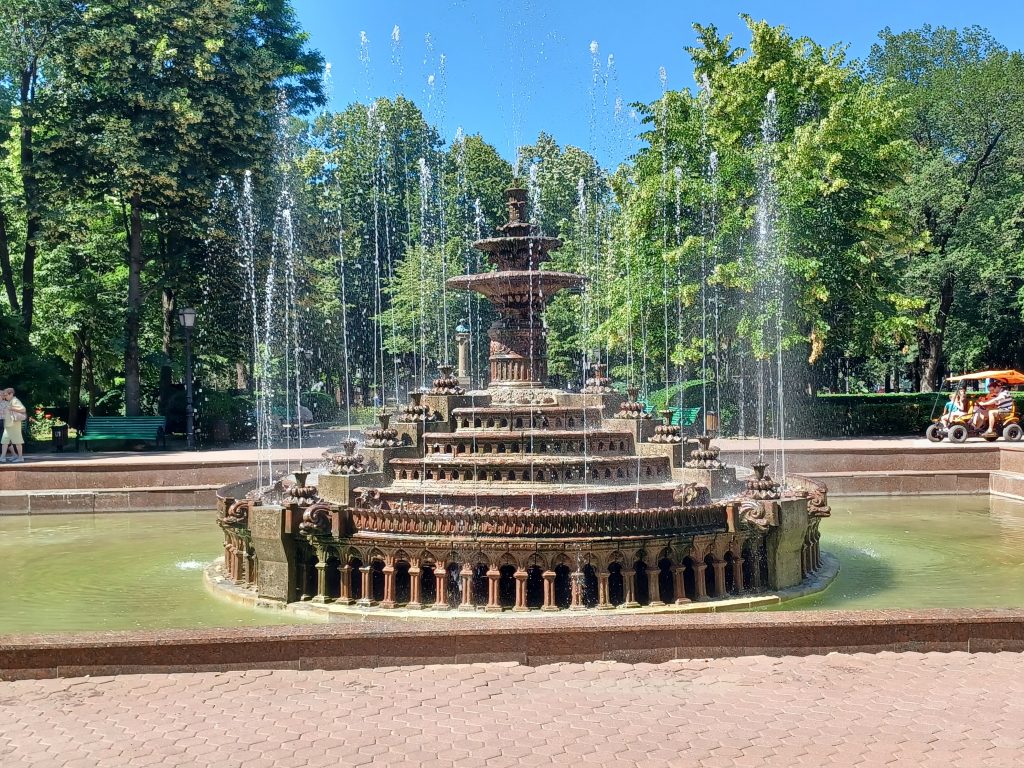
Anyway, park visitors are provided with green painted benches along the pathways and, hearing some music, I veer right. A guitarist is playing ‘Sleepwalk’, one of my favourite pieces, so I settle down on one of said benches to listen. Fresh green foliage around me and a tinkling fountain, named the Flower Fountain. A few pigeons stalk about and a rook perches on a litter bin. People wander idly by or sit and chat on the green benches and a gentle breeze flutters through the tree tops. Dream a while.
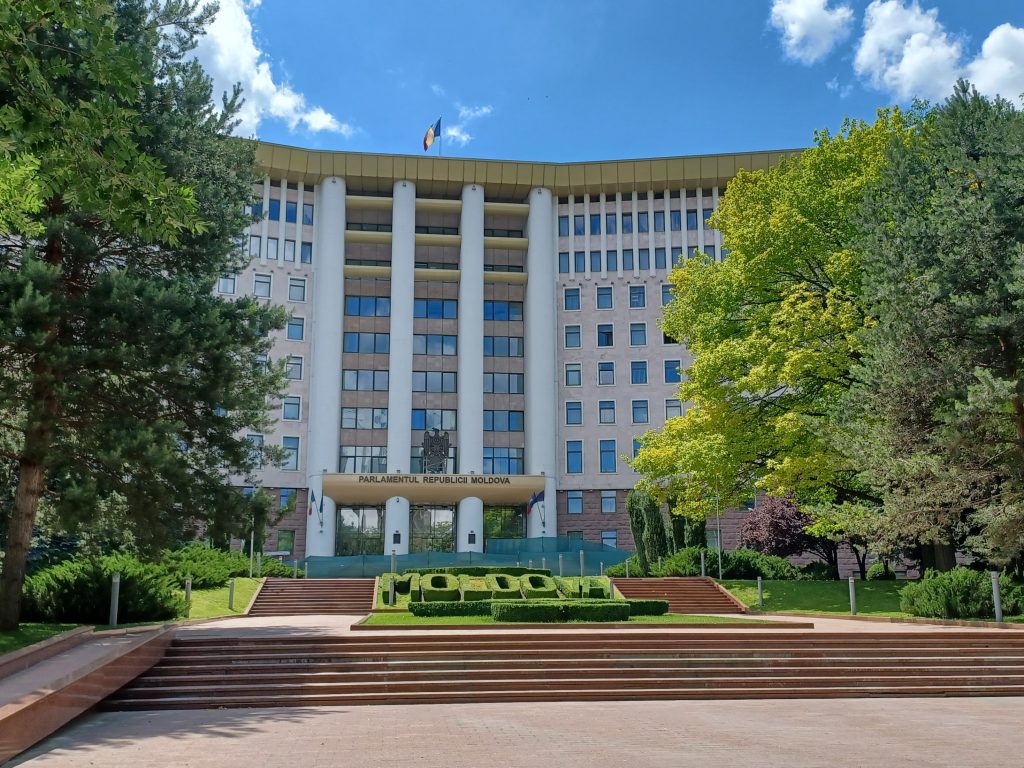
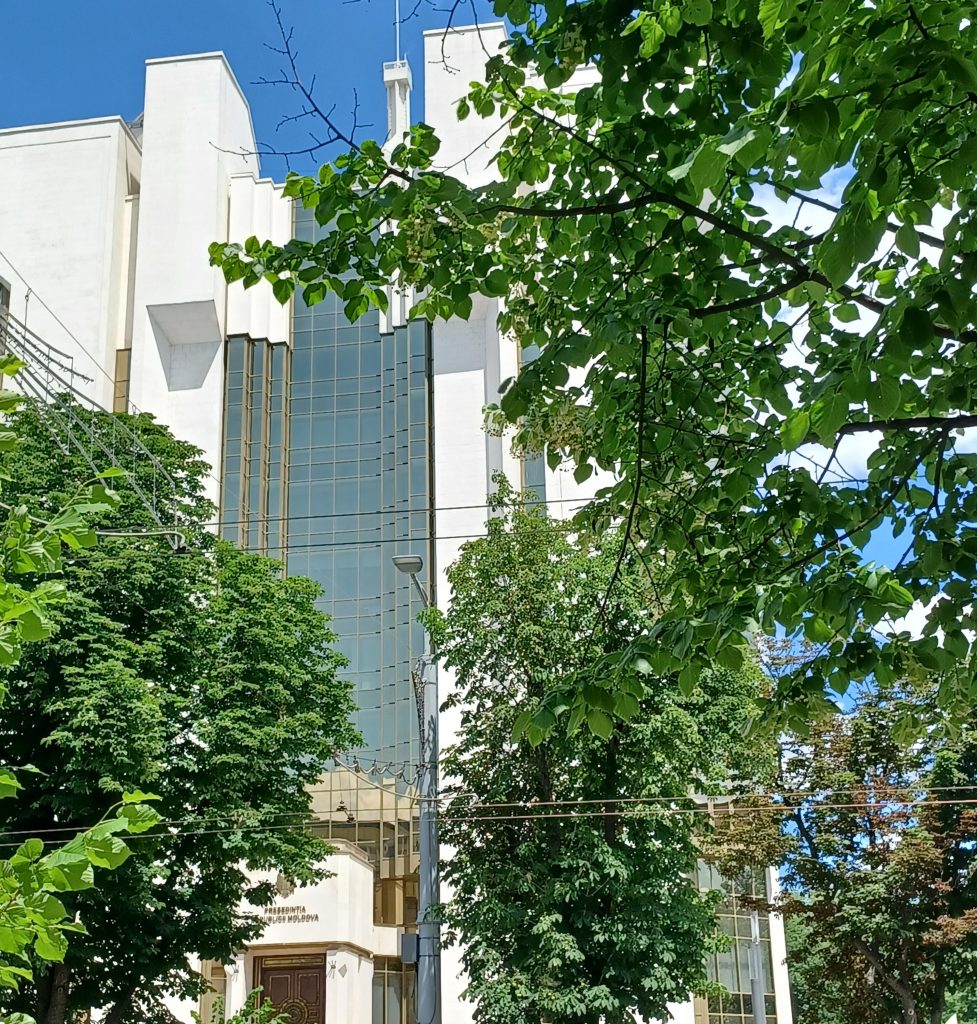
Saunter off shortly to a street on the other side of the park called ‘31 August 1989,’ which is named after the revolution. Occupying this street and the immediate surrounds are smart government ministries and the UN building. And along Stefan cel Mare Boulevard is the Presidential Palace of the Republic of Moldova, built in the 1980s, and the Parliament of the Republic of Moldova opposite. The name, ‘Moldova,’ is portrayed in neat topiary.
Beyond these buildings and further from the centre, one comes across more examples of Soviet architecture, mostly unremarkable, but some with statuary, some rather run down with fading mosaics adorning the walls. I soon head back to the pristine prettier areas again. Flowers bloom in abundance. In fact, I see many people wandering about conveying bunches of flowers. Flower stalls, flower beds, flower pots brighten up the place. I duly comment upon this to the receptionist in the hotel. “The flowers are to welcome people”, she says.
Orhei
I am joining a day tour today to the Orhei area to view diverse attractions, which include a stunning monastery complex, a 14th century cave monastery, the famous Cricova wineries, and archaeological sites. Am picked up by a youngish female guide at the bottom of my hotel steps and proceed to a minibus where others await. Drive hence into the hills about 50 km north of Chișinău.
Curchi Monastery
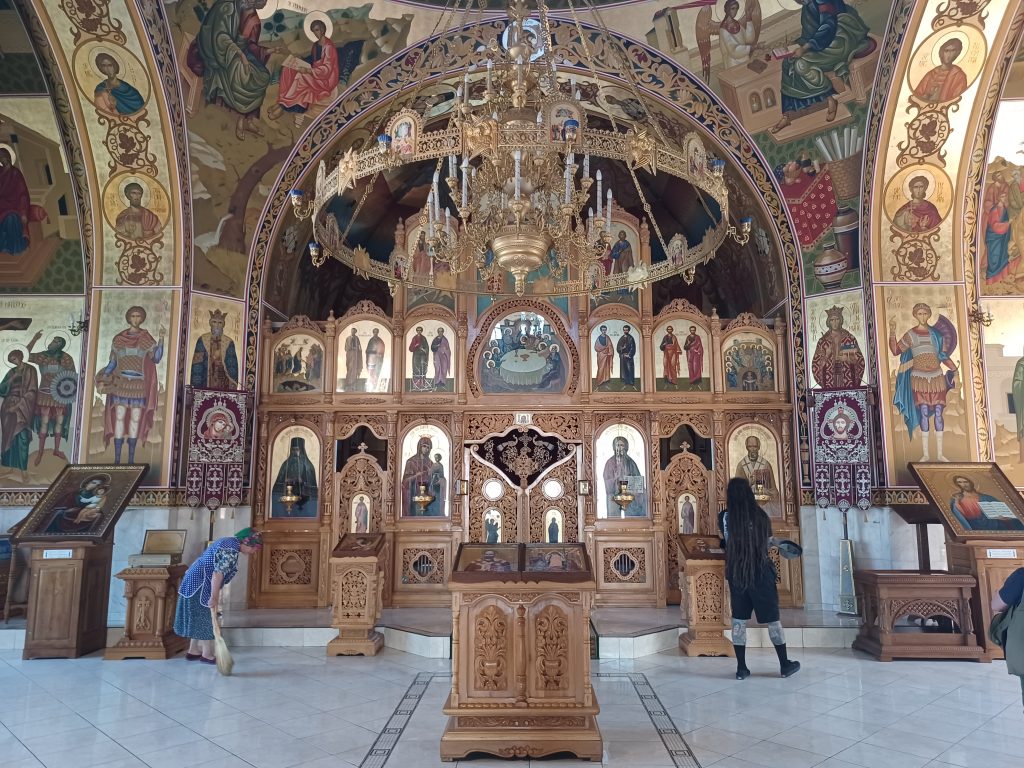
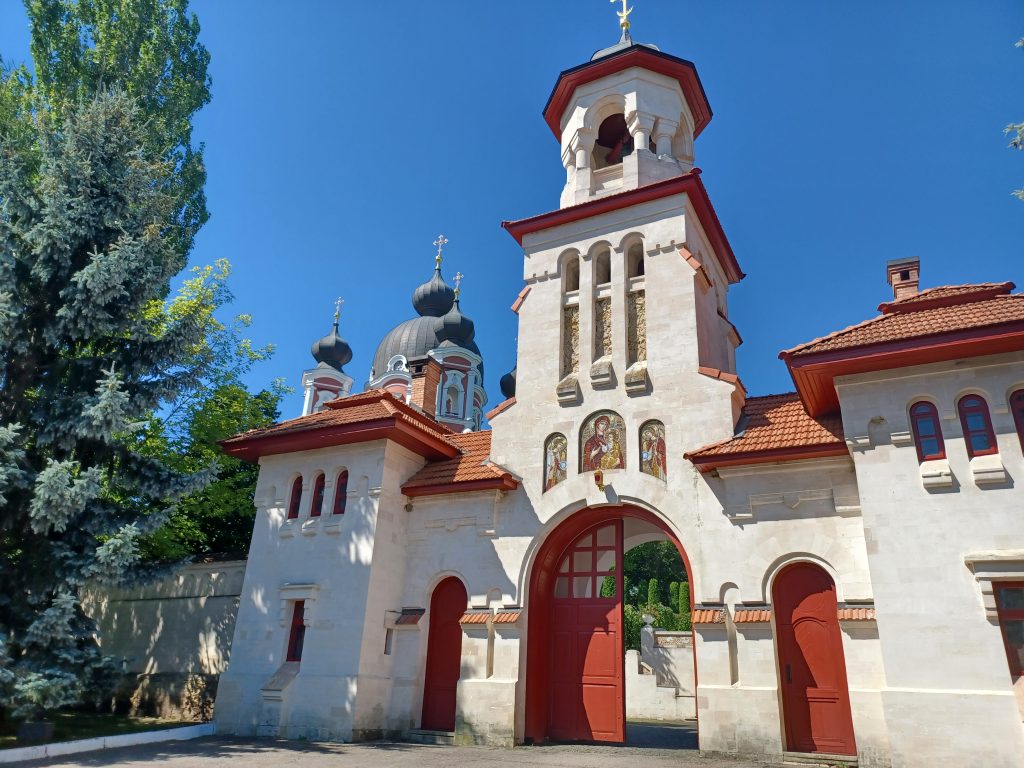
As we approach our first destination, stunning black domes appear amidst the lush forests of Orhei. Atop each dome is a cross. We pass through the elaborate entrance gate to view walls of dark pink with white surrounds. This is the baroque Church of the Nativity of the Virgin Mary which boasts the highest dome in Moldova at 57 metres. It was founded in 1775 and designed by the Italian architect, Bartolomeo Rastrelli. He it was who designed the Rundale Palace in Latvia (see the Baltics, Part 2: Latvia), as well as other sumptuous Baroque buildings, such as the Winter Palace in St Petersburg. The church is beautiful inside with the usual iconostasis, and other icons of saints.
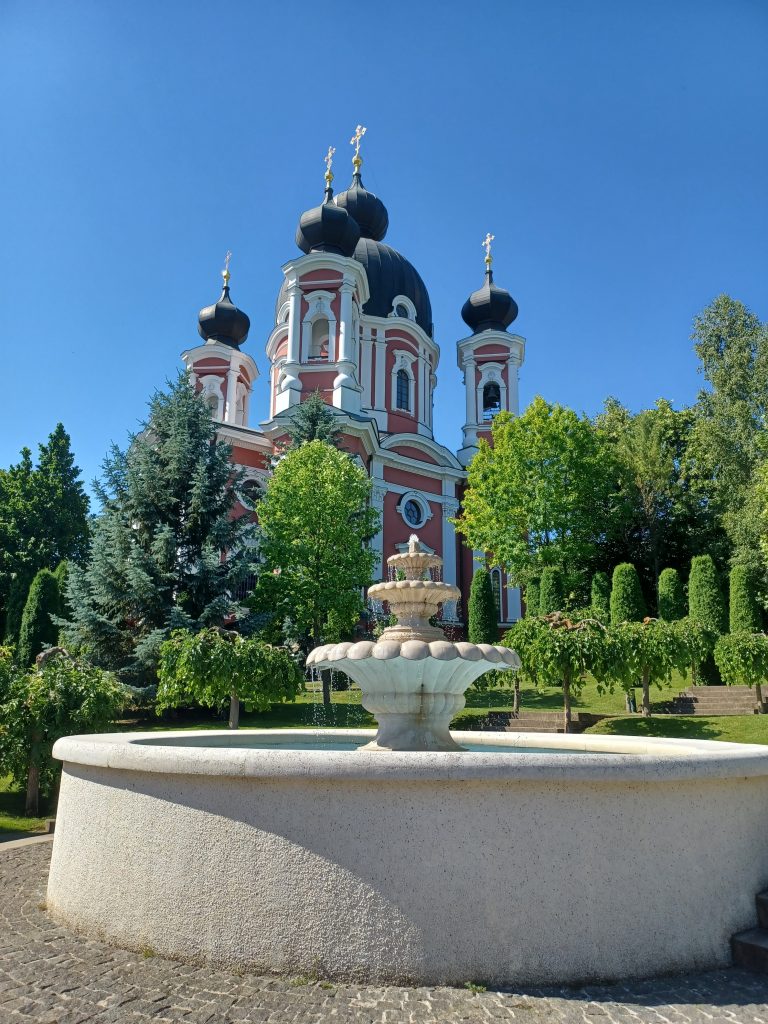
There are five churches within the monastery complex but only two are used, we are told. The other church in use is white painted and dedicated to Saint Nicholas. Surrounding the complex are meticulously manicured gardens, fountains, flower beds of geraniums and roses, and peaceful pathways. And a bell. The place is a pilgrimage site. Not surprising, so serene it is. Used as a psychiatric hospital by the Soviets, I gather. Hmm. Better than an ammunition dump I suppose, the fate of some other churches within the USSR. Anyway, after Moldova gained its independence in 1991, the monastery was restored to its former glory and reopened as a place of Orthodox worship.
Orheiul Vechi
Orheiul Vechi Archaeological Complex
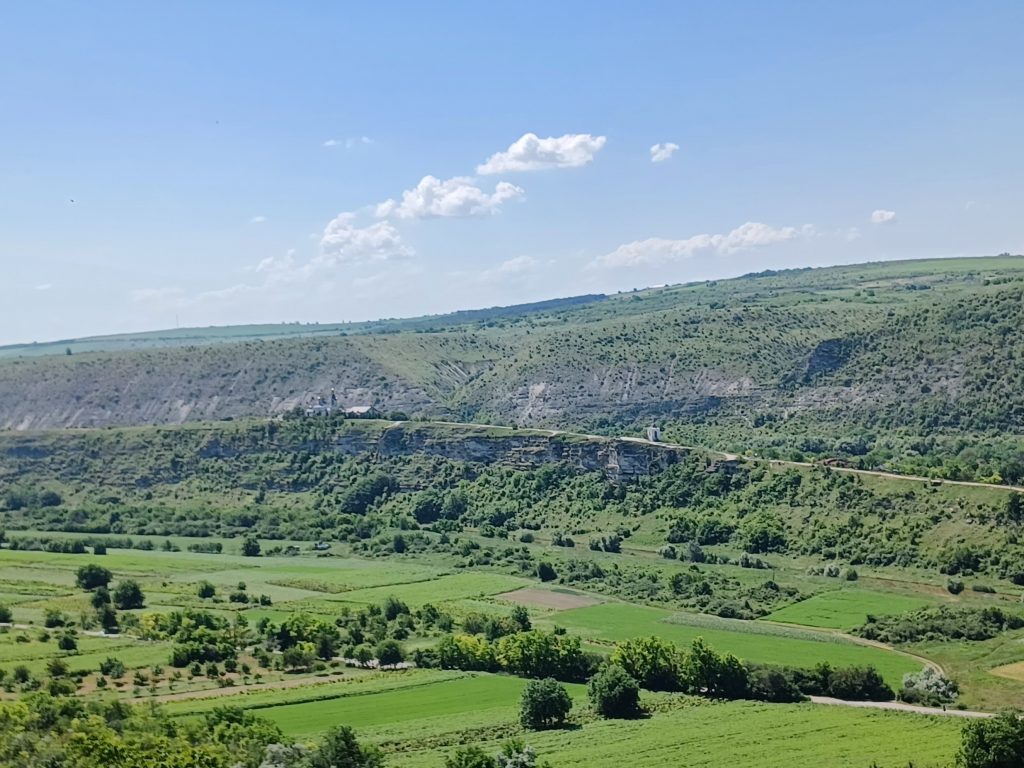
A short distance drive now into the natural surroundings of the Orheiul Vechi cultural- natural reserve. Splendid spot, full of historical monuments, ancient archaeological sites and dramatic scenery. First stop is at the Belvedere view point, 170 metres above sea-level, whence one can see, atop a low limestone ridge across the valley, caves in the cliffs. There are over two hundred of these caves, apparently, used and enlarged by monks fleeing from the Mongols. Located within one of them is a Cave Monastery. On the ridge above it, one can just make out a small white bell tower, 19th century, our guide tells us, and an earlier cross. Further along the ridge is a golden domed church.
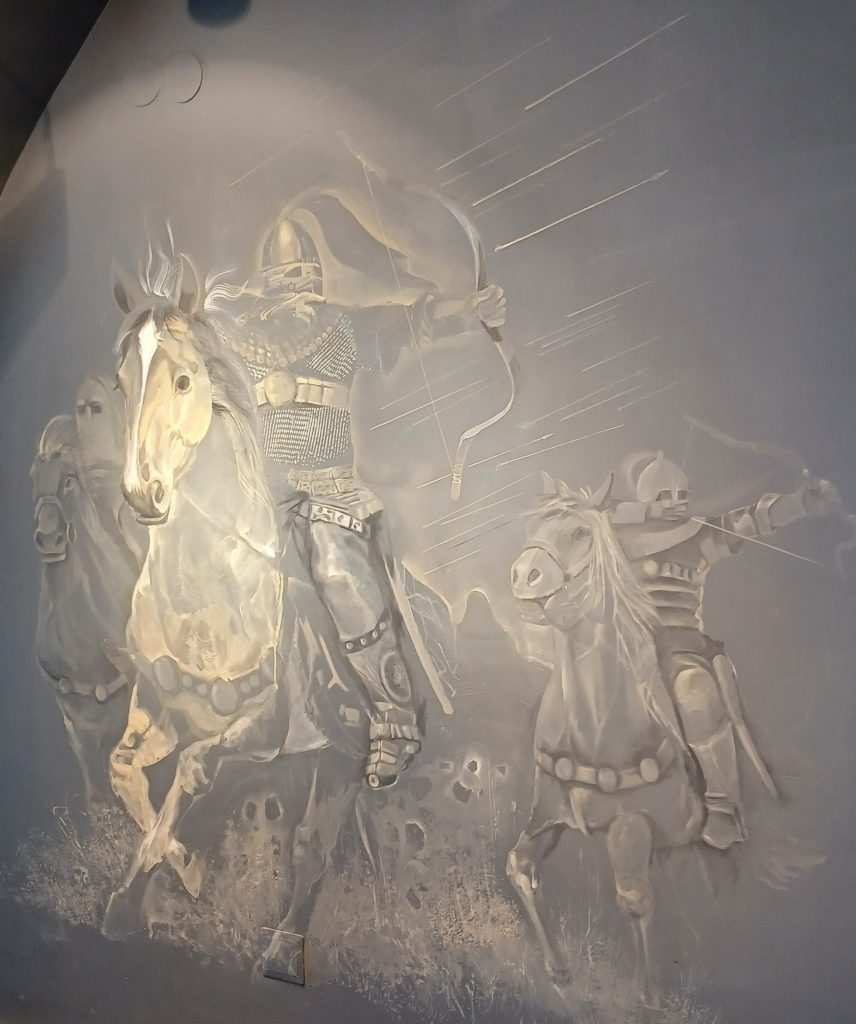
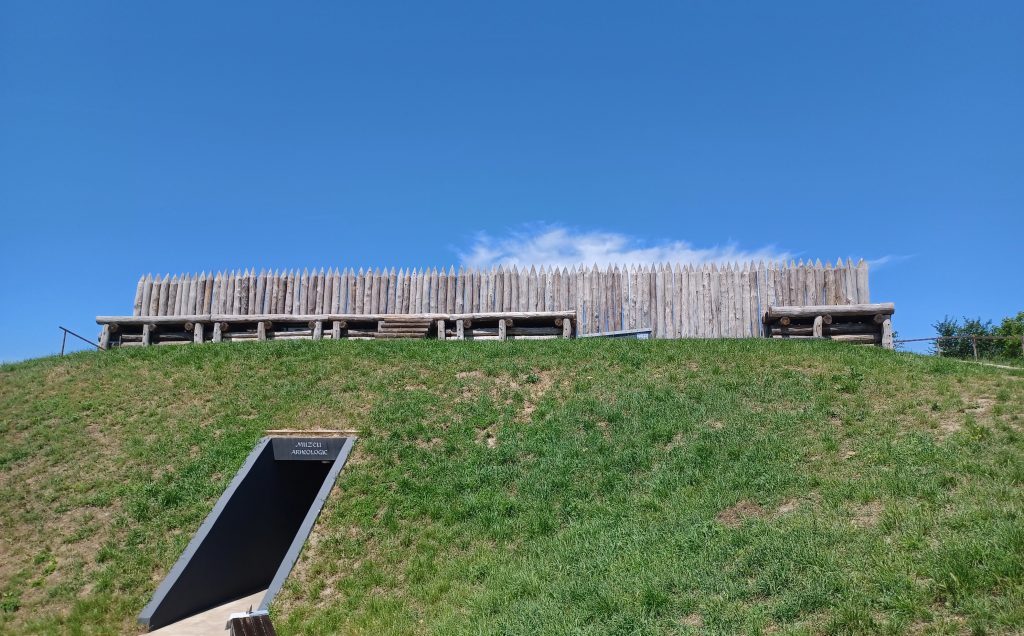
But first, we visit an underground museum atop which is a reconstruction of a defensive rampart with wooden palisades, which originated during the Mongol era in the 14th century. We climb the steps up to the top and take in the view before descending into the museum of archaeology beneath. There to view objects from daily life in the medieval period. This includes jewellery, coins, arrow heads and pottery from the golden horde. Striking mural in here of the Mongols on horseback shooting arrows.
Orheiul Vechi Cave Monastery
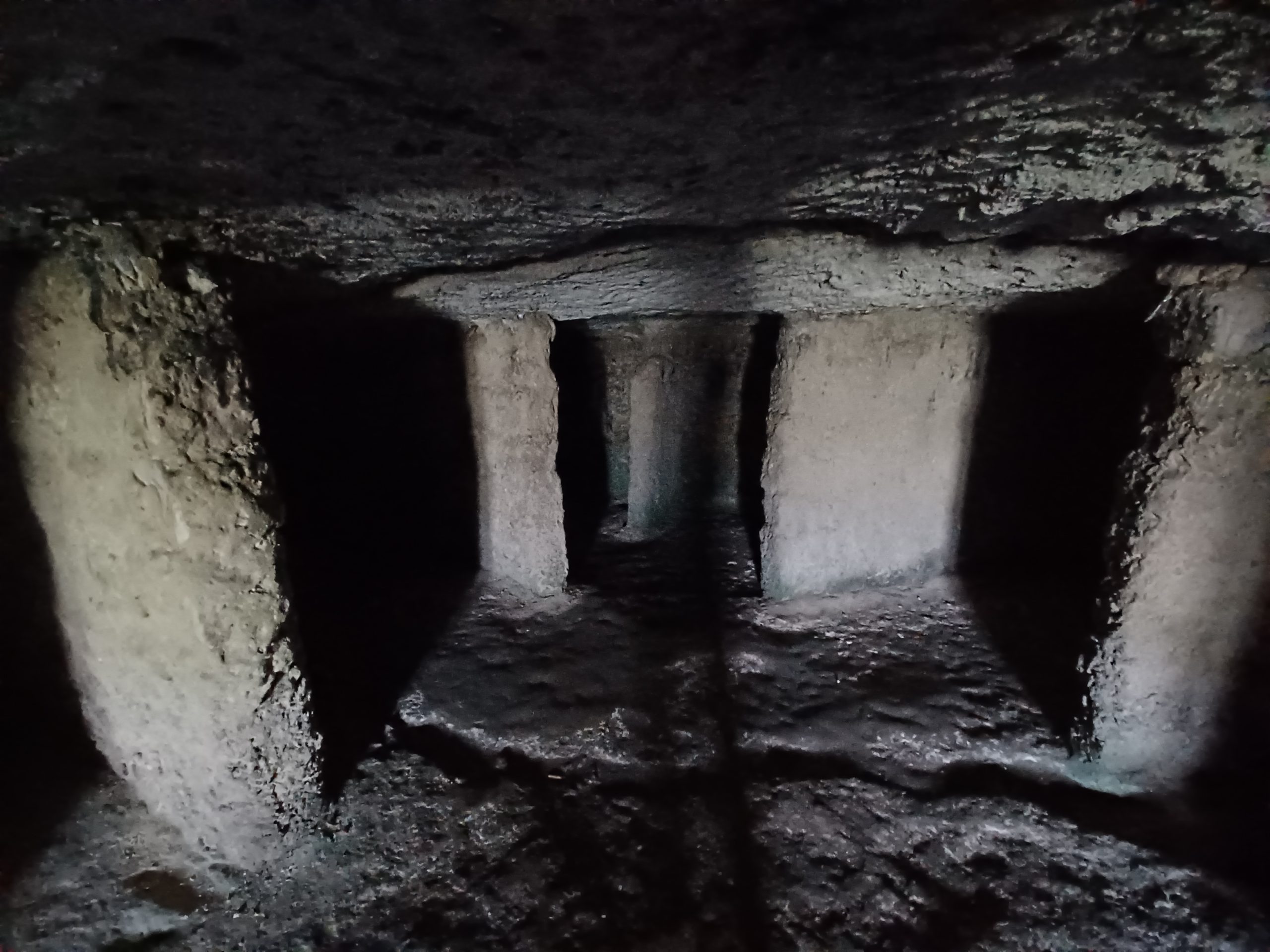
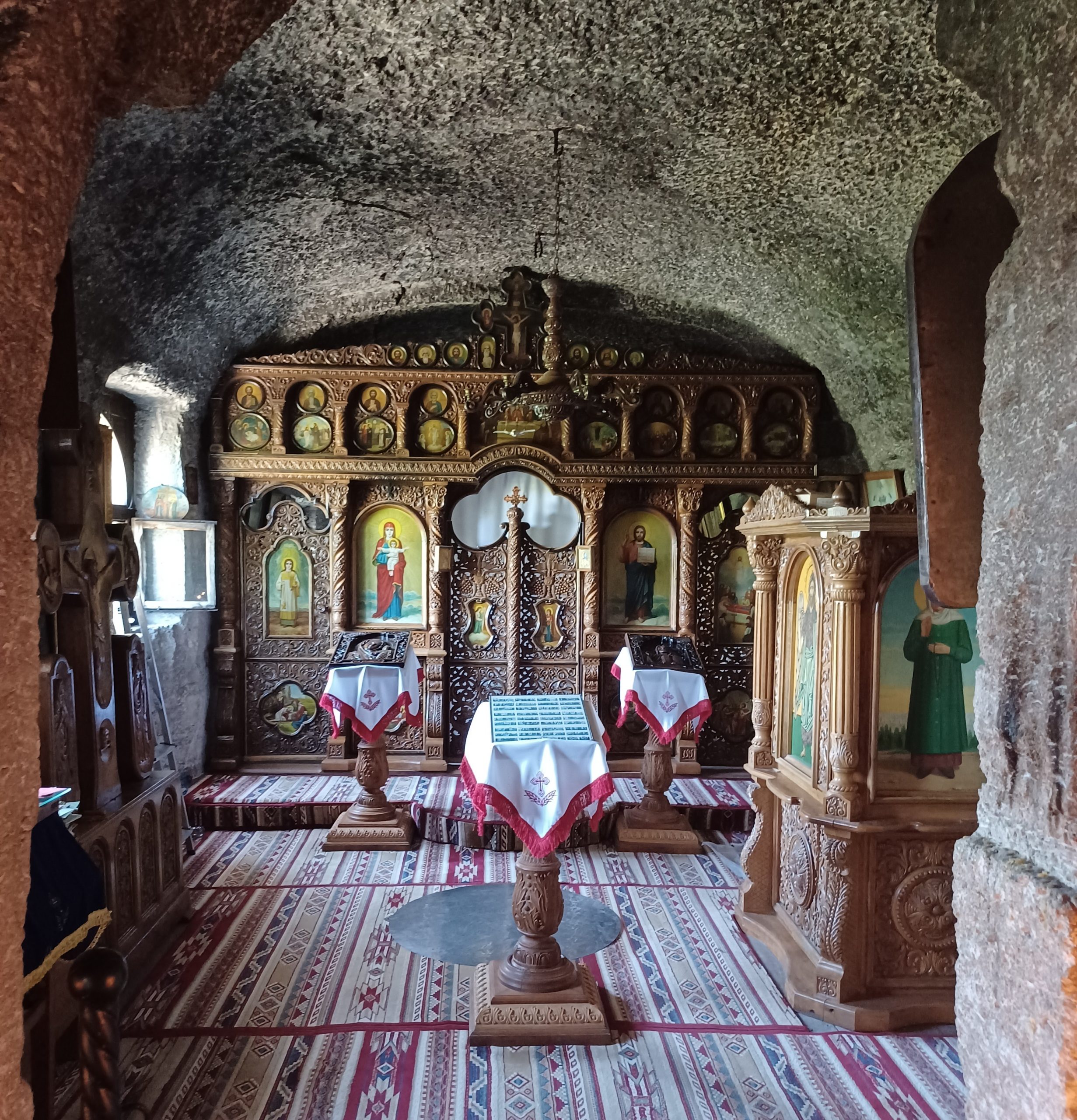
Thence, a quick drive to the cave monastery at Butuceni. After clambering up onto the Butuceni ridge above the village, we descend a rocky path to the cave entrance. This cave, as with the many others in the area, was hewn out by hand by monks sometime in the 13th or 14th centuries, we are told. We ease our way down worn stone steps, through a dark narrow passage and climb up into the cells where the monks would have slept during their several hundred years of occupation. There are nine cells altogether. Bit cold, dismal and uninspiring in there. Must have been a tough life. The little cave church is bright and beautiful, however. A monk glances gravely at us all.
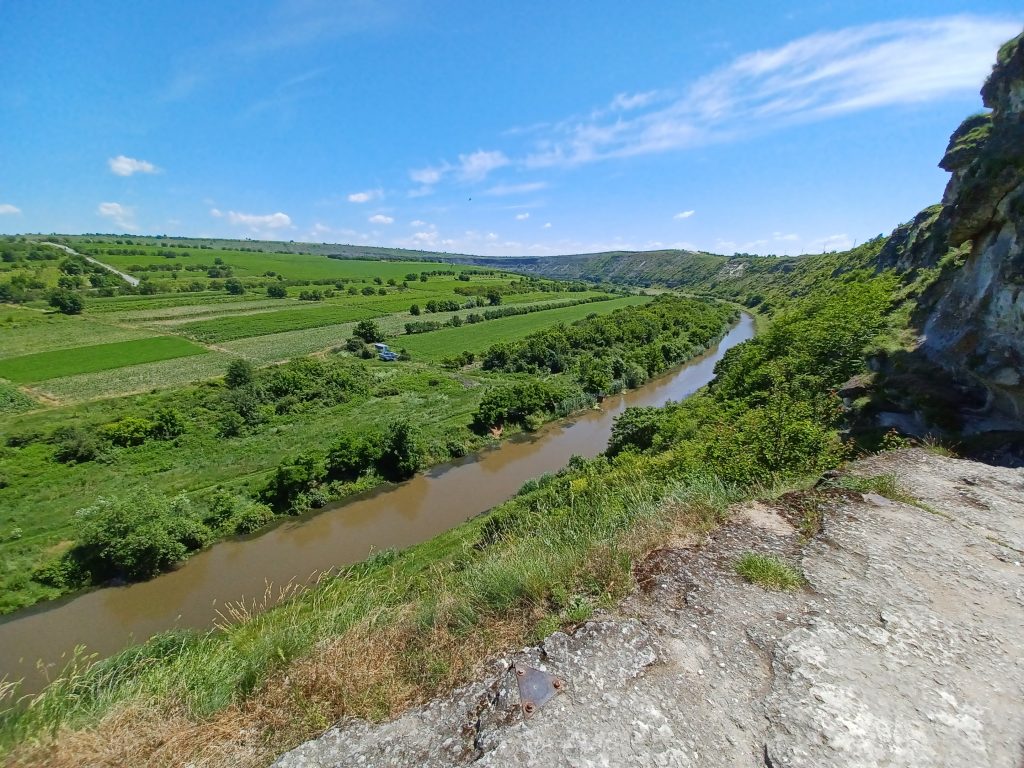
We exit through a tunnel onto a rocky ledge with a steep drop and a splendid view over the valley of the River Răut. Good job I didn’t rush out with exuberance as I would have been over the edge and into the abyss. Not conducive up here to those suffering from vertigo. Backs lodge firmly against the cliff. Behind us, stuffed within small crevasses in said cliff, are coins and scraps of paper with written notes. “People wrote their wishes on them”, our guide informs us.
We edge back into the cave again, back past the divine little cave church with its shiny icons and bright rugs, fumble though the dark passage, and exit.
St Mary’s Church
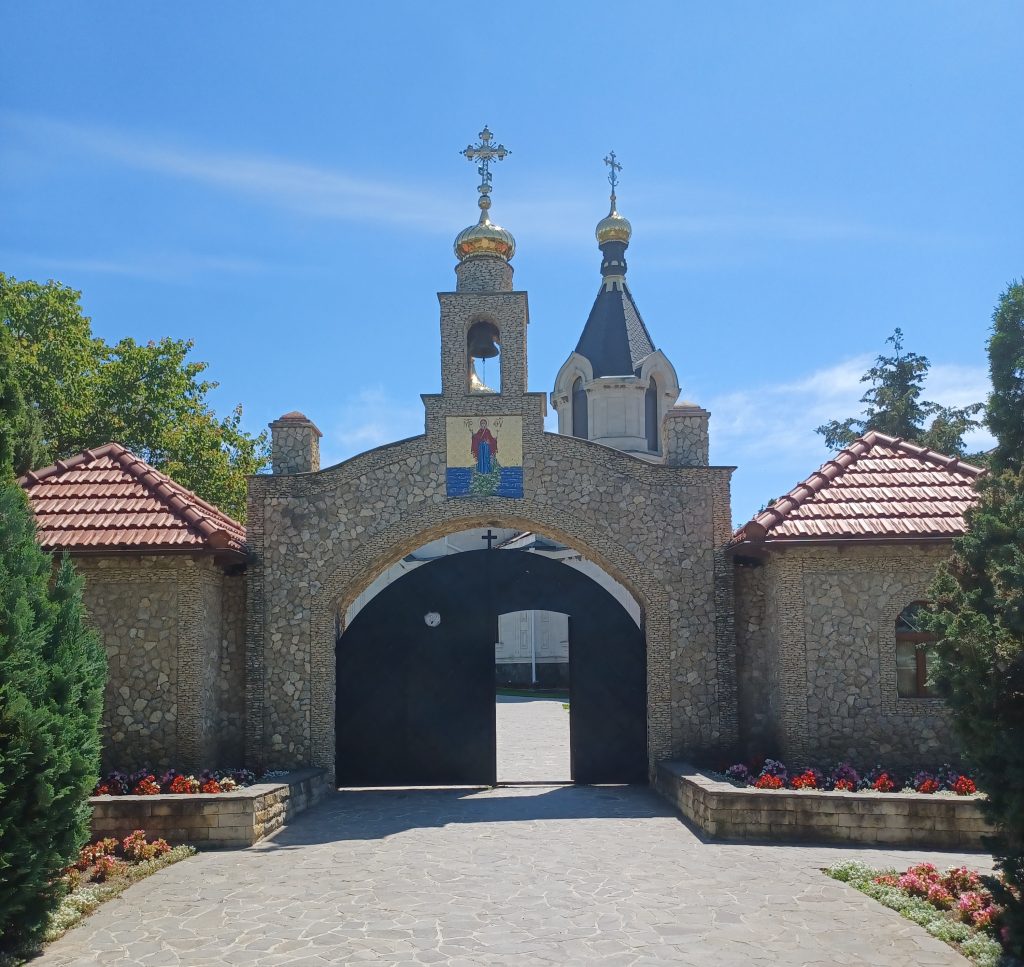
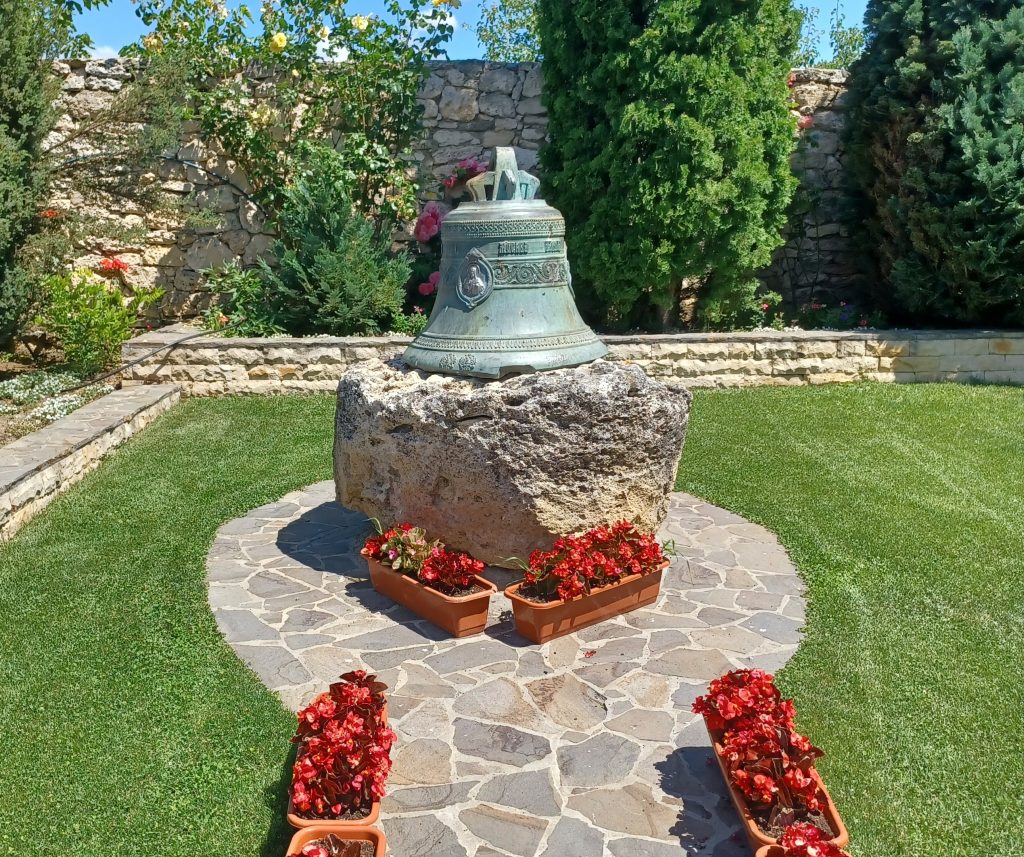
Thence comes a walk along the ridge top to the Orthodox church which we could see from Belvedere viewpoint, that of St Mary with its golden onion domes. Enter into its holy precincts. Gorgeous. It was built in 1904, within the ruins of a much older wooden church on the highest point of the ridge, and serves as the parish church of the village. Surrounding the church are the monastic gardens with flowers and a bell. Apparently the Soviets removed the bell, and it has recently been brought back again from Russia.
And so to lunch. A well earned respite after all that clambering about. Lunch was ordered in advance and prepared by a family in the village. Dolma, tender vine leaves stuffed with rice and veg, was my choice. And we share a bottle or two of the family’s home-made white wine. Bit rough but enjoyable. Their cat joins us sitting haughtily on the cushioned seat. Lots of laughs. The schedule doesn’t allow for visiting the plenty more archaeological sites on Butuceni ridge. The remnants of a Dacian fort, medieval citadel, mosque and caravanserai and Tatar baths will have to wait until another time.
Cricova Wineries
The day finishes with a visit to the Cricova wine cellars, which has about one hundred and twenty kilometres of tunnels packed with wine bottles. Our guide explains that much limestone was quarried to build the splendid white buildings in Chișinău (not the Soviet blocks) leaving space in the vacant quarries to store wine at the perfect temperature. Jolly good, say I. Notwithstanding the enjoyment to be had from spiritual uplifts in beautiful monasteries, it is time for this different type of uplift now. One doesn’t want to overdo it.
Upon arrival, we are sped downwards into the cellars in open red vehicles. Feels freezing. I had the foresight to bring a fleece. Others shiver in their shirt sleeves.
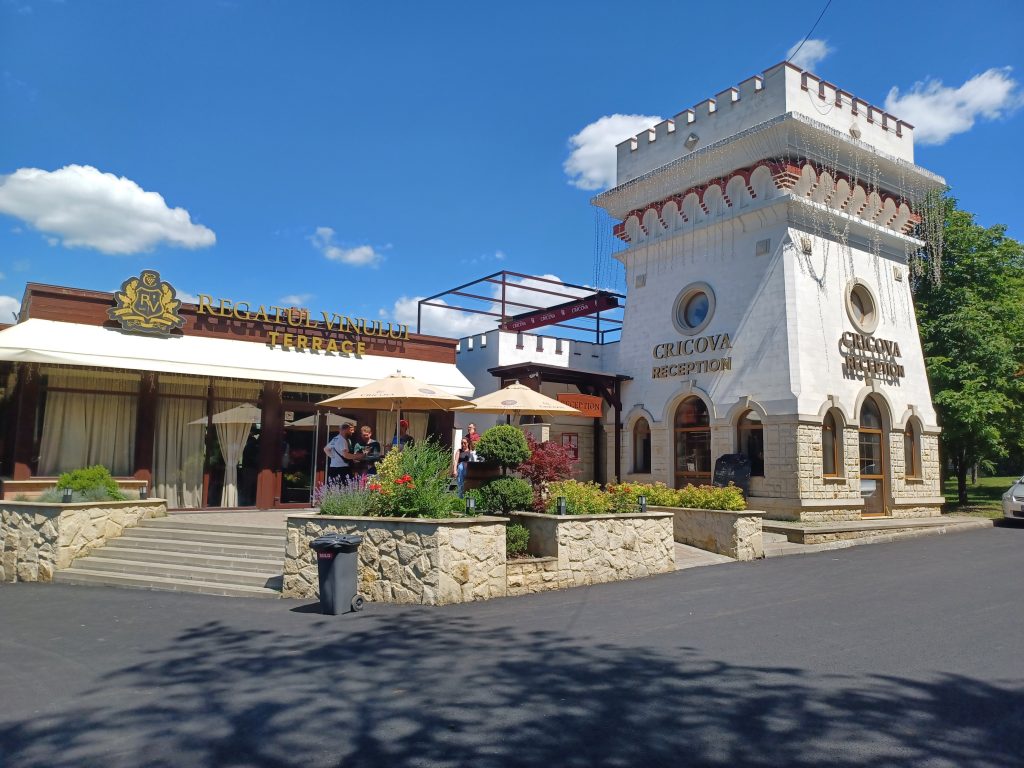
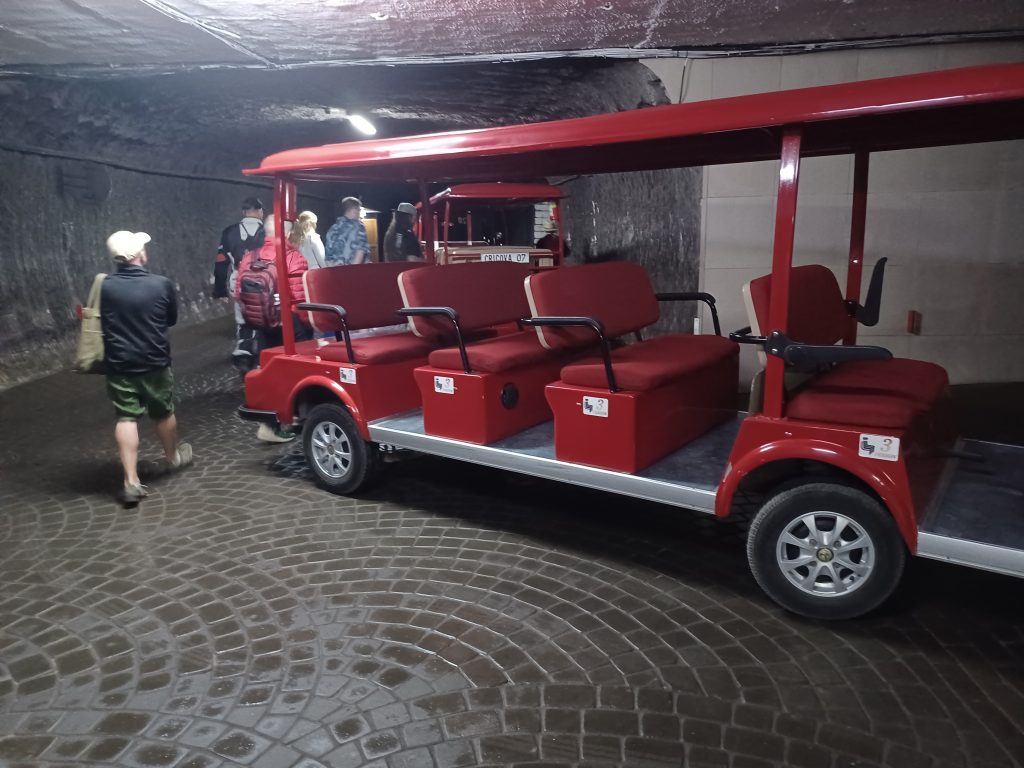
First, a visit to view a video clip about the winery in the cinema, accompanied by a splash of sparkling wine. A positive start, I have to say. Soft seats. A lady guide then takes us round the cellars, walking backwards. She, not us. File along tunnels named after the grape varieties, such as Sauvignon and Cabernet. Stop to observe bottles stuffed at angles into pitched roof shaped racks. Said bottles are turned and tilted by a team of women, I gather, at a certain number of degrees each day for about six weeks, in order to slide the sediment to the bottle neck. This process is known as ‘riddling’. The plug of sediment is then removed during the disgorgement process and ensures that the sparkling wine is clear. A labour intensive process for sure but necessary, as a cloudy wine would be less than appealing to wine buffs.
Other tunnels reveal white shelves stacked with bottles and some show cases of wine, including one from 1902 with the name ‘Easter Jerusalem’. There is also an Orthodox church in the tunnels. Here, I surmise, the wine makers pray for a good vintage.
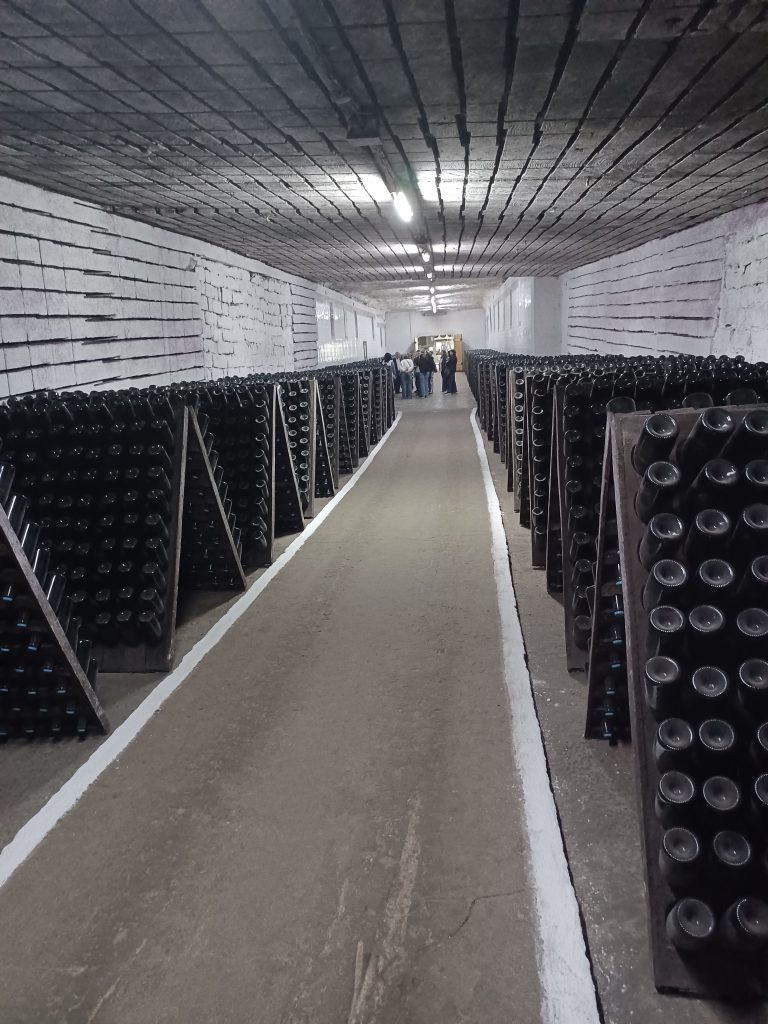
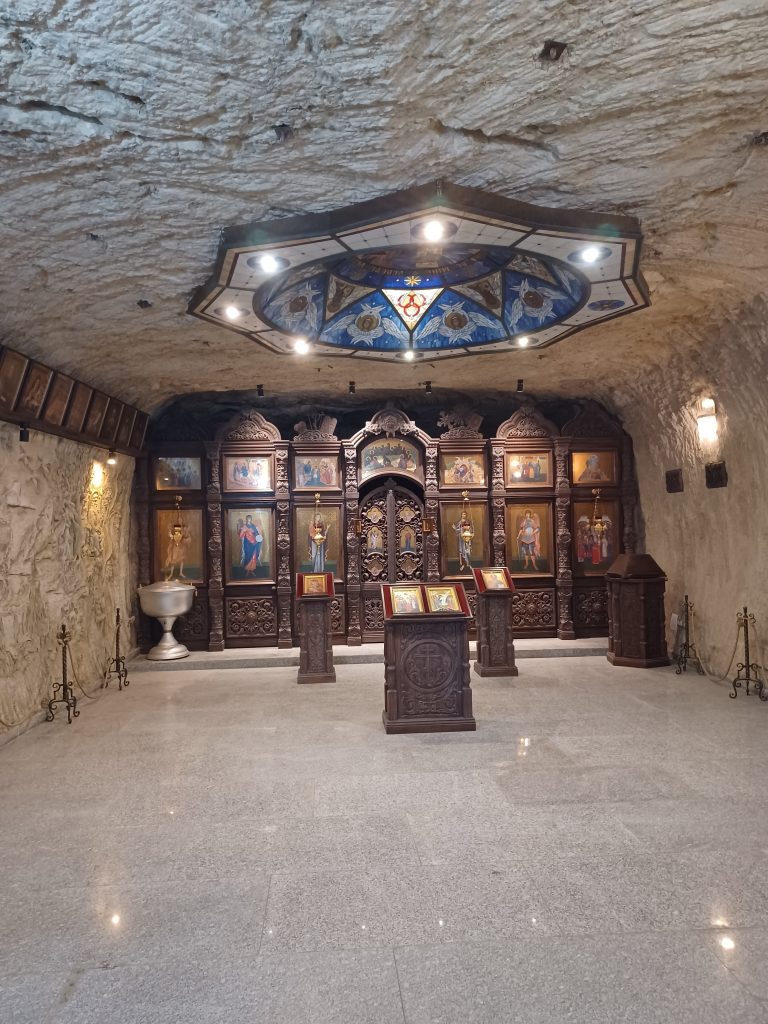
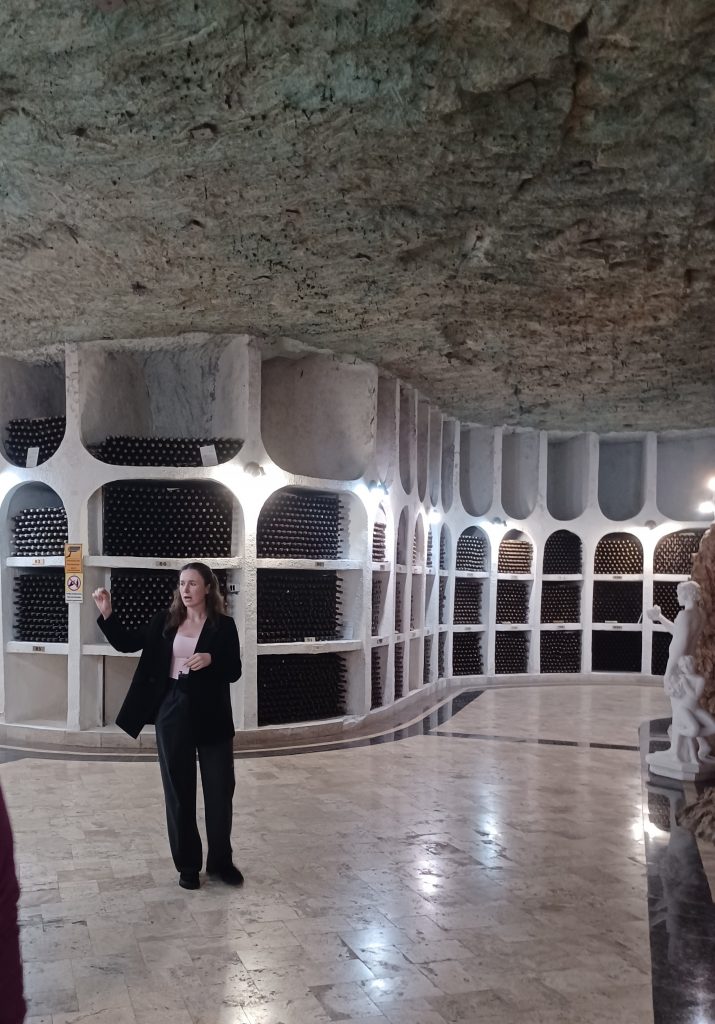
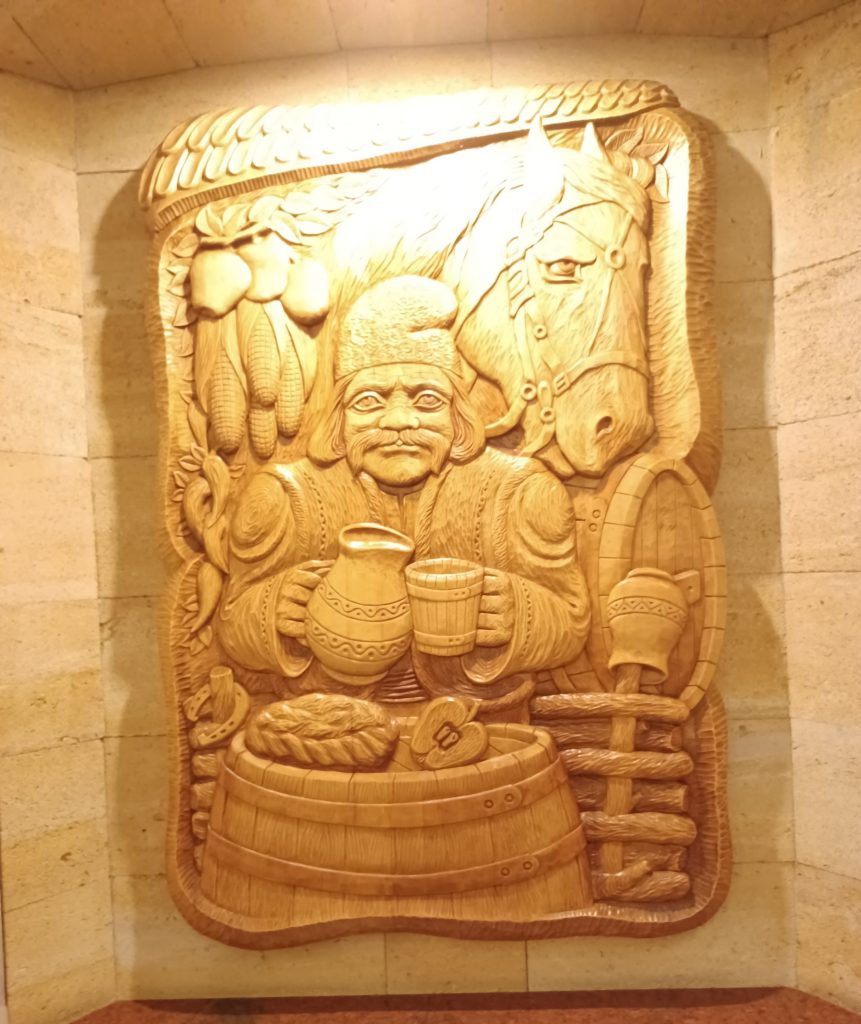
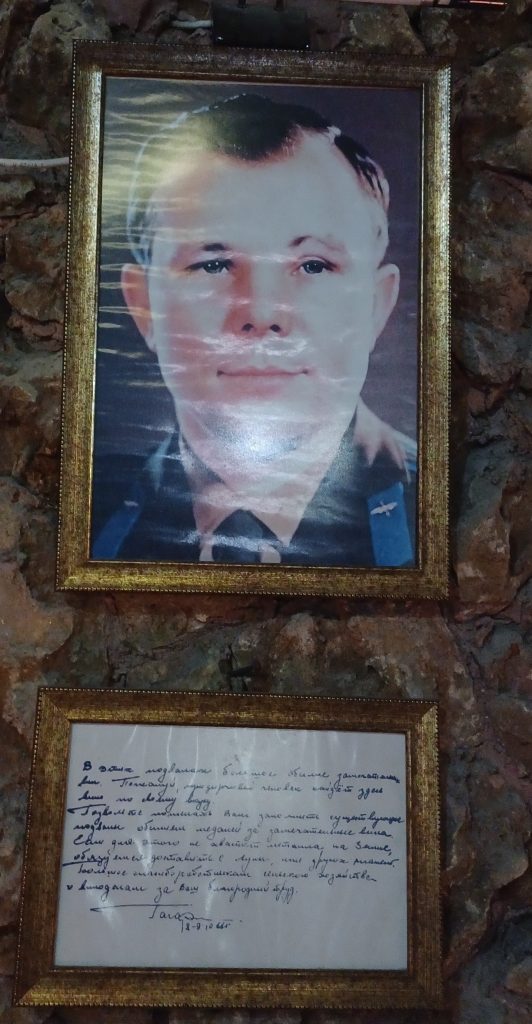
Around each corner appear more shiny floored wine-filled cellars and long tunnels, some lined with relics of past wine making practices, like wooden wine presses and barrels and earthenware pitchers. Paintings on wall tiles, carvings, sculptures, and plaques of worthy people who have visited, including the Russian astronaut, Yuri Gagarin, and onetime Chancellor of Germany, Angela Merkel.
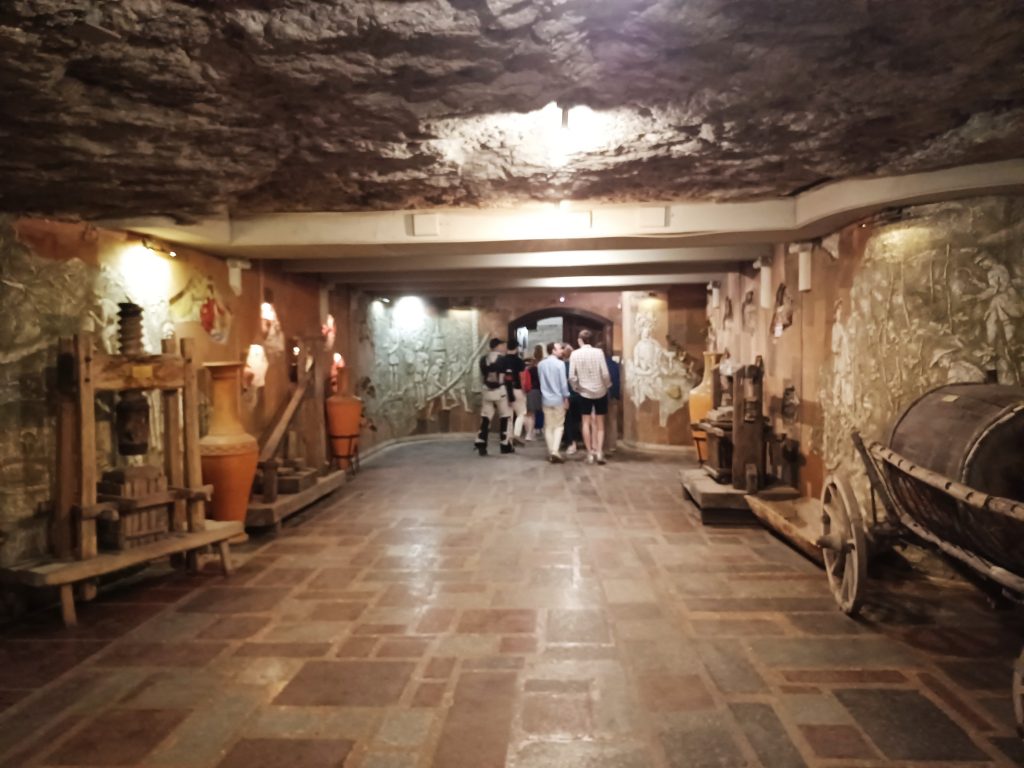
“Yuri Gagarin got lost in our tunnels in 1966”, our guide tells us. “So nobody now is allowed to explore on their own!”
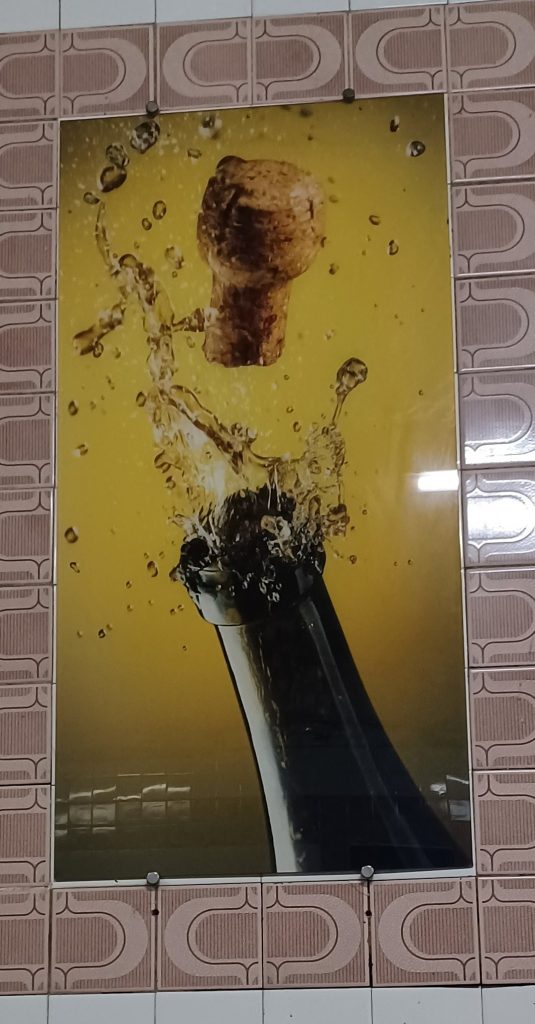
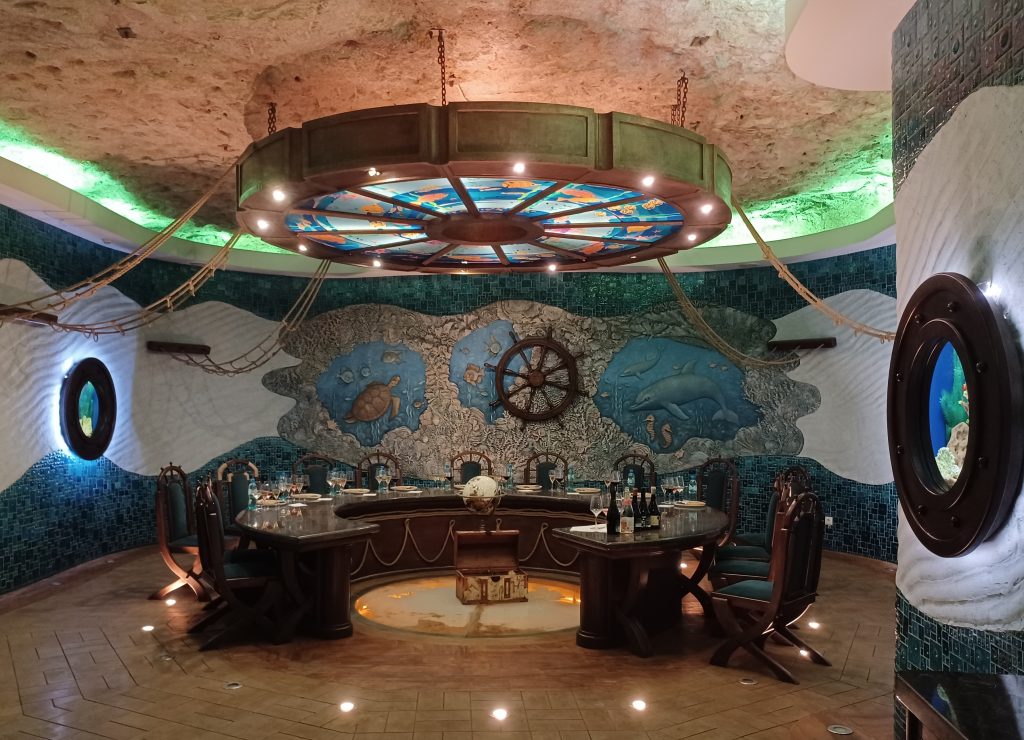
Eventually the important bit: we are led into one of the tasting rooms. This one is set out with a nautical theme because once this limestone area was under the sea, our guide enlightens us. Dolphins, turtles, ships’ wheels, and portholes adorn the walls. And a huge painted glass chandelier decorated with fish, shellfish, starfish and seaweed hangs from the ceiling on chains. Centre stage sits a large carved crescent shaped wooden table. Upon it, at each setting, are diverse wines already dispensed in five glasses. The guide leaves us to it and we prepare to imbibe: a rosé, sweetish, and a dryish white, another sweeter white, a mellow red and another pink accompanied by walnuts and biscuits and prunes and water. Knock it all back. Soon the group is in merry mood. And we are allowed some time to savour it all before being shuttled back to the surface. Phew.
Transnistria or Transdniestr or Pridnestrovian Moldavian Republic
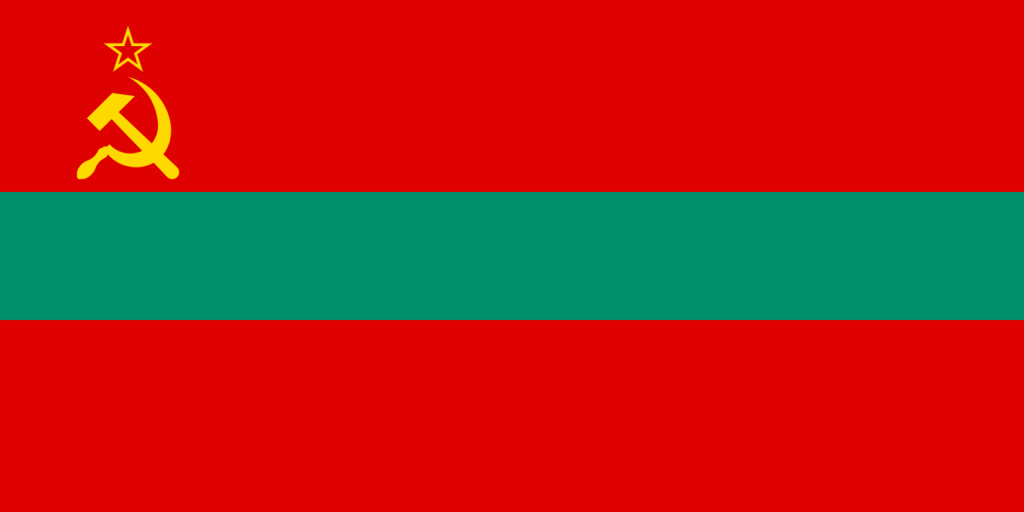
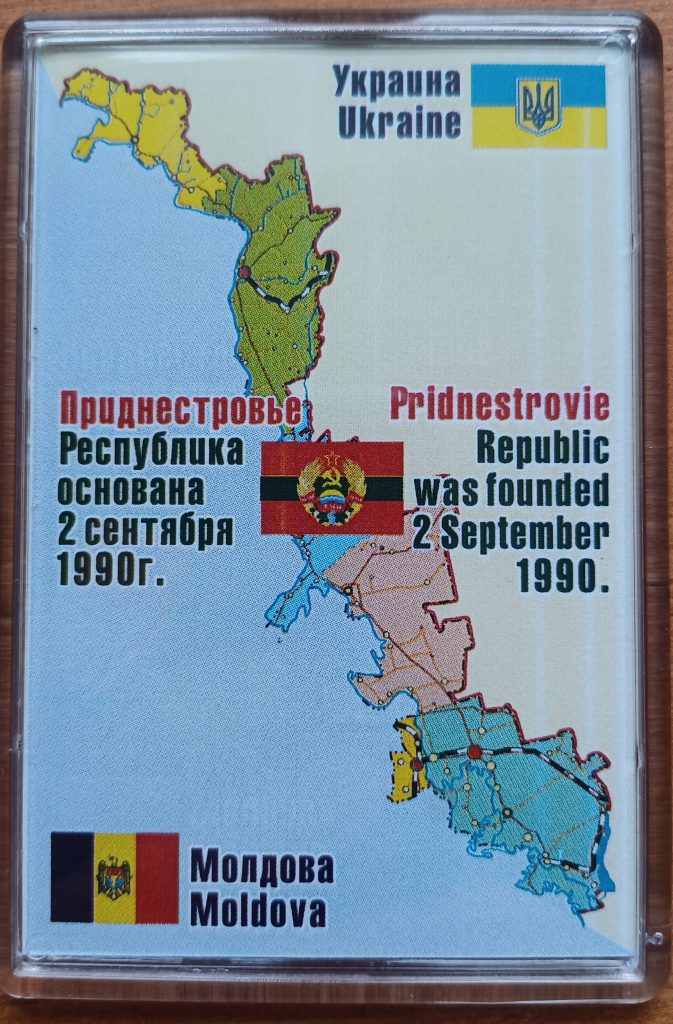
I have booked a tour today to visit Transnistria, which broke away from Moldova and declared itself a republic in 1990. A civil war, the Transnistria War, between Moldova and Transnistria was fought in 1992, ending in a ceasefire, with Russian troops being stationed here, purportedly, as peacekeepers ever since. Anyway, this ‘Republic’ of Transnistria is not recognised by the United Nations, and not by Moldova itself. Known as a ‘frozen conflict’ zone, it occupies a long sliver of land in the east of Moldova between the Dniester River and Ukraine. It has its own the flag, the only one in the world that still features a hammer and sickle. And the Republic is full of nostalgic memorabilia of the Soviet regime.
Bender
It takes about an hour to get to the border town of Bender, driving through scenic rolling landscapes with vineyards and fields. As we approach the border, our guide, a tall robust Romanian chap sporting red baseball cap and shorts, collects our passports to enter the territory. “No photographs of the border. OK?” OK. There are uniformed guards here bearing weapons. He alights to do the necessaries and returns holding bits of paper upon which are the permit stamps to enter. The guide doesn’t trust his party not to lose them so hangs on to them all.
The town of Bender was named by Suleiman the Magnificent, the Ottoman sultan who conquered it in 1538. It is called Tigina on the map. Also Tighina. Once part of the historical region of Bessarabia, it is actually situated to the west, or right bank, of the Dniester river, while the capital, Tiraspol, and most of the rest of the territory is on the east or left bank.
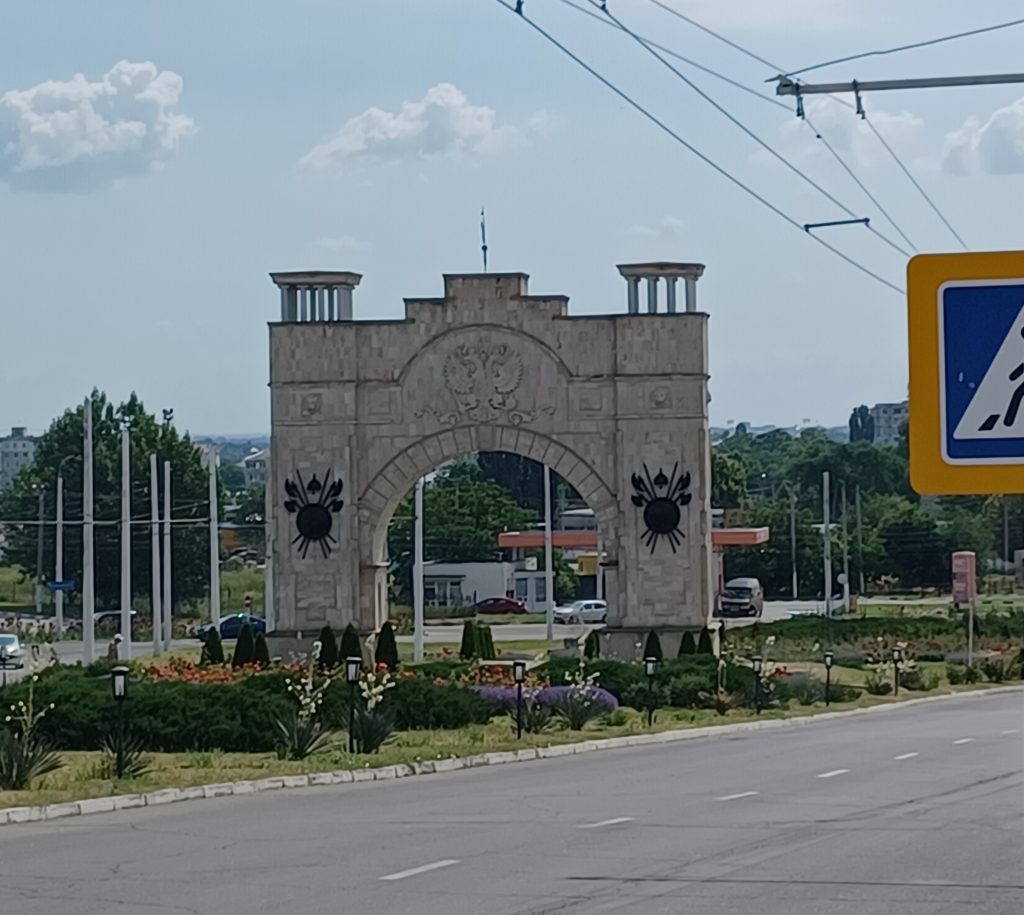
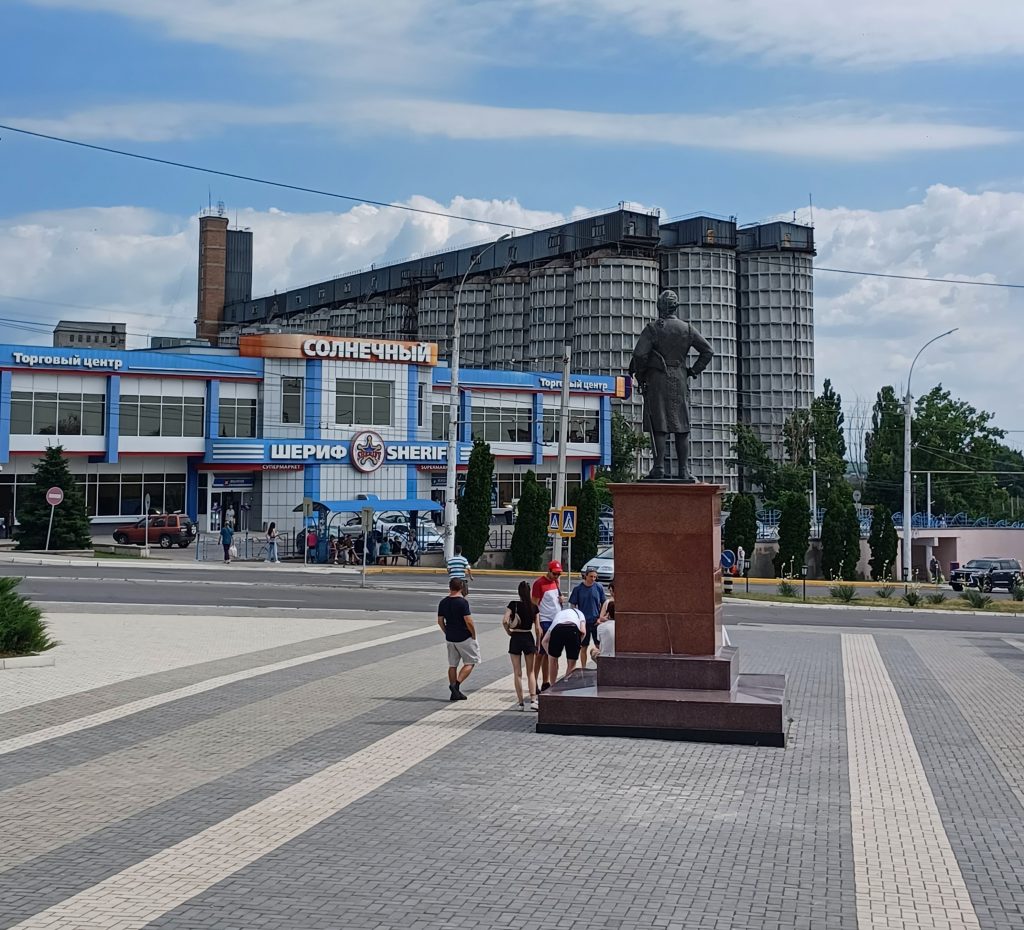
By the carpark, where we alight, is the Bendery Military Historical Memorial Complex. And a bit further on a triumphal arch, a conspicuous monument with a double headed eagle embossed in the middle. It was erected in 2008 and set amongst pretty flower beds. Across the road is a massive silo next door to a supermarket. Inside the latter a currency exchange booth invites us to exchange Moldavan Leu to Pridnestrovian rubles. Under the watchful eye of our guide, we exchange sufficient cash for the day’s amusements.
Bendery Military Historical Memorial Complex
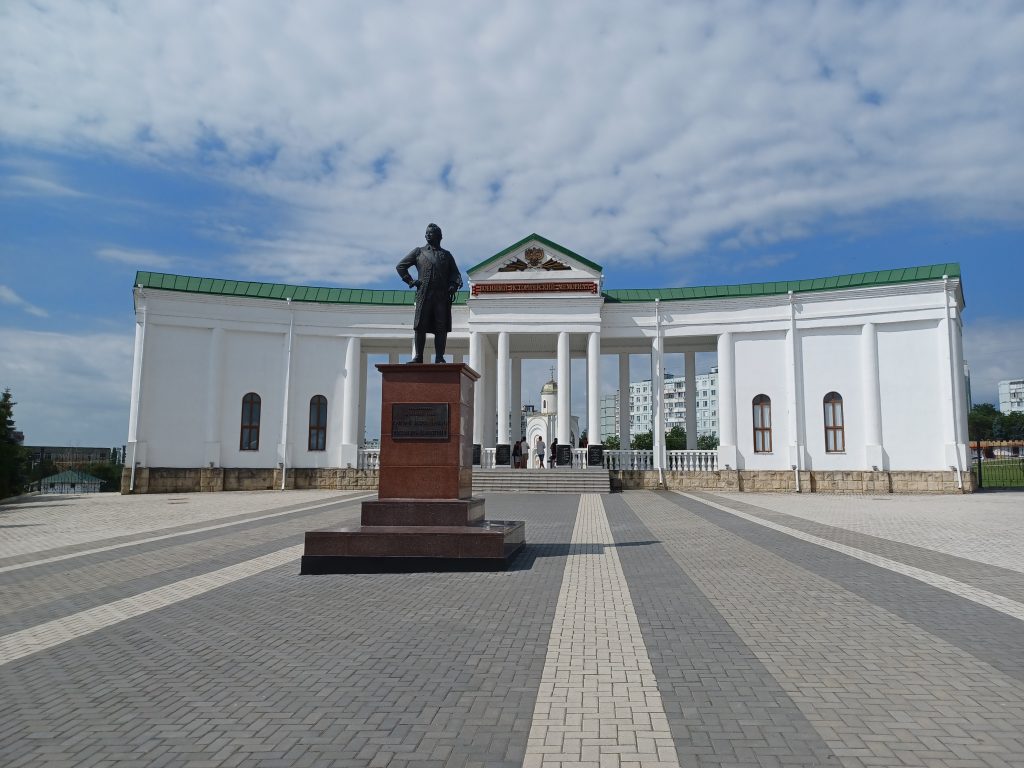
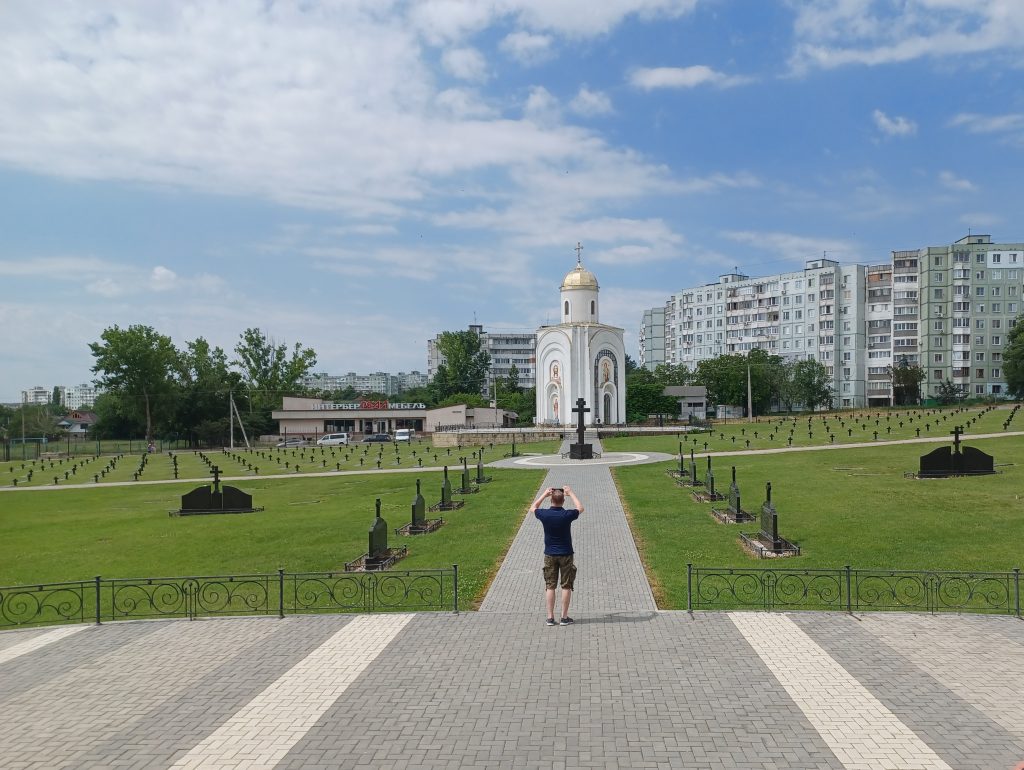
The first thing of beauty to behold is the Military Memorial Complex, opened in 2008. It was built atop an old military cemetery in which are interred over 5000 soldiers and officers of the Russian Imperial Army. The central path towards the large black granite cross is named Generals Alley. And behind the cross is a pretty little Russian Orthodox chapel surrounded by the polished engraved granite gravestones of the fallen. Also buried here were Romanians and other nations’ soldiers. Ugly Soviet blocks provide the urban hinterland.
The statue in front of the shiny white Neo-classical monumental entrance is of the Imperial Russian General Potemkin. He it was who led the conquest of the Ottomans at Bendery Fortress in 1789. A favourite, probably lover, possibly spouse, of the Russian Empress, Catherine the Great.
Our guide endeavours to fill us in with the history of this complicated region. Basically the population of this area, comprising the border town of Bender and the long strip of land east of the River Dniester, is pro-Russian. They did not wish to be part of Moldova, even less so after Moldova declared Moldovan the official language of the country in 1989 and, moreover, changed the alphabet from the Cyrillic to the Roman. The ‘Republic’ is supported by Russia financially, e.g. in terms of energy – “It’s cheaper here”, he says, “than in the rest of Moldova” – and the people still venerate the likes of Lenin, whose statue graces various prominent places.
In 1991, he explains, it was hard for the people of the ex SSRs who had all been used to having a flat in a block and a job. Albeit they had to wait in line for basic foodstuffs and sometimes years for a car, unless they were members of the Communist Party, in which case the wait might be only a few months. “During this time they had plenty of money but nothing to spend it on”, our guide jokes, “while now they have no money but lots of things to spend it on”. Anyway, while Pridnestrovie wishes to remain with Russia, Moldova itself wishes to become part of the EU, and is in the process of applying. A tricky situation.
Memorial of Military Glory
Close by the cemetery is displayed a tank painted with Cyrillic letters (ПМР) (Roman: PMR for Pridnestrovian Moldavian Republic), an eternal flame, and a wall with the names of the fallen on engraved plaques upon it. The Memorial commemorates those lost in many conflicts including those in Afghanistan and Transnistria.
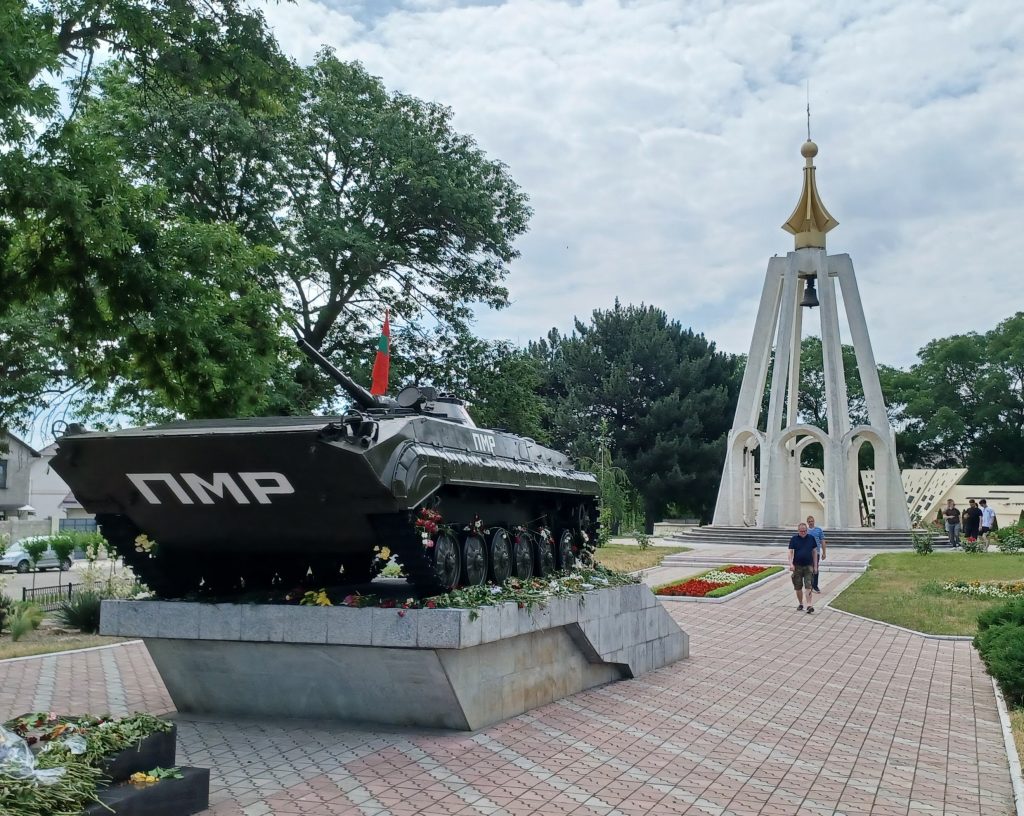
In front of the memorial wall is a bust of Alexander Lebed. “Who was Alexander Lebed?” someone asks. “Ah, he was a Russian General and politician”, we are told.
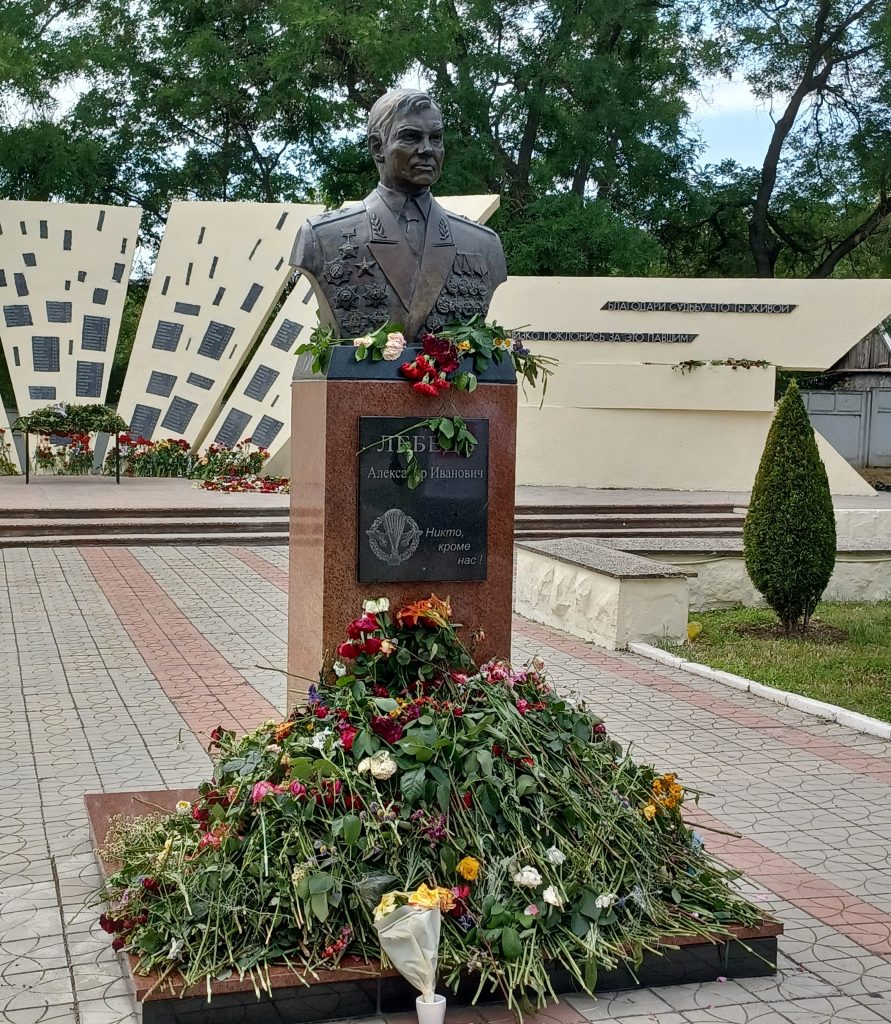
It was largely due to him that ceasefire negotiations took place in 1992. He stood for election against Boris Yeltsin in 1996 election, but lost. When Yeltsin resigned, Putin succeeded him and became President in 2000. Lebed contested Putin but lost the first round and withdrew. He was a popular figure and highly thought of but not, it seems, by the regime. So “he eventually went the same way as all the others”. “That is”, our guide continues, “he was assassinated”. “Oh, I mean he was killed in a helicopter crash in 2002”. Move swiftly on.
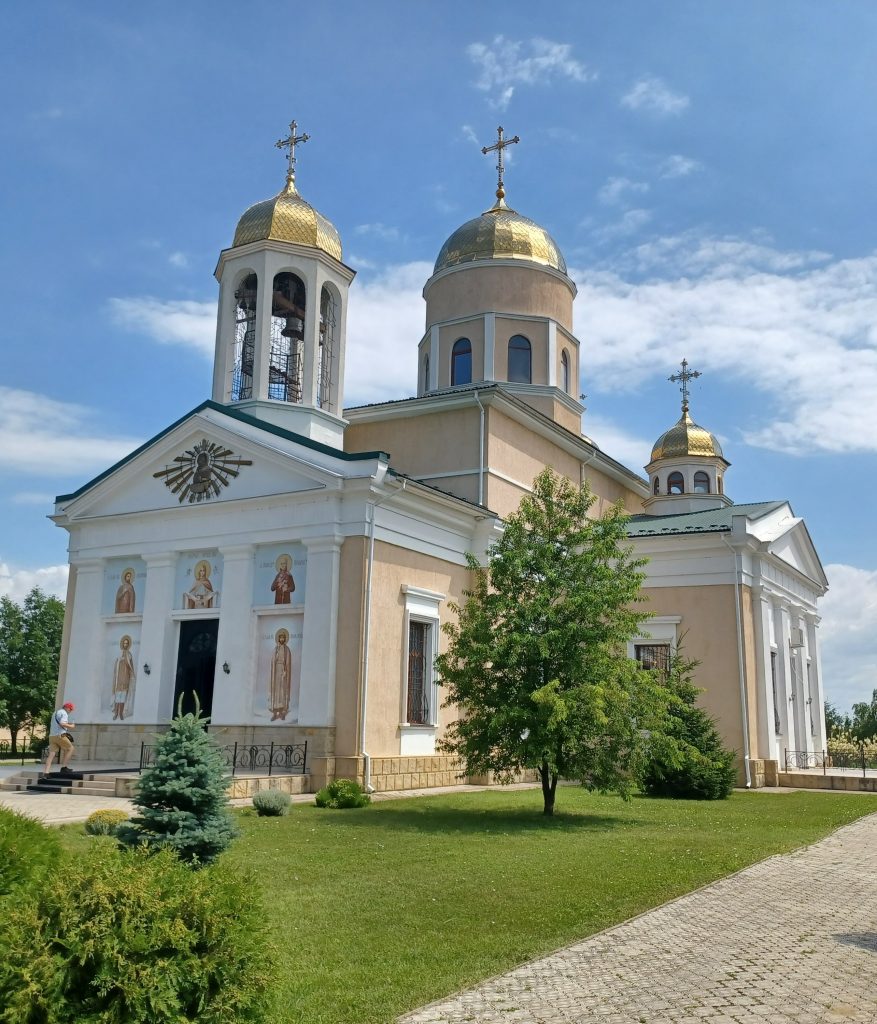
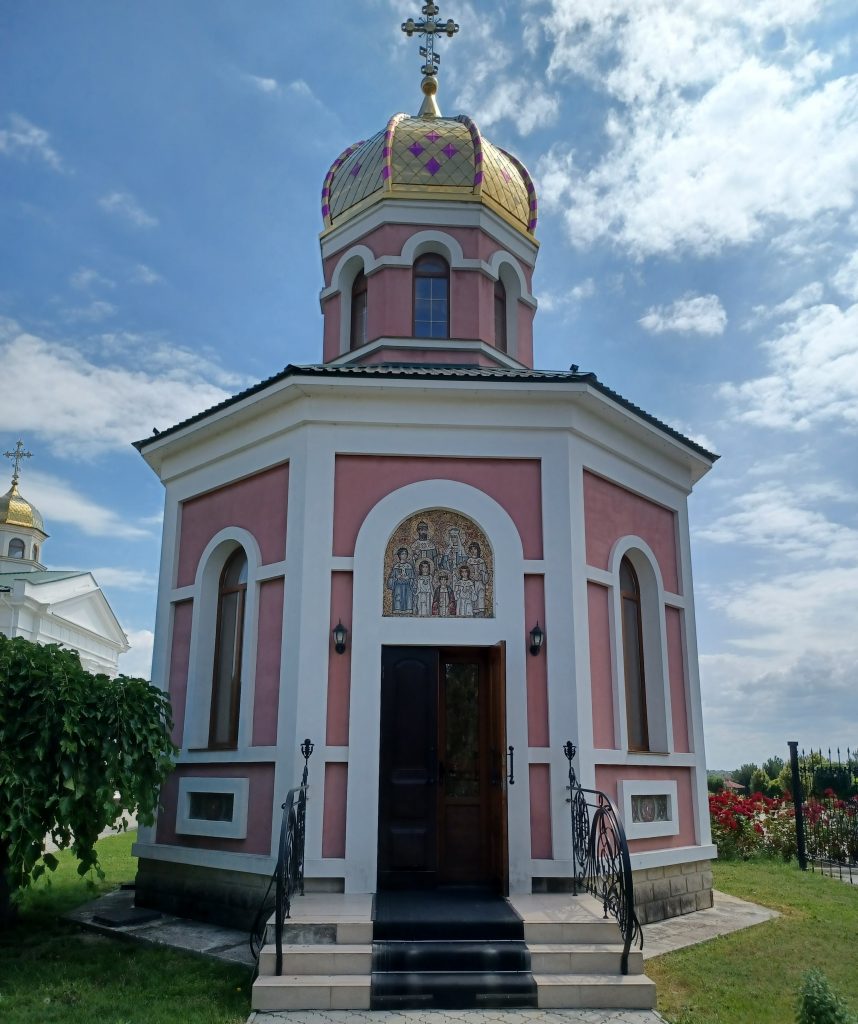
Close by we wander into the precincts of the gorgeous Russian Orthodox Church, the Transfiguration Cathedral, founded by Archbishop Dimitrios of Chișinău and constructed between 1814 and 1822. Baptisms are going on so we don’t enter. In the same grounds is the small but perfectly formed Alexander Nevsky church, the only one acting as a military church in Pridnestrovie, I gather. Built in 1833. Above the doorway, our guide points out, is a mosaic depicting Tsar Nicholas II and his family. They prayed in this church during a visit to Bender. Inside is a shrine to their memory.
Bendery Fortress
We head now to Bendery Fortress, or Tighina Fort, first built during the reign of Stefan cel Mare out of wood, later rebuilt in stone by Suleiman the Magnificent between 1538 and 1542. Strategically important, it was one of a network of Ottoman forts built along the Dniester River to help stave off the Russians. Even so, it was finally conquered, as before mentioned, by the Imperial Russian Army under General Potemkin in 1789. And, since 1992, has been under the authority of the Pridnestrovians.
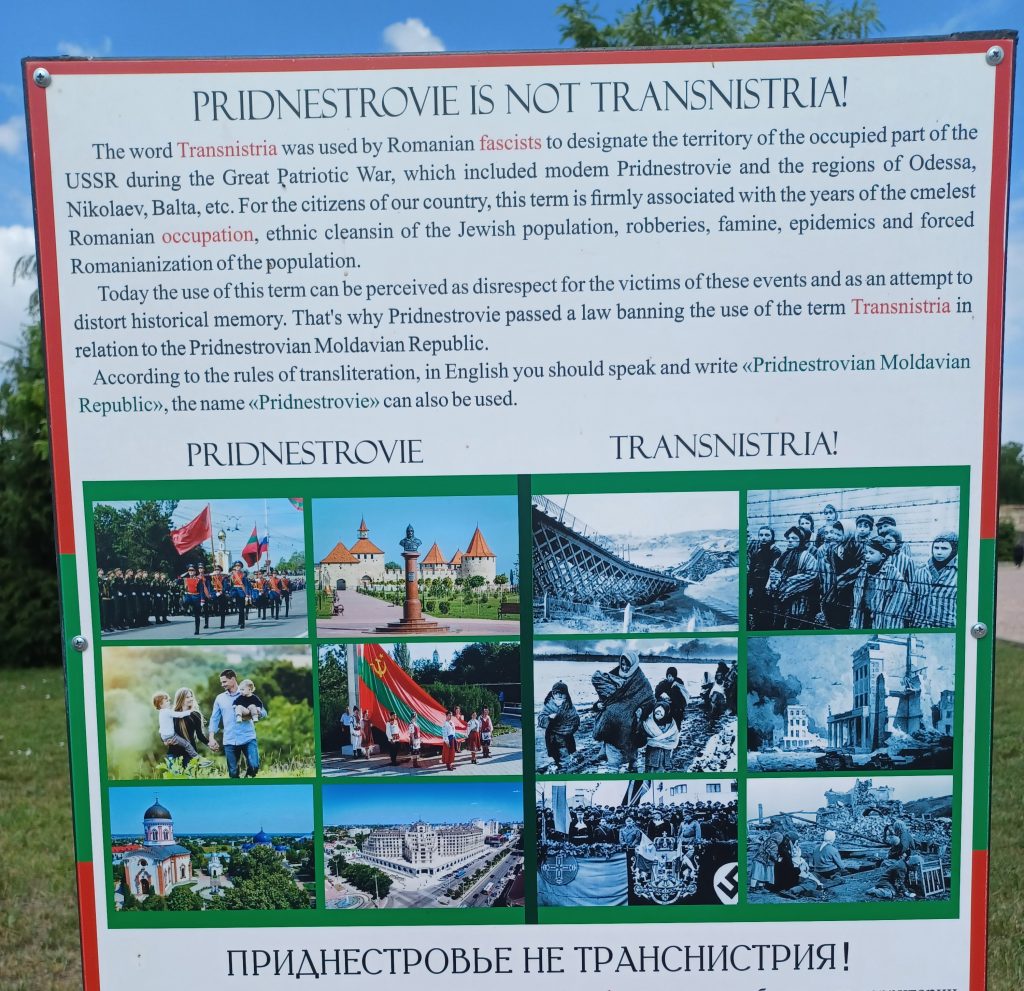
Outside the entrance to the Fortress, where we cannot fail to see it, is a signpost pointing out that it is disrespectful to call this republic ‘Transnistria’ because the term is associated with the Romanian occupation during the Great Patriotic War (WWI). The term is banned in the Republic. ‘Pridnestrovie is not Transnistria!’ it declares in bold letters. OK.
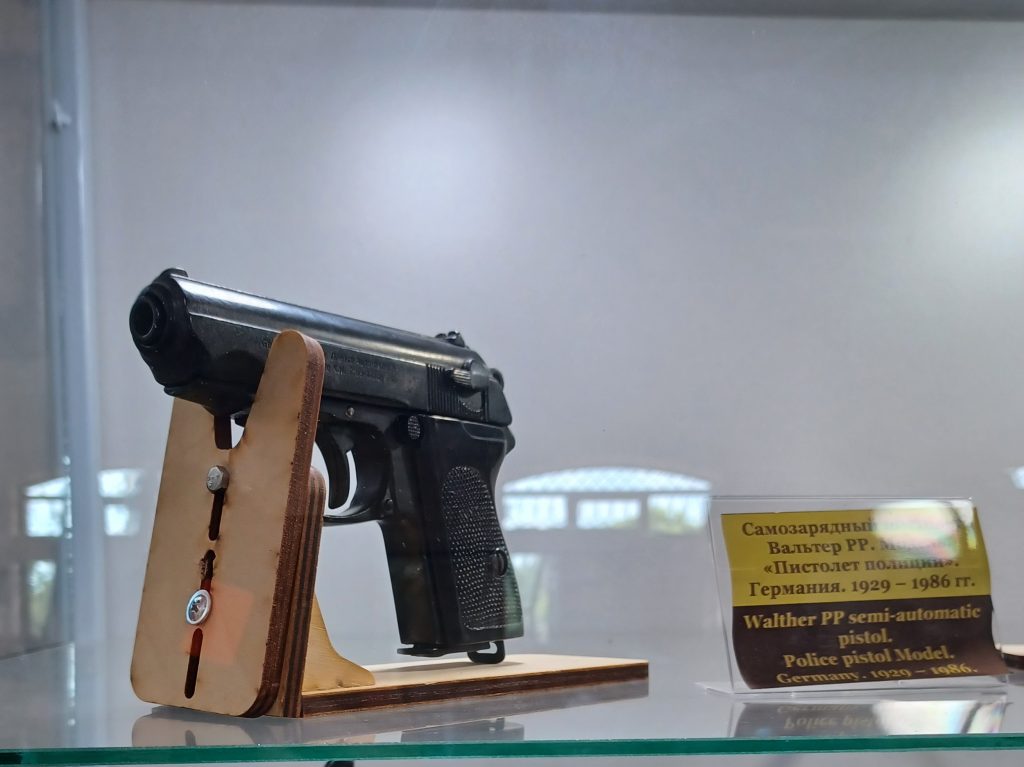
Sidle past the signpost and follow the guide into the Exhibition Hall within the fortress where there is a display of weapons. It includes a gun, the same type as Hitler shot himself with, apparently, the Walther PP semi-automatic pistol. Good to know. Rifles such as the Kalashnikov with info about the maker, Mikhail Kalashnikov, and how successful these weapons have been, Stalin with hunting rifles, mortars and more.
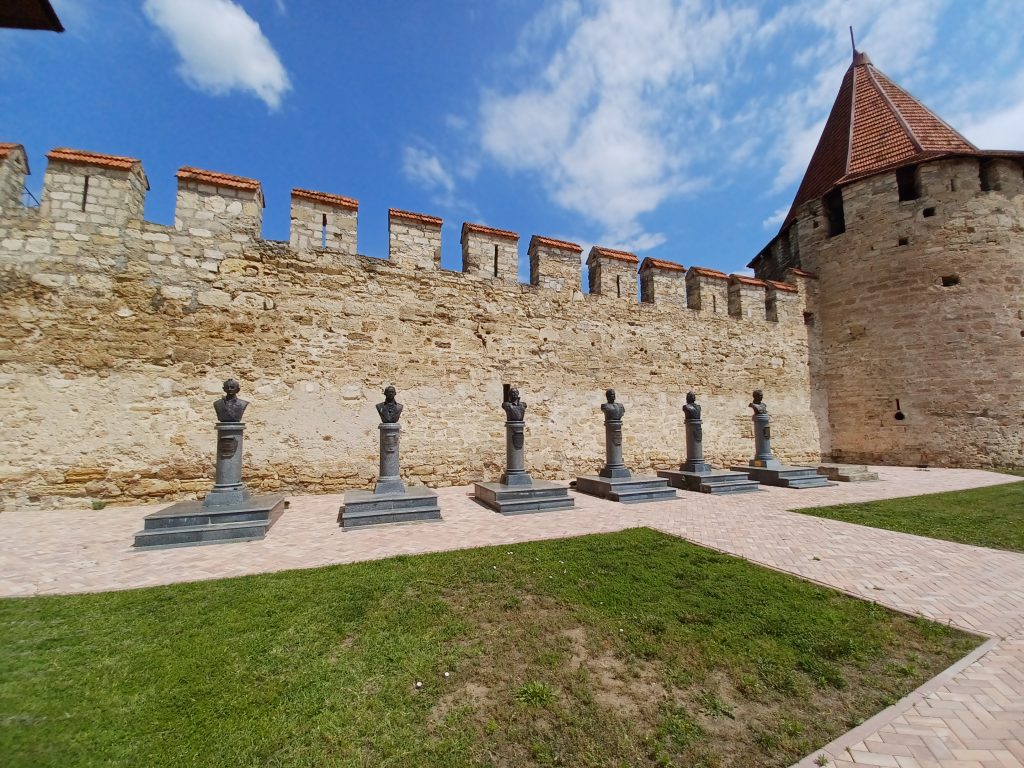
In front of the fortress gate, there is a Cognac stop. “Who would like to try the local Cognac?” Well, it is nearly mid-day, I suppose. Nevertheless, I refrain, whilst the others indulge. Instead I amble off to view a number of busts lined up alongside the fortress wall. A pantheon of famous Russian figures, it would appear, connected in some way with the history of the fortress.
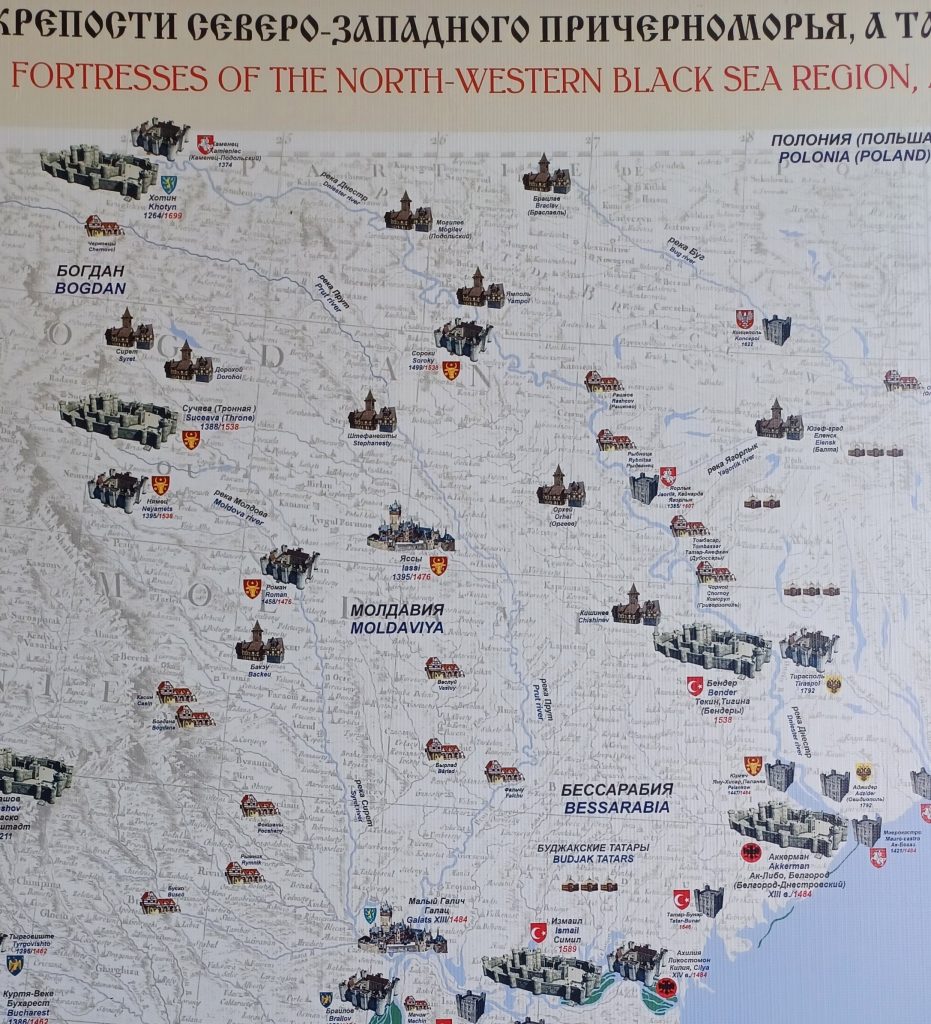
I migrate to the inside of the gateway where, upon a wall, is a map showing the position of Bendery Fortress within the network of fortresses within the NW Black Sea region. Peruse it awhile.
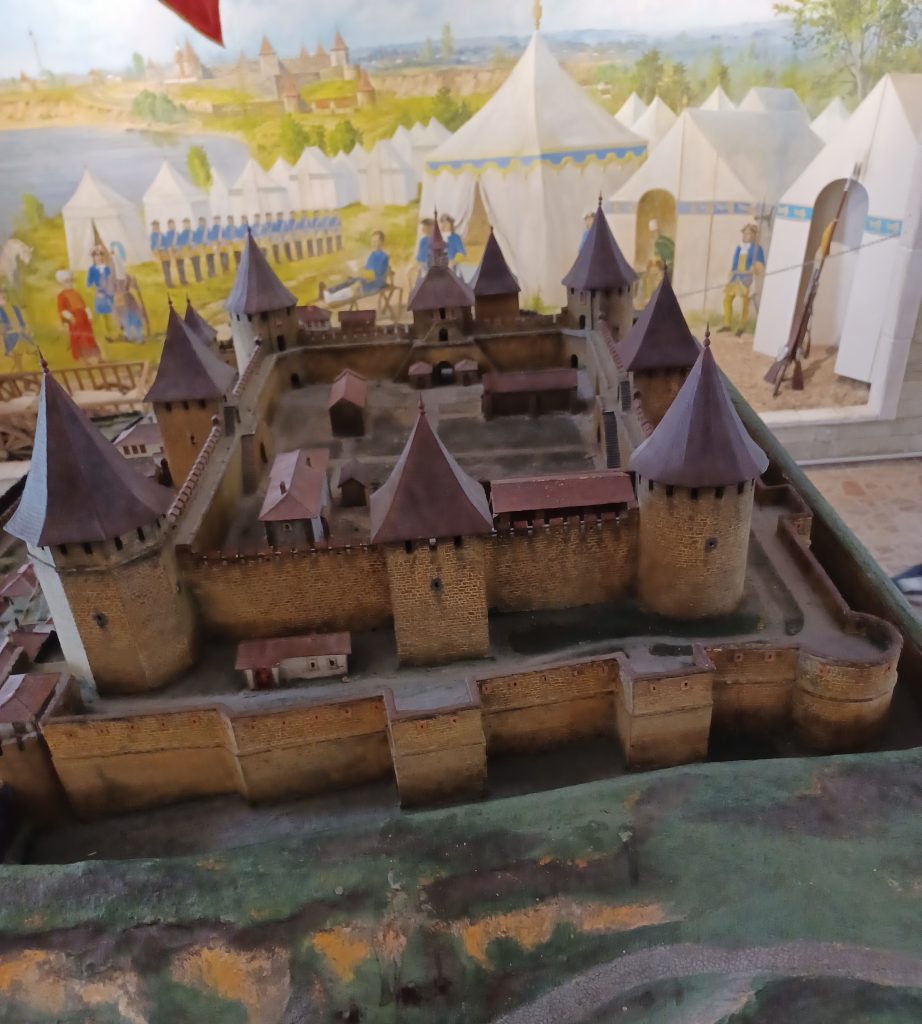
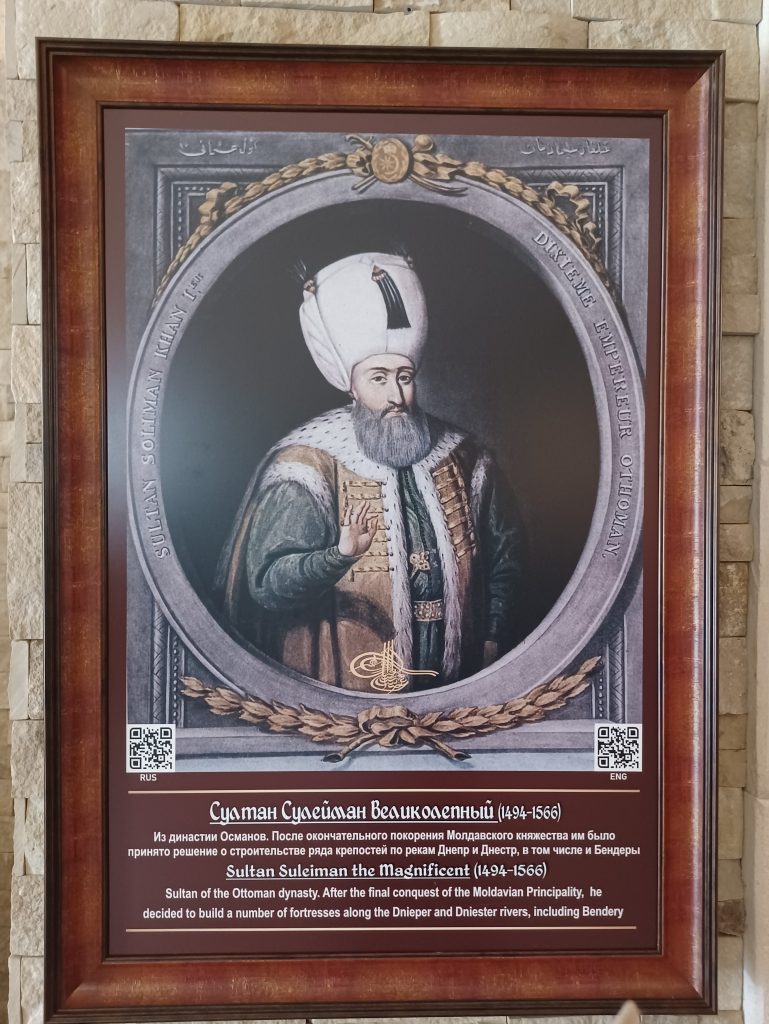
There is a small museum here displaying a model of the fortress as it once was with its double walls and eight towers. Here also a portrait of Suleiman the Magnificent.
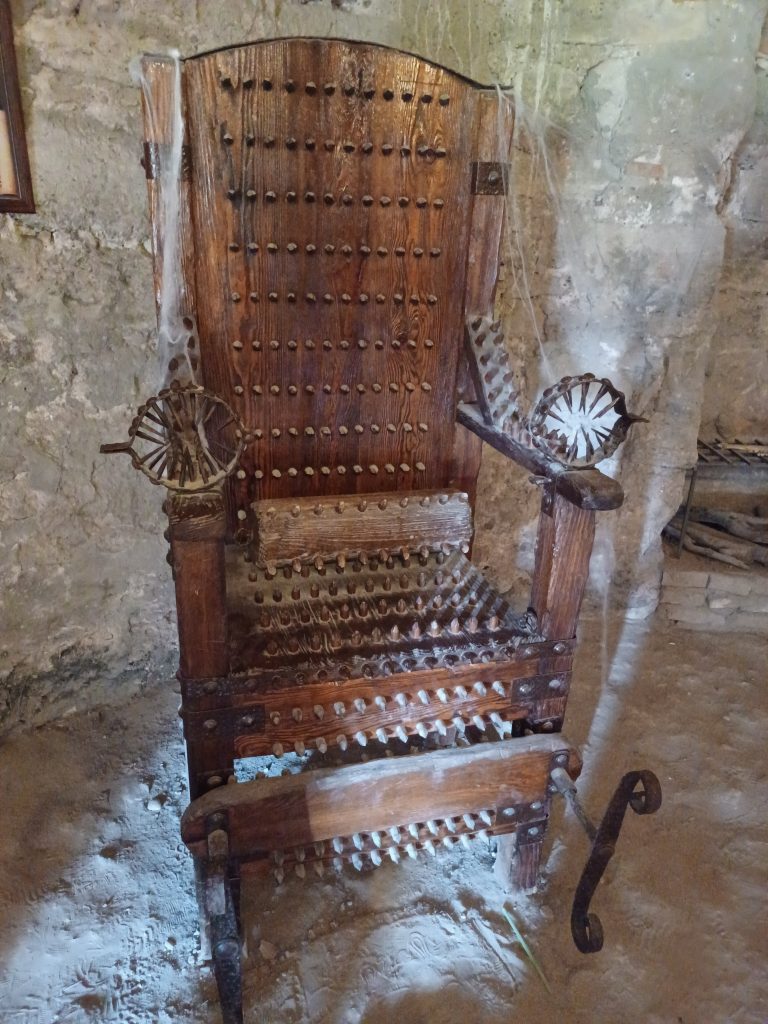
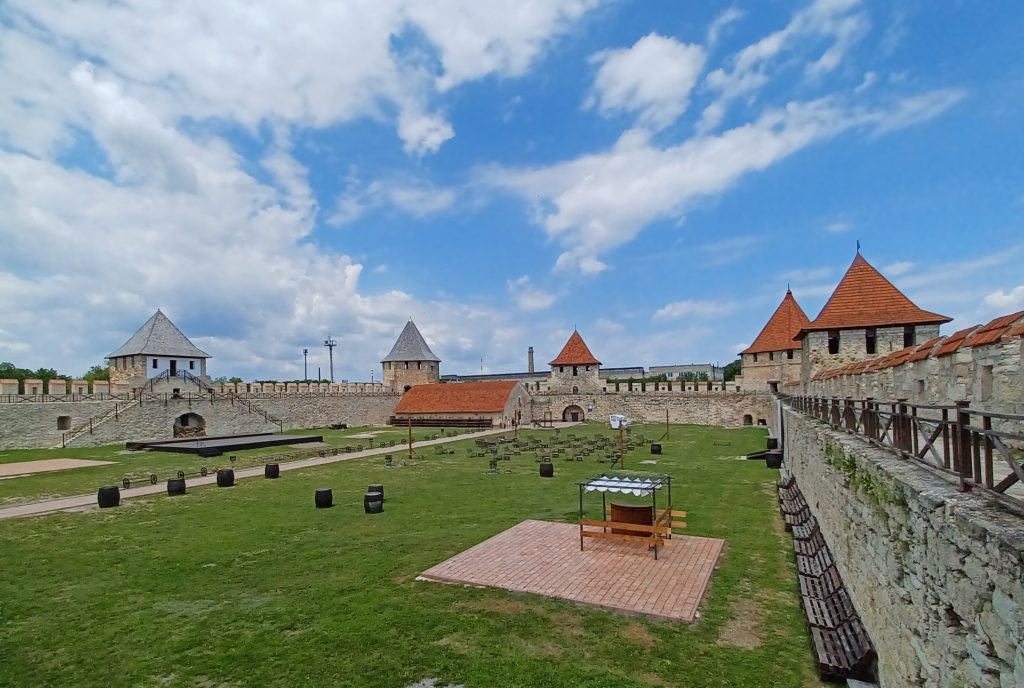
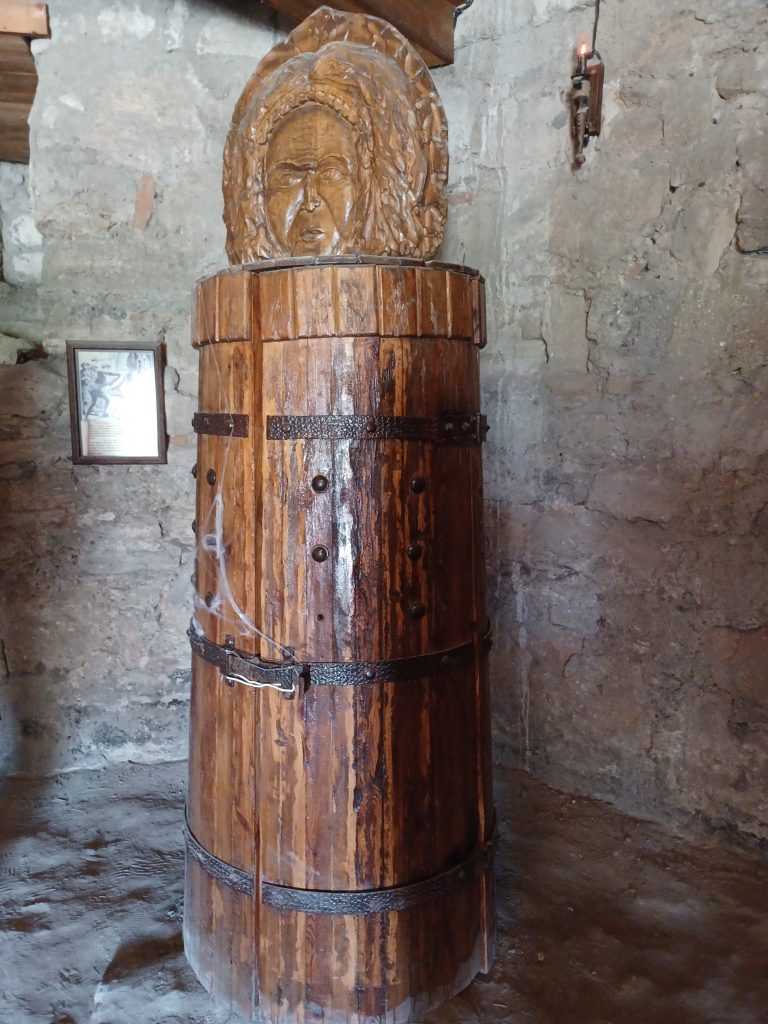
Thence into the open verdant expanse within the fortress. Follow our leader up steps to stride along the inner walls and then climb up more steps into a watchtower. Very well preserved it all is. There is a torture chamber in one of the towers, once part of the Turkish prison. Some of these gruesome instruments of torture remind me of Vlad the Impaler, Count Dracula, and his torture chamber in Bran Castle (see Romania, Part 2), e.g. an iron maiden and an interrogation chair, both armed with spikes. Eek. From the walls is a grand view over the inner space. Benches and barrel tables, a big screen on a wall and a stage provide clues as to today’s less macabre entertainment.
Stolovka USSR
After this edifying morning, we are off to lunch in a Soviet style canteen. Named Stolovka USSR. Enter through a nondescript porchway and head up the stairs. Old newspaper cuttings adorn the walls along with a large poster of Lenin and a world map.
Upstairs inside the canteen one is transported back to Soviet days. Old portraits and paraphernalia such as radiograms, bayan accordions, bits of furniture, old telephones, sewing machines, empty Vodka bottles, velvet banners, and tables with red and white check tablecloths.
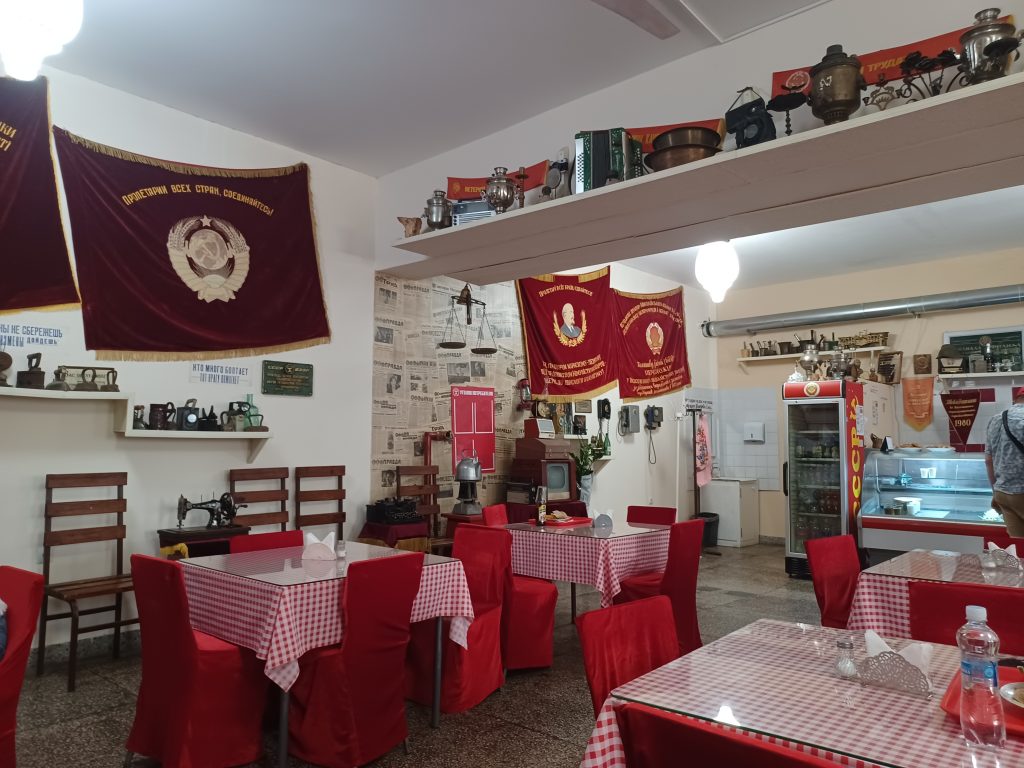
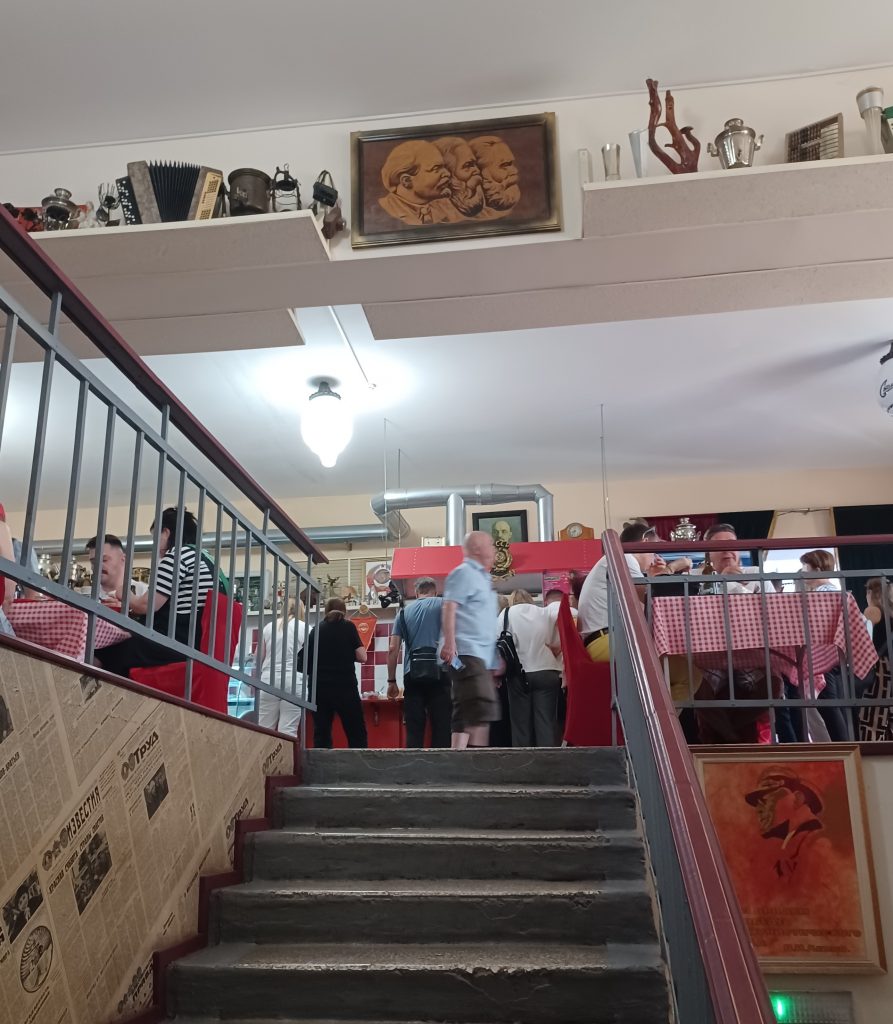
Food is served by a stolid looking lady with coloured headscarf, and we all queue in line and point out the delicacies we wish to savour. Service is a tad slow. Said lady also takes the cash. I opt for a couple of sort of minced meat burgers and a dolma along with some chips and tomato and cucumber salad. It costs 90 Pridnestrovian rubles altogether, about five euros. Grab myself a table and tuck in. Luke warm, scarcely gourmet, but tasty enough fare and heartily adequate. Anyway, the décor more than makes up for any deficiencies in the foodstuffs.
Interesting experience. Such canteens once fed the Soviet masses. Today they feed the tourist masses, who, one by one, do sit and eat. The queue now wraps around the canteen. More tour groups join the throng and add themselves to the line.
Tiraspol
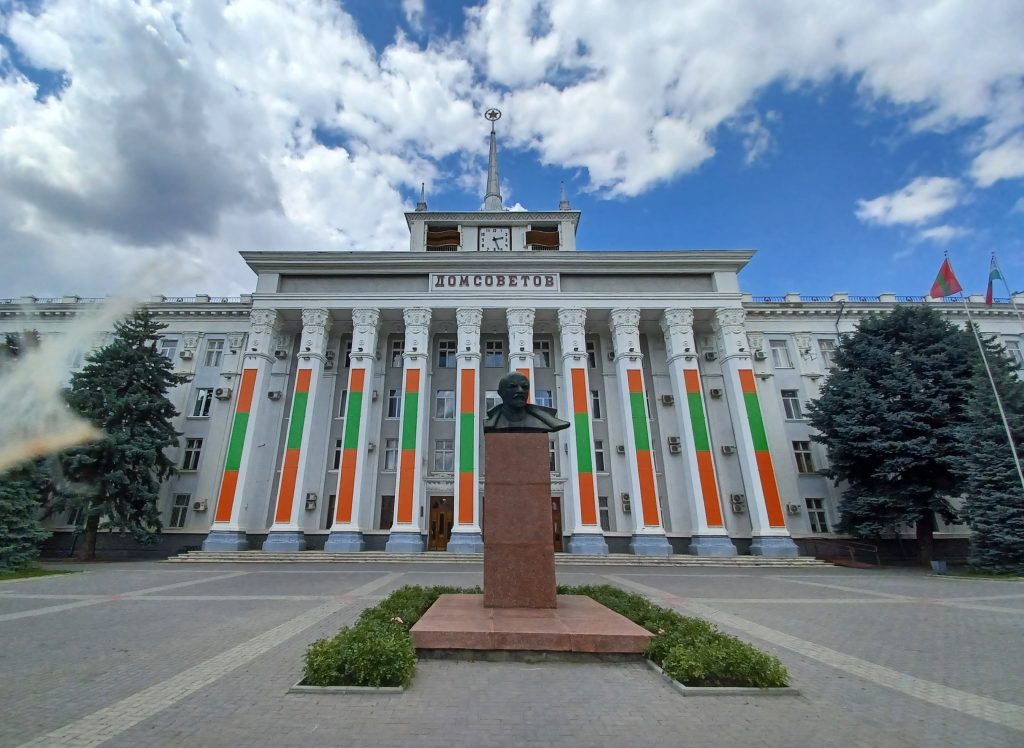
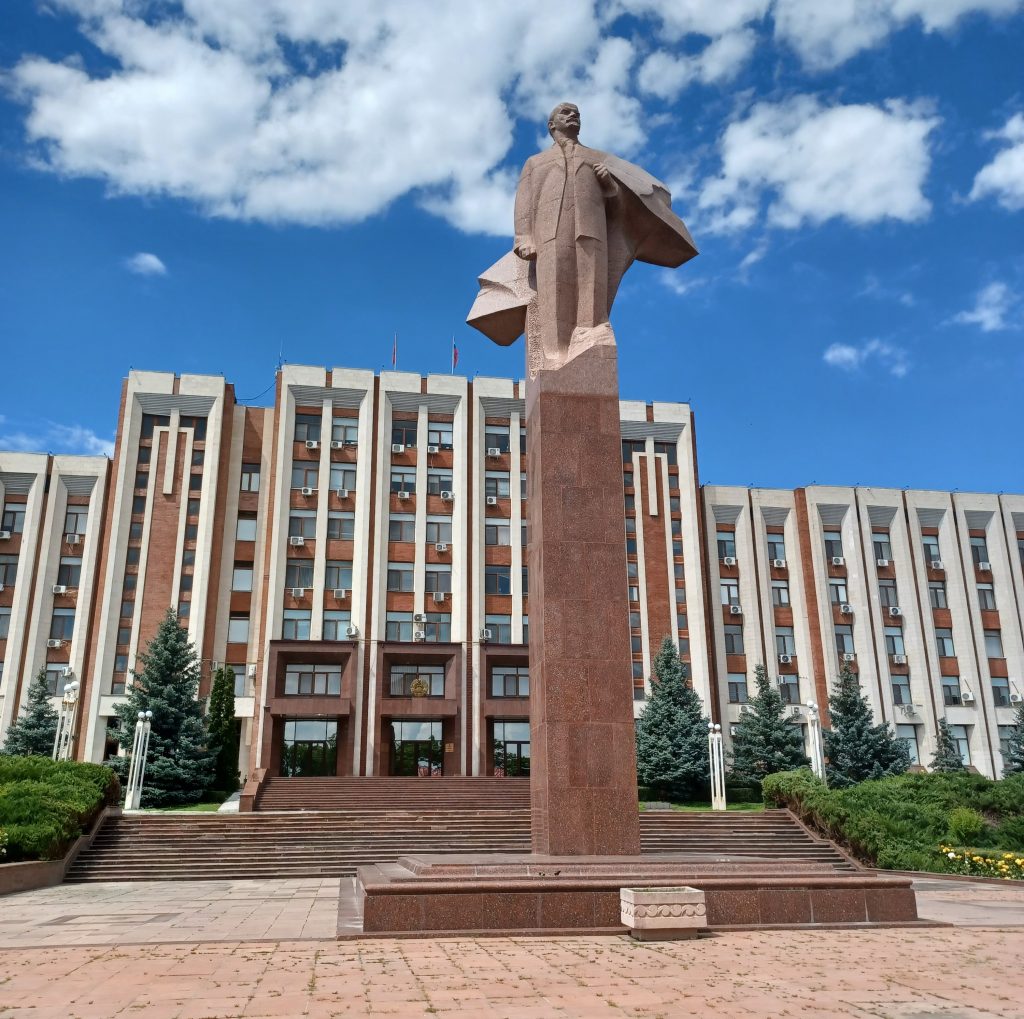
A short drive after lunch and we arrive in Tiraspol, Pridnestrovie’s capital and Moldova’s second largest city. Some call Tiraspol an open air Soviet museum. It is hot now. We traipse from one monument to another in the plus 30 degrees heat. First to be viewed is the Domsovietov, the House of Soviets, in front of which is a bust of Lenin. The colours of the flag are painted on its pillars. Further on, the Presidential Palace features a whole length statue of Lenin in front of it on a tall pink granite plinth.
Memorial of Glory
And close by the Palace is the Memorial of Glory dedicated to those who lost their lives in the Great Patriotic War. Opened in 1972, it now also commemorates the fallen of the Transnistrian war. It features the M24 tank, which was the most commonly used Soviet medium tank during WWII.
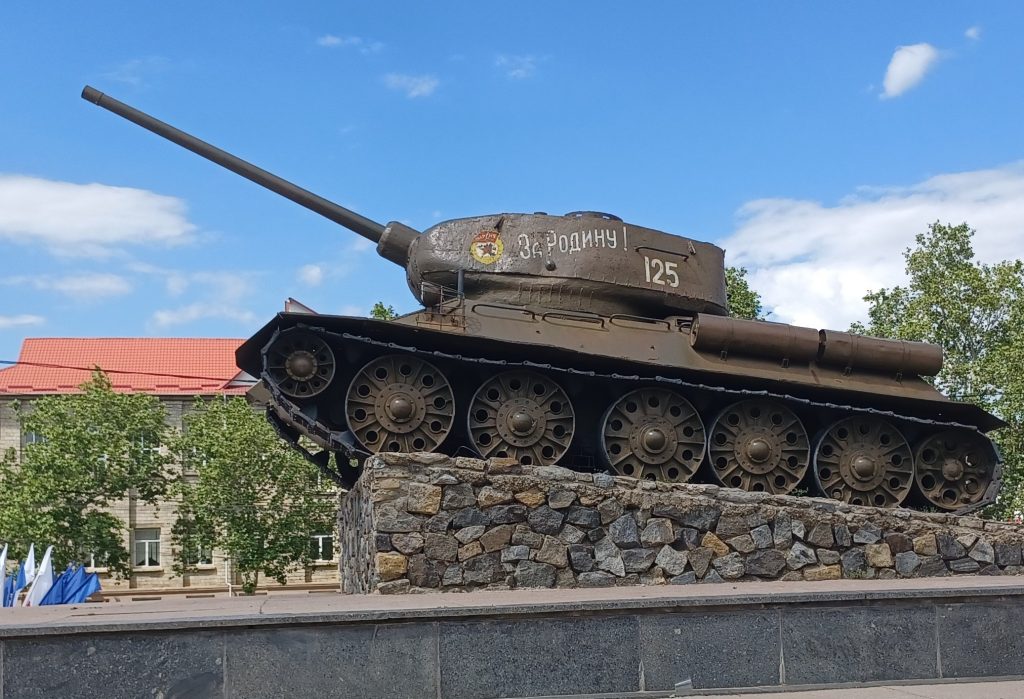
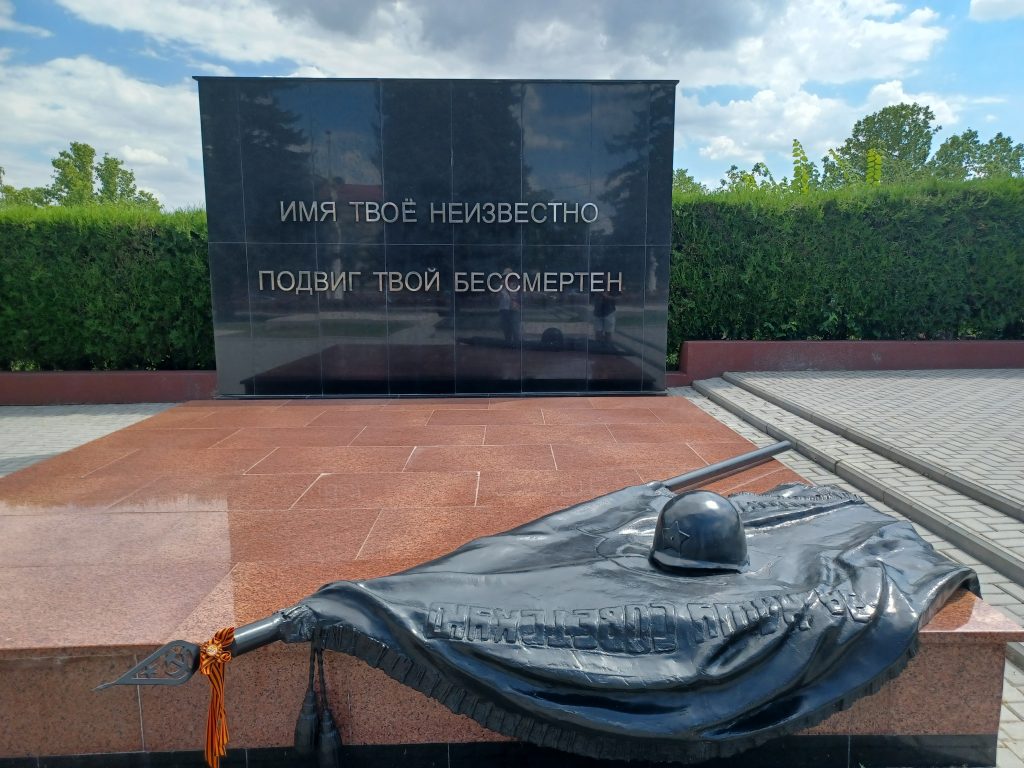
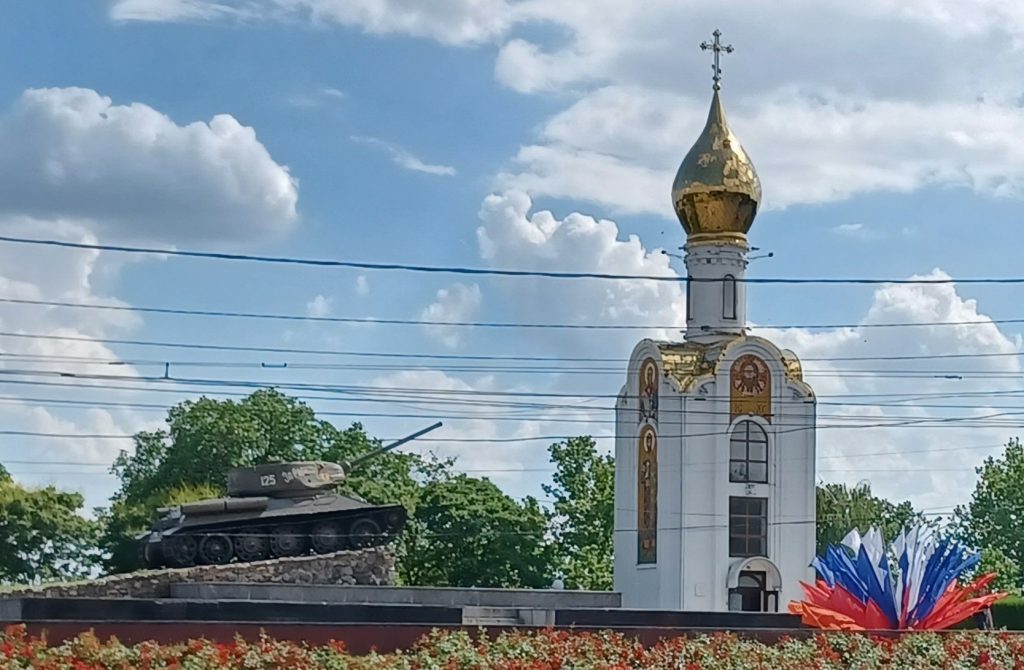
Painted on its turret in Cyrillic letters are the words ‘за родину’, ‘For the Motherland’. People climb up and pose on it. Its cannon aims at a beautiful church, dedicated to St George. War and Peace. More memorials, one on a black granite slab dedicated to the unknown soldier with a banner and helmet on pinkish flagstones; another to the victims of the Chernobyl disaster in 1986.
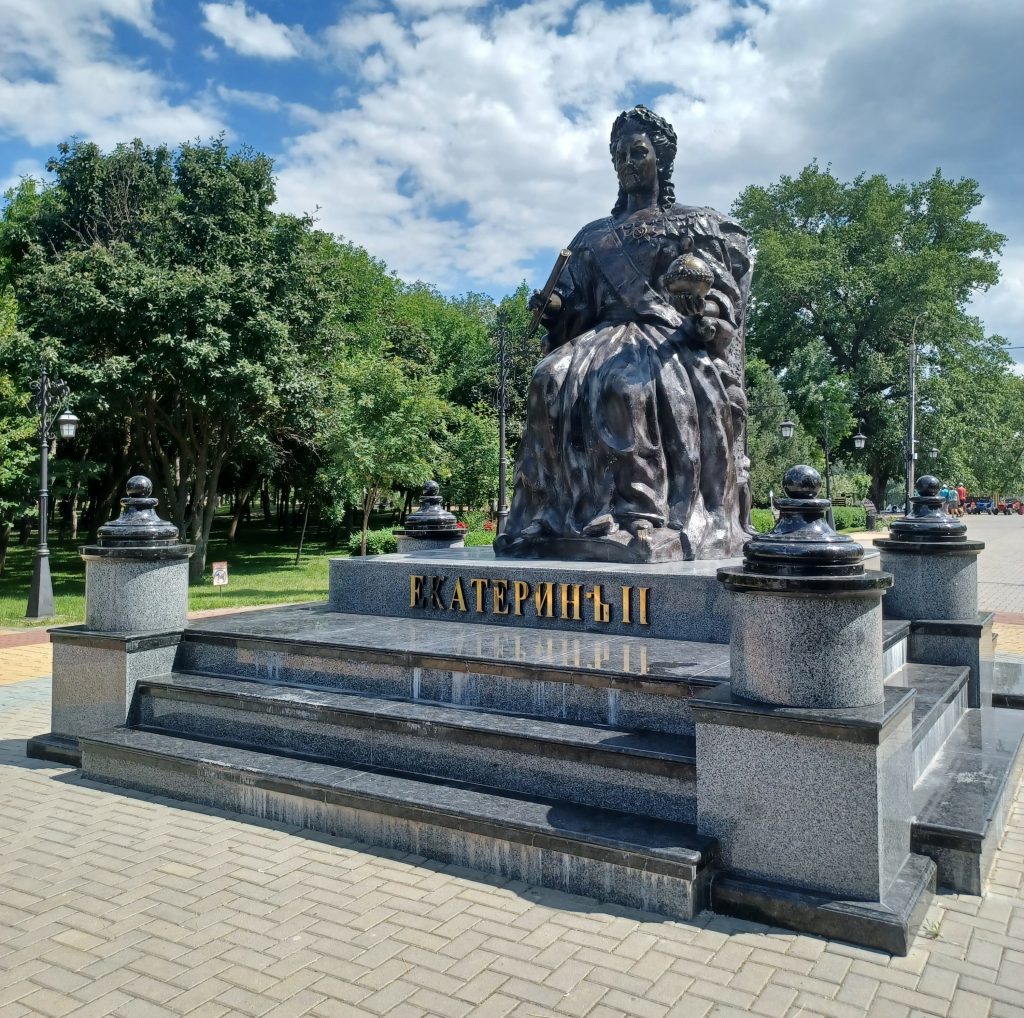
More plodding in the sticky heat. Grab some bottled water from the minibus, after which the driver attempts to park his vehicle in the shade. Even the guide is perspiring now, and some Italians in our group buzz off to partake of refreshments in a café. We reach a large leafy park, minus Italians, within which stands a statue of Catherine the Great (Ekaterina II), Empress of Russia, who reigned from 1762 to 1796.
Surfeited with memorials, it is now time to spend our remaining rubles. So the group heads off to souvenir shops and antique shops. Usual tat on display: fridge magnets, flags, T shirts, hats, and mugs with famous Soviet faces thereon, to tempt the tourist. Stamp albums too. One of the Italians purchases some of these for very little. Remarkably good value, he announces, pleased with himself.
Soon we reassemble at the minibus for the drive back to Bender. Those with spare rubles are able to change them back to some other currency. Hop on bus again, stop at the military controlled border and exit into Moldova. A fascinating excursion it has been to this unique enclave, part progressive European, part retrogressive Soviet. Interesting times.
Leave a Reply