
I am on a journey in Romania. Sated with the sights of Bucharest, it is time to venture into its wildish hinterland to view the highlights of the enigmatic region of Transylvania.
Not much sleep was had last night. Thumping music carried on until at least 03:30, making the fabric of this old palace hotel in Bucharest’s old town, vibrate. Much honking traffic and hollering outside in the street. Not to worry. Have to get up at 05:30 anyhow for this full day trip.
Having carried out that judicious reconnaissance on my first day in Bucharest, I head to the pickup point like a homing pigeon. Get there early. And am first on the coach and bag a seat near the front. Very satisfying. As Wellington said, or could it have been Rommel, or even the Chinese military strategist, Sun Tzu in the 6th century BC: “Time spent in reconnaissance is seldom wasted”. Turns out to be a packed coach, and by 07:00 all participants have boarded. Emmanuel, our guide, lean, earnest and conspicuous in base-ball cap, introduces the driver and himself. Very knowledgeable he turns out to be. And he manages to keep this big group in line, spelling out a few dos and don’ts before we set off, e.g. keep strictly to the set timings. OK.
Bran Castle
It is a long way to Bran castle, the fictional seat of Count Dracula in Bram Stoker’s 1897 Gothic horror novel. The castle is sited on the historic border between the two regions of Wallachia and Transylvania, the first stone fortress there having been built by the Saxons in 1377. It will be crowded, we are warned. Until then we endure two and half hours driving through the countryside of Wallachia with no comfort stops, before passing into Transylvania. “The name comes from Latin and means ‘through the forests’”. And there are dark Satanic hills surrounding us, actually the Carpathian mountains, smothered in forests. Inhabited by various cultures: Germans, Romanians, Hungarians and Roma, Transylvania has changed hands a number of times, from the Ottoman empire to the Austro-Hungarian empire to Romanians to Hungarians to Romanians again. A checkered history, Emmanuel tells us.
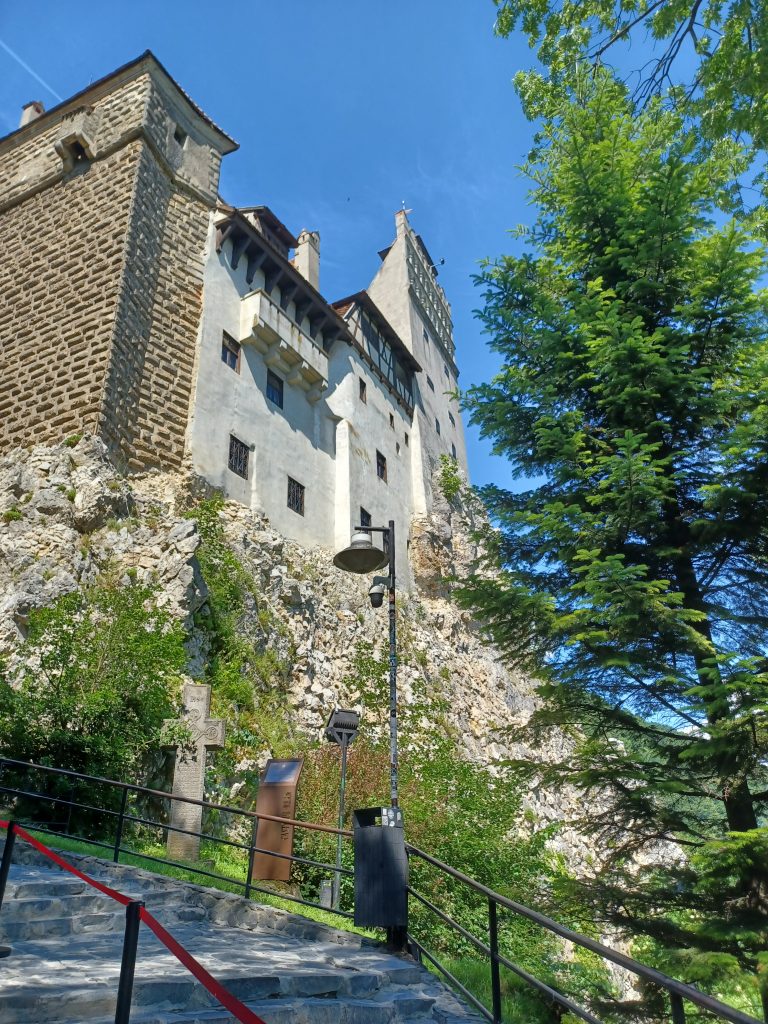
We are the first tour group to arrive but are followed speedily by myriad coachloads of other tour groups. I would like to say that Bran castle glares down at the multitudes from its rocky bluff. But actually it’s not at all foreboding. And it is rather attractive. Painted creamy white with neat brickwork and orangey tiled rooves. Leafy trees in abundance. Scarcely dark, gloomy and vampire like. Perhaps it adopts such attributes in the witching hours. Anyway, the gauntlet of souvenir stalls selling Dracula themed tat, such as vampire’s fangs, vampire T-shirts, even vampire wine, endeavours to put one in the mood.
Thence upwards. Up a steep path and steep steps to the entrance. Hand rails, lamps and litter bins line the way.
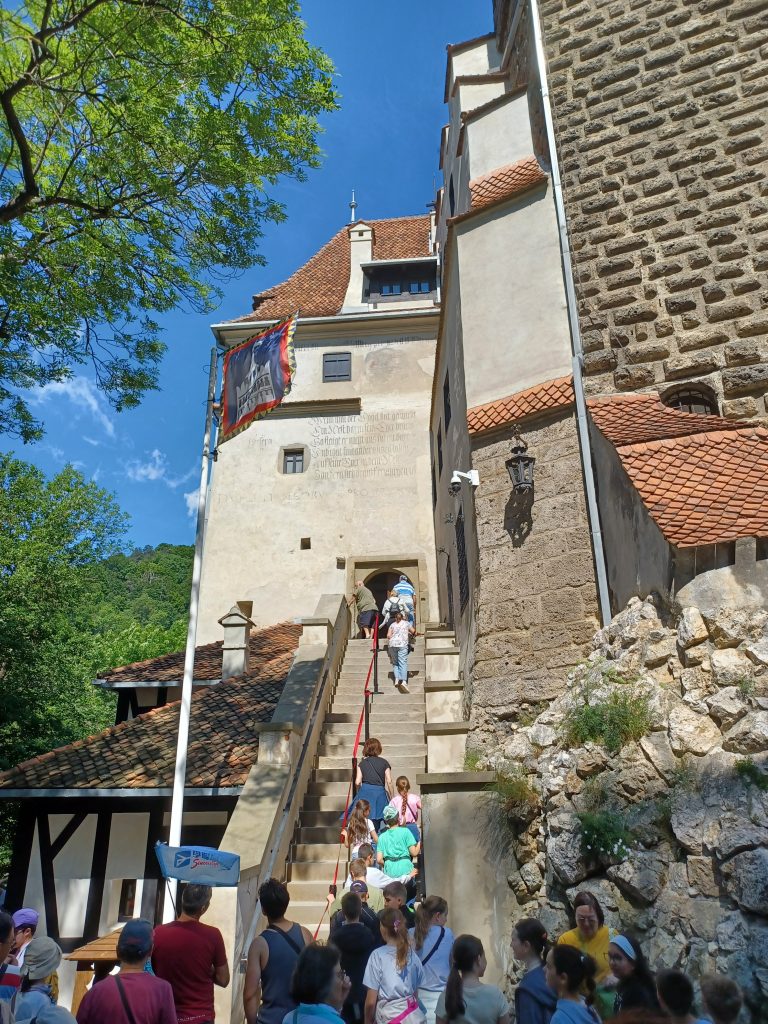
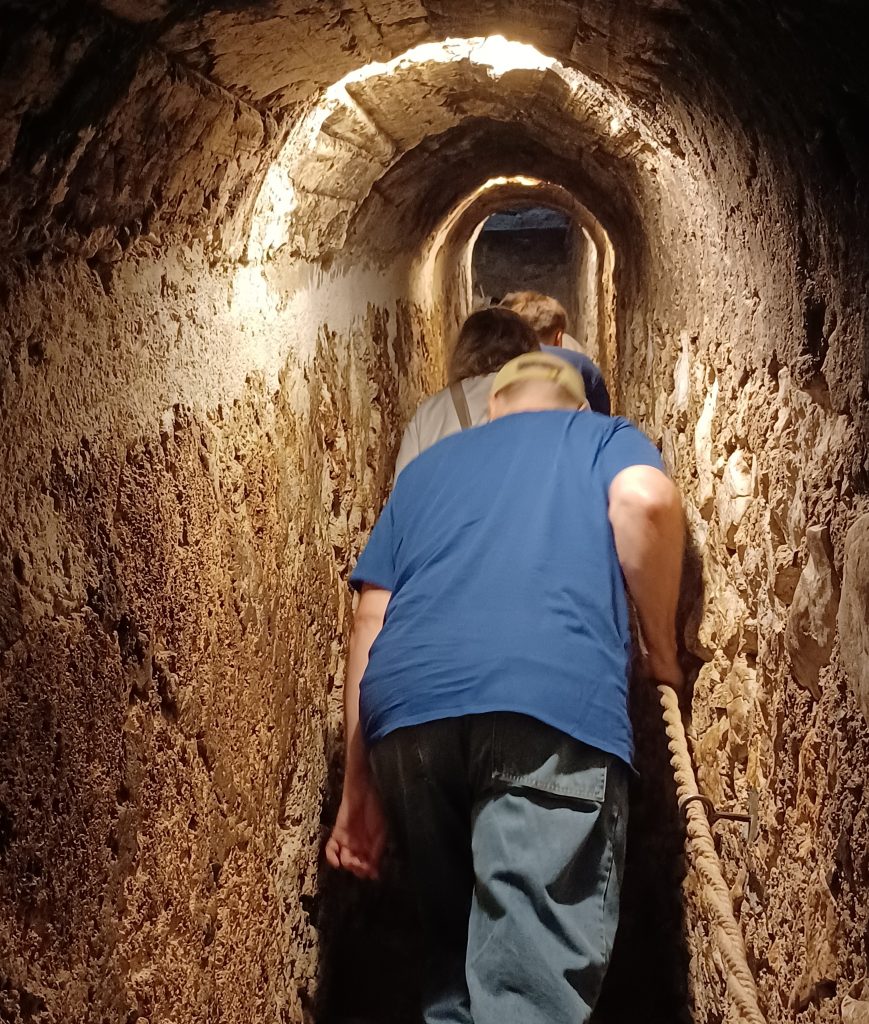
Lots of tourists are bearing flashing phones as we are herded around the castle in one direction, following the arrows and shuffling through narrow stone corridors, up and down winding staircases from one small space to the next. Not conducive to those suffering in the mildest degree from claustrophobia. Some ghostly light flickers on a wall with shadowy figures. Spooky. Every now and then we have seconds in the fresh air to pause on balconies and peer down into the central courtyard of the castle, which is encircled by tiled turrets and pitched rooves. Oozes character.
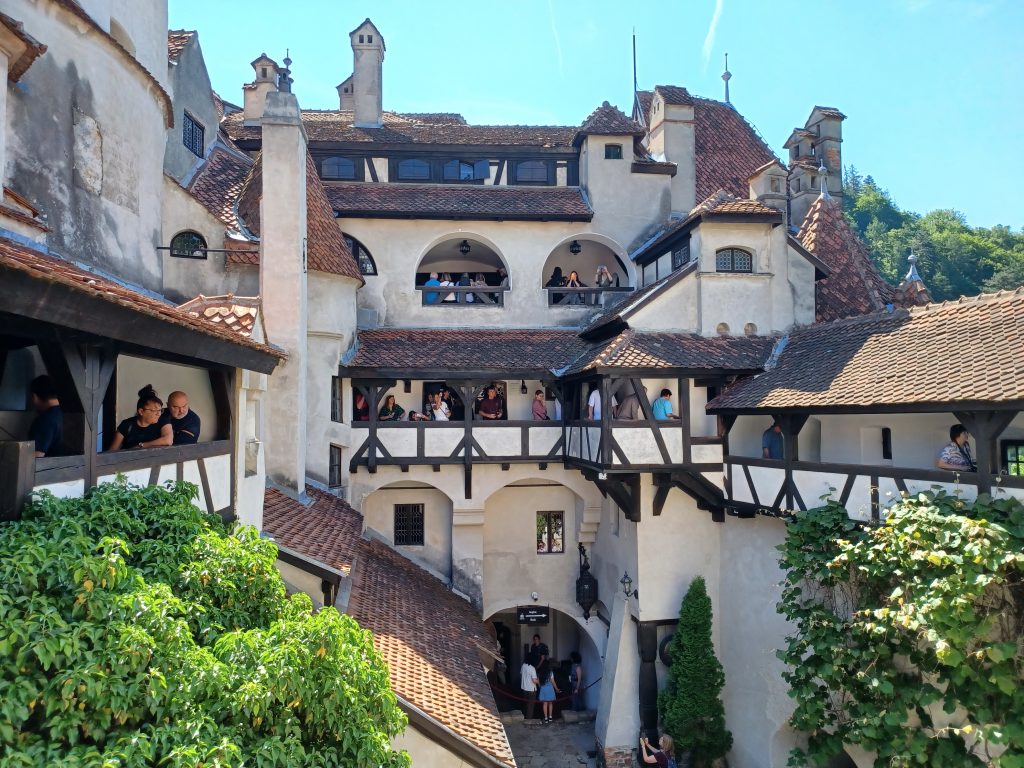
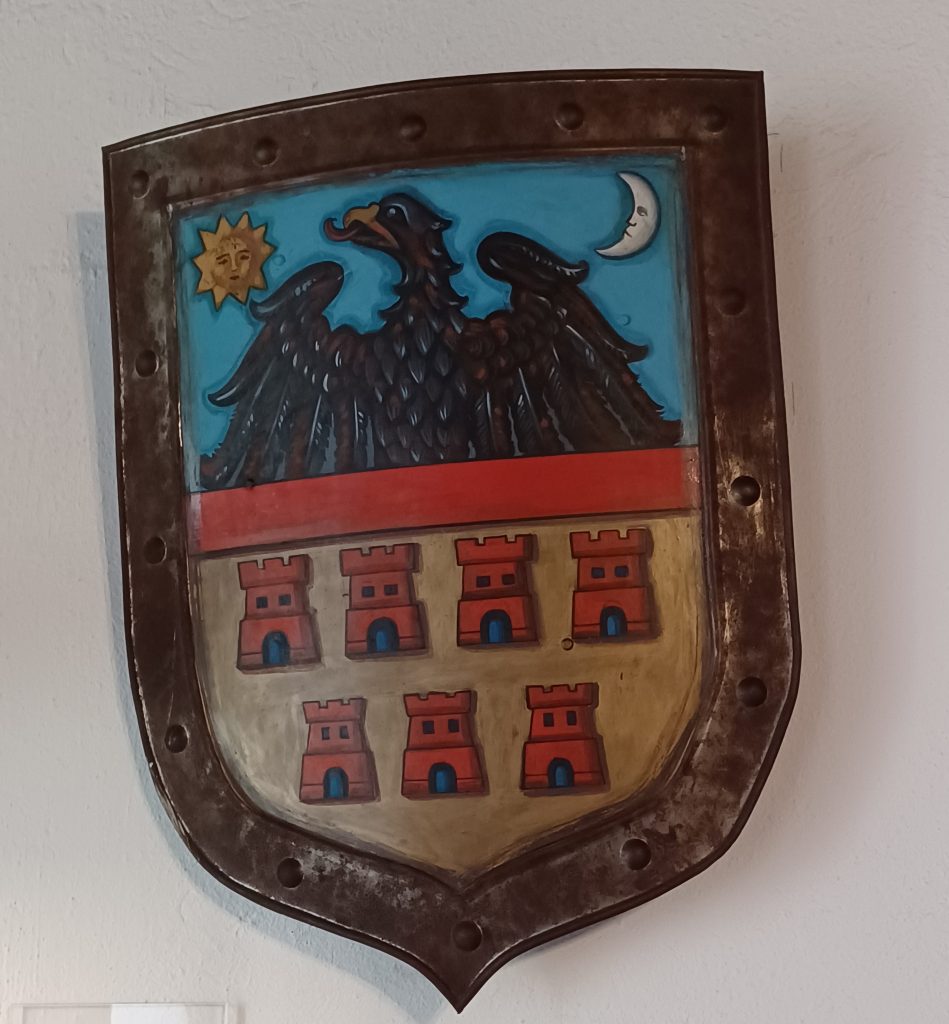
Notice Transylvania’s coat of arms on the wall of one room. Known as ‘Siebenbürgen‘, or seven castles, in German as the Transylvanian Saxons built seven fortresses in the area in Saxon times. And, as we shuffle along, we get a momentary glance into the small museum. Here, some info is displayed about some of the Romanian royal family who sojourned here, particularly Queen Marie, who furnished the castle in the 1920s and assembled a collection of artworks. This was her favourite home, I gather, and was her summer residence. Very nice too. Her youngest daughter, Ileana, used the castle as a hospital in WWII. After the communists seized the castle in 1947, the Royal Family of Romania went into exile. The last king was Michael I, who was forced to abdicate, and Romania became a socialist republic, the RSR, and a member of the Warsaw Pact. The castle has since been restored to its rightful owners, Ileana’s heirs, though they are no longer ruling royals.
Interesting stuff but the main attractions are the torture chambers and an upper turret containing grisly reminders of Vlad the Impaler’s cruel practices. Vlad III or Vlad Tepes, c1428 – 1476, Prince of Wallachia, was somewhat brutal but then, so were others in his lifetime, we are informed. No more nor less bloodthirsty than the Romans under Trajan (see Romania, Part 1: Bucharest). Anyway, as did Trajan to his victims, the Dacians, so did Vlad to his stricken foes and impaled their heads on large spikes. There are some models of these spiked heads and an effigy of Vlad himself, along with his family tree here. Vlad III’s father, I read, was Vlad II Dracul.
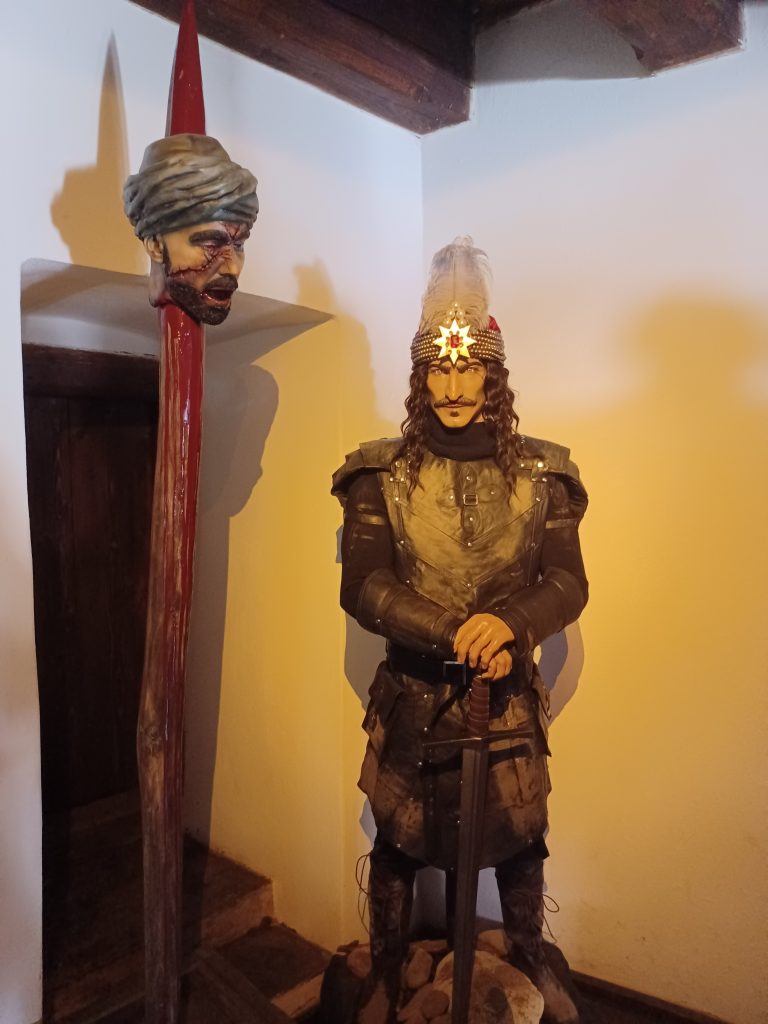
‘Dracul’ means dragon, and Vlad II had earned the prestigious award of the dragon in 1431, becoming a member of the chivalric Order of the Dragon. Dracul also means devil. Perhaps this is why Bram Stoker took the name ‘Dracul’ for his lead character. And poor Vlad has been forever immortalised as ‘Dracula’. As for Bran Castle, it is probable that neither Bram nor Vlad himself ever even saw it. Evidence is lacking.
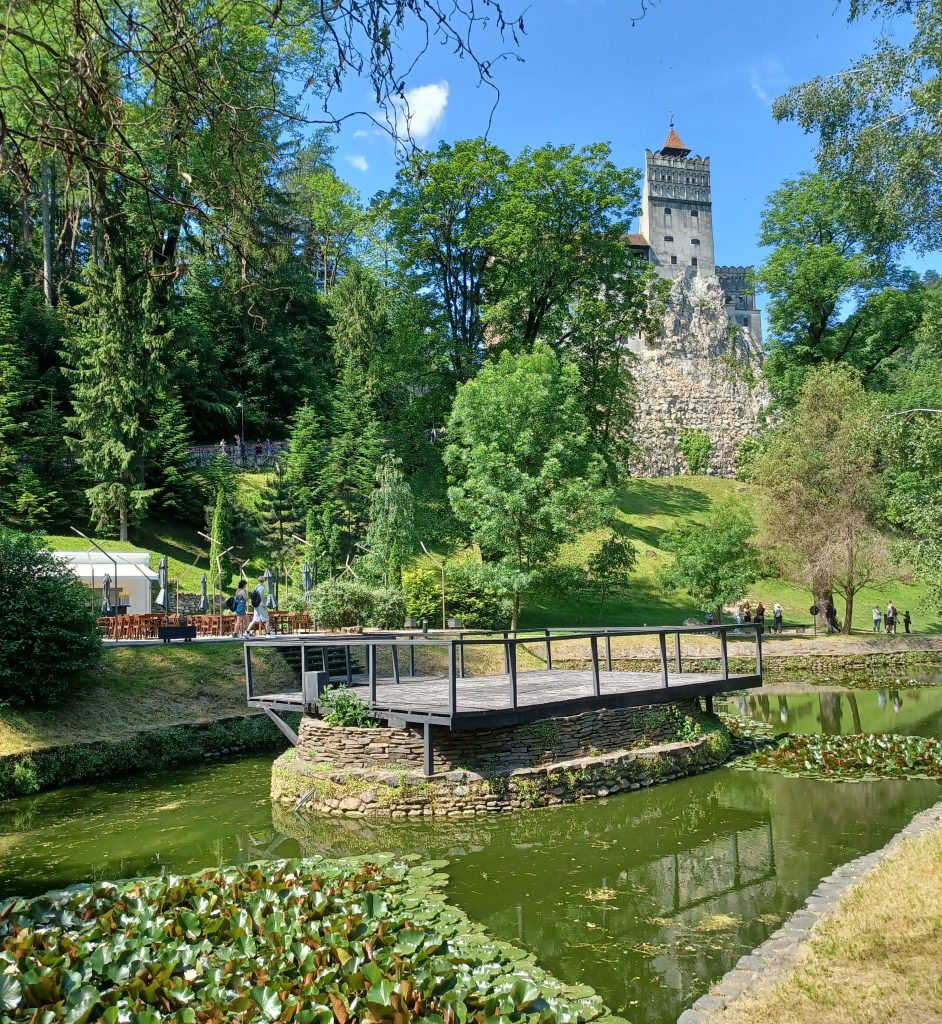
Glad to get out of this darkened room with Vlad’s victims’ heads displayed. Exit the castle and saunter downhill into a glorious garden with lily ponds whence the view of the castle is best.
Head coach-wards now, bearing in mind Emmanuel’s strict instructions about timings. I pass hurriedly back through the gauntlet of Dracula themed stalls in search of coffee. Find a take-away. Just time to gulp it down. All aboard for the short trip to Braşov for lunch.
Braşov
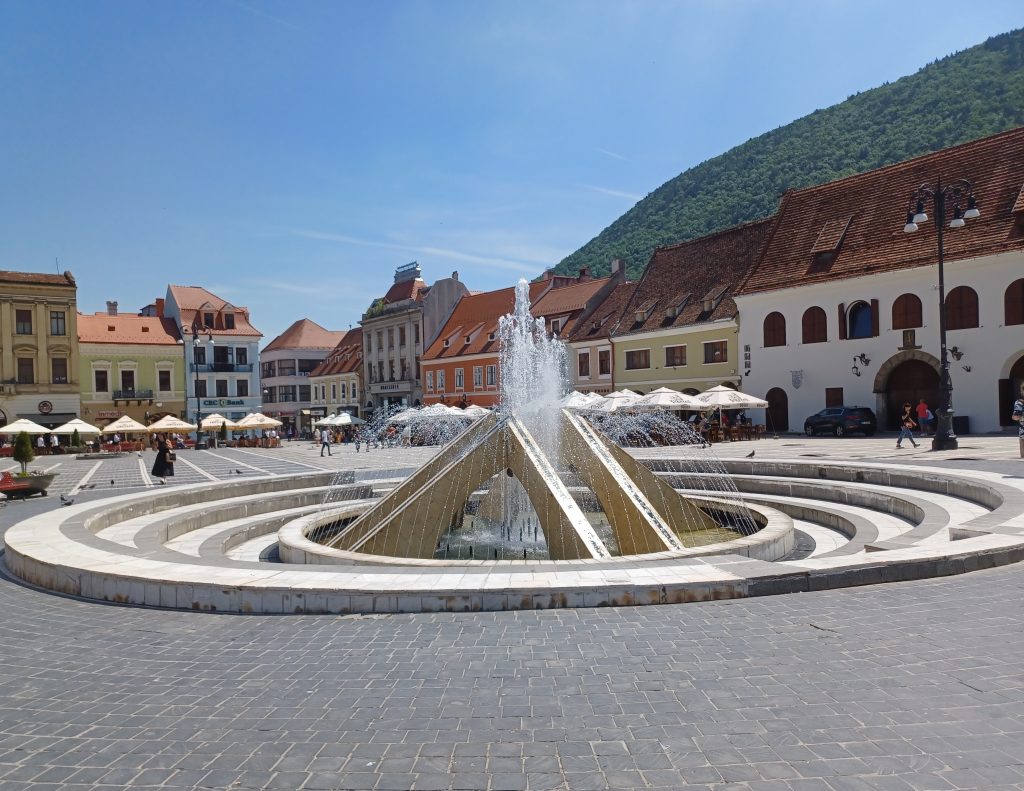
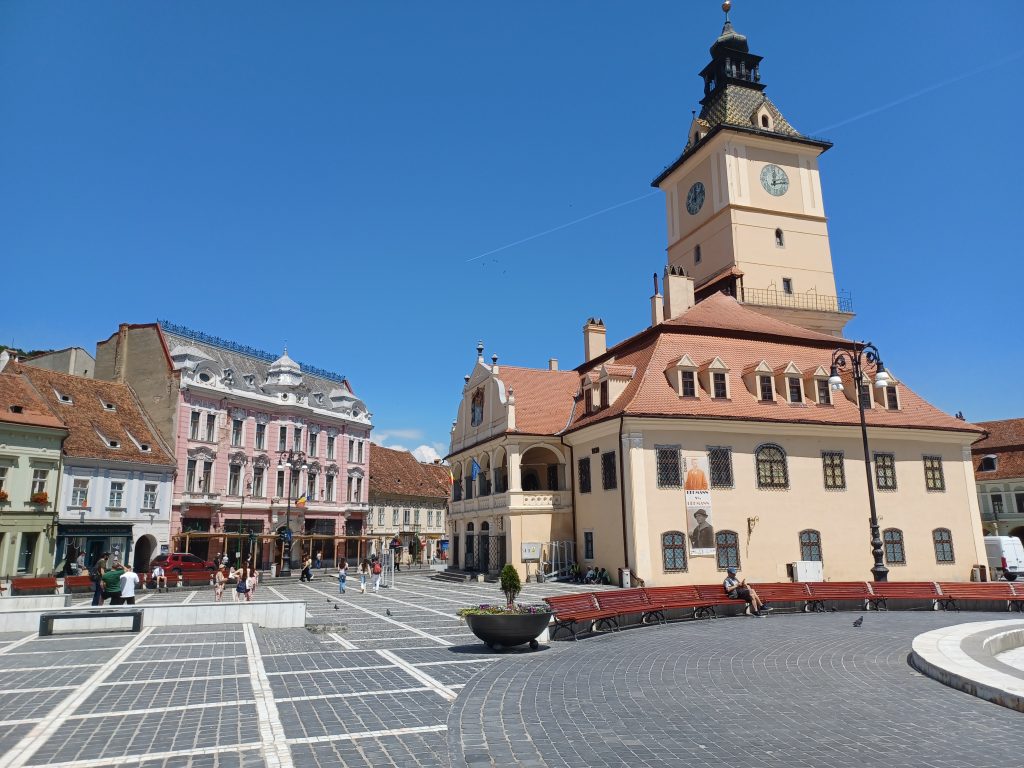
Braşov was founded in 1211 by the Teutonic knights, and is one of the seven castles/fortified towns depicted on Transylvania’s coat of arms. Its huge stone walls can still be seen. A medieval town, and once an important hub for trade between the various empires, its cobbled central square, the Piata Sfatalui, is at its heart. Full of pastel coloured character buildings, with a large fountain in the middle, and surrounded on three sides by the southern Carpathian mountains, the word gorgeous springs to mind. A huge white painted sign, in the midst of forests, stands high on Tampa Hill, overlooking the town and announcing its name to the multitudes: ‘BRASOV’.
By the fountain, Emmanuel delivers a short spiel, pointing out the red roofed merchants’ houses and the old town hall with its clock tower. “It was also known as Trumpeter’s Tower”, says he, because a trumpeter sounded the hour from the top of it. Braşov also, he declares, was the place to which the Pied Piper, in Grimms’ fairy tales, led the 130 children of Hamelin with his magic pipe. Who knew? For readers unfamiliar with the legend, the Pied Piper, having rid Hamelin (Hameln in north Germany) of its rats by means of piping a tune and leading them to the river Weser, in which they drowned, did not receive the agreed payment for his services. He thus returned to Hamelin to wreak his revenge and piped a different tune to lure the children away. And they ended up in Braşov.
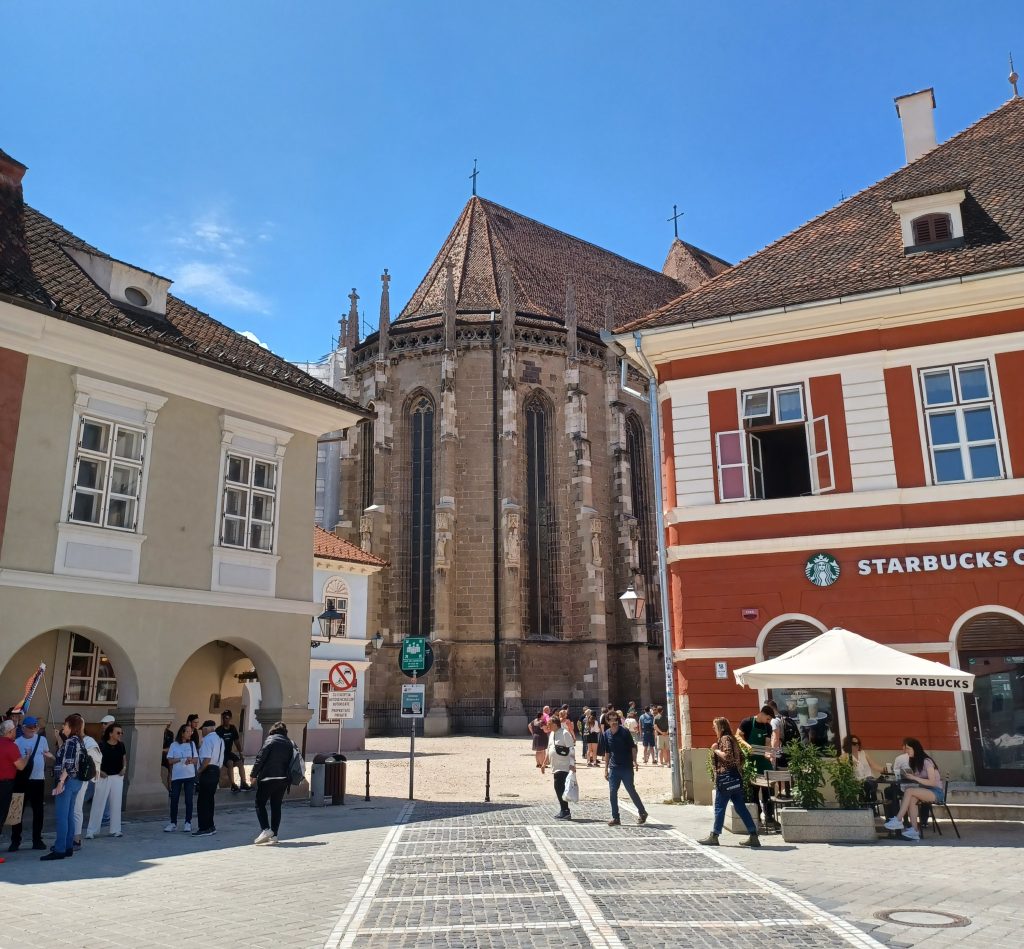
One of the main tourist attractions here is the Black Church, the east end of which is visible at one corner of the square in between the orange painted Starbucks and another handsome building. Shame about the Starbucks, reminding us that they get everywhere. But there are plenty of enticing outdoor restaurants from which to choose. And, having set the deadline for returning to the coach, Emmanuel takes his leave and off we go to explore.
Black Church
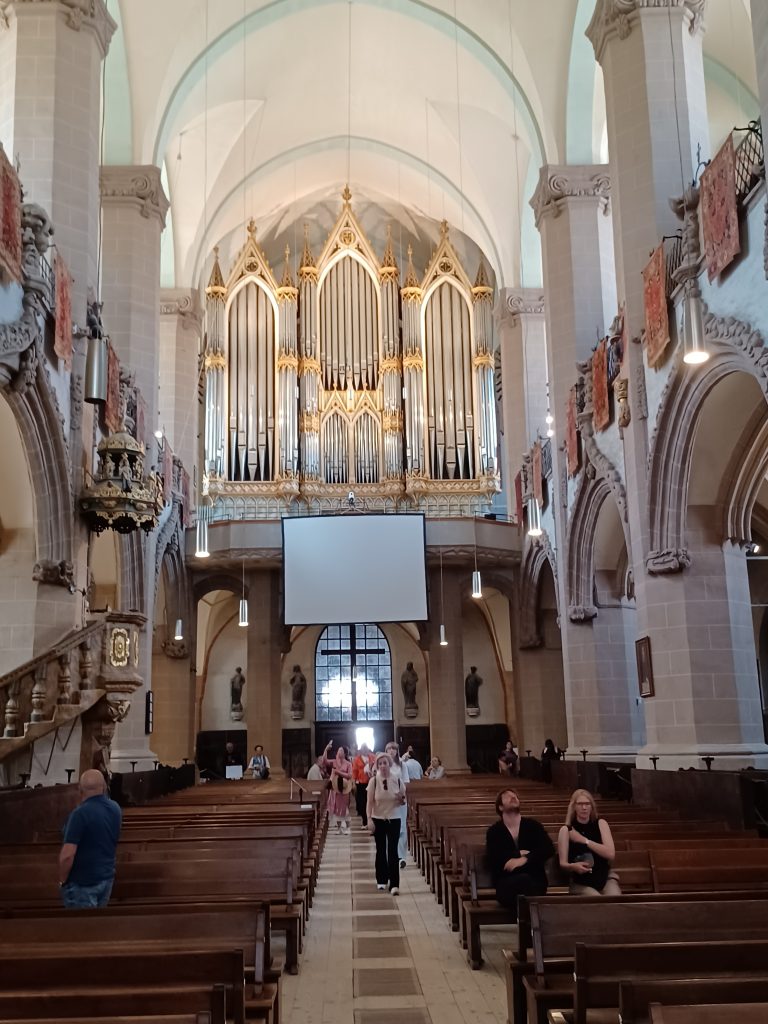
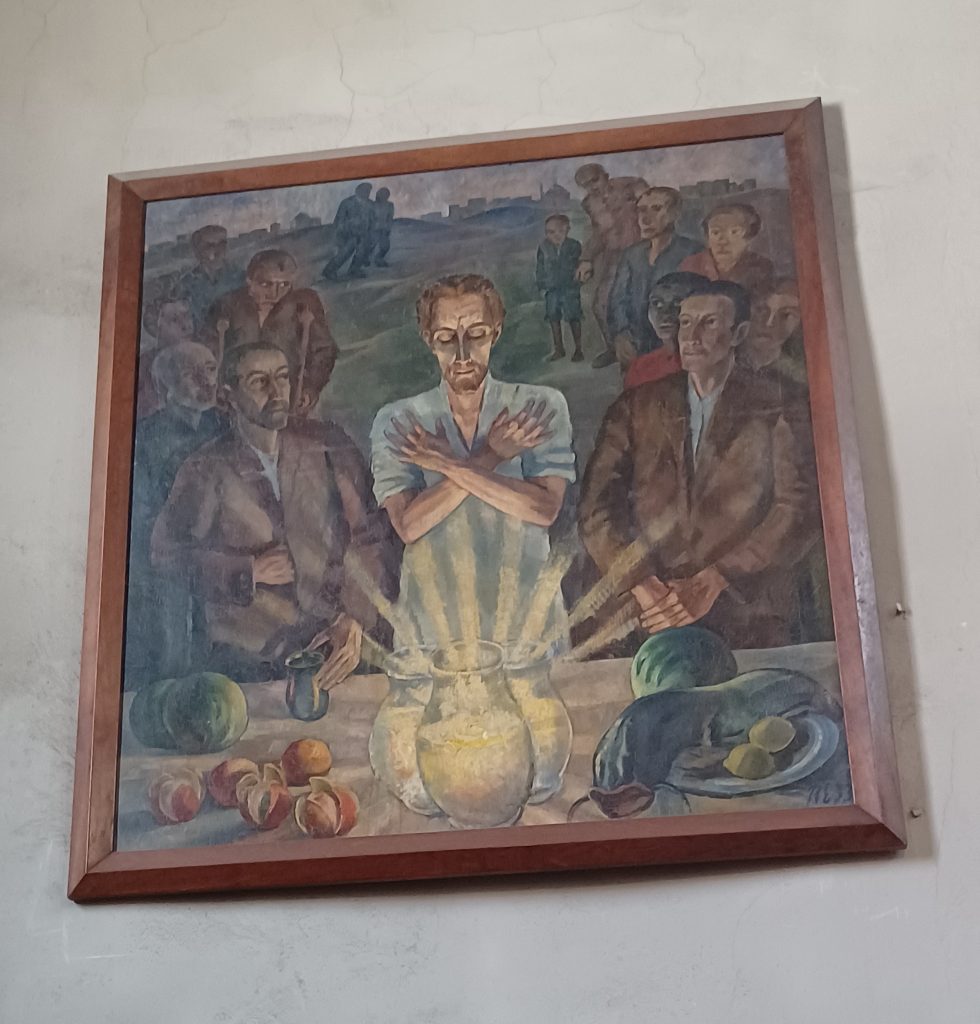
I head to the Black Church. Enormous Gothic structure. Famous church, so -called, Emmanuel had told us, “because it caught fire three times and was charred black”. Today it has been cleaned up so it no longer black coloured but it is still known as the Black Church. Purchase a ticket and enter. Bright within, with carved wooden pews, elaborate stone arches, and an organ with four thousand pipes. A painting, by Braşov-born Hans Eder, of the wedding at Cana, where Jesus turns water into wine when the hosts ran out of the necessary, hangs on a wall.
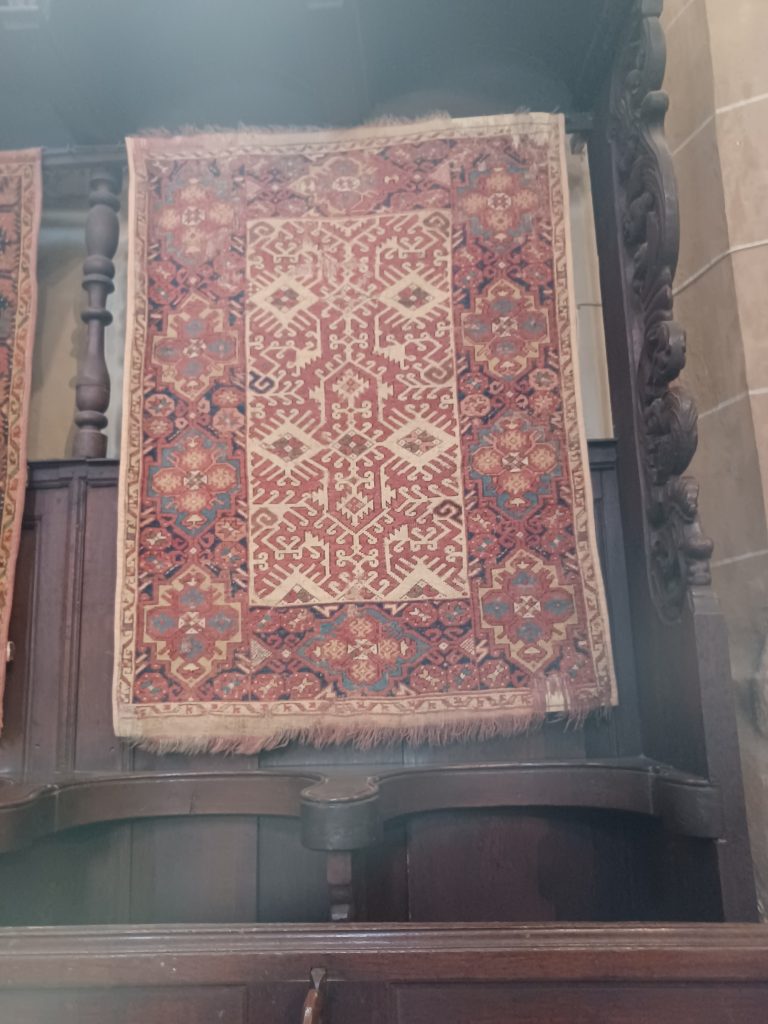
Ottoman rugs are placed in the spandrels. According to the accompanying info, these rugs were brought to Braşov through trade between Transylvanian towns and the Ottoman empire in the 17th and 18th centuries. Mostly donated to the Black Church by patricians or guilds of the town and used to adorn their personal pews. One of the largest collection of its kind in the world apparently. Someone is playing a violin. Atmospheric. Near the entrance, I admire some whitish tombstones carved with the names of the great and the good.
Drift back into the buzzing square. Folk are relaxing in the bars and restaurants. Head off to one of the restaurants with an Englishman on the tour and there we join an Australian participant, already quaffing a beer. Order some drinks and sustenance. And converse with my fellow travellers about past travels, whilst savouring the surroundings. No more time to explore the town though. This is regrettable. There is much to see. Instead, we head back past the fountain, the old town hall and a handsome pink building, to the bus stop at the specified hour.
Peleş Castle
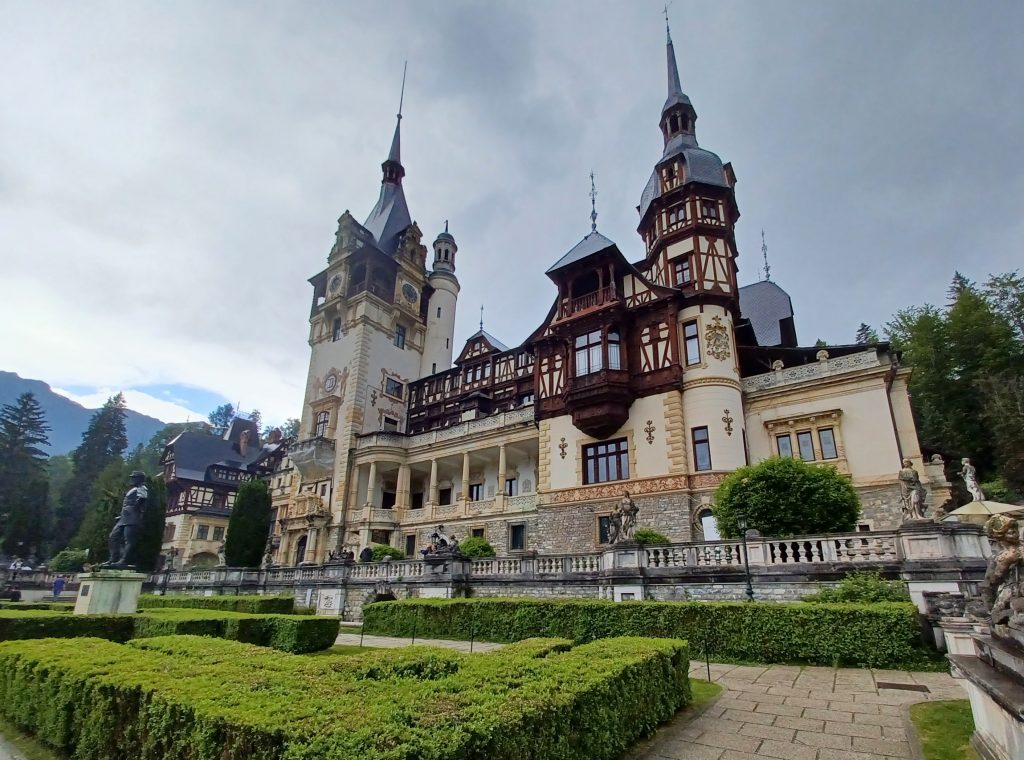
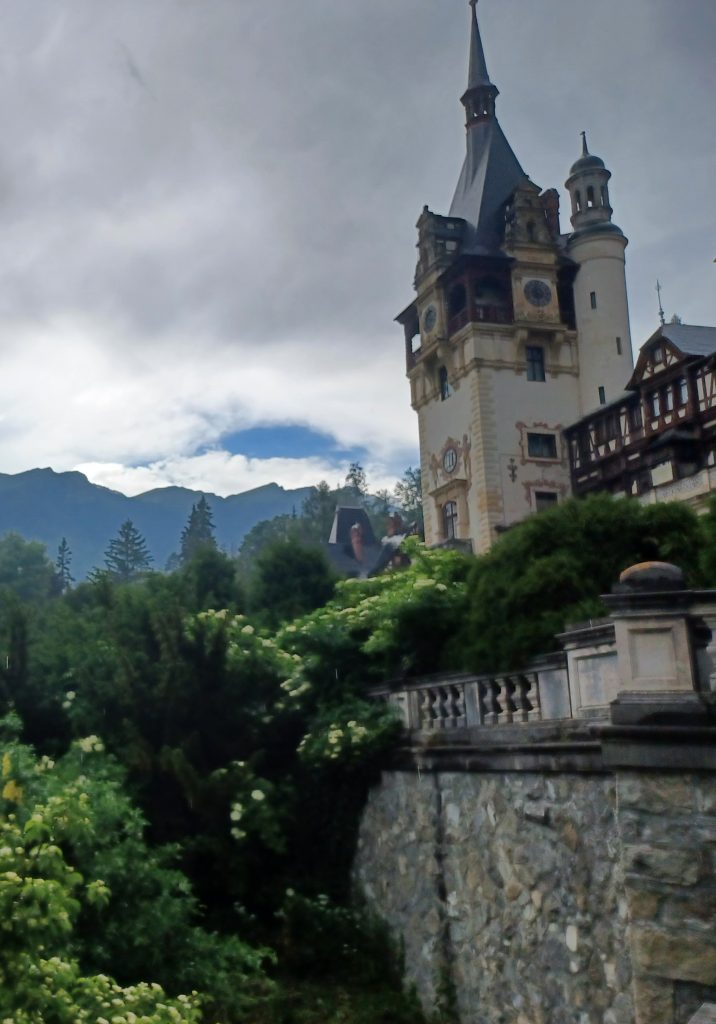
It takes twenty minutes driving south from Braşov to reach Peleş Castle in Sinaia, the site having been chosen by King Carol I for his summer residence. It is mid-afternoon and many of the crowds have buzzed off elsewhere. Rain threatens and brooding black clouds hover over the hills of the Carpathian mountain range. This seems more like a Dracula setting. Sheer sided forested mountains harbouring bears and werewolves. Fantastic castle, more interesting than Bran castle with its giddy mix of architectural styles. Built between 1873 and 1883.
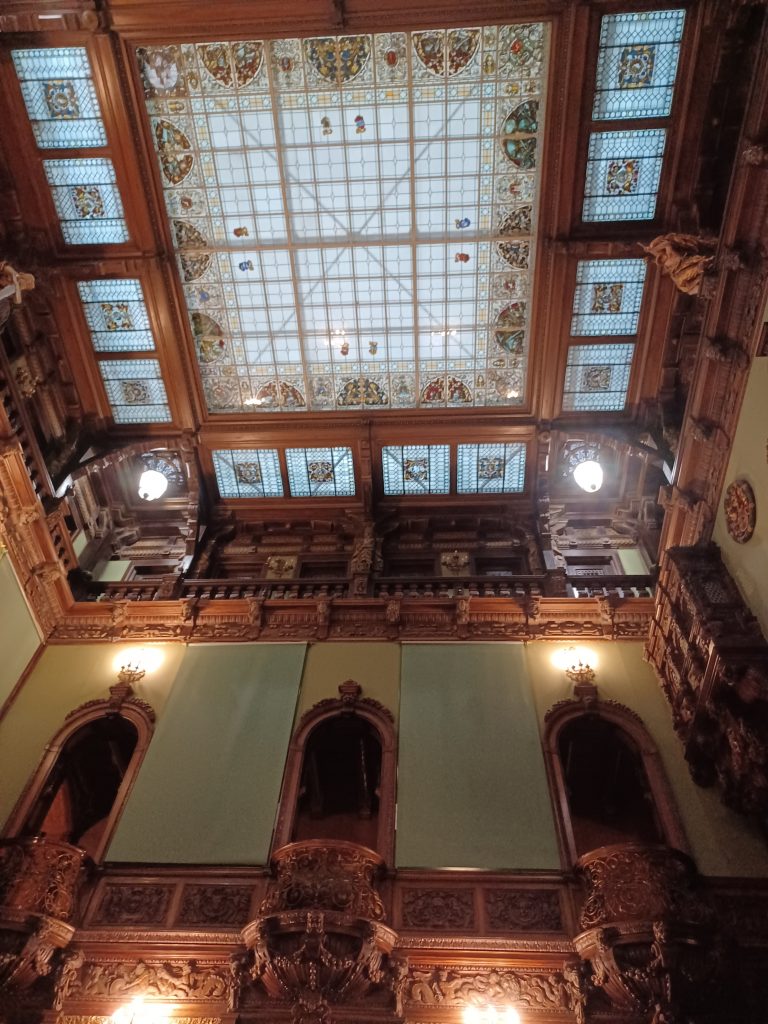
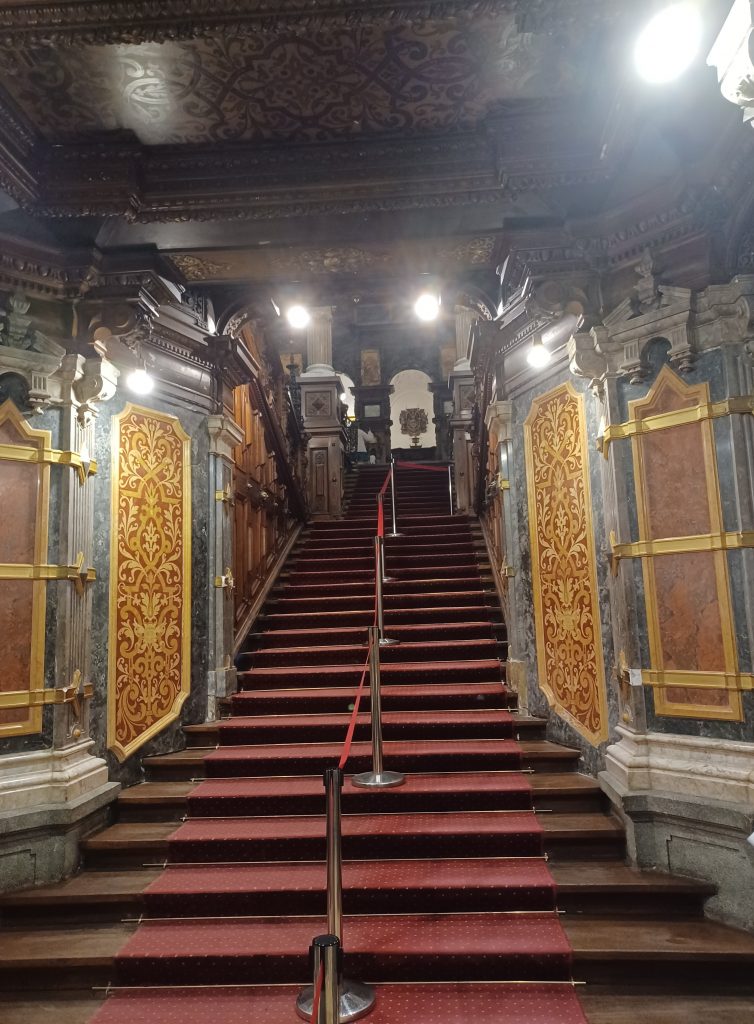
And the interior of Peleş Castle is sumptuous. Woodwork everywhere, commissioned from German and Austrian workshops, dripping carved wooden ceilings, carpets and cherubs. We venture up the wooden, red carpeted staircase into a magnificent space, the Hall of Honour, with stained glass skylight. No doubt this is where Ceauşescu got his idea for the glass skylight in his Palace of the Parliament. Intricate woodwork, paintings in panels, arches, columns and capitals. Talk about lavish. But the interior décor is rather more intimate than Ceauşescu’s vast Palace, and more tasteful. The castle also had the more modern accoutrements of central heating installed, electricity, running water, and telephone. That was all before 1900. Not long after, two electric elevators were put in. No expense spared.
King Carol had a splendid weapons collection and we enter the armoury halls to view. Emmanuel points out a Turkish sword, worth plenty, and there are 4000 examples of European and oriental weapons from the 15th -19th centuries according to an info board. And a complete set of armour for a horse and horseman, called ‘Maximillian Armour,’ from the 16th century.
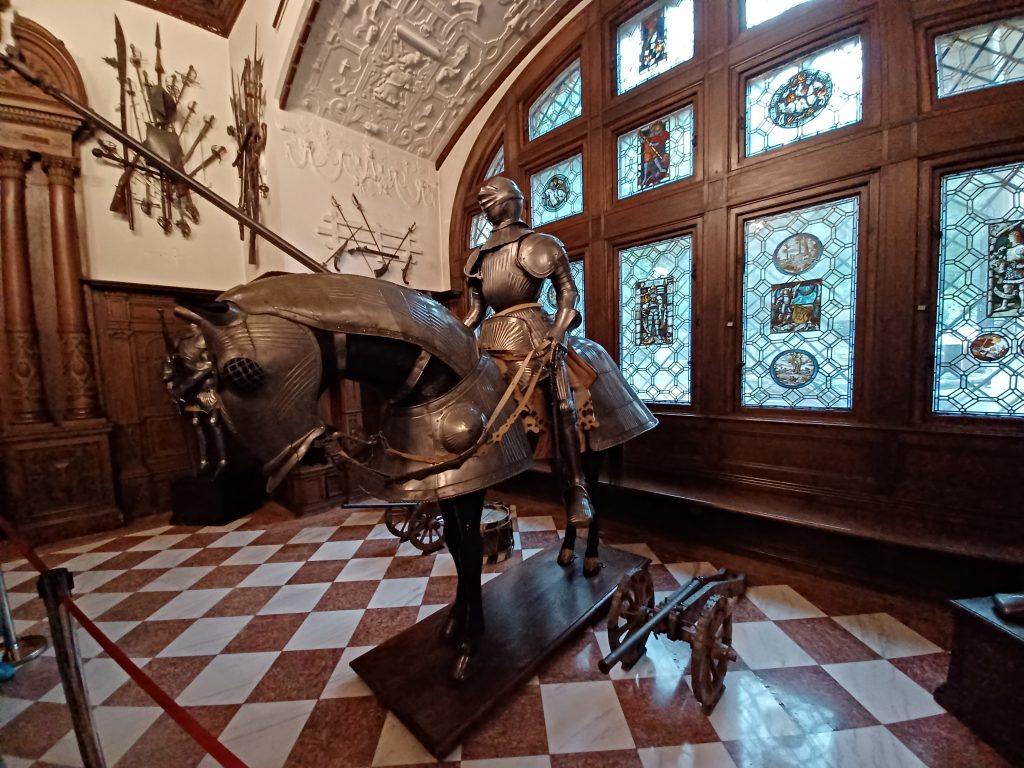
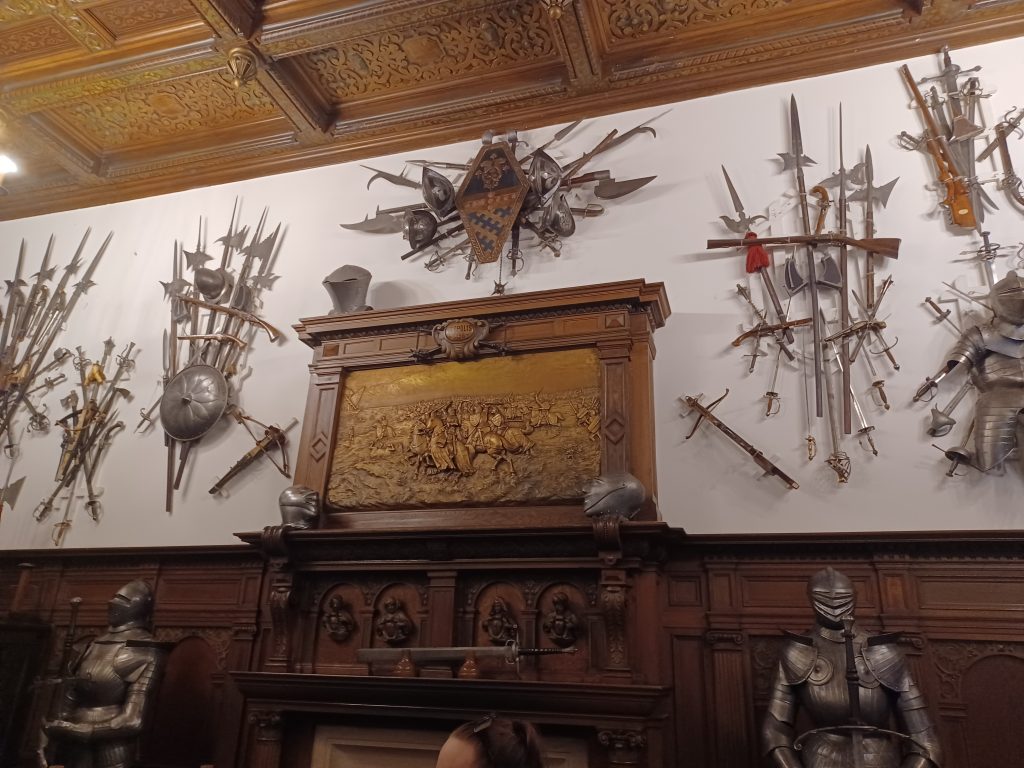
Pass by King Carol’s study with its warm walnut and oak décor with a writing desk. Then the music room.
Exsquisite with a Beckstein piano and a golden harp; paintings, chandeliers, stained glass windows… Used by Queen Elisabeth for her salons. This castle has it all. “The music room is an important room,” Emmanuel tells us, as “it was here on 3rd August 1914 that it was decided that Romania would remain neutral in WWI”.
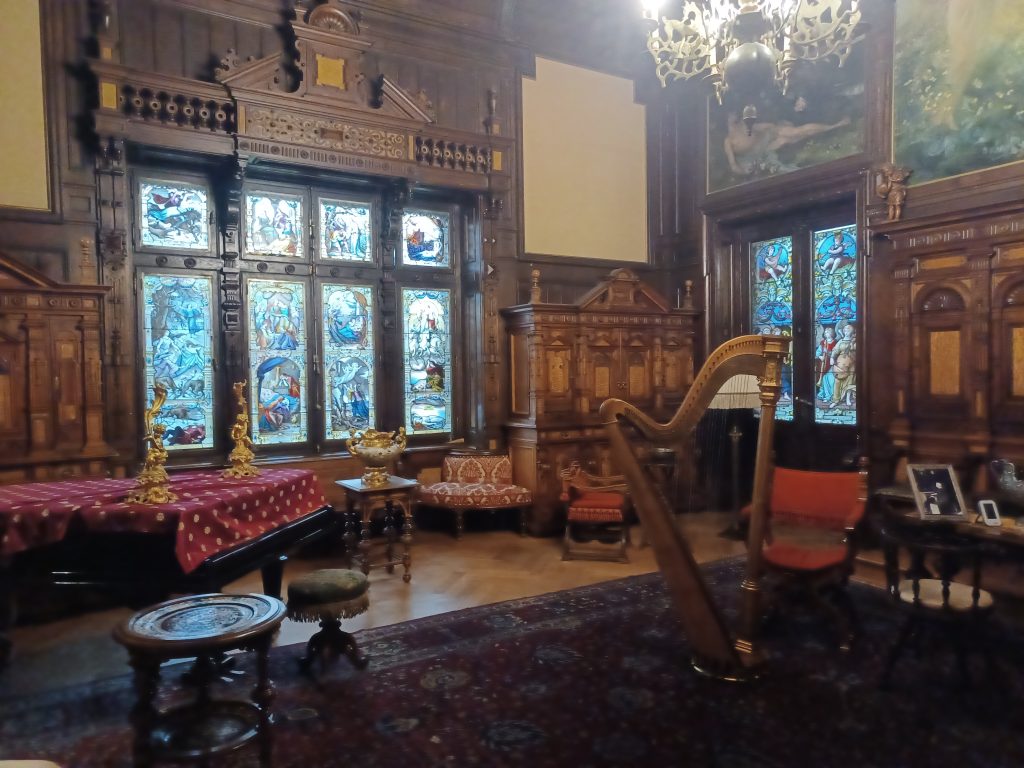
As previously mentioned, though, the country eventually joined the war in 1916 with the ‘Triple Entente’ of Russia, Great Britain and France. In WWII they were on the wrong side, fighting alongside the Axis powers, and the Romanian army suffered huge losses at Stalingrad. But I digress…
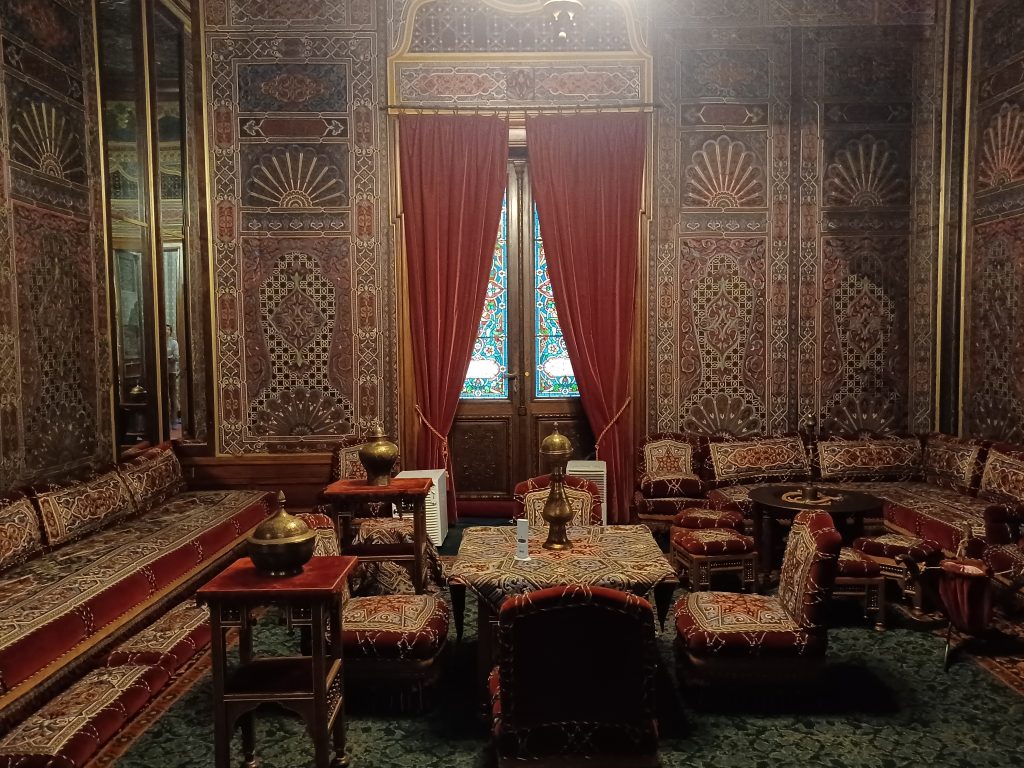
Many and various rooms in different styles include a Florentine room with gold painted wood, Murano glass chandeliers, an Italian grand marble fireplace, and paintings; a glorious Turkish room with embroidered silk upholstery and tapestries. All splendiferous.
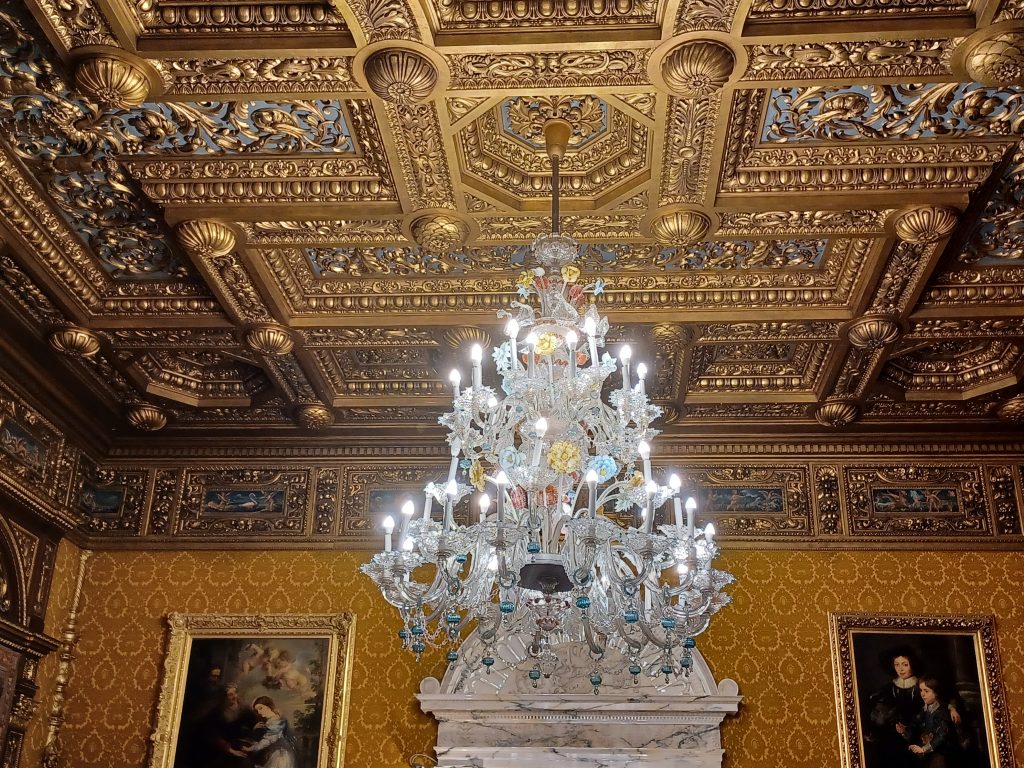
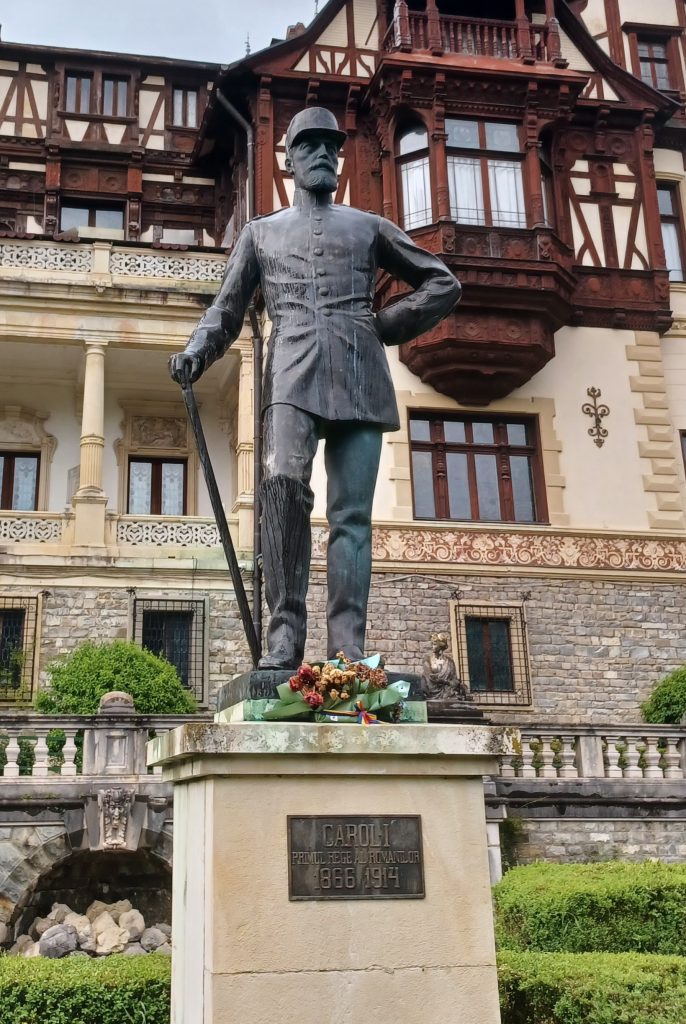
Having had my fill of superlatives, I head outside once more for a stroll around the gardens. The rain holds off. Lucky us, as the clouds still loom over the mountains. Fountains and sculptures, manicured hedges, terraces, stairways and King Carol’s statue in front. He looks distinguished. Lord of all he surveys.
As we head back to Bucharest, everyone’s phones start exploding with alarm signals. There be bears on the road south. Oh good. They are exiting from the steep dark forests to disrupt the tourist traffic. Rather glad I wasn’t walking about the trails. Adds a bit of excitement though. And that brings to a close my trip to Transylvania. Deserves more exploration. Would come here again.
Leave a Reply