

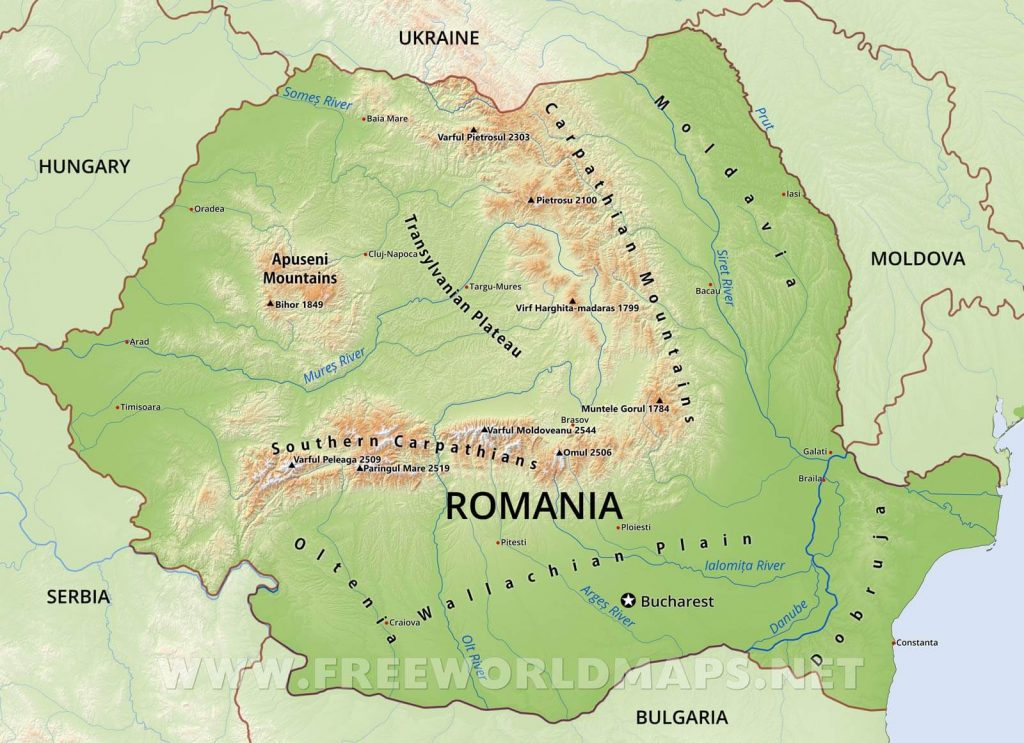
Spring just never seemed to arrive in England this year. Day after day of dreary drizzle. Activities, which might normally rouse the passions, palled. Time for a trip to an undiscovered country, undiscovered by me anyhow, to rekindle the spirit. Things natural: mountains, water, forests. How about Romania. That should do the trick. It has its fair share of forested hills inhabited by bears, wolves and lynxes; once home also to Vlad the Impaler, otherwise known as Dracula, in that mysterious region of Transylvania. The country is bordered on the southeast by the Black Sea into which empties the river Danube. Here lies the Danube delta, with its massive expanse of waterways and reeds and marshes, a paradise for birdwatchers and fish enthusiasts. What’s not to like!
Bucharest
I confess to not having planned this trip awfully well. To start with, I had booked a short tour of the country including visits to Transylvania and the Danube delta, but arranged the flights before the tour had been confirmed. But it wasn’t! The tour I mean. It wasn’t running that week or something. Jolly inconvenient. Thus I had to resort to planning my own thing between the dates of my flights or change the flights. I did a bit of both with all the associated aggravation. All part of life’s rich pageant. Anyway, off first to Bucharest, Romania’s capital.
NF Palace Hotel
I take a taxi from the airport. Massively overcharged. The redeeming feature, however, is that the driver gives me a bit of a guided tour en route. My hotel is in the centre of Bucharest’s old town on the second floor of a splendid building. An old palace with columns and arches and sculptures and all that sort of thing. At various times the Palace of the Stock Exchange and the National Library, it houses the Chamber of Commerce on the third floor above the Hotel. Built in the early 1900s and listed as one of Romania’s historic monuments. The cobbled pedestrian precinct is just across the road from where my yellow taxi draws up. Head upstairs to the reception area.
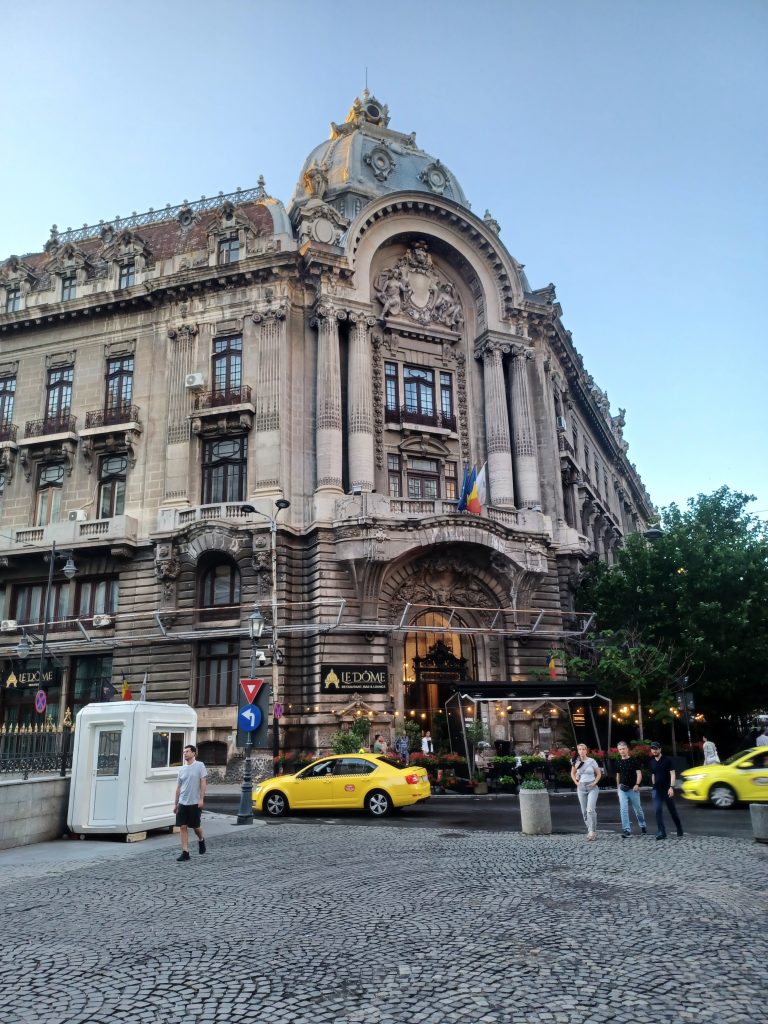
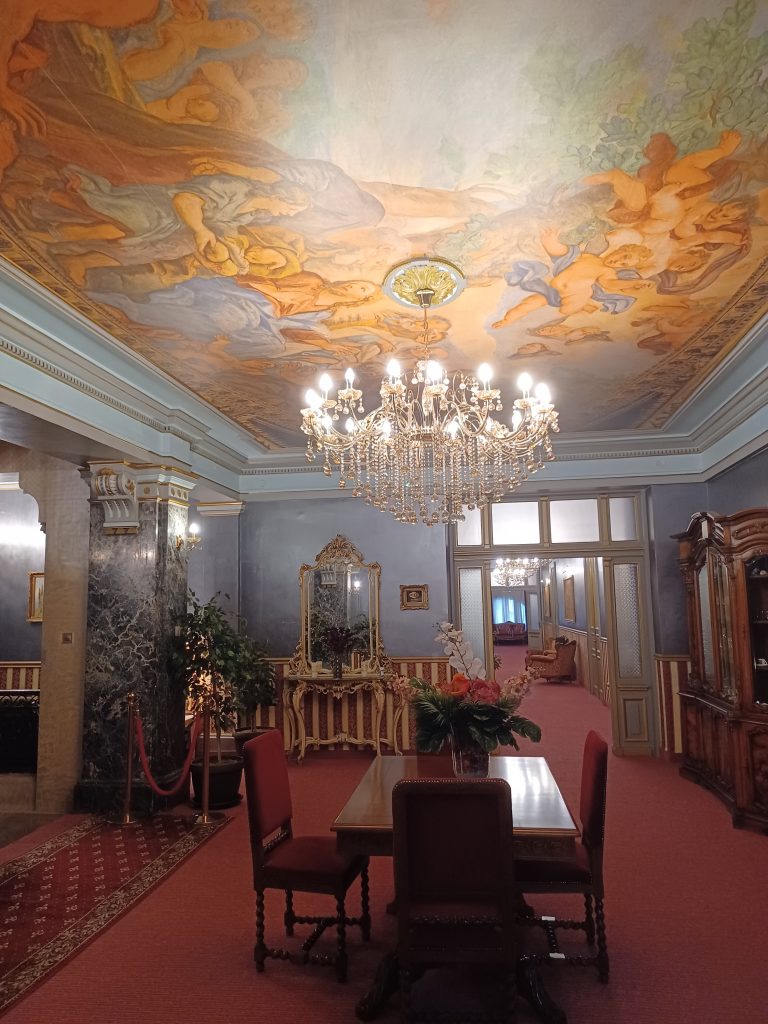
The ceiling is decorated with a fresco of cherubs fooling about in foliage, among other things. Framed paintings line red carpeted corridors. I have a huge bedroom with high ceilings. Brass taps in the bathroom. Bits of them are falling off. My windows overlook the National Bank of Romania with its gleaming white columns and Corinthian capitals. Said windows don’t shut properly and it is extremely noisy in the street below when the capital’s movers and shakers fill the streets, cafés and restaurants in festive mood. In fact, the hotel is situated above one of said restaurants, called Le Dome, which occupies another magnificent space in this onetime palace.
Kettle in room, but no cups. Obliging receptionist finds a white teapot, which lodges within a large white cup, and conveys it to my room. “Multsu mesc” “Thank you.” Excellent. I am armed with my usual supply of teabags from home. That I should shake off the habit of drinking tea for my morning beverage ‒ and afternoon beverage if I can ‒ in countries where coffee is the norm, I freely admit. Anyhow, all I need now is milk. After a swift recce of the old town, I come upon a small shop, the shopkeeper of which once lived in Walton-on-Trent ‒ not far from where I currently reside. “It is better here”, says she. I nod in agreement. “Absolutely”. And purchase milk. Exit the shop and get caught in a torrential rain storm, which delays my return somewhat. The brew is postponed.
Stavropoleos Church
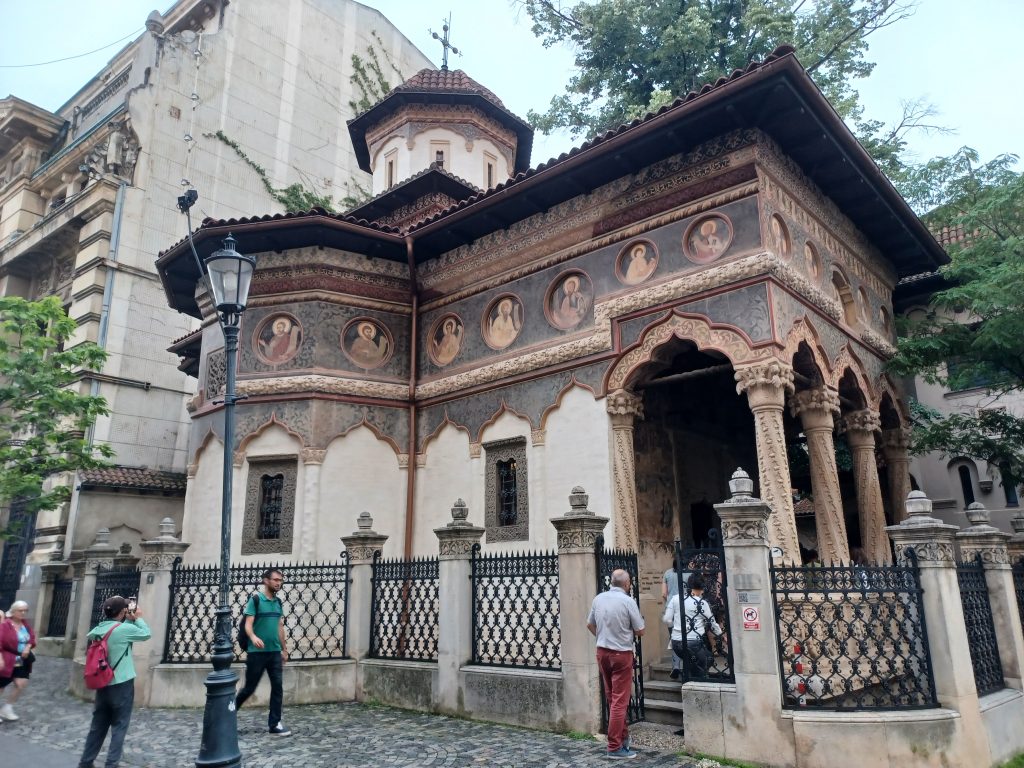
Soon emerge from my hotel to explore the delightful old town. There is a small Eastern Orthodox church on a cobbled street nearby, the 18th century Stavropoleos church. This is pretty much the only building left of the original Stavropoleos monastery, I gather. Frescos adorn the walls and ceilings within. It is rather lovely. I linger a while breathing in the incense. Tourists stream in and out.
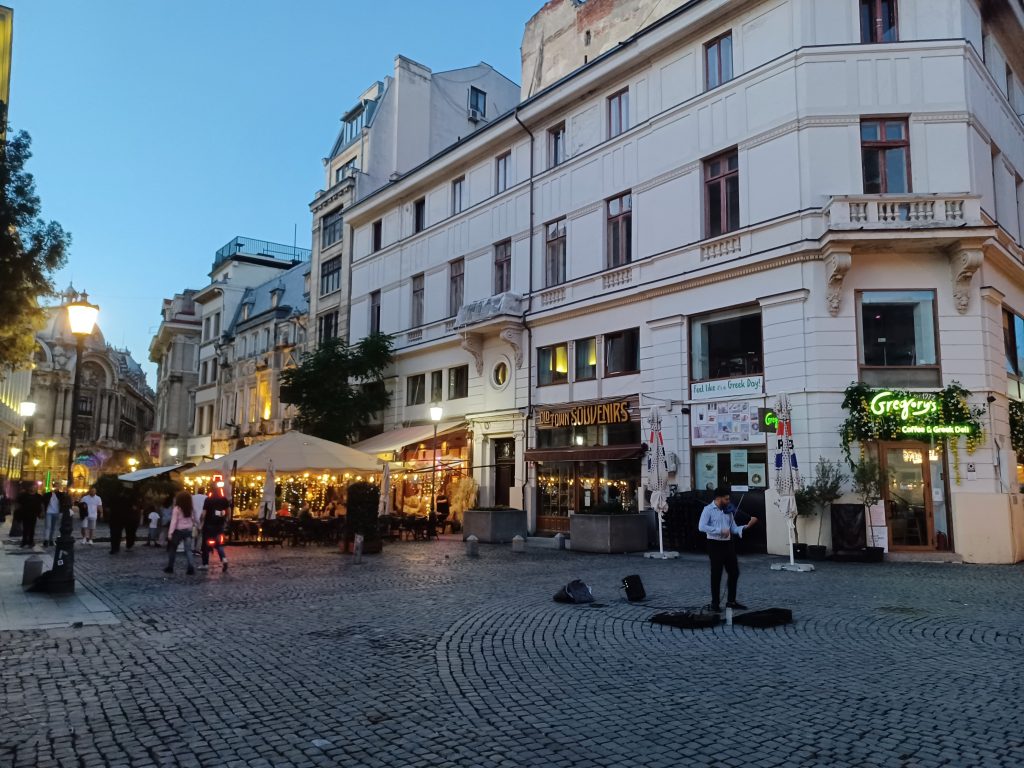
The streets of the old town are becoming lively now, folks filling up the eateries and delving into souvenir shops. As I sit outside on a comfy chair in my chosen restaurant in a small square, a violinist sets up his pitch and entertains the passersby. Pretty good accompaniment to supper, which, if readers are interested, consists of duck and mash with truffle sauce drizzled on top, along with a glass of commendable Romanian wine.
Shame about the smokers in the vicinity. No laws here banning the puffing of cigarettes and vapes in restaurants and cafés. Thus endeth the first day.
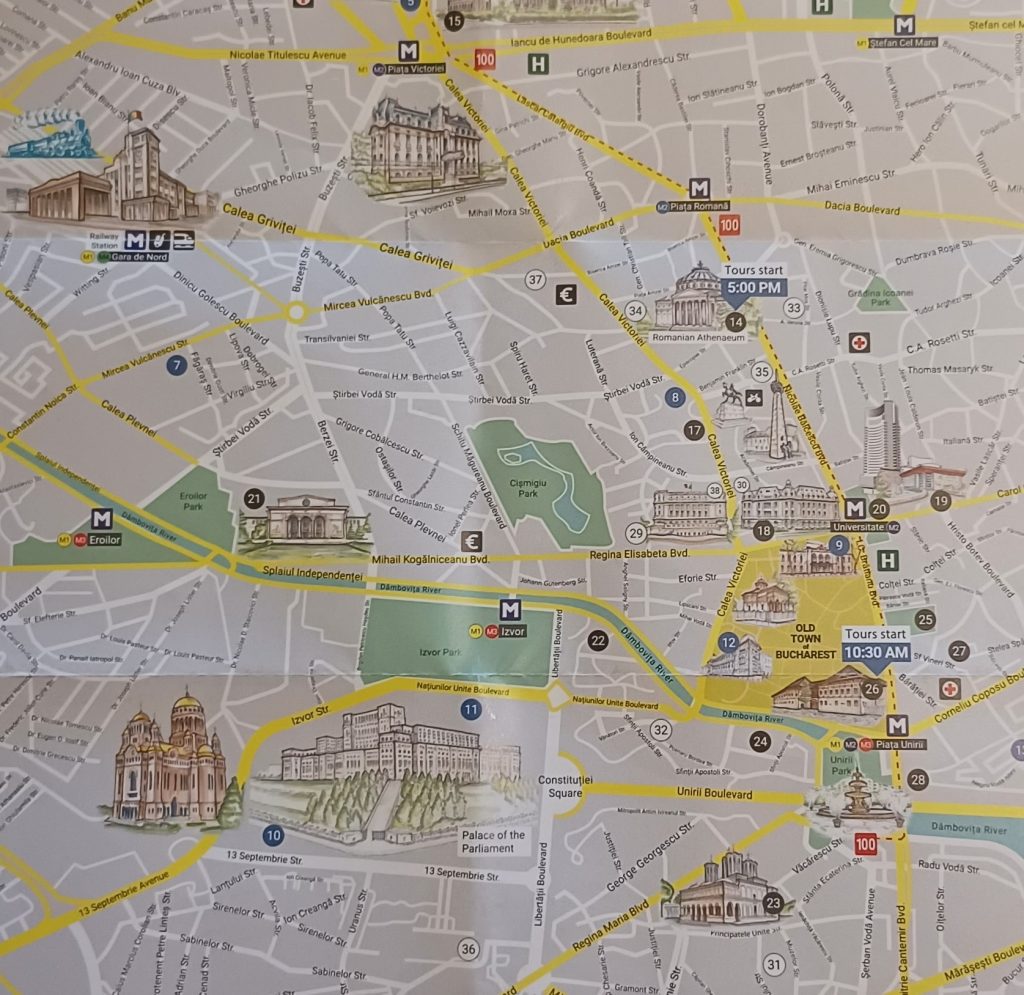
Earlyish tea. Breakfast is served in Le Dome restaurant below the hotel from 10:00, I am told. Seems a trifle late, even for me. Don’t bother with it. Today, I intend to do some exploration of the capital but my first job is to find the pick-up point for a day trip to Transylvania, which I have booked later on during my sojourn. I booked this tour with Viator. Use them a lot. Reliable. Easy to use website. Anyway, using the map supplied by the hotel, I head to the metro station close by, take an escalator down onto the largish concourse, which serves as an underpass, and cross it. There are three exit escalators to choose from. I pick the correct one last, of course, before emerging onto the road on which stands the Grand Hotel Bucharest (once the Intercontinental Hotel), where the pick-up point will be. OK. Got that sorted then.
Caragealiana sculpture
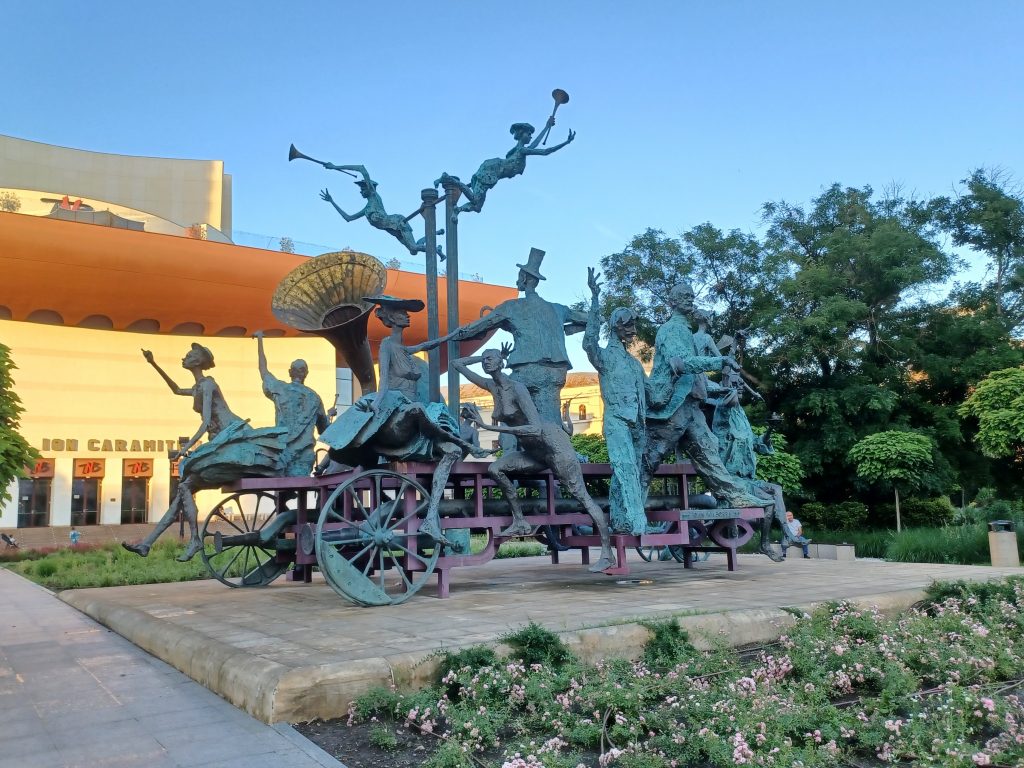
A quirky sculpture catches my eye. Next to the hotel in front of the modern National Theatre building (19 on map), it appears to consist of actors and musicians. Made of bronze. Called the Caragealiana sculpture, dedicated to the actor and playwright Ion Luca Caragiale, it depicts characters from his works: clowns and performers on a cart. Sculpted by Ioan Bolborea and placed here in 2009. I like it.
Romanian Athenaeum
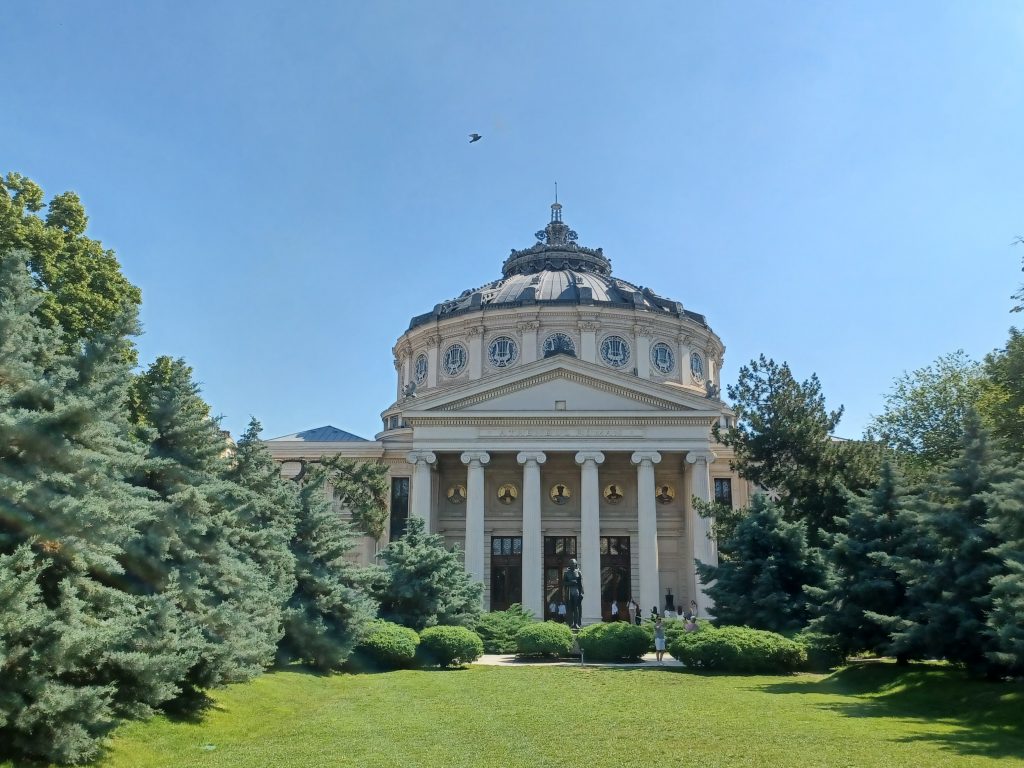
I wander further up this main road seeking out the Romanian Athenaeum, Bucharest’s concert hall, home to the Georg Enescu Philharmonic, Romania’s ‘oldest and most important symphony orchestra’, according to the website. Go too far. Ask for directions a few times. Obliging locals point the way. It is situated in an area behind the main road (14 on the map). The Athenaeum is a magnificent Neo-classical building, completed in 1897, sporting a copper dome and columns with Ionic capitals in front. Around the dome are sculpted the names of famous artists and writers, e.g. Michelangelo, Raphael, Virgilinus. And golden mosaic roundels on the façade depict rulers, such as King Carol I. In front is a manicured patch of shaven grass and leafy trees. Picturesque. Tours of the Athenaeum start at 5pm. It is morning. Pity. Mosey around for a bit, taking some photos of the building from the outside, and poodle off.
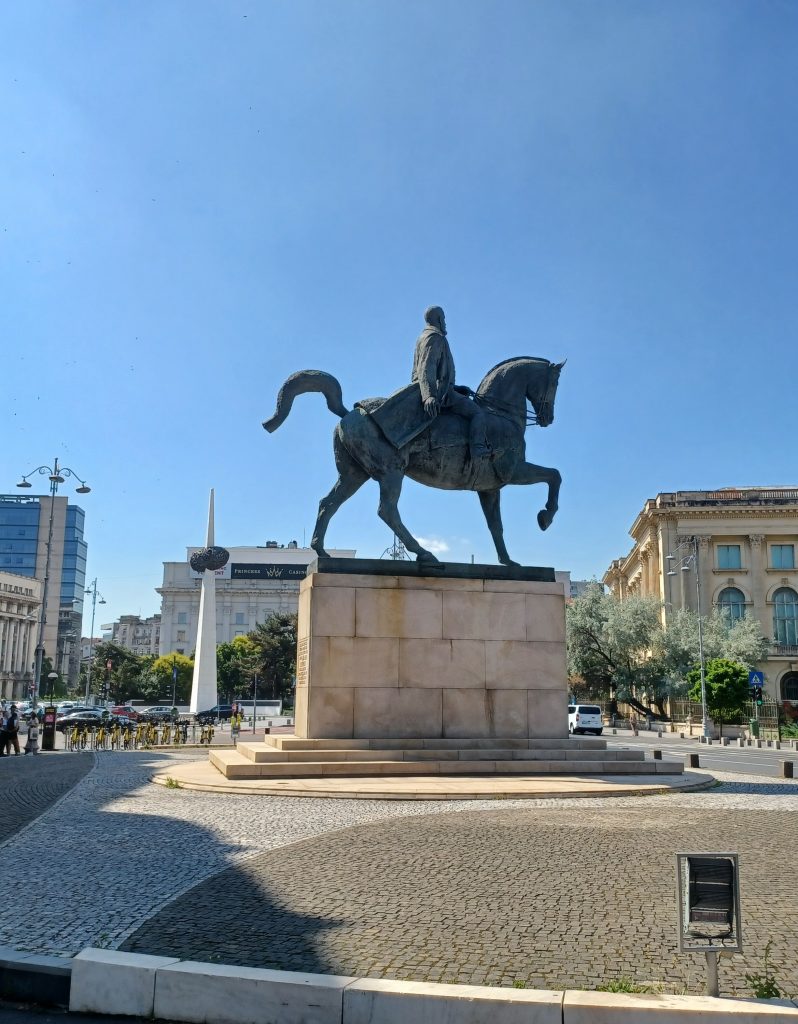
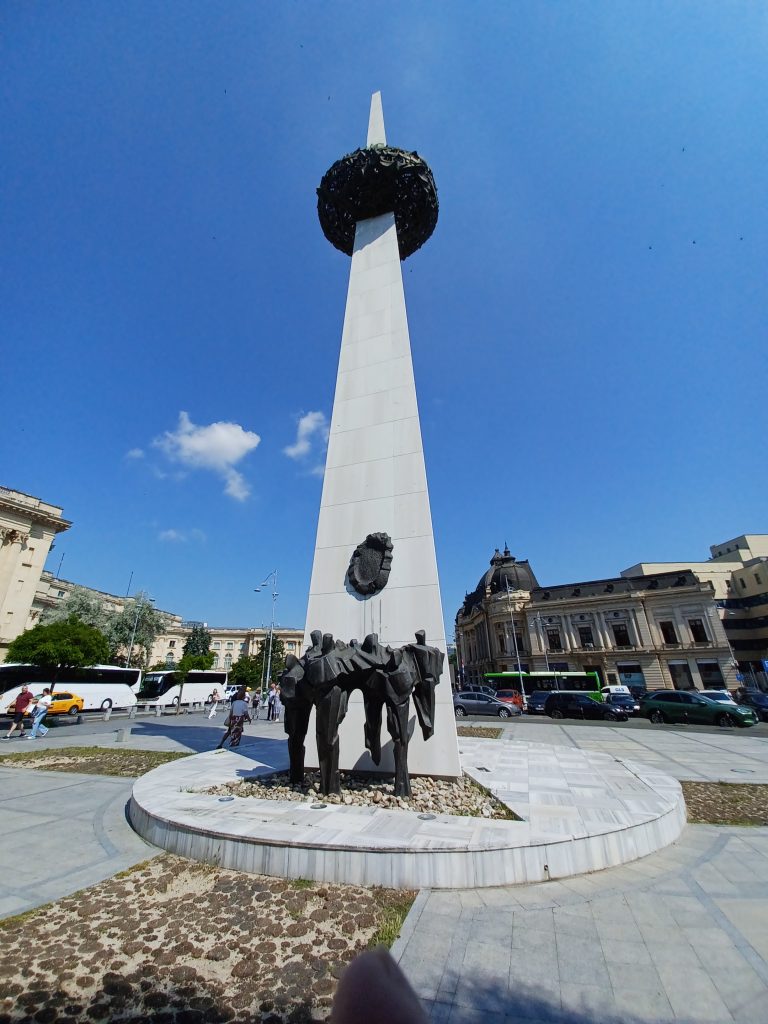
I head along the splendid Calea Victoriei passing grand buildings and statuary. Reach a large equestrian monument of King Carol I in front of the University building in Revolution Square. Nearby comes a monument to the fallen, ‘The Memorial of Rebirth’, a sheer white column tapering at the top. The names of the fallen, who died for the revolution in 1989, are inscribed on semi-circular walls. I overhear a tour-guide tell his group that the heaviest fighting during Romania’s bid for freedom took place in this square. Other statues appear, one to Mustafa Kamal Atatürk in front of the Odeon Theatre. Wonder what he is doing here.
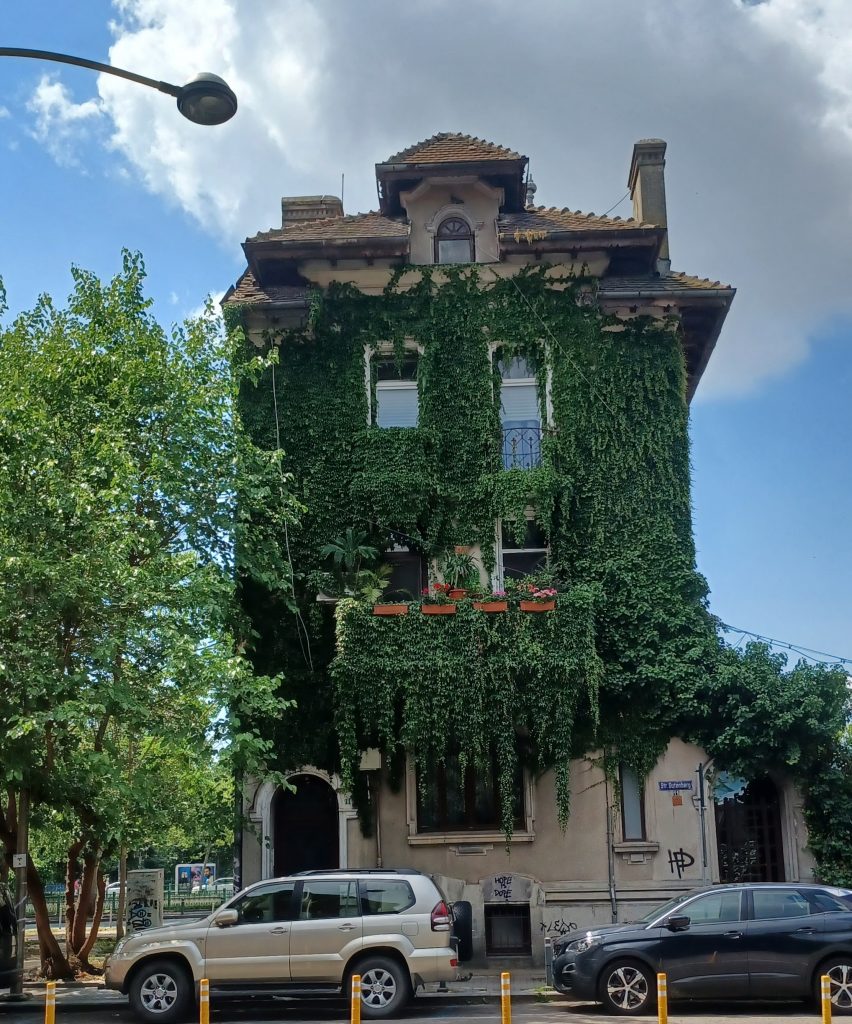
Continue past other grand buildings including the Corinthia Grand Hotel du Boulevard Bucharest. With the EU and Romanian flags flying either side of the grand entrance. The date of 1867 is inscribed below the left dome. Then wander down a side street and observe an ivy covered house with graffiti daubed on its lower wall: ‘Hope is dope’. OK.
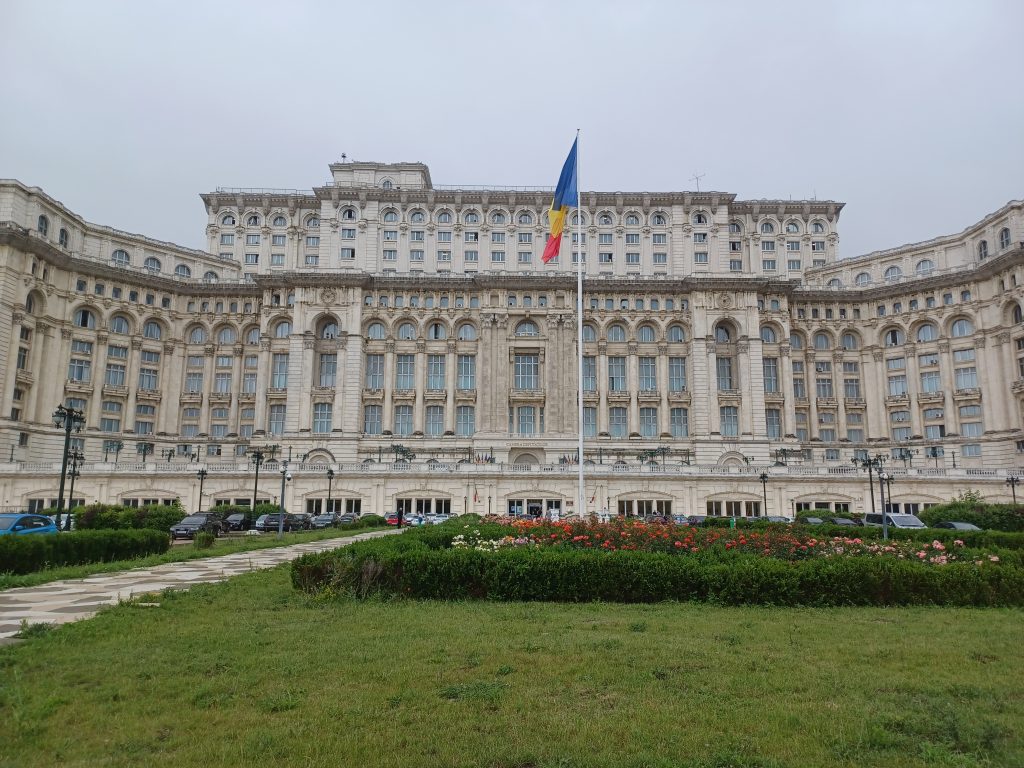
Cross a bridge over the Dambovita River, stroll through the slightly scruffy Izvor Park and find myself walking along the pavement in front of the megalomaniac, Nicolae Ceauşescu’s, Palace of the Parliament building. He, Ceauşescu, became General Secretary of the Communist Party in 1965 and President in 1974. Anyway, it is not what I would call a beautiful building. Looks like a grander type of Soviet block. Perhaps the interior décor makes up for the somewhat lacklustre exterior. Make a plan to visit. Got to book in advance. As I stand at the foot of a corner entrance, a barrier goes up and a dark car drives up the pinkish cobbles. Back to the hotel to book a tour of said palace on the morrow.
Palace of the Parliament
We meet at the offices of the tour agency where an officious female ensures that we all have our passports with us: “Madame, do you have your passport?” and demands a view of it. A nod to acknowledge that it passes the test. “Sir, your passport please.” Checks them all against her list, before issuing each of us with a blue plastic bracelet. Feel like one of a party of school children. Roll my eyes at another participant. A return grin. Our leader up ahead gesturing imperiously, we walk thence towards the imposing palace. “Take a photo here” she instructs us. OK then. We are crossing the road towards the corner of the building where the black car drove up yesterday.
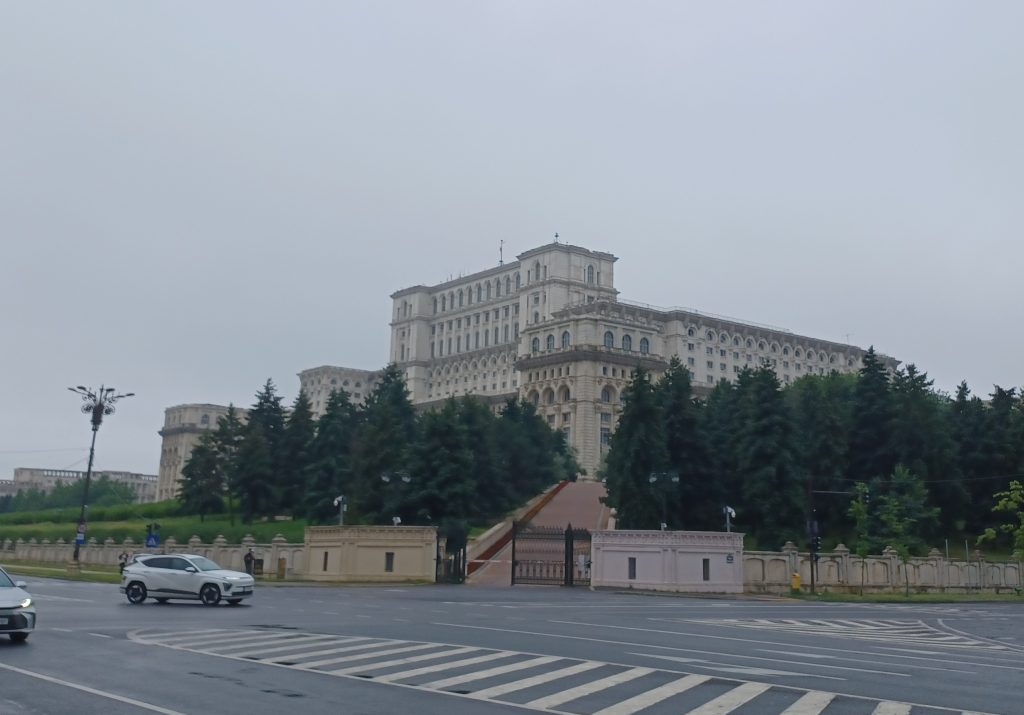
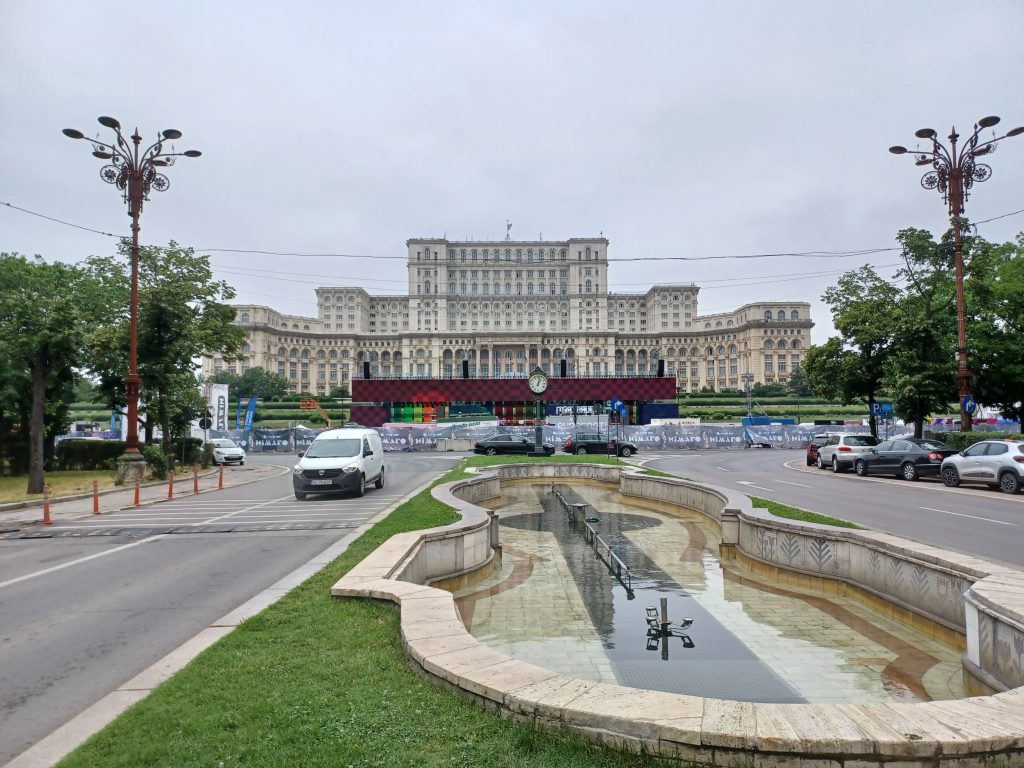
Opposite the Parliament Palace is the grand Union Boulevard (Unirii Boulevard), a look alike Champs Elysées but “it is six metres longer” says she. “And wider.” Ceaușescu didn’t want to be outdone by the French, evidently. Continue to walk along one side of the building to the visitors’ entrance. Once through, we are greeted by a form of airport security: passports checked, bags X-rayed and lanyards issued. Then all stand in a waiting area until our tour is called for 11:15. Dutifully follow our animated and rather droll palace guide, who speaks loudly, commandingly and fast. Strides off, dress billowing. The tour will be one hour long.
This is a palace with a difference to be sure. Conceived as a sort of civic centre with Ceaușescu at its head, we are told.
“He admired the monumental buildings of Pyongyang in North Korea,” she says. Unfortunately, in order to satisfy his grand vision, “he destroyed a whole area of the old city”, including thousands of homes, and religious edifices. The first room we come to on the ground floor is the C.A Rosetti Hall with a huge chandelier. This sets the scene for what is to come.
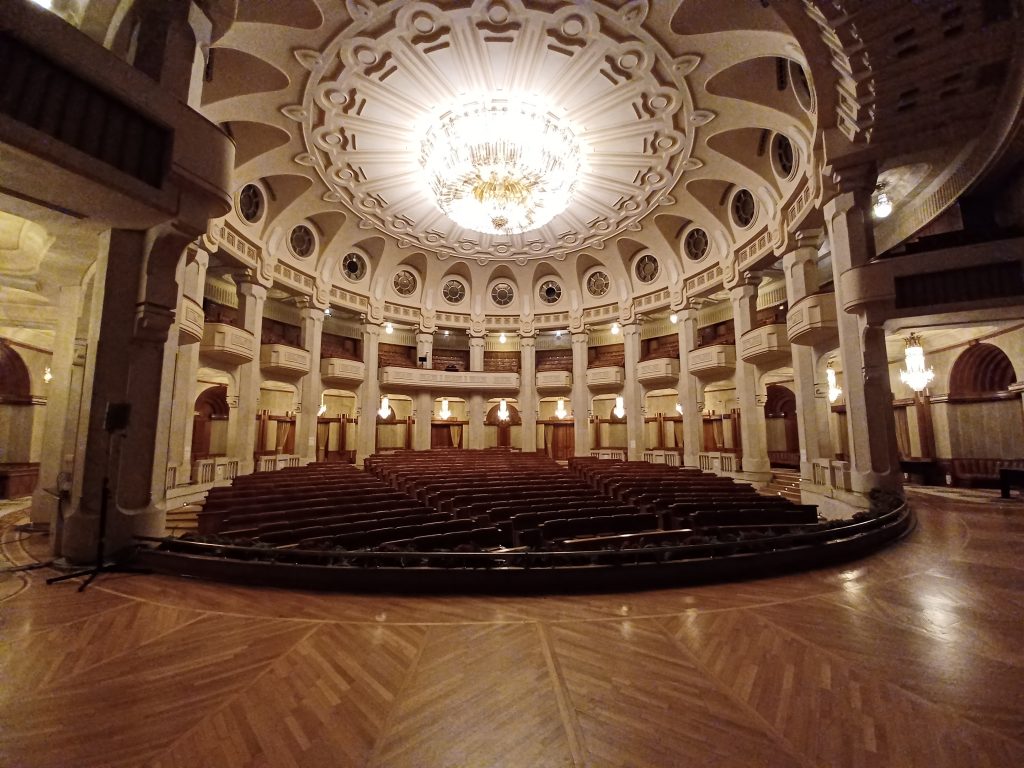
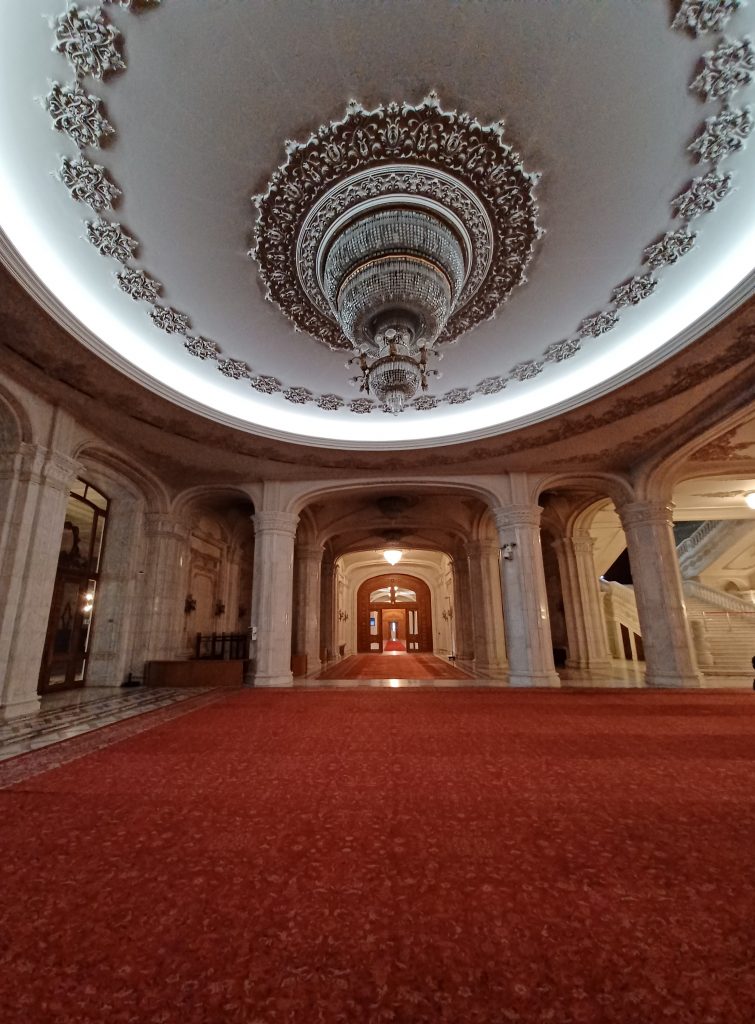
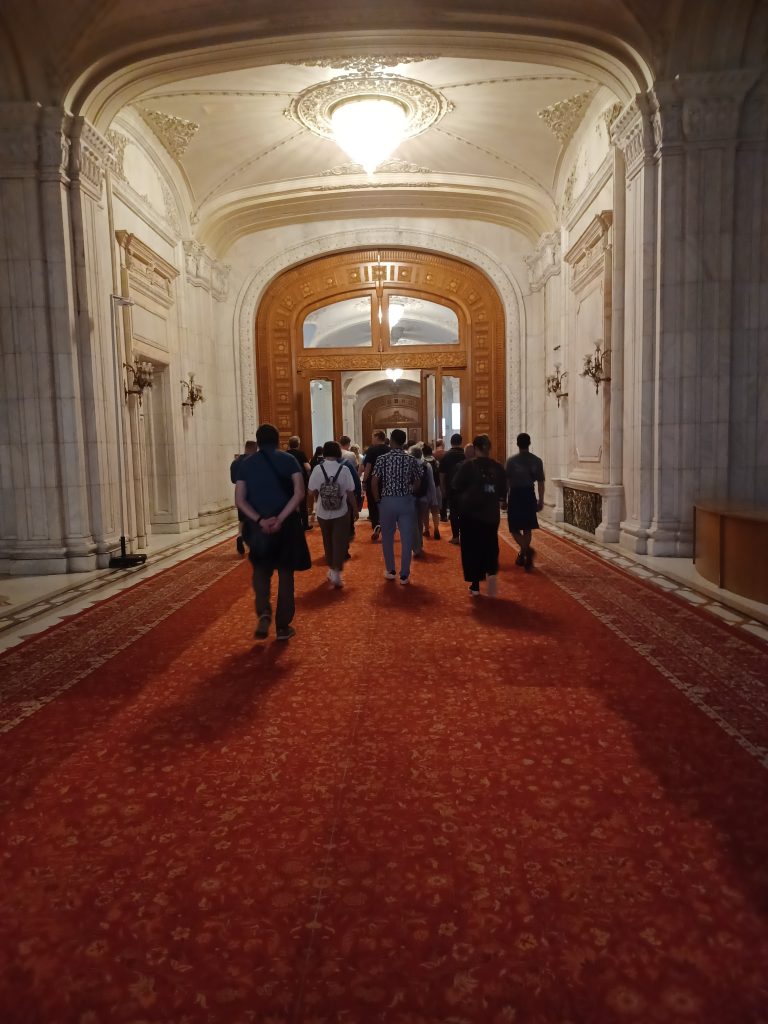
We ascend marble staircases and are led, via long corridors, from one ginormous room to another. Red carpets on marble floors, painted stucco, columns and arches, carved wooden doors and massive crystal chandeliers. Our guide rallies us round, ensuring our undivided attention, and points ceiling-wards. “How do you think we change the light bulbs?” Ponder. “The chandelier is accessed via an area in the ceiling above”. “There are 2,800 chandeliers altogether”, says she. Furthermore, she continues, “it takes four people to change a light bulb”. I wonder how many are required in each chandelier. Anyway, that is a lot of light bulbs.
All the materials were sourced in Romania, we learn. (Ceaușescu wished to emulate what King Carol I did for Peles Castle, i.e. use Romanian materials (I am headed there tomorrow)). All the fittings were made by Romanian craftsmen and fitted together under the guidance of a Romanian lead architect, a female, Ana Petrescu. However, Ceaușescu could not decipher the architectural drawings, and to ensure the building was to his taste, he would come view the work in progress and have it taken down if he didn’t like it.
Not much furniture in any of the rooms but they are lavishly decorated. “Many of the rooms are hired out for conferences”. Some have seating laid out, some with screens at one end. The luxurious Nicolae Bălcescu Hall boasts silk drapes, crystal chandeliers and pinkish marble columns. Phew, not a bad conference venue. Other parts of the building host the Romanian Parliament, the Senate, Chamber of Deputies and others. We don’t see these, but we certainly are getting a flavour.
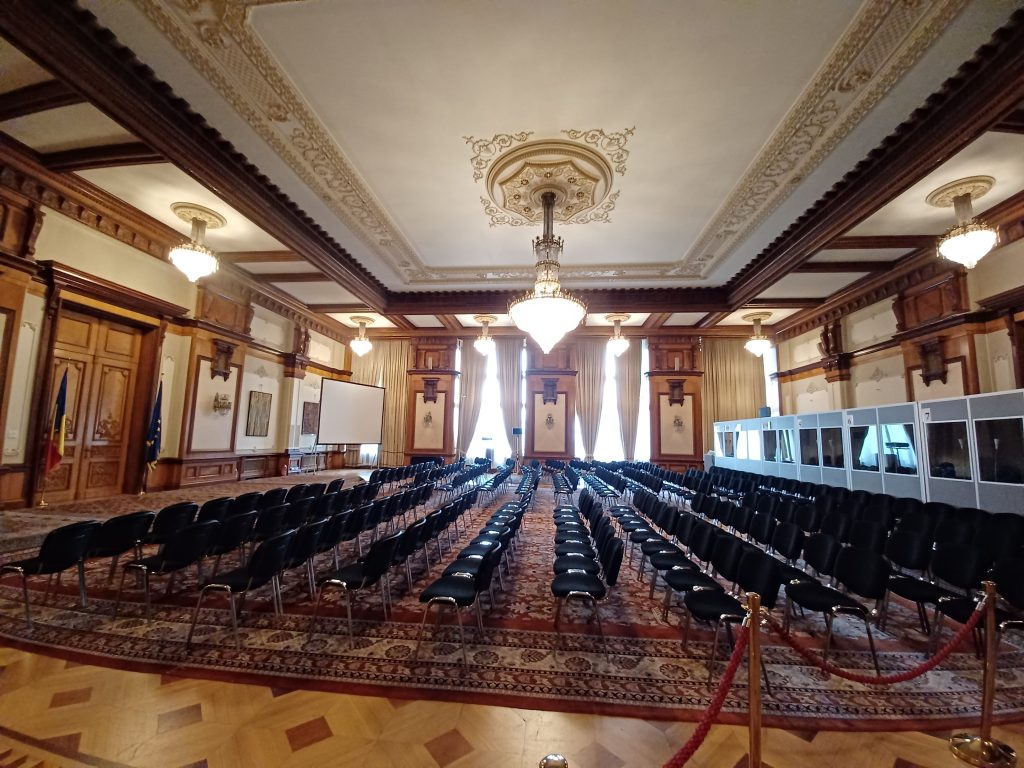
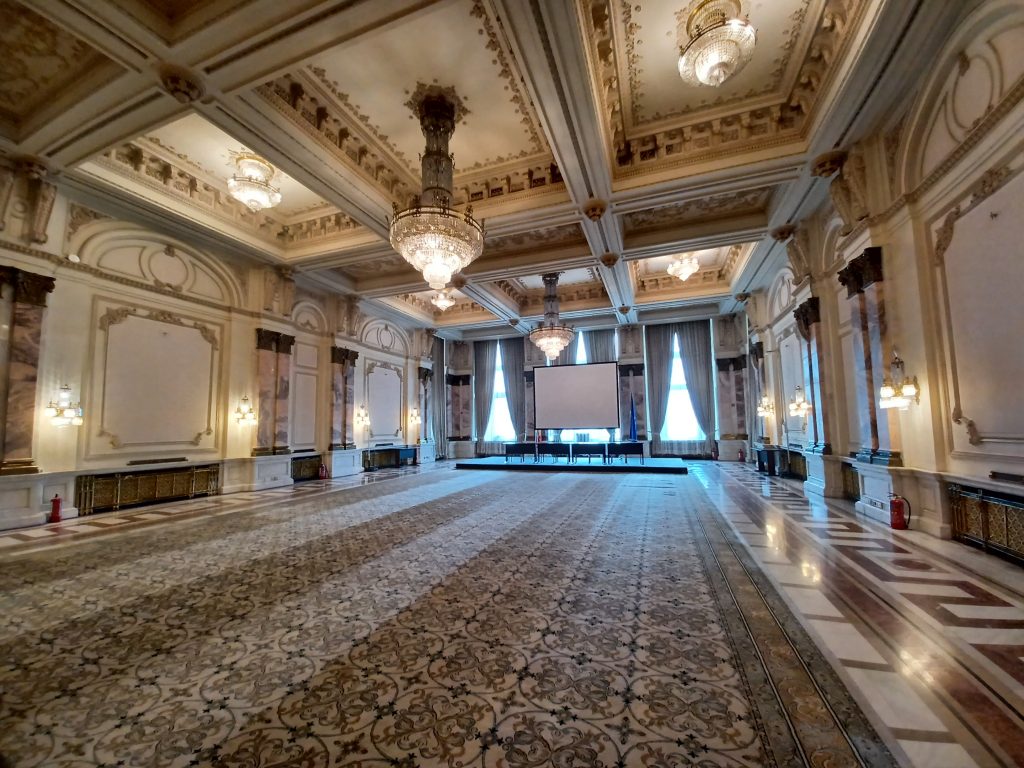
One room contains some models of Romanians in national dress, another some sculpted bronze busts of famous Romanians, not Ceaușescu, needless to say. In fact there is no mention of the executed President anywhere despite this Palace being his particular megalomaniacal vision.
Ceaușescu decided his civic centre should be built on a hill, which apparently did not suffer earthquake damage – the big earthquake of 1977 did not damage this area, and was thus chosen as the spot. “It used so many millions of tons of marble in the construction that the building hasn’t settled down yet,” our guide informs us. 4.1 million tons in fact. “The Palace is second only to the Pentagon in size”, “with about 1100 rooms”. I wonder how long it takes to walk around them all. We only see about 4% of them, which cover an area of 365,000 square metres, spread over twelve floors. Some of these are underground, along with a nuclear bunker at its deepest point. Bit paranoid was Ceaușescu. With good reason as it turns out, though he was executed by his own people, not by some enemy nation.
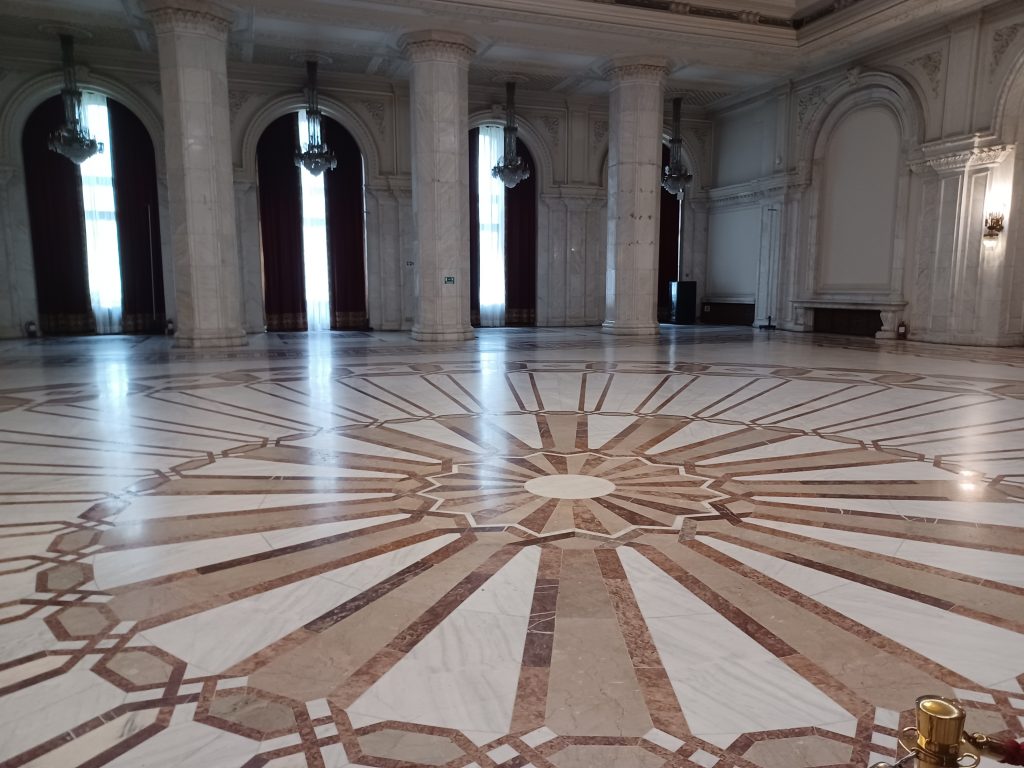
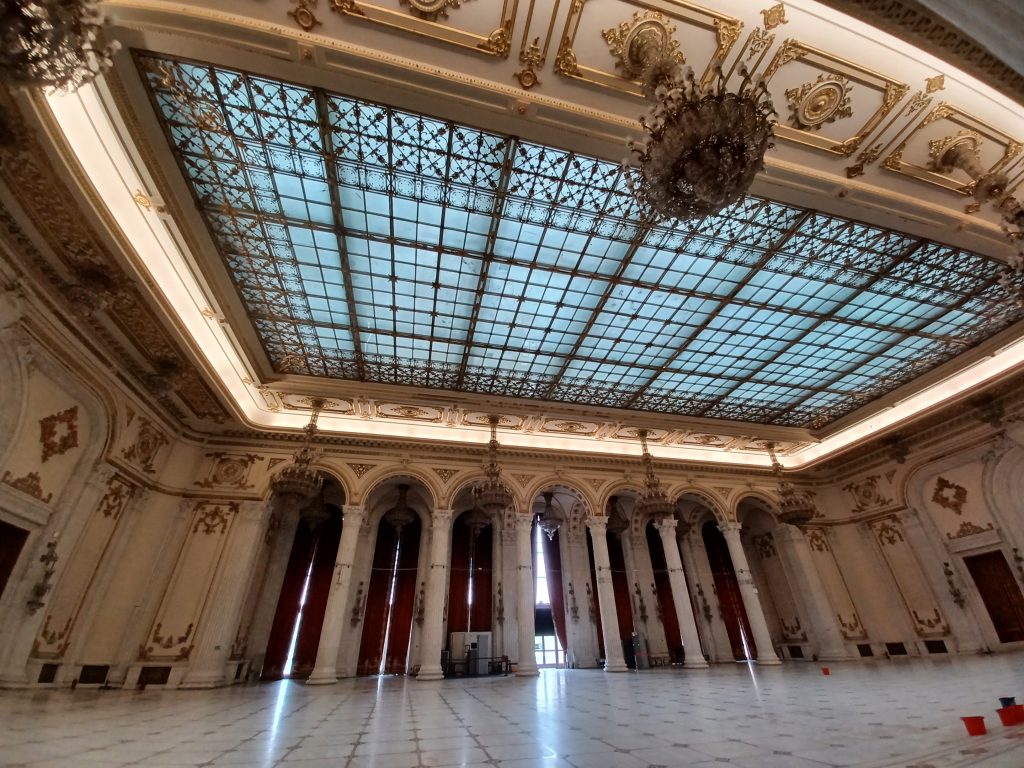
We arrive at the middle room of the Palace, which has a white circle at its centre. Further on is a splendid room, Union Hall, with a glass skylight. Used for parties and banquets. Red buckets on the enormous shiny floor today await the cleaning brigade. This hall apparently has mahogany doors gifted by the then President Mobutu of Zaire, (now the Democratic Republic of Congo). “These are the only features of the palace, which are not of Romanian origin”. OK.
Construction of the palace began in 1984, about five years before the revolution in 1989, but was never finished, taking until about 1997 to complete. There is still some interior work to do. I ask why they completed it at all, seeing as the dictator and his wife, Elena, met their demise – by firing squad – on Christmas Day, 1989. The reply was that it was far too far along into the construction with all the materials assembled. “Only the labour was required”.
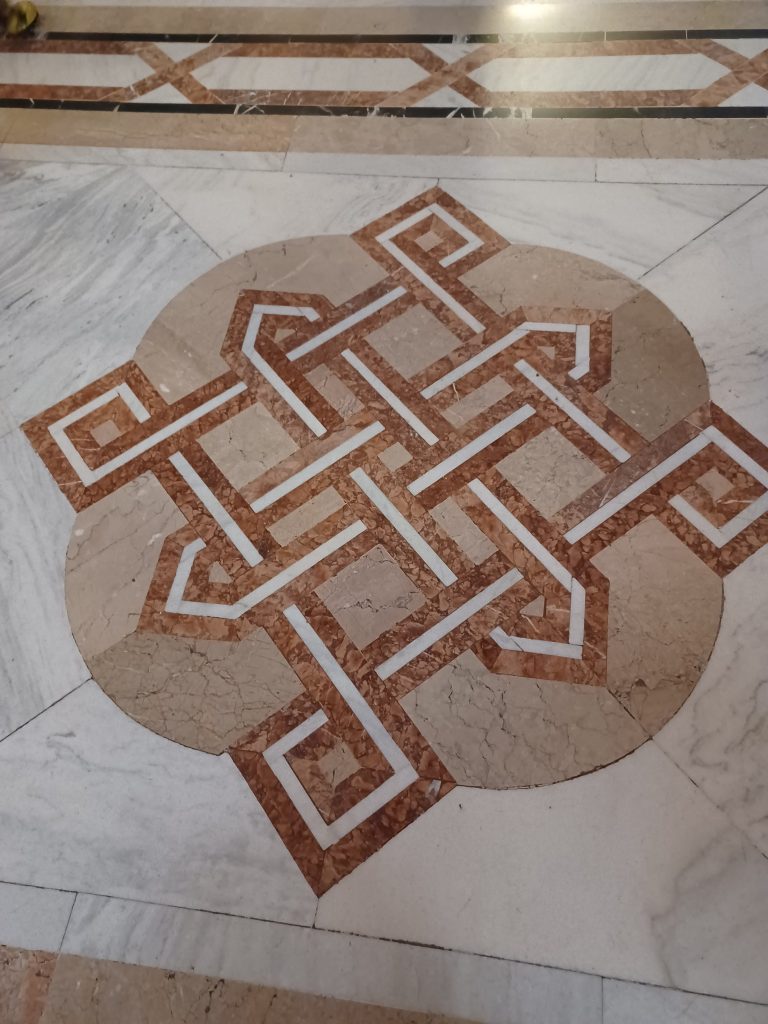
Scarcely cosy and intimate, the place seems rather designed to impress, for ceremonial occasions, pomp and circumstance, despite it being known merely as the “People’s House” by the Communists. Anyway, we continue traipsing along the corridors and stop at a design on the floor. “Can you guess what this is?” “It is a plan of the building and exists in every room.” Clever! She bounds along the red carpet again, her group in hot pursuit, through the oak doorways, and down the marble staircases once more to the exit. There are lifts, about 53 of them, she answers my query, but visitors don’t appear to be offered use of them.
We exit the building on the other side from which we entered. Seems to be used as a staff carpark. Cars are parked between rose bushes and from here I observe a huge Orthodox church rising up behind the Palace. That would be good to see, I muse. It won’t take long to get there. Head off.
National Cathedral of Bucharest
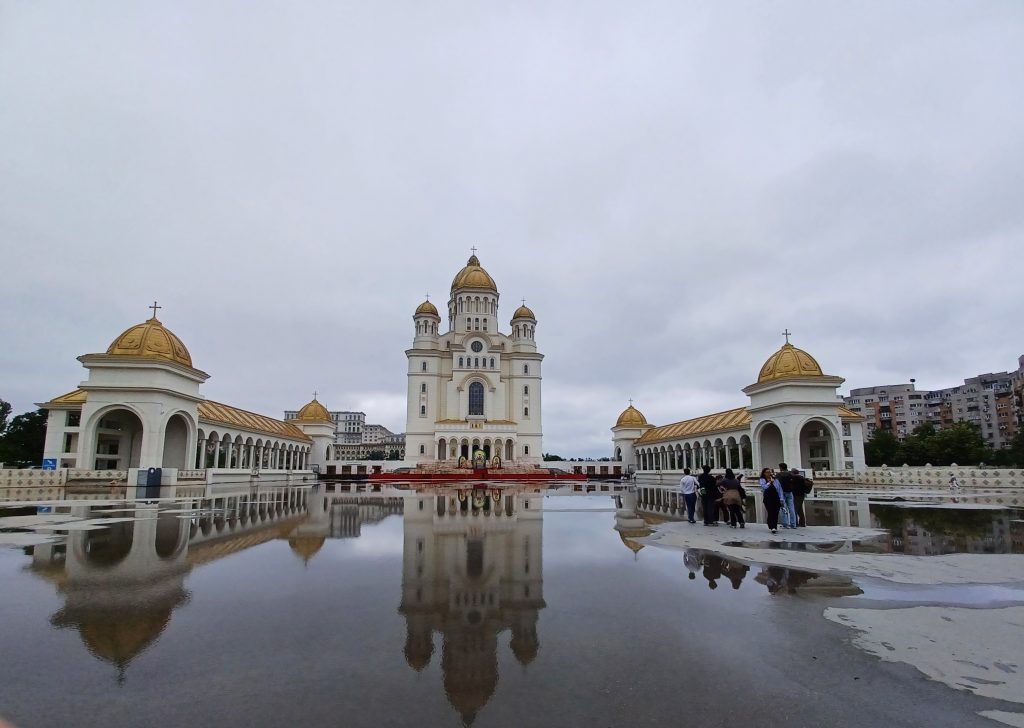
It actually takes a whole lot longer to get to this golden domed church than I first thought. Misjudged the distance. Arrive in front of it where a vast puddle puts off some tourists from venturing close. I thought it was a lake at first glimpse. Having tramped all this way, I find the church is not open for visitors. Only the souvenir shop is open. What a building though. Shame about the Soviet apartment blocks spoiling the view. It is actually the National Cathedral of Bucharest, apparently the largest Orthodox church in the world. King Carol I it was, who first proposed that this national cathedral be built. The process was set in train in 1882 but the building was not begun until 2010! It was only finished recently in 2025. There are eight domes in all, the central one representing Jesus Christ and, circling this one, four domes representing the four evangelists, Mathew, Mark, Luke and John.
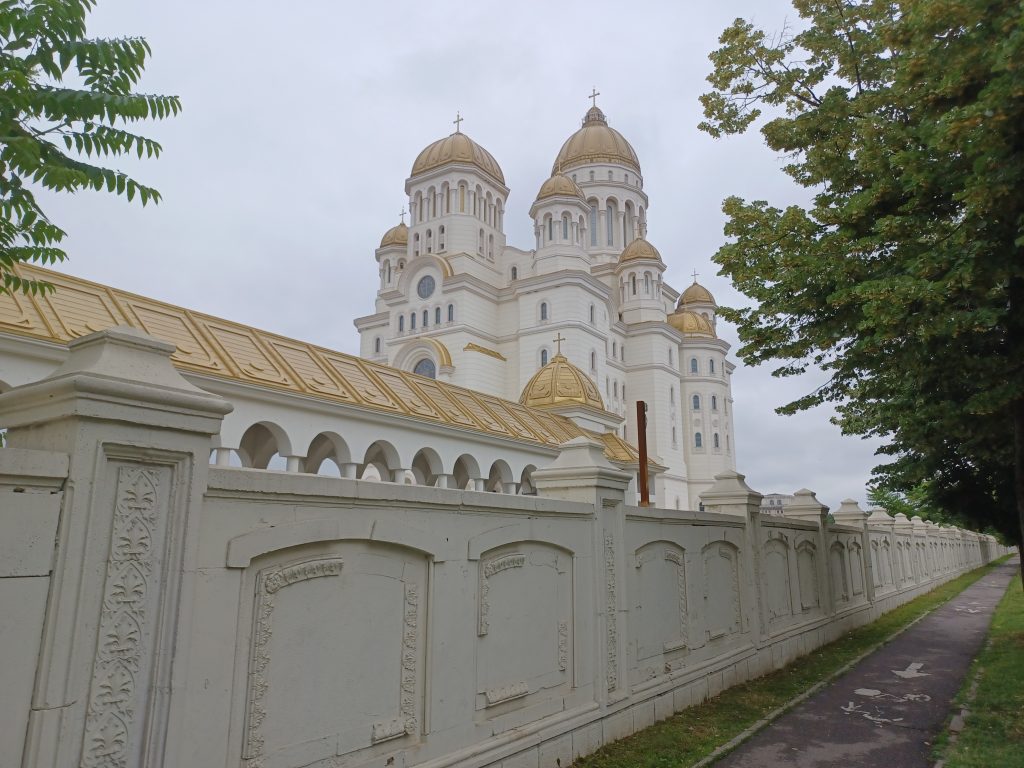
I end up walking right around the walls, which enclose the church. It is situated in the same grounds, it seems, as the Palace of the Parliament. It is a good number of steps. I end up on the Champs Elysées lookalike boulevard. A platform has been set up at the end of the boulevard in front of the Palace here and a female voice is testing the acoustics or something. Deafeningly so. Put fingers in ears and stride speedily into an area of ministerial buildings. Mistake. Cannot find a different way out, so return by the same route. Not wishing for any more detours, I enquire of a young couple to point me in the direction of the old town. Find it. Relief. Settle down in an Italian restaurant for refreshment.
National Museum of Romania
Recovered from my hike this morning, I am all set to visit the National Museum. Not far from my hotel.
Trajan’s Column
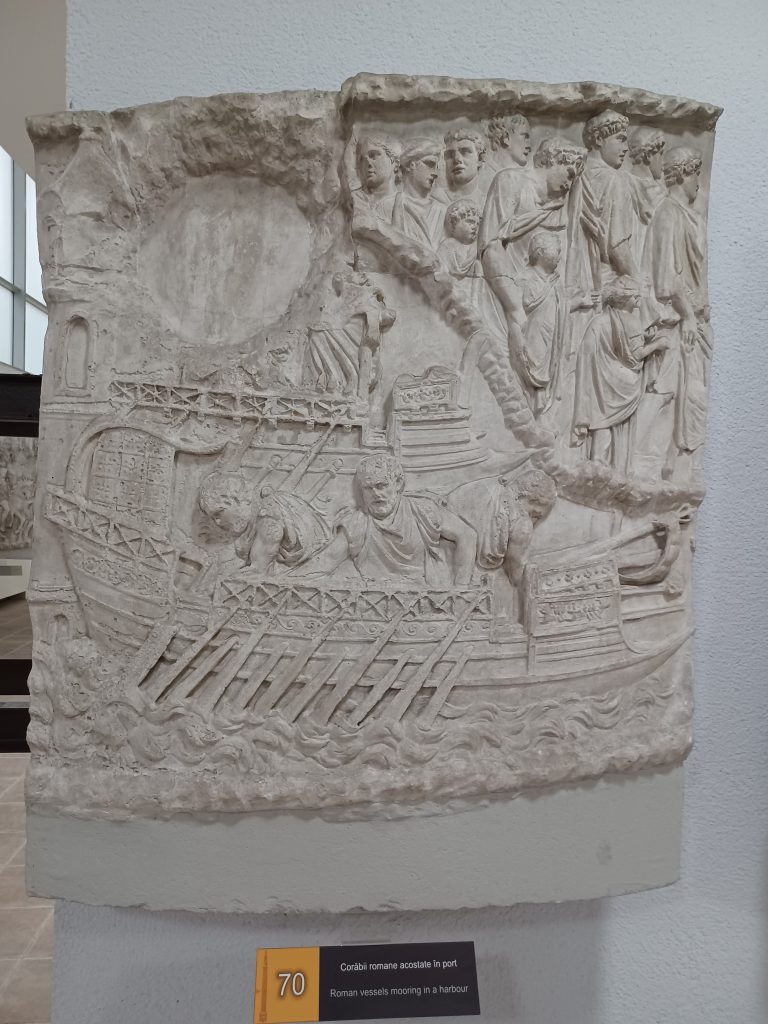
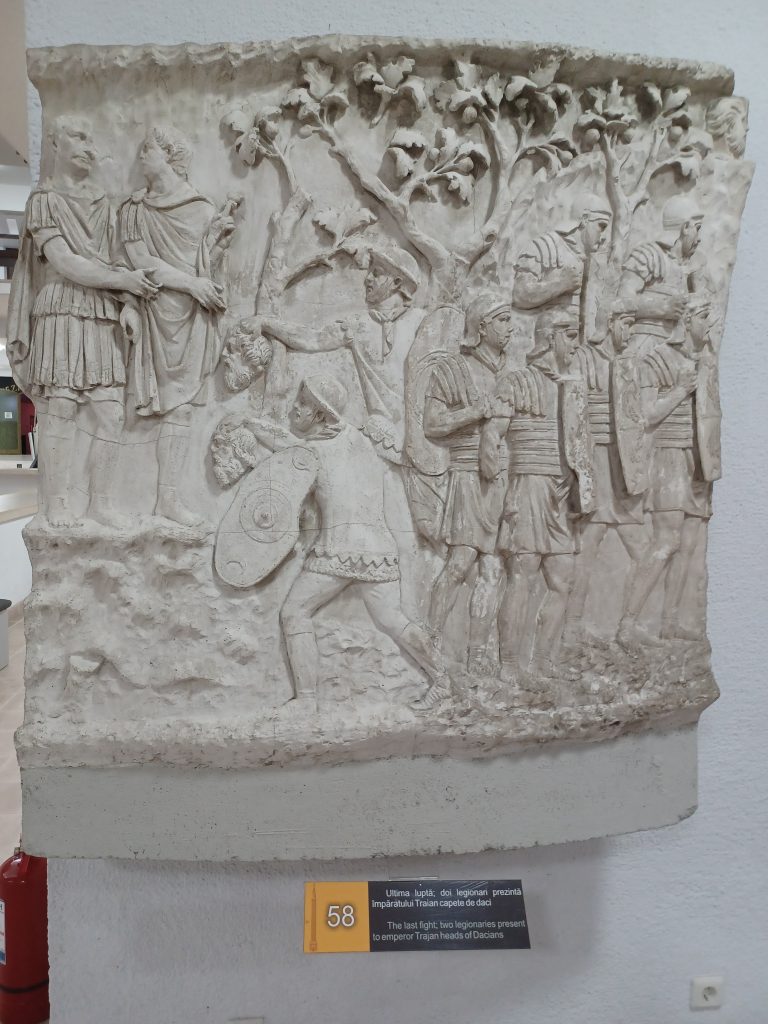
Surprised to find a copy of Trajan’s column taking up a large space. Although not much info is provided in English, I gather that Trajan defeated the Dacians, the original inhabitants of this area, in 106 AD. This was after several conflicts with said Dacians under their King Decebalus. The Romans annexed the region and it became a province of the Roman empire. Thus did the Romans gain considerable mineral wealth, security from further Dacian invasions, as well as further cachet for the emperor. It remained a province of Rome until 271 AD. The column consists of a number of marble panels depicting Trajan’s campaigns against the Dacians. They include Trajan crossing the Danube, Trajan dispensing libations, and Dacians’ heads chopped off and stuck on spikes. Vlad the Impaler did nothing new. More about him in part 2. All very fascinating.
Queen Marie of Romania
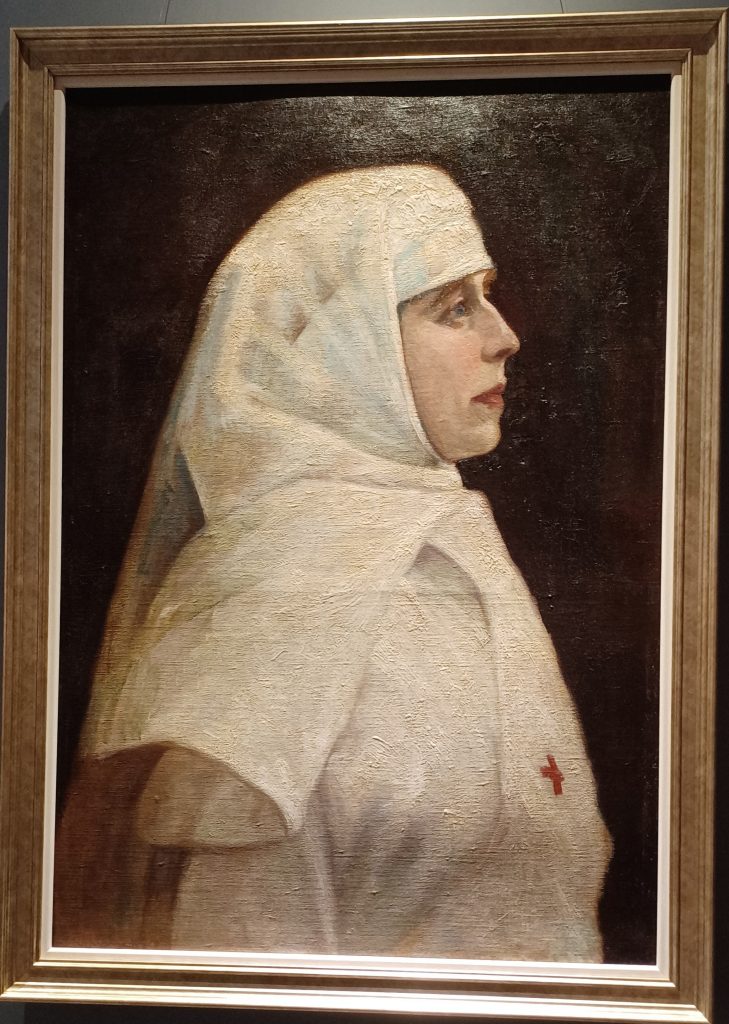
One space in the museum has a fair bit of info about Queen Marie of Romania. After King Carol I’s death in 1914 after a 48 year reign, the throne passed to his nephew, Crown Prince Ferdinand (1865 -1927), later King Ferdinand I. King Carol and his wife, Elisabeth, had only one daughter, who died aged four. Hence the throne passing to Ferdinand. He married one of the British Queen Victoria’s grandchildren, Marie, daughter of Alfred, Duke of Edinburgh and the Russian Grand Duchess Maria Alexandrovna. Ferdinand and Marie ruled from 1914.
After WWI broke out, Marie apparently persuaded King Ferdinand to join the ‘Triple Entente’ of Russia, Great Britain and France. Thus, Romania eventually entered the war in 1916. The country benefitted from being on the winning side and the country doubled in size, retrieving Transylvania from Hungary in 1918 after the Austro Hungarian empire was dissolved. (It later reverted to Hungary but was retrieved again by Romania after WWII.) During the war, Marie nursed wounded soldiers at military hospitals. Highly respected, her portrait hangs here in the museum.
King Carol I of Romania
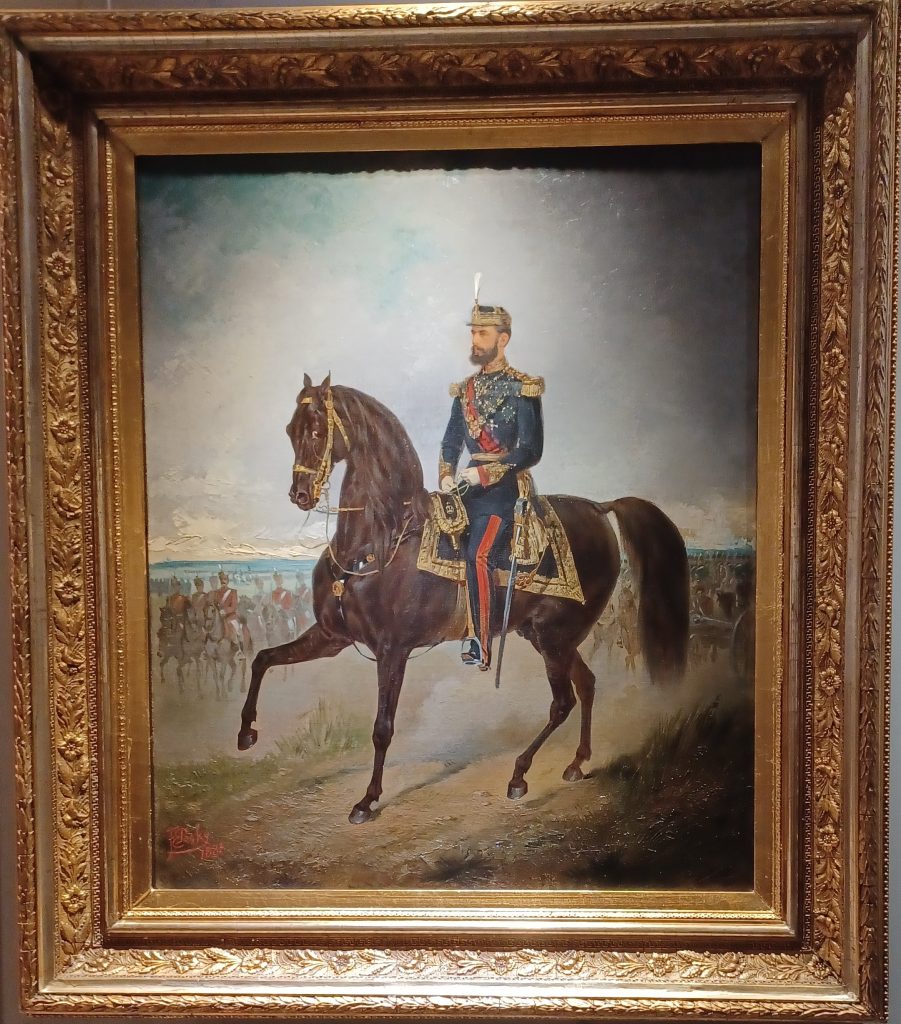
Alongside Queen Marie’s portrait is a portrait of King Carol I on horseback. He was the first monarch of Romania, having been offered the throne of the provinces of Wallachia and Moldavia in 1866. He had been Prince Charles of Hohenzollern-Sigmaringen, a German prince before this. He became King Carol I in 1881. Said King did not even speak Romanian when he arrived, but soon learnt the language. He achieved independence from the Ottoman empire in 1877. The country flourished under his rule.
A lot more of interest is on view in the museum, including golden bracelets from ancient Dacia and iron age gold and other objects. I leave, reluctantly, at closing time.
More of Bucharest Old Town
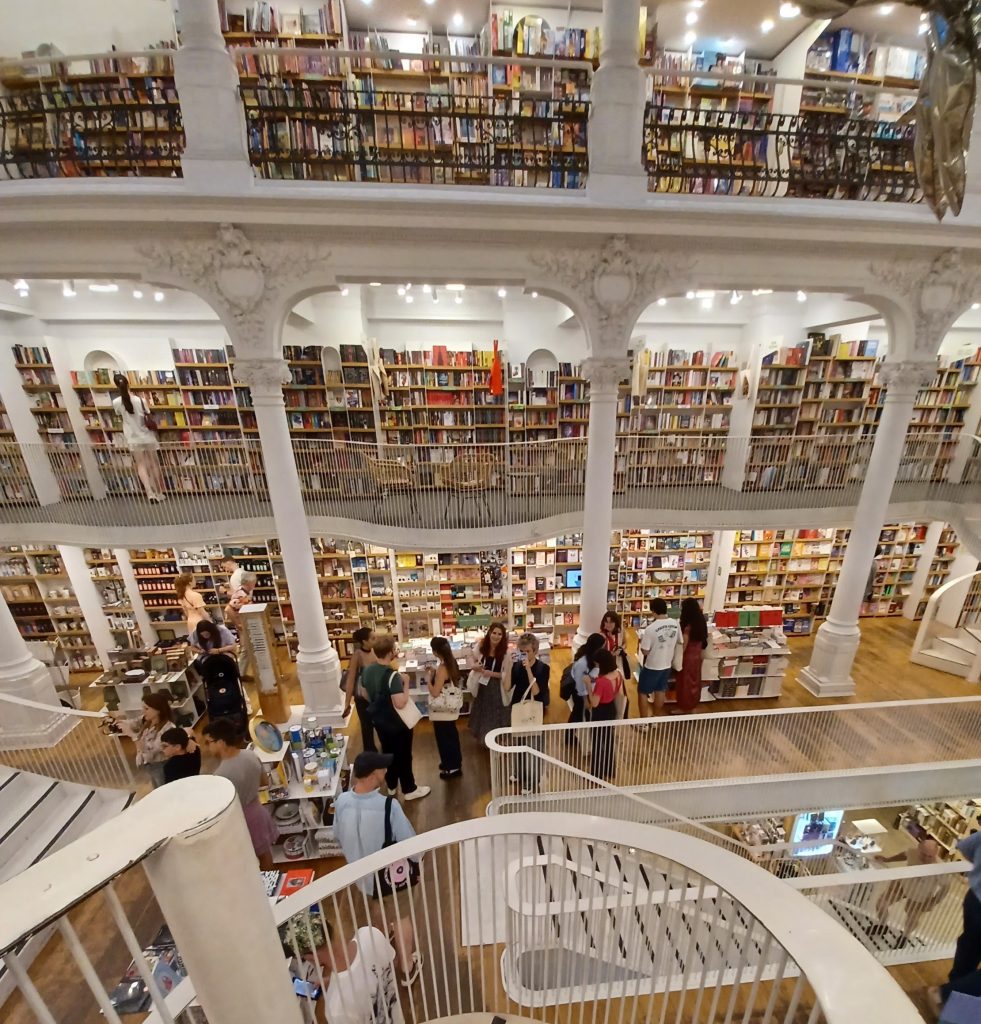
Carturesti Carusel
I finish up the day by exploring another part of the old town. I stop at the famous Bucharest bookshop, the Carturesti Carusel. It is still open at 1930ish. I enter in to view its floors stashed full of books, several levels of them with spiral staircases. Quite splendid. Peruse some of the ten thousand volumes and buy one, a volume on Eastern Europe. Seems suitable.
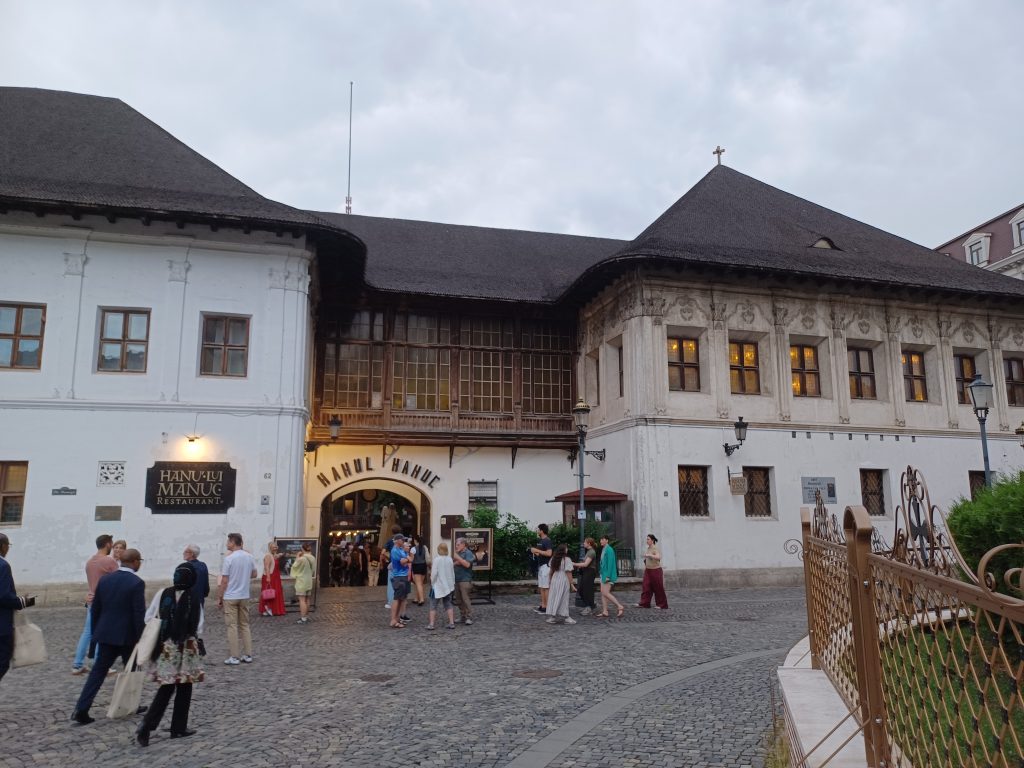
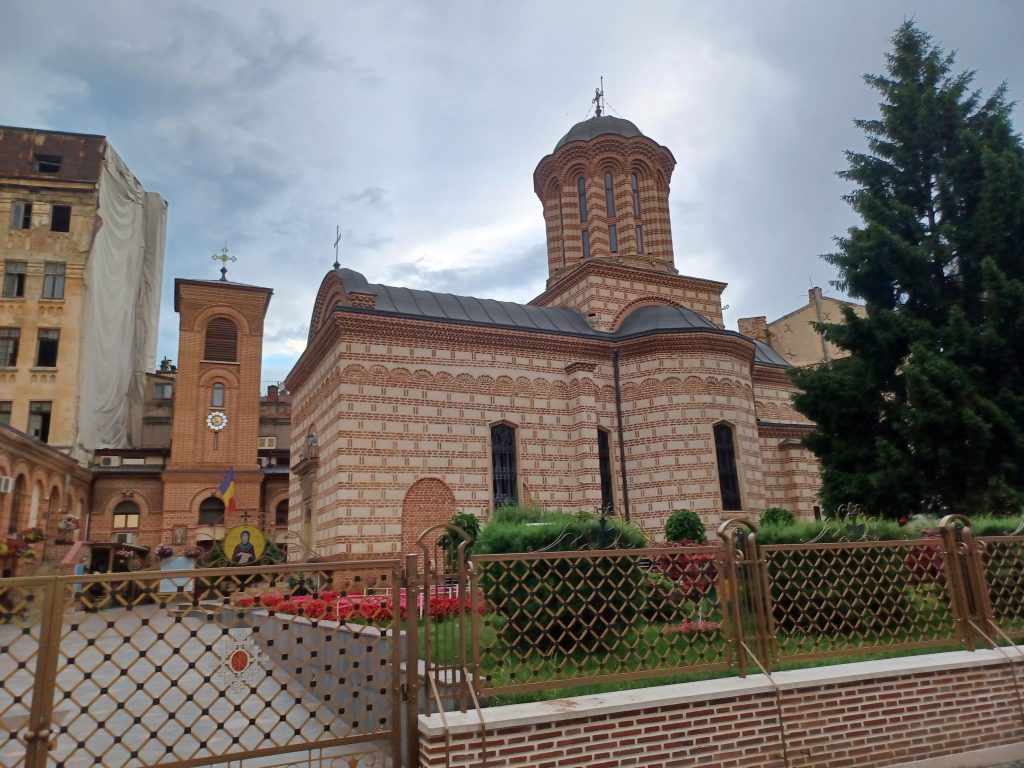
End up at Hanul lui Manuc restaurant, which started life as Manuc’s Inn, a meeting place for merchants and travellers in the early 1800s. Peep in. Lot of people in its courtyard immersed in salads and steaks and such. Looks tempting, but I resist the temptation. Across the cobbles is an Orthodox church, The Curtea Veche Church, the oldest in Bucharest, apparently, dating from the mid-1500s. Lovely brickwork. Observe it a while. Reminds me of the churches in Ohrid, North Macedonia (see the Balkans, Part 6: North Macedonia). Delightful odours are emanating from the Hanul lui Manuc. Yield to temptation. Well rewarded.
Leave a Reply