

Stage two of my travels to Chile and it is away from the mainland to the magical mystery isle of Rapa Nui in the South Pacific. Settled by Polynesians from the Marquesas islands it is thought. With its legendary carved stone heads, the moai, monuments to the ancestors. The first European didn’t arrive on the island until 1722, the Dutch admiral, Jacob Roggeveen. He it was who named it ‘Paasch-Eyland’, 18th century Dutch for Easter Island, because he arrived on Easter Day. Since then other European explorers, such as Spanish, French and British, dropped by, bringing with them their diseases, which helped to practically wipe out the inhabitants. Peruvian slave traders in the mid-19th century contributed even further to the decline in numbers. Chile annexed the island in 1888.
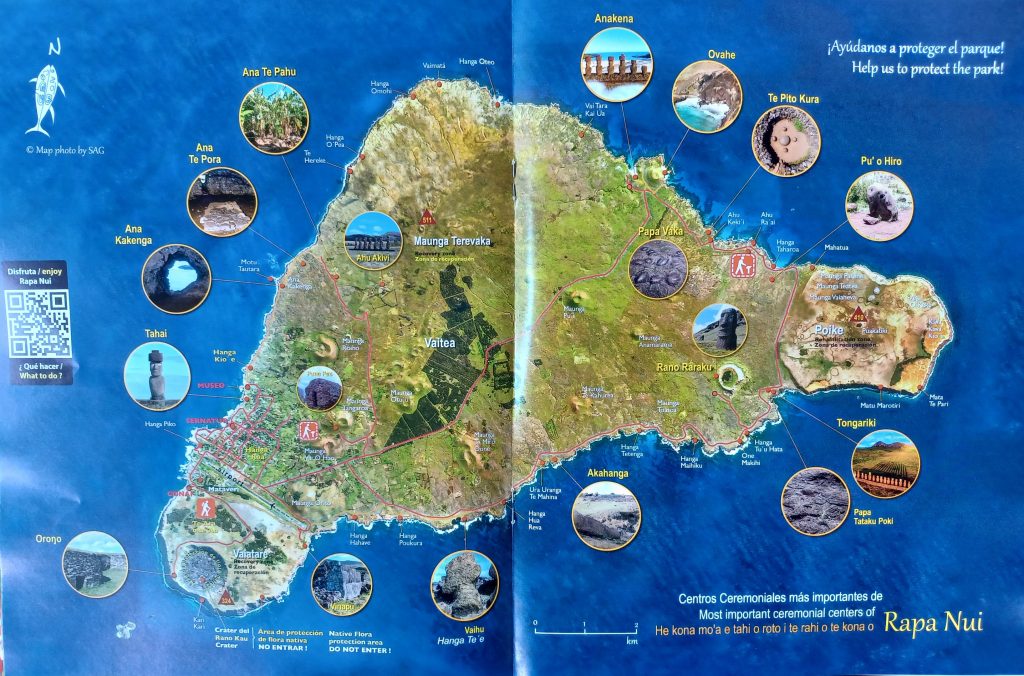
The most usual way to get to this Chilean part of Polynesia is via a five hour flight westwards from the capital, Santiago. Alternatively one could fly eastwards from Papeete, Tahiti also in around five hours. Rapa Nui’s airport, Mataveri International, is said to be the most remote airport in the world. The nearest land is actually Pitcairn Island, notable for its initial habitation by the mutineers on the Bounty. Further west are the south sea island groups of French Polynesia, the closest group, the Gambiers, about 2000 miles away.
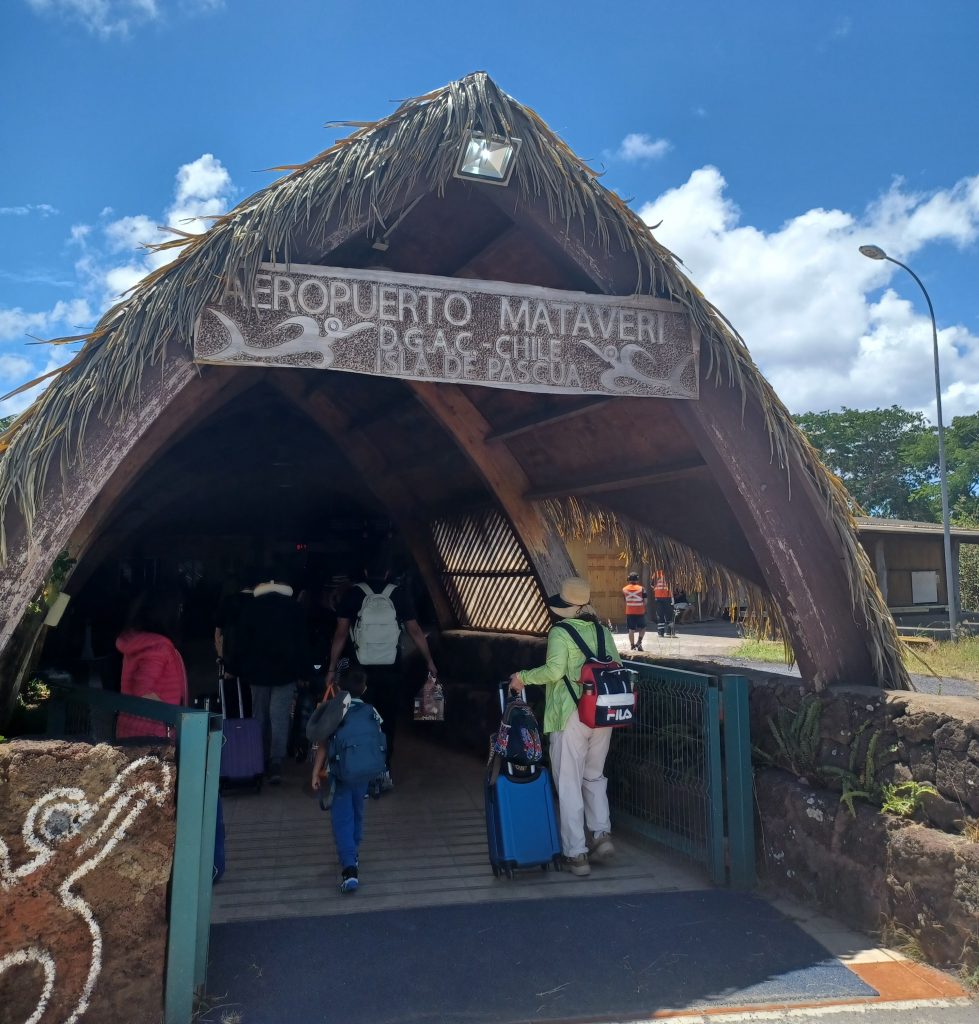
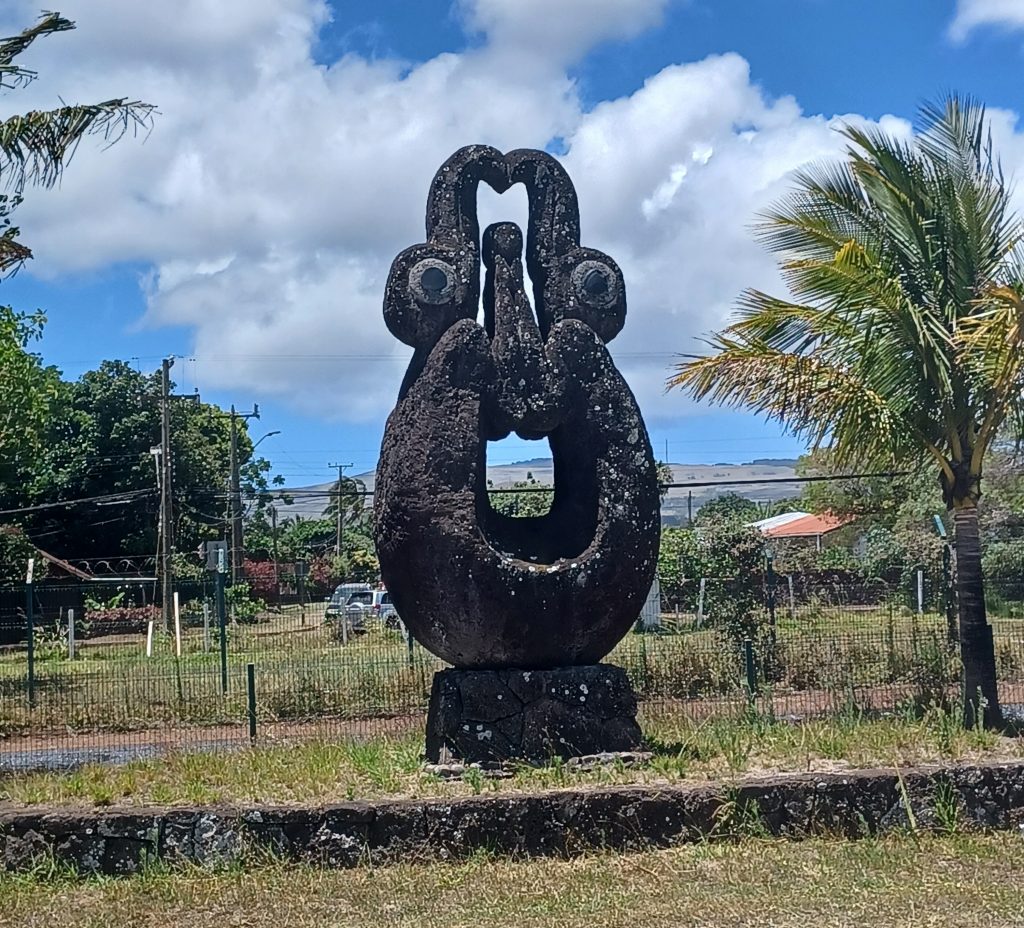
The island is shaped like a triangle and its airport is on the south-west point. The runway spans practically the whole way from coast to coast. Not much room for pilot error then. I descend from the LATAM airways aircraft onto the warm tarmac and am greeted with an odd looking statue and a sort of thatched corridor leading to the baggage hall. A turtle mosaic adorns the tiled floor. Scents of palm trees and flowers.
Hango Roa
Am due to be met, and am duly picked up by a pleasant jollyish lady with curls, who places a garland of flowers around my neck. Nice. It is not far to drive to the hotel on the main high street in Hanga Roa on the west of the island.
Pretty hotel. Just looks like a family residence from outside, low rise with a white wicket gate. Guest rooms are in two rows opposite each other with a central space between, in which are positioned tables and chairs and a water point. Good size room. Basic shower. Notice a couple of dead cockroaches behind the bathroom door. The cleaners must have forgotten to sweep them up after, presumably, hastening their premature demise. Anyway, I now have the afternoon to explore the capital.
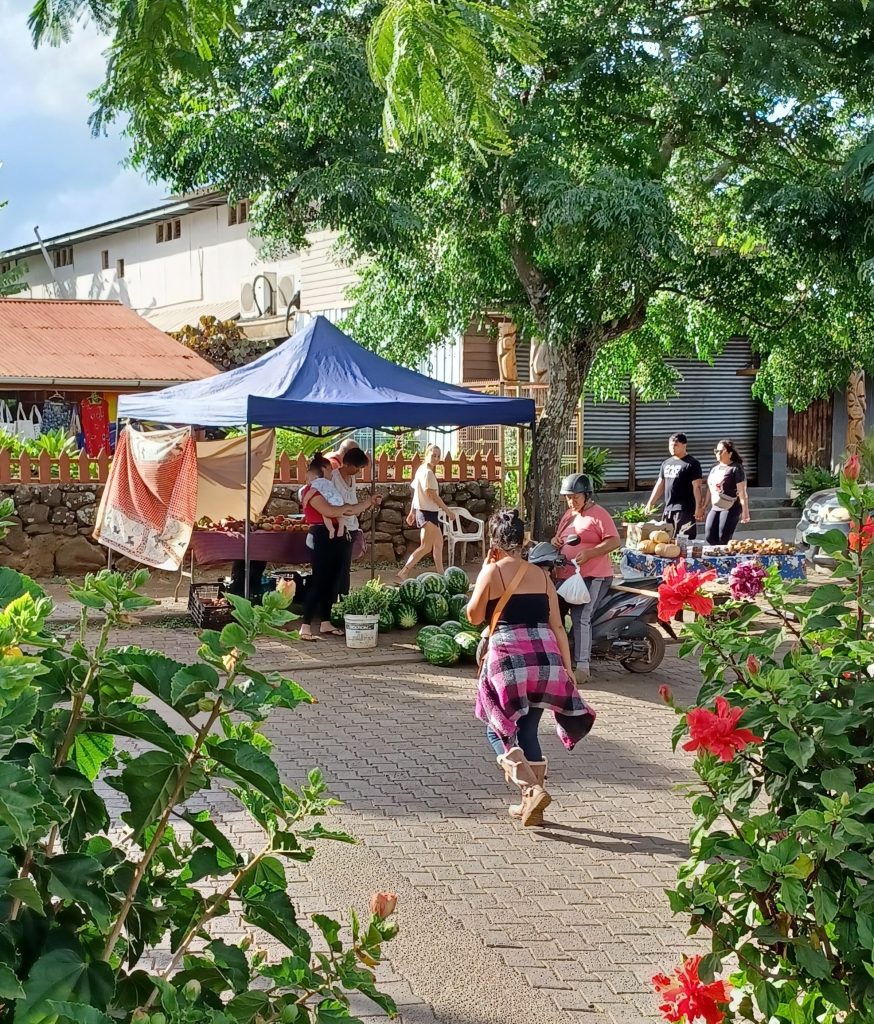
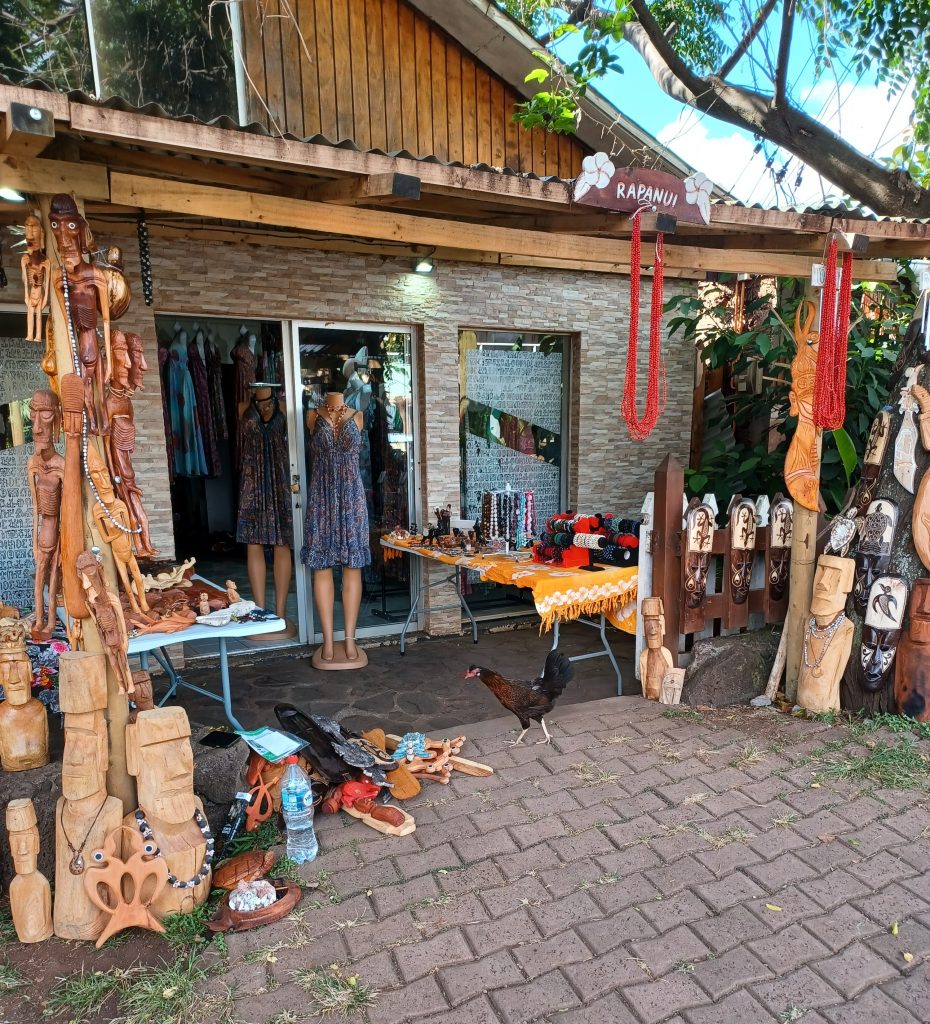
Hanga Roa is the centre of activity on Easter Island. The main street is full of cafés, restaurants and shops, including souvenir shops selling such things as carved moai models, fridge magnets and T shirts. Other establishments are marketing fruit and veg and outside many of them are displays of water melons, pineapples, sweet potatoes, and more. Vans unload their produce. Chickens and dogs pad about between the stalls. Luscious palms and bougainvillea and hibiscus line pathways and pavements. From the main street a few sideroads descend to the harbour while others head out north-east and east.
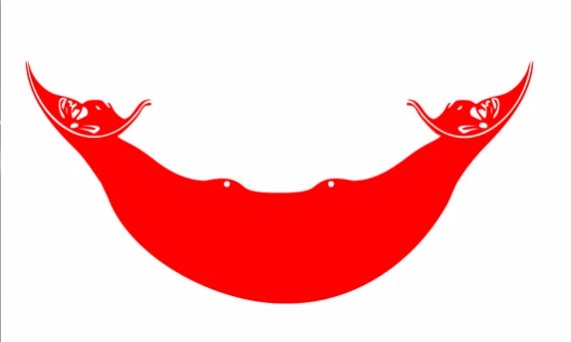
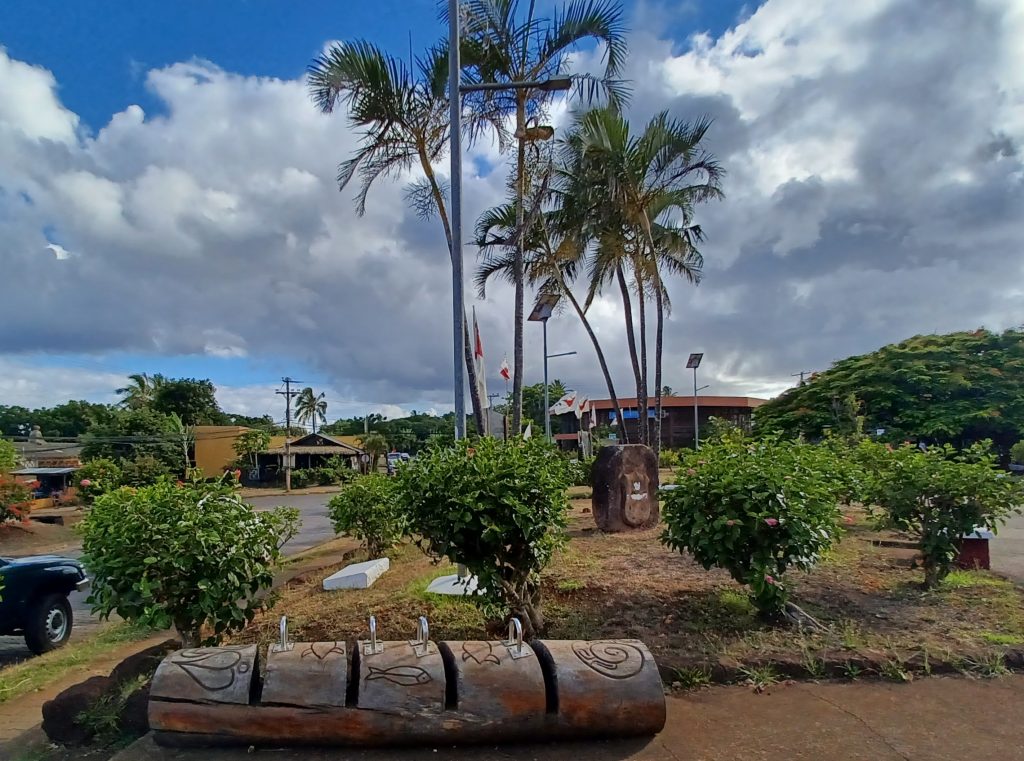
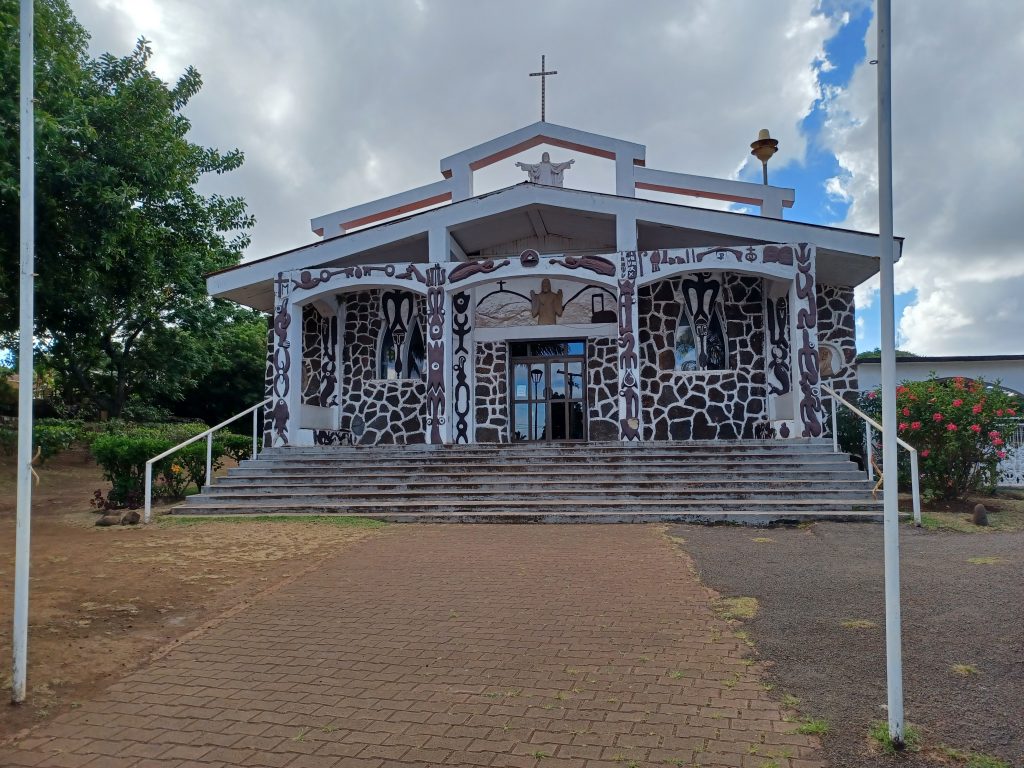
At the first T junction is a little park area with shrubs and trees, some carvings and a few Rapa Nui flags flying. The red ‘reimiro’ on the white background symbolises an ornament once worn by the indigenous people. It depicts a Polynesian canoe with two figures representing chiefs at either end. First flown in 2006. To the right, the road slopes upwards to Holy Cross Church, and to the left, it slopes downwards to the harbour. Turn right. Pretty church, Catholic, part of the diocese of Valparaiso, I gather, and founded in 1937. Interesting façade on the church, decorated with a mixture of Christian symbols and carvings of the Birdman, the 17th century cult. I peep through the glass door. The church is shut.
Thus, I turn about and amble down to the coast to the harbour with its brightly painted boats moored inside. Here, I encounter my first moai on its ahu (platform), ‘Hotake’, looking inwards from the sea. Further on, a couple of turtles are swimming in the shallows off a little beach, and a statue of an early inhabitant with a top knot stares from his pedestal. Anchored out in the bay is a large cruise ship. I look through my binoculars. It is one of the Peace Boat cruise ships owned by a global NGO. Some sort of floating university as far as I know.
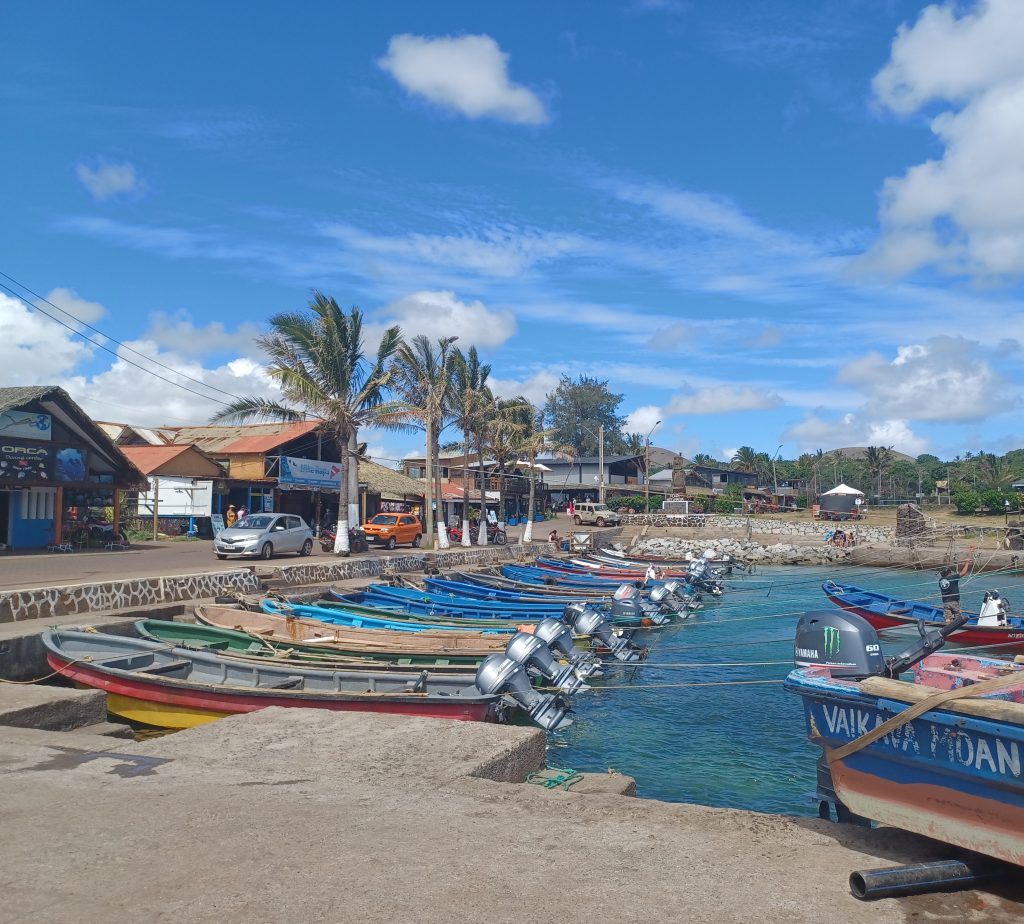
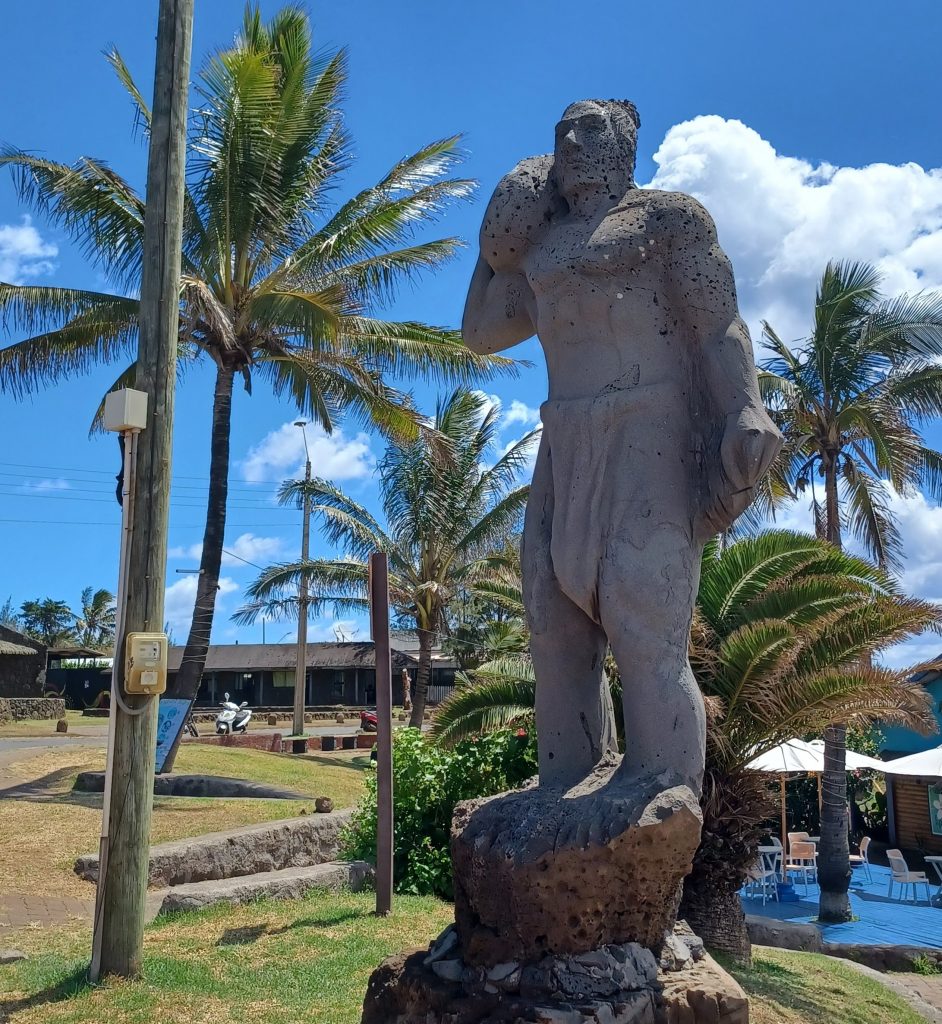
Time to find some sustenance. Some jolly looking restaurants on the waterfront. Pop into one of them. Lively looking venue with colourful tablecloths. Peruse the menu. Tuna fish salad should fit the bill. Arrives shortly. Realise I have ordered the raw variety of tuna. Smothered with some kind of noxious sauce. Made edible solely by the cool fruity glass of Chilean Sauvignon Blanc ordered to swallow it down with. Gulp. Friendly waitress though.
An interesting afternoon’s reconnaissance. Wander hotel-wards.
Rapa Nui National Park
I have booked a two day tour of Rapa Nui’s highlights, contained within Rapa Nui National Park. A permit to visit the archaeological sites has to be acquired before being allowed to visit any of them. I purchased mine online at home, but one can buy them in town. It is compulsory to have a guide. The whole island is now a UNESCO World Heritage Site.
I am picked up by a young driver outside the wicket gate of my hotel, where I patiently await. Hop in the car, already holding two American passengers in its back seat. ‘Morning, morning’, and we head off to meet with the main transport, a minibus. The guide, who goes by the mercurial name of Yoyo, drives said minibus. I alight to greet him. Sporting shorts and flipflops and dark glasses, he has greyish hair tints and careworn lines on his face. Suitably welcomed, I get back in the car again, which appears to be the mode of transport for the other two and me for the tour’s duration, the minibus being full of other participants. Probably over booked. No matter. We head off eastwards to the major site of Rano Raraku. Splendid drive along the southern coast road. Breathe in the fresh Pacific breeze through the windows.
Rano Raraku
We approach the entrance to Rano Raraku past a large reclining moai face up by the roadside, then enter the carpark and hie to the National Park Office to have our entry permits stamped. Here, Yoyo gets into oratory mode. He speaks good English as well as Spanish and Rapa Nui, the language of the islanders.
Rapa Nui, we are told, was settled from Polynesia by the legendary Hotu Matu’a, a descendant of the gods, sometime in the 11th or 12th centuries, although some believe it was considerably earlier. Hotu Matu’a established his son as the Ariki Mau (headman or king). At the time of arrival there were plenty of trees on the volcanic island but not much in the way of foodstuffs. The settlers, with some foresight, had brought fruit and vegetable plants with them, such as sugar cane and yams and bananas and the rose apple. And their diet was supplemented by fishing. The Ariki Mau made important decisions, such as when fish should be fished, plants should be planted.
At this juncture in the narrative, a gang of Chinese tourists shows up. They have no guide. Oh dear. Either unaware of or trying to circumvent the regulations. They try to persuade Yoyo to take them along with our group. A terse and definite no.
Anyway, the carving of the giant moai began soon after the settlement and continued until some kind of ecological disaster in the mid 17th century brought all this industry to a halt. The two distinct tribes on the island then began a civil war, probably due to the dwindling resources, and the moai were upended. OK. Brief and succinct. More to be elucidated later.
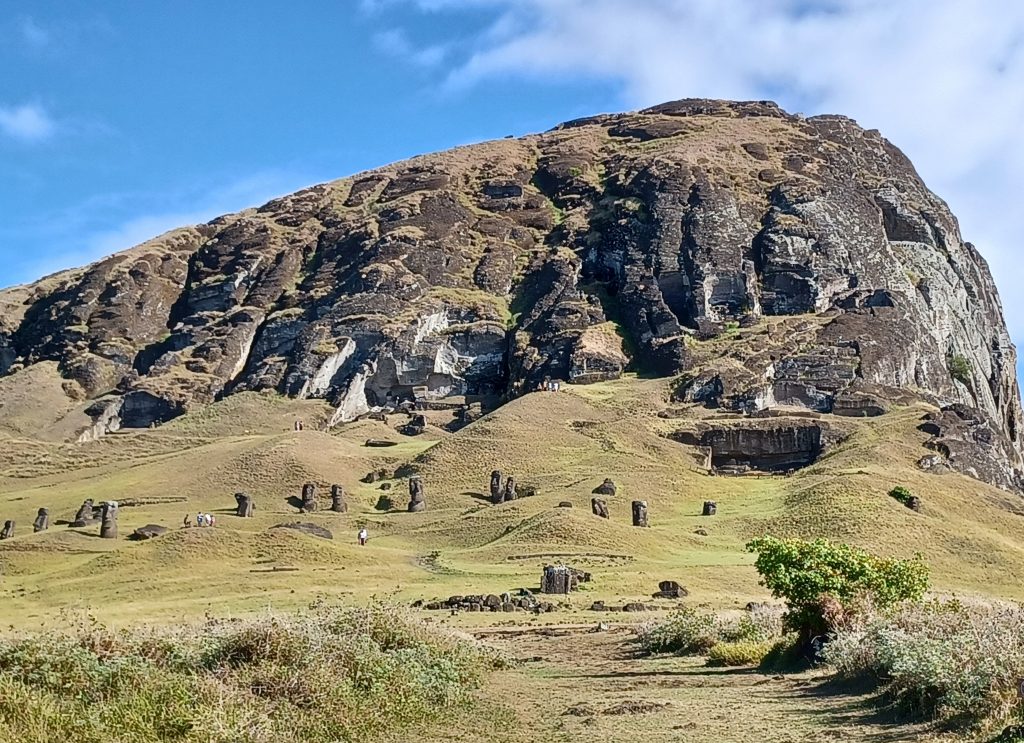
From the Park Office, we walk along a well defined track up the hillside encountering these enigmatic moai heads as we go. Some are upright, some tilted, but many are face down on the ground or face up on the ground, due to the toppling of the statues in the civil war.
According to oral tradition, Yoyo explains, there was a social hierarchy on Rapa Nui, with the headman, Ariki Mau, followed by his nobility, various spiritual and warrior leaders, specialists in such things as astronomy and stone carving, then the bulk of the population, followed by the lesser mortals, the servants/slaves, at the bottom of the pile. This structural arrangement enabled the master masons to carve the huge moai statues, which were erected after the death of a high status member of the tribe. The first moai carvings from the 11th or 12th centuries were smallish, perhaps one or two metres tall, but they gradually increased in size in the last years before the ecological catastrophe took place.
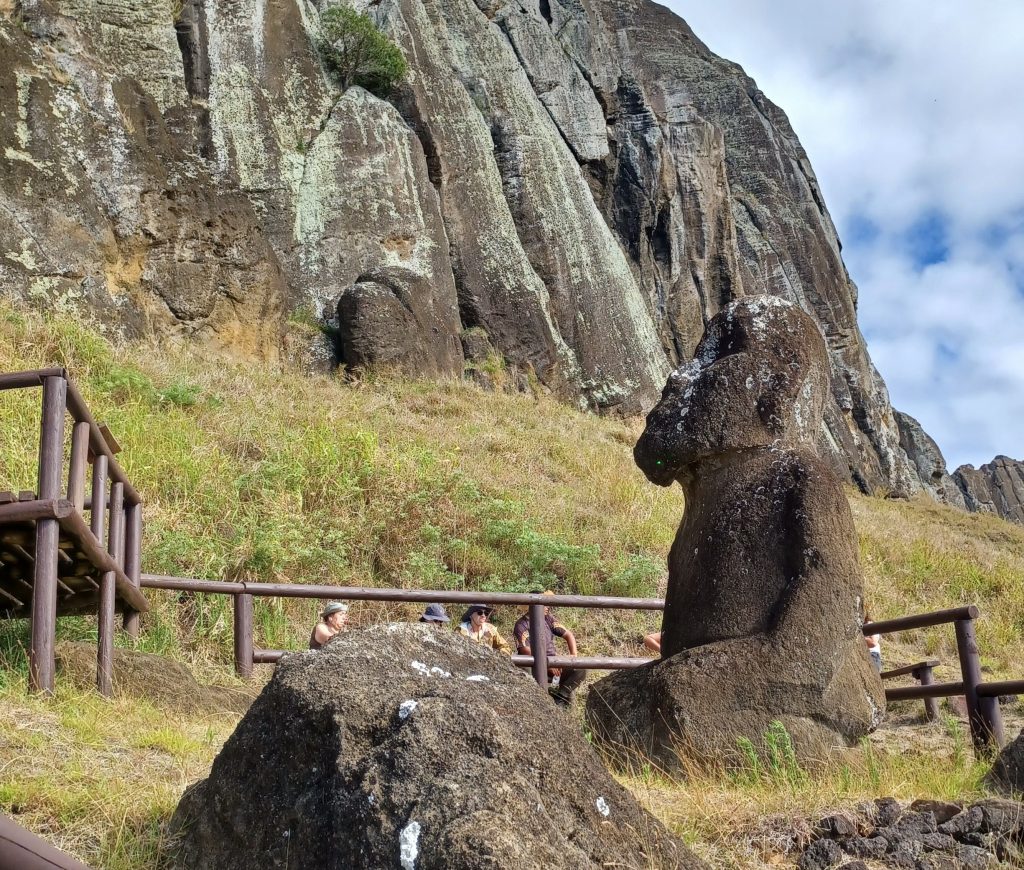
We wend our way further up. Around a fenced off area, the path curves around the “kneeling moai”. Different to other moais, he seems to be gazing skywards. “Tukuturi is the name”, Yoyo informs us. “The only kneeling moai here”. He has a rounder head and softer profile. Wonder what he is staring at.
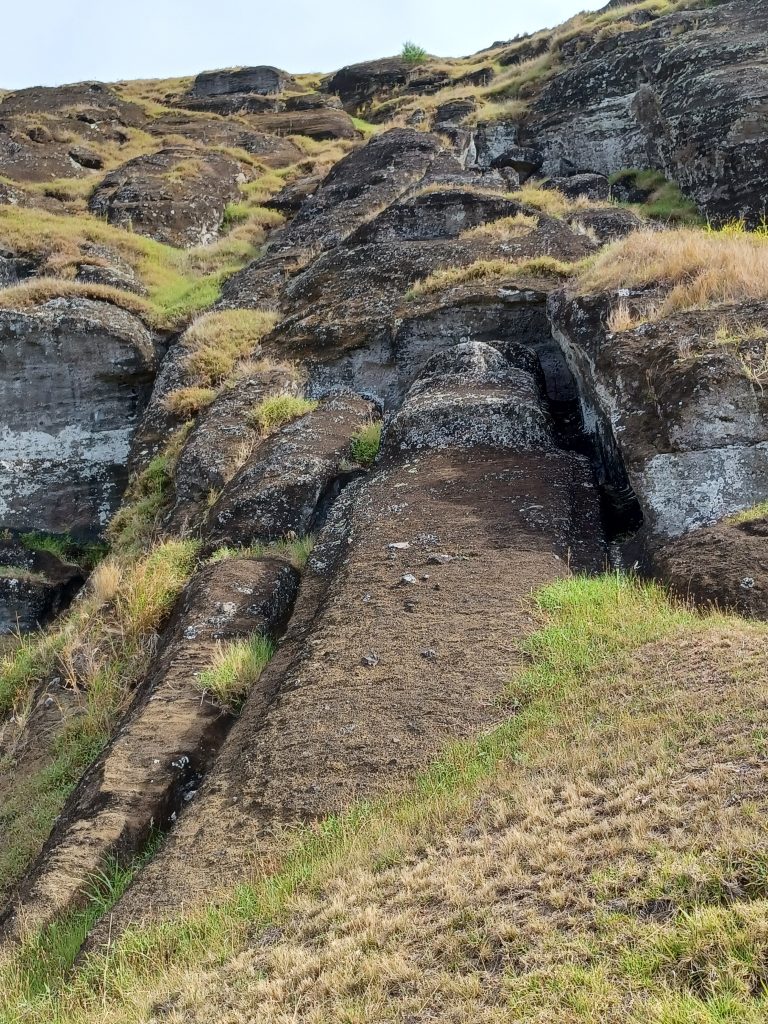
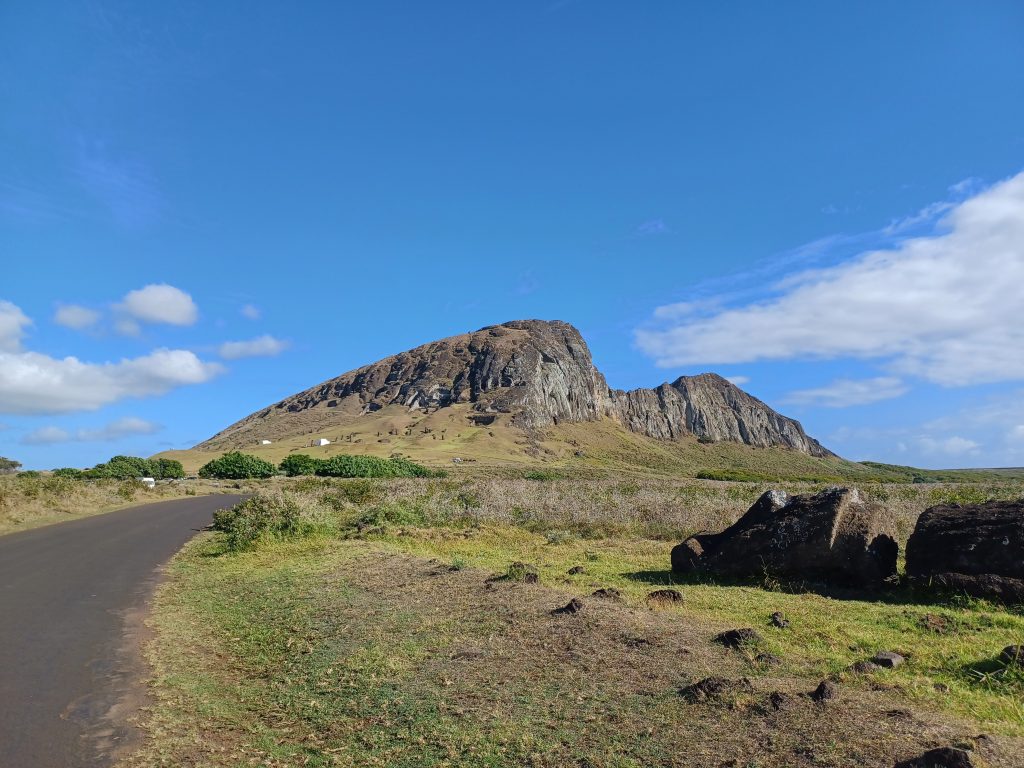
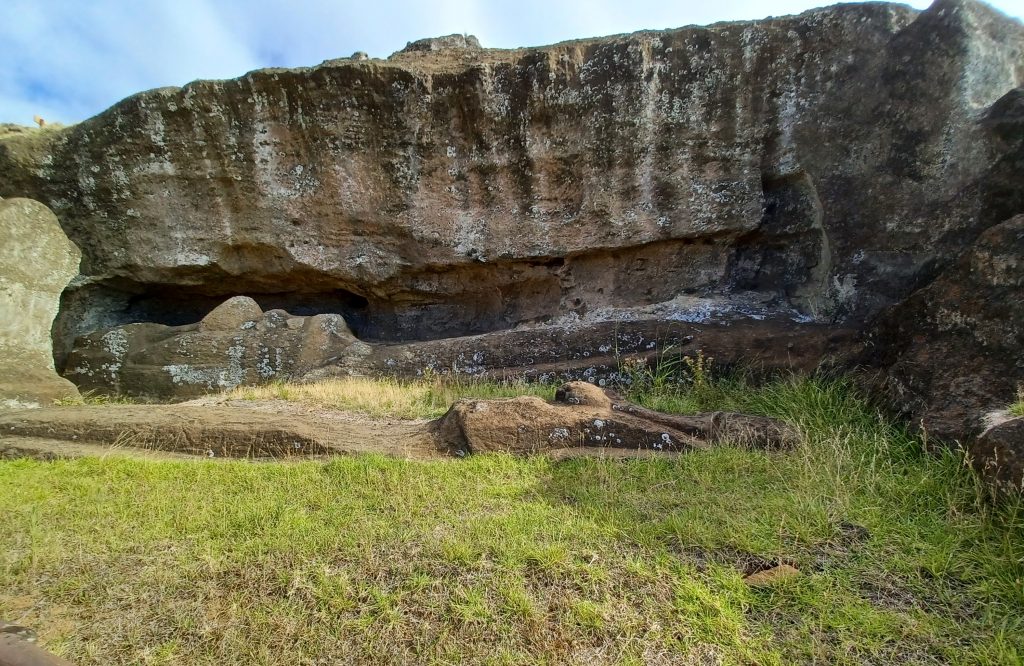
Now ascend to the quarry itself inside of which is a large recumbent moai. Carved but not removed. Made out of tuff. Tuff is softer than basalt, I understand, and thus easier to carve. The moai were carved with picks and smoothed with adzes, we are told. Another moai lies in front of the quarry and, upon closer inspection, one can make out many moai shapes in the rocks round about, which were started and never finished. Conspicuous noses poke out. And on the left side of the quarry is the largest moai ever carved, a colossus, still in situ at nearly twenty metres long. Named El Gigante. Good name.
Splendid view from here downhill over a large toppled statue, other moai dotted about and a little oasis of trees, sheltering within which is the National Park office and a few eateries. Backed by the sparkling Pacific.
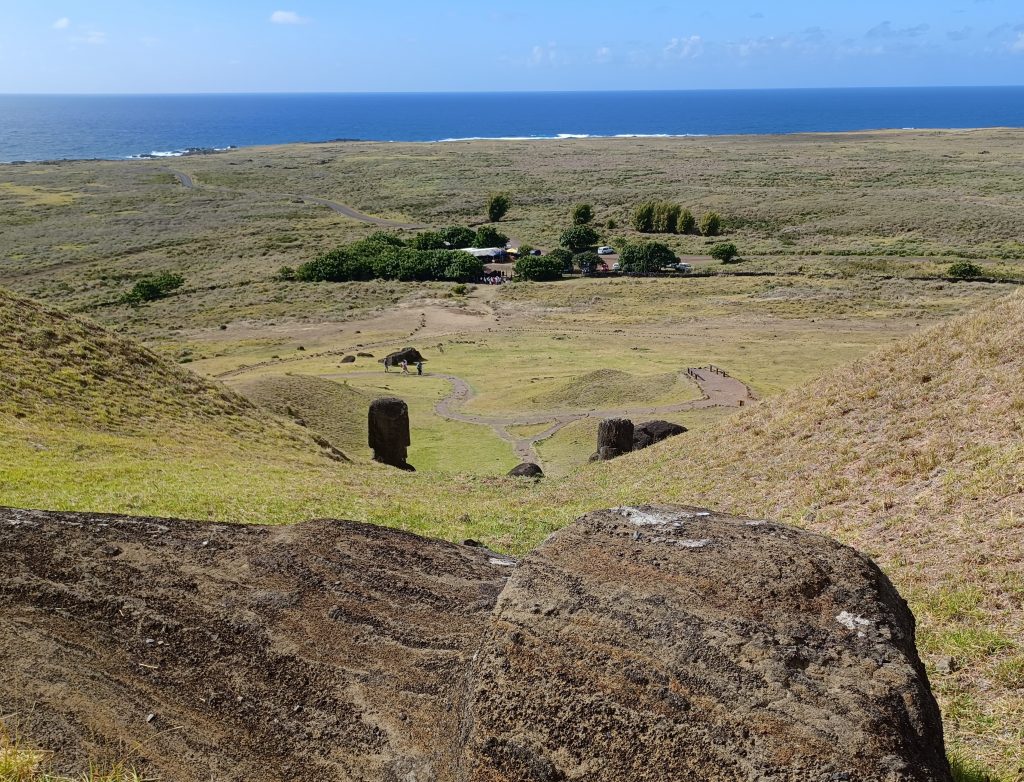
Continue along the path to a moai with a ship carved on its torso, signifying contact with western sailors, we are told. ‘Ko Kona He Roa’ is his name. Yoyo’s task here is to take photographs. Smirks and smiles and gawkish poses as, one by one, our pictures are taken.
Many more moai. Nearly a thousand were created on the island altogether. From the quarry, some were transported to their ahus. Quite how they were transported has intrigued archaeologists and laymen alike. Experiments have been carried out to ‘walk’ them along. Yoyo says that the bases of the moai are not horizontal but slanted at a slight angle so as to enable them to be rocked from side to side and thus walked along using ropes. Other theories have them transported on wooden rollers or sledges. Some fell down during transportation and lie where they fell.
Further along the path we encounter another moai with a prominent nose, called ‘Piropiro’. “The name means bad smell”. Due to said nose. Huge head. Thor Heyerdahl, the Norwegian explorer, visited Rapa Nui in 1956 wanting to investigate, among other things, how large this moai actually was. He dug down around Piropiro and found that the buried part was twice the height of his head, the largest moai ever extracted from the quarry. Heyerdahl it was who sailed, on his ‘Kon-Tiki’ expedition, on a balsa wood raft from the South American mainland to Polynesia in order to try to prove that the inhabitants of these islands came from there. Later proved wrong.
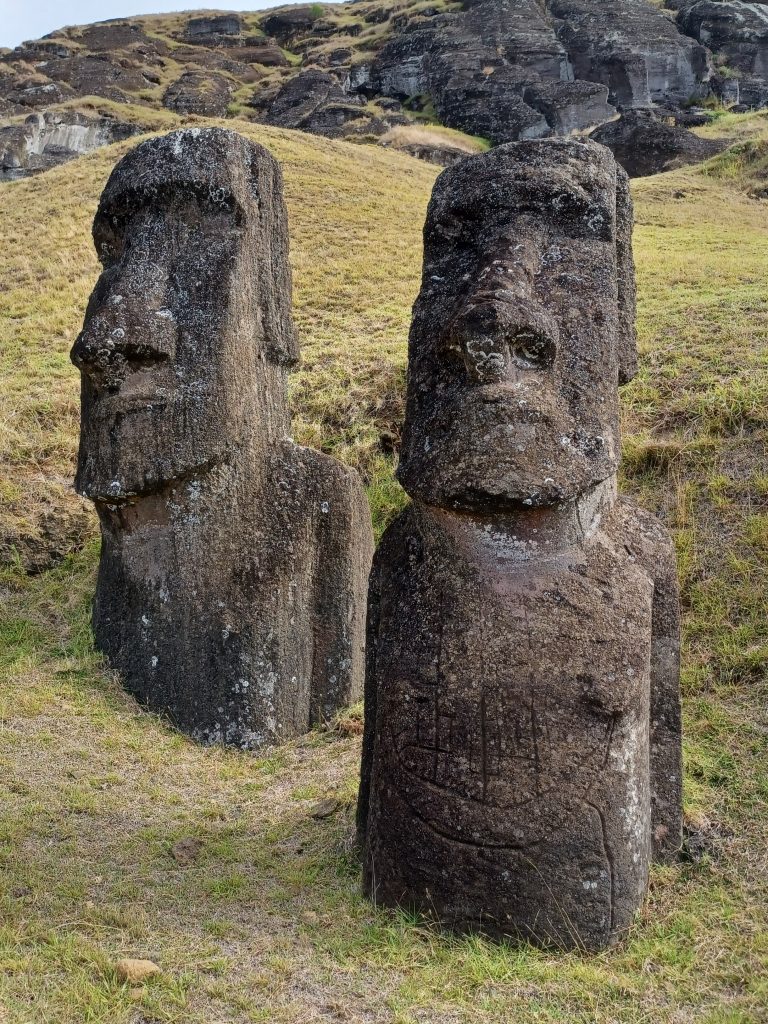
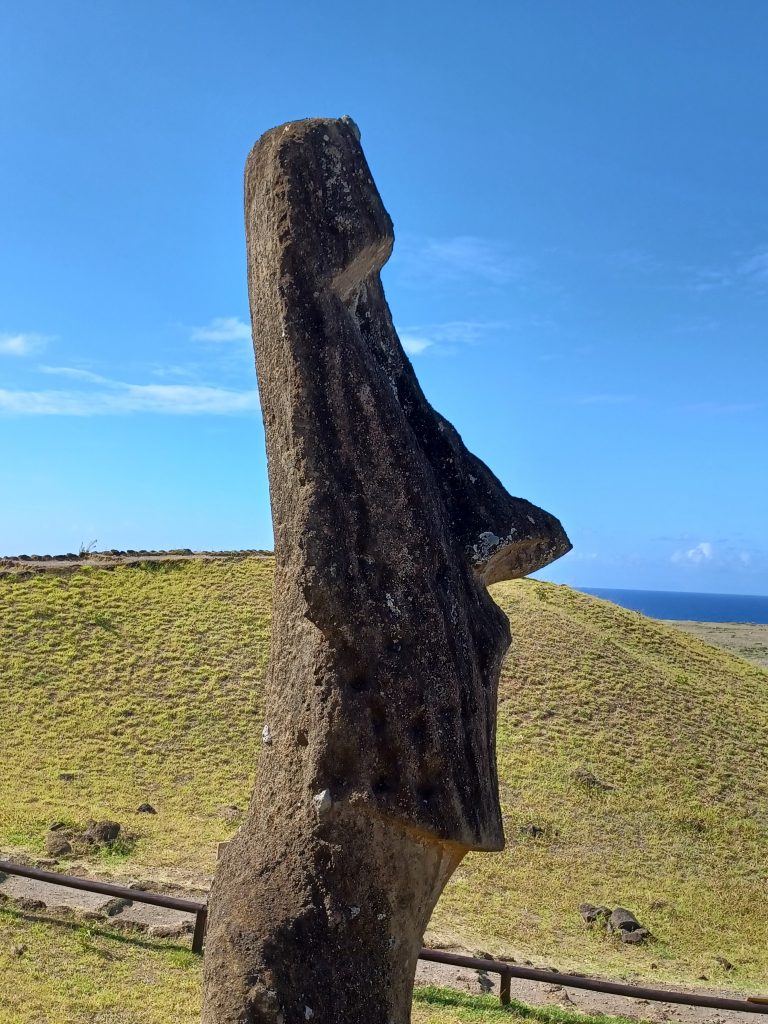
Some moai spout earrings, others tatoos, all are slightly different but most with long ears and that similar unfathomable pouting expression, mouth curved downwards. “Why are they all looking so unhappy?”, I ask. “Well, you cannot expect them to look happy going to their deaths” responds Yoyo with a sort of gloomy contentment. Bit tongue in cheek I feel. Indulgent smile. Some moai were used as target practice by Chilean military personnel and are pockmarked with holes. “Look here”, it is pointed out with some peevishness. Hmm OK.
Ahu Tongariki
Time now to descend the pathways and exit the site. As we walk down, a stunning view over Ahu Tongariki, a short distance south-east of us, appears. Background of silver sea and ancient headlands.
Drive slowly towards the ahu, then walk the final few hundred yards to the entrance via an unmade road, then uphill alongside a lava wall to be greeted by a large moai. This one is known as the ‘Travelling Moai’ as it toured Japan after the restoration of this site by a joint Japanese and Chilean team. A diuca finch has taken up residence on his head. The fifteen moai atop the ahu were all toppled during the conflicts of the 17th century, according to a notice here. As before mentioned, the two tribes were probably fighting over diminishing resources, but there are various theories about what happened and the demise of this culture, too detailed to go into here.
Anyway, one of our number enquires as to how much the restoration of Ahu Tongariki cost. “Two million US dollars” is the reply. Funded by the Japanese government.
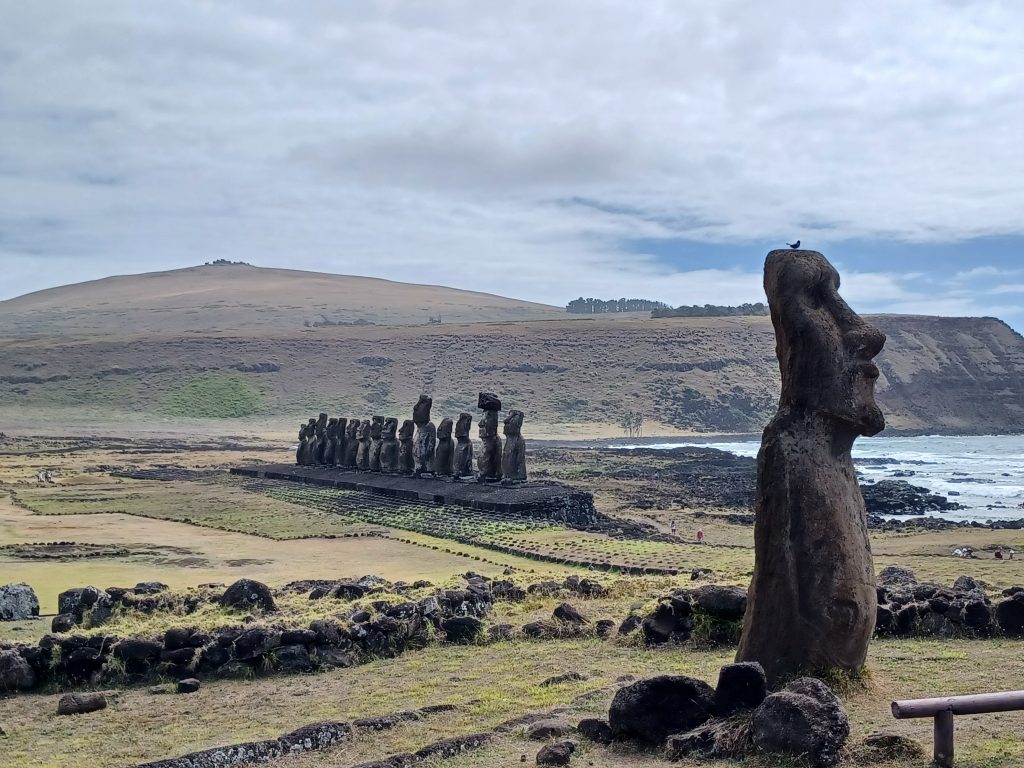
We walk up close to the ahu, in which were buried a bone or bones, in stone boxes, of fifteen high ranking people. The fifteen moai would then have been placed on top. The chief is the tallest. Only when the moai were finally fixed and upright on their ahu could their eyes be inserted. These were made of white coral with obsidian or tuff in the centre. The moai spirits would then rise up through the statues and open their eyes. Thus, eminently equipped to watch over their descendants.
Only one moai had its top knot replaced during the restoration as a gesture to see what they would all have looked like before the tsunami of 1960 took the moai inland and scattered their top knots and torsos all over the place. Yoyo emphasises the role played by Katherine Routledge, a British archaeologist who visited in 1914 and made the first true survey of the island, took photos and documented the moai.
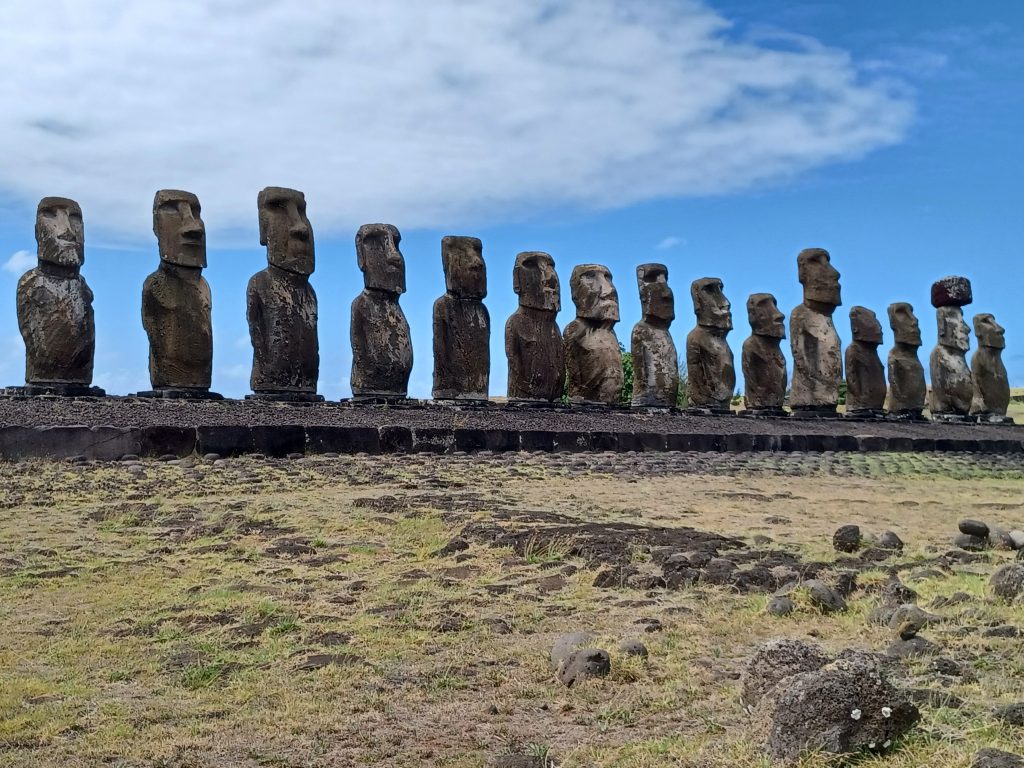
The moai, at that time, were in recumbent posture, after being toppled in the wars, but still in situ (before the tsunami). She excavated over thirty moai. She also interviewed the elders on a leper colony, who had tatoos on their backs, like the moai here. The missionaries had suppressed the tattooing tradition. This meant that Katherine Routledge’s records from her interviews were the main source of knowledge to later scholars. Her work much assisted in the piecing together of the moai and re-assembling the platform, which is the largest on the island at 720 feet long. The moai here all look inland, silent spectators of Rapa Nui’s past. Awesome.
Also here at Tongariki have been found hundreds of petroglyphs carved onto the flattish eroded tops of exposed lava. Depicting animals, birds, turtles and some of tuna fish, including a large one with holes in. Tuna was clearly an important part of the diet, as it still is, a major menu item in Rapa Nui’s restaurants. Amongst the glyphs are some of the Birdman (see Chile, Part 3: Easter Island).
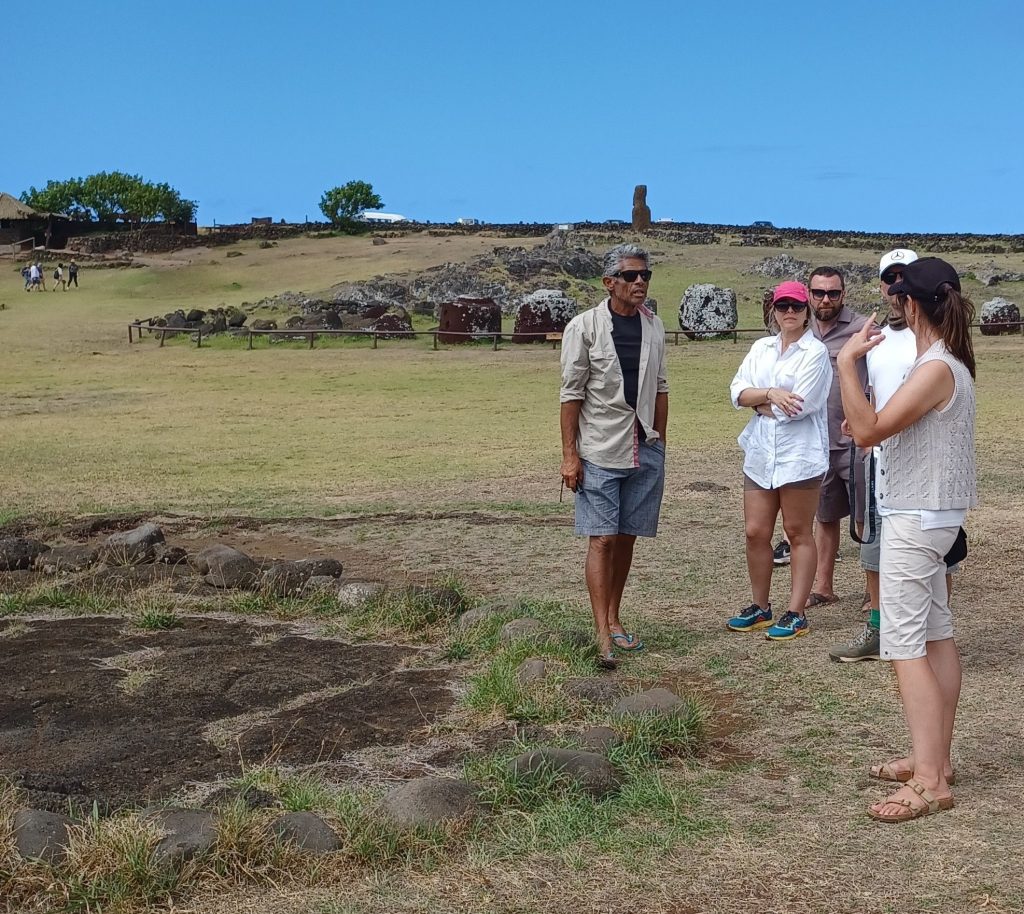
A bunch of smaller chunky moai heads with short ears and different shaped eyes has been clustered together within a low wall. Guessing that they are earlier and represented a different tribe. But missed that part of the narrative.
Anakena Beach
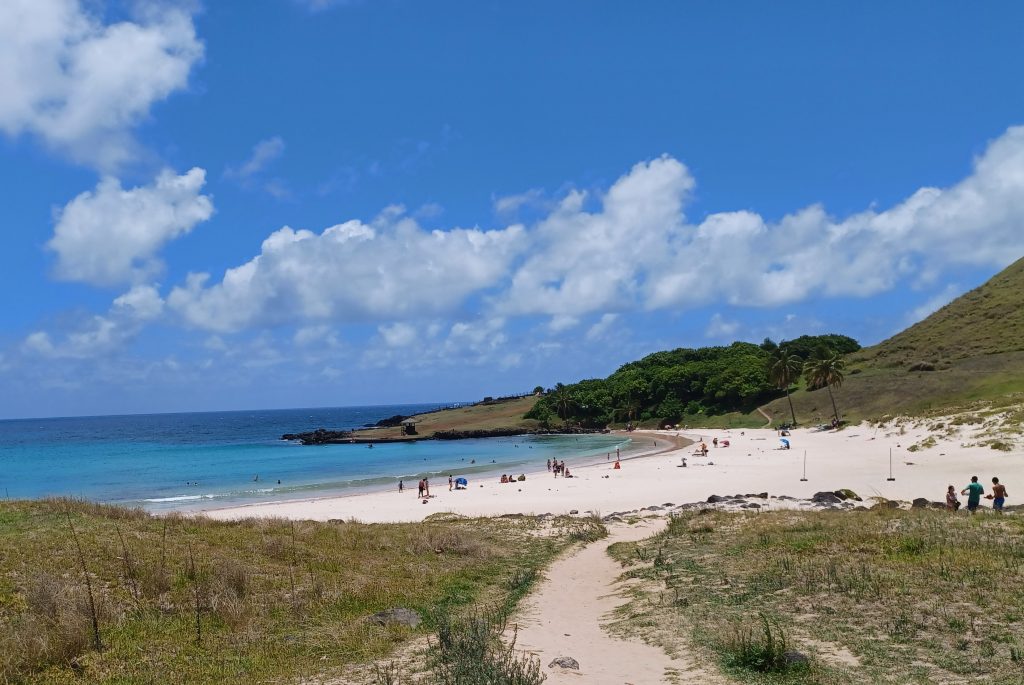
We head now to the lunchtime stop at Anakena beach. An exquisite beach. A white coral sand crescent, with turquoise waters. Calm and soothing. Popular with the locals as it is the only beach on the island where one is permitted to swim. Here it was that the legendary Hotu Matu’a landed from what is thought to have been the Marquesas Islands in his, probably, two hulled canoe. Behind the beach are two ahu with their moai and, shaded by palms trees, a few tasteful eateries offering tuna fish, of course, and empanadas, and other local delicacies, and drinks. From the refreshment area one can spot one ahu, Ahu Nau Nau, with four of its moai, their top knots intact, between the palms.
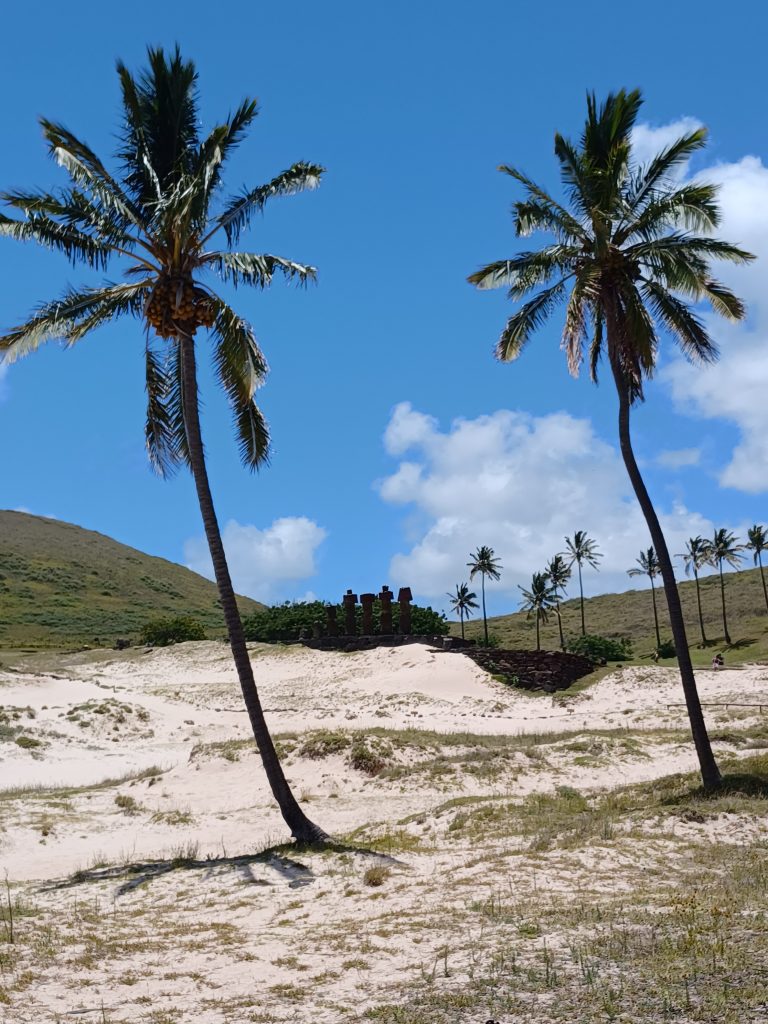
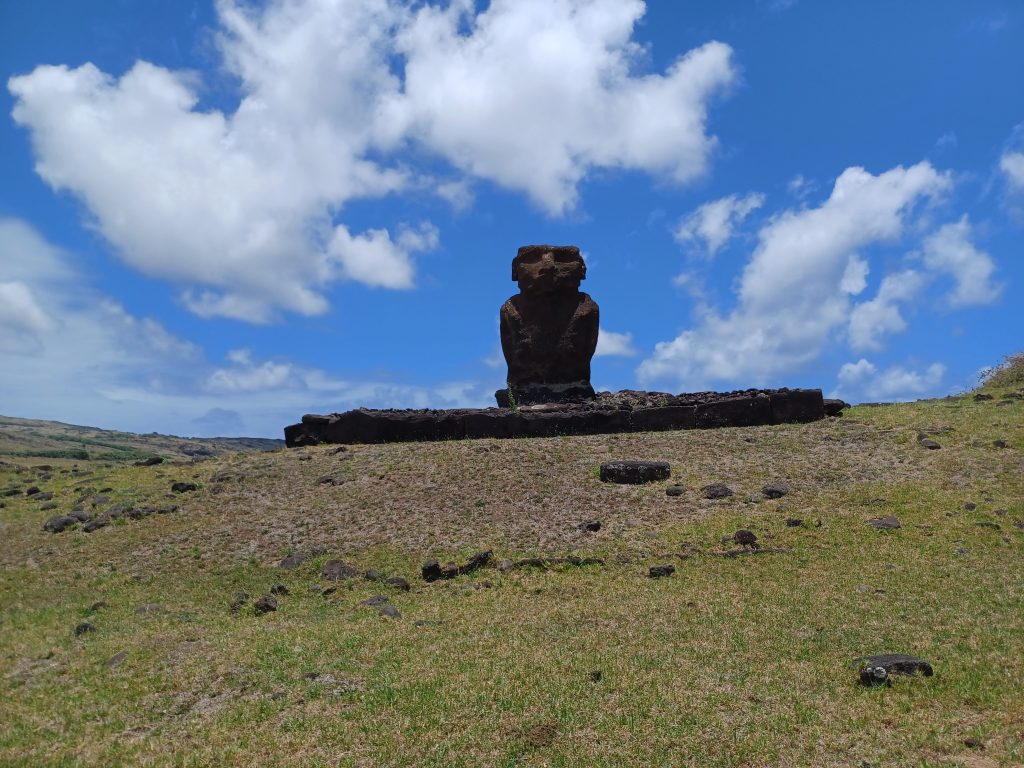
I wander over to Ahu Nau Nau after lunch to peruse the seven moai up close. Not much left of two of them and the other is bereft of its top knot. Then to a moai, all on its own up the sandy slope on the other side of the beach. This is Ahu Ature Huki, re-erected by Thor Heyerdahl during his visit in 1956. Why Ature Huki is on his own is a bit of a mystery. Yoyo is having lunch. I will interrogate him anon. Anyway, the enticing beach beckons. It is hot. I paddle in the waters.
And so endeth the first day of exploration.
At the hotel later, I meet up with a couple of solo female travellers, and we dine together in an atmospheric restaurant. Plenty of fine eateries about. Raw tuna is on offer, as is usual. Prefer the cooked form personally, especially after my experience yesterday. Anyway, fried fish now arrives in abundance. Over abundance. Jolly tasty but consume only about half of it. Perhaps less. Ample portions served everywhere on the island in fact.
Back to the hotel. The dead cockroaches are still in situ behind the bathroom door. Perhaps they deter live ones. A hasty shower before slumber and the next day’s adventure.
Leave a Reply