
Ana Te Pahu
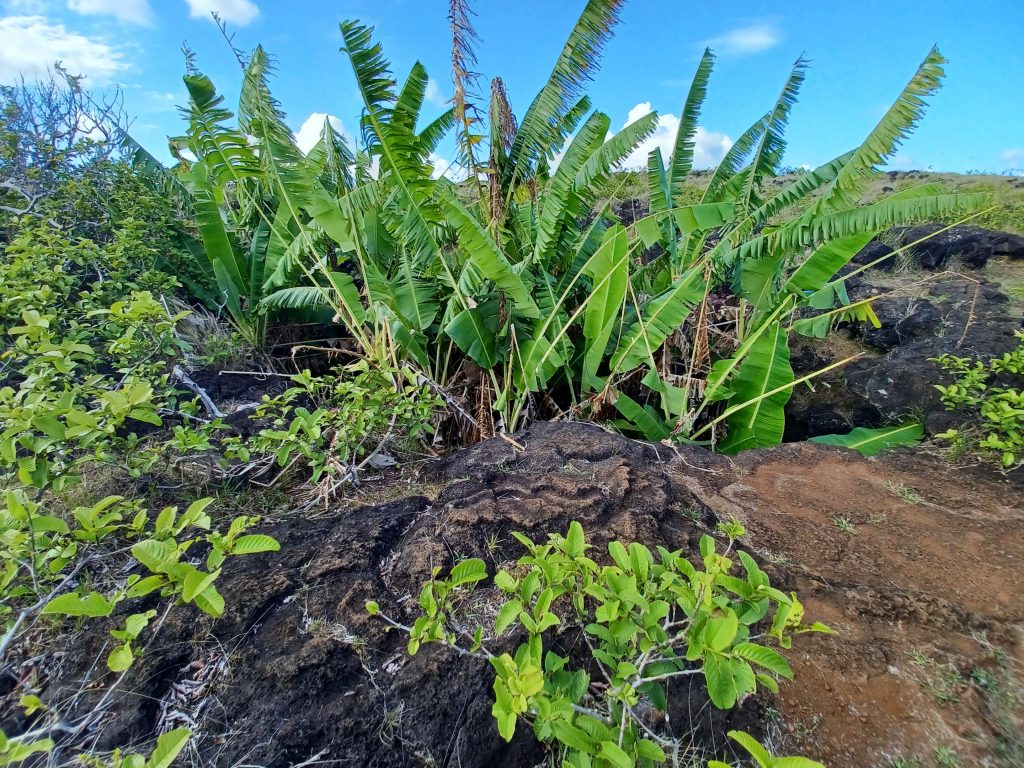
Our first stop today is at an area of collapsed lava tubes with gaping mouths. Inside the main cave here, Ana Te Pahu, after which the site is named, bananas are growing. The leaves poke out of it. Some bunches of green bananas droop from its branches. Also vines are grown in this cave, brought in by Frenchmen, I gather. So why cultivate plants in lava tubes? The mid-17th century catastrophe, a drought perhaps, resulted in the disappearance of most of the species of trees. Despite having deforested large areas, the islanders still had plenty of trees to harvest before this time, sufficient to construct their boats and houses and provide cooking fuel.
After the catastrophe, they were deficient in the necessary wood for their needs. Grass was used for cooking. This has been proven through dating of the charcoal as well as pollen analysis. A barren island then, with thin and dry surface soils, so the islanders began to use lava tubes for cultivation. The soils inside are deeper and damper.
The disaster also caused the collapse of the moai cult, civil war, and the toppling of the statues, as we have seen.
We pass by a few other lava tubes. Fig trees grow in one of them and a rose apple tree bristling with white coloured fruit in another. “Would you like to try it?” “Oh yes”. Yoyo reaches up and plucks a few for us. Crunchy and sweet. Rather good. These tubes are apparently interconnected underground forming a seven kilometres long cave system. Speleologists rejoice!
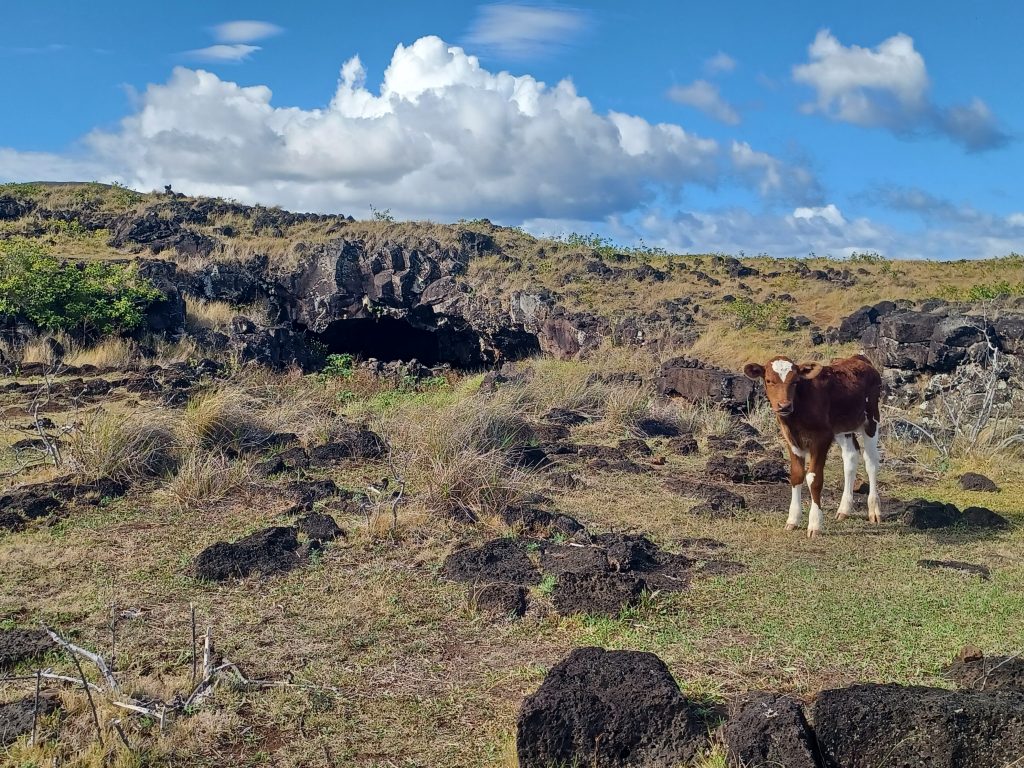
Cattle are roaming about the area and a calf stands placidly near the entrance to another lava tube. The grass is quite short and littered with lava along with shards of obsidian, the shiny black glassy volcanic rock, much used to make tools, such as knives, by the ancients. I pick up a bit of obsidian from the ground. Smooth and cold. Lots of shards scattered about here. One dead cow too, decomposing slowly.
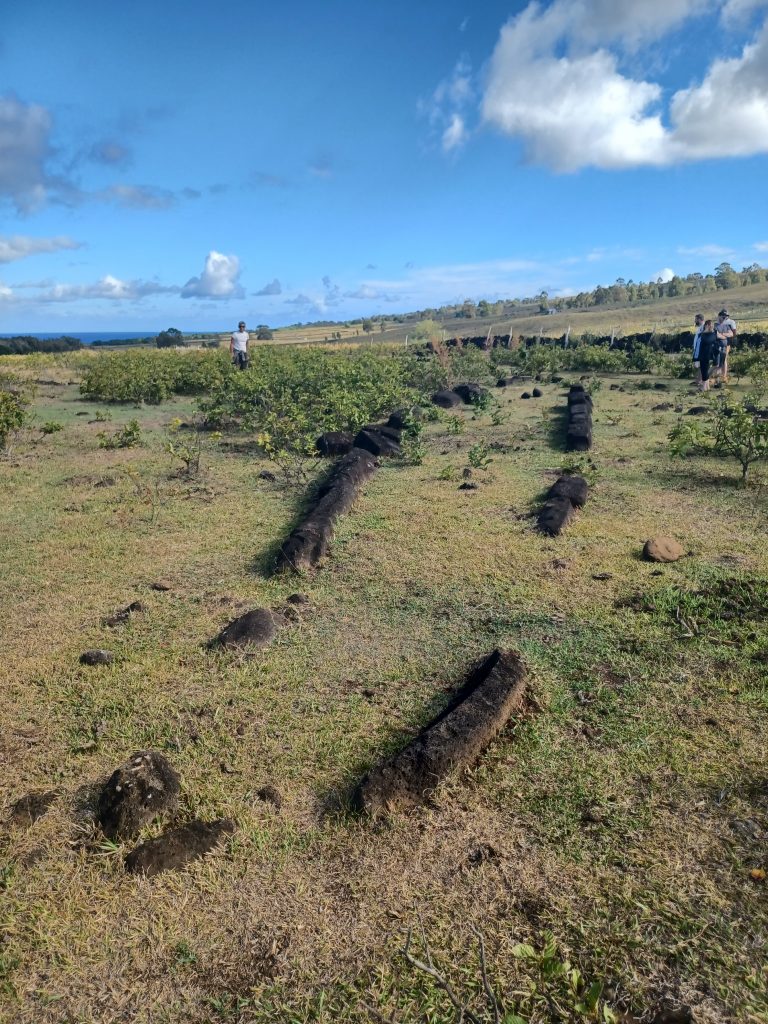
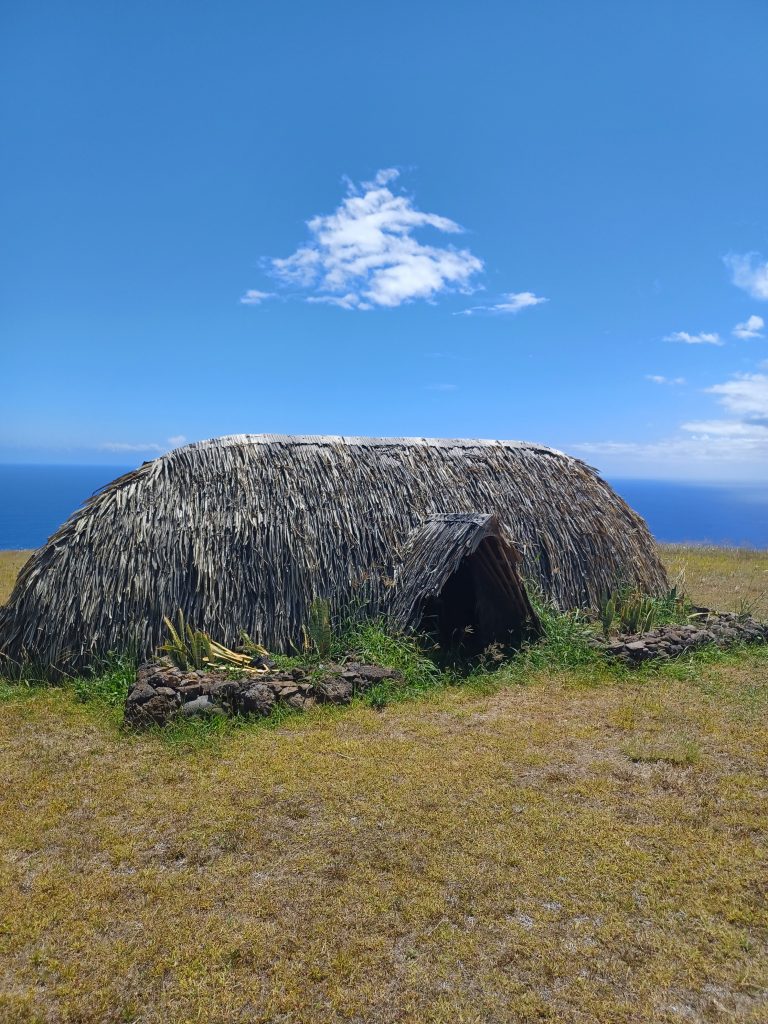
This area was once inhabited by families who each had a strip of land. The basalt foundations of some of their old houses are still visible. Long and narrow. They would have been covered with reeds or grasses on a framework of poles. We were to see a reconstructed one at Orongo later. Their gardens were surrounded by stone walls, known as ‘manavai,’ which protected plants from the wind and retained moisture.
There are lava walls here too, built by the Scottish, we are informed, to keep the sheep in. Oh. Apparently, in the 19th century the island was leased by the Chilean Government to sheep farmers from Scotland. There were as many as 60,000 sheep at one time, ravishing the delicate flora. And the islanders themselves were confined to Hanga Roa, not receiving Chilean citizenship until 1966. Theirs has not been a happy history I feel.
Ahu Akivi
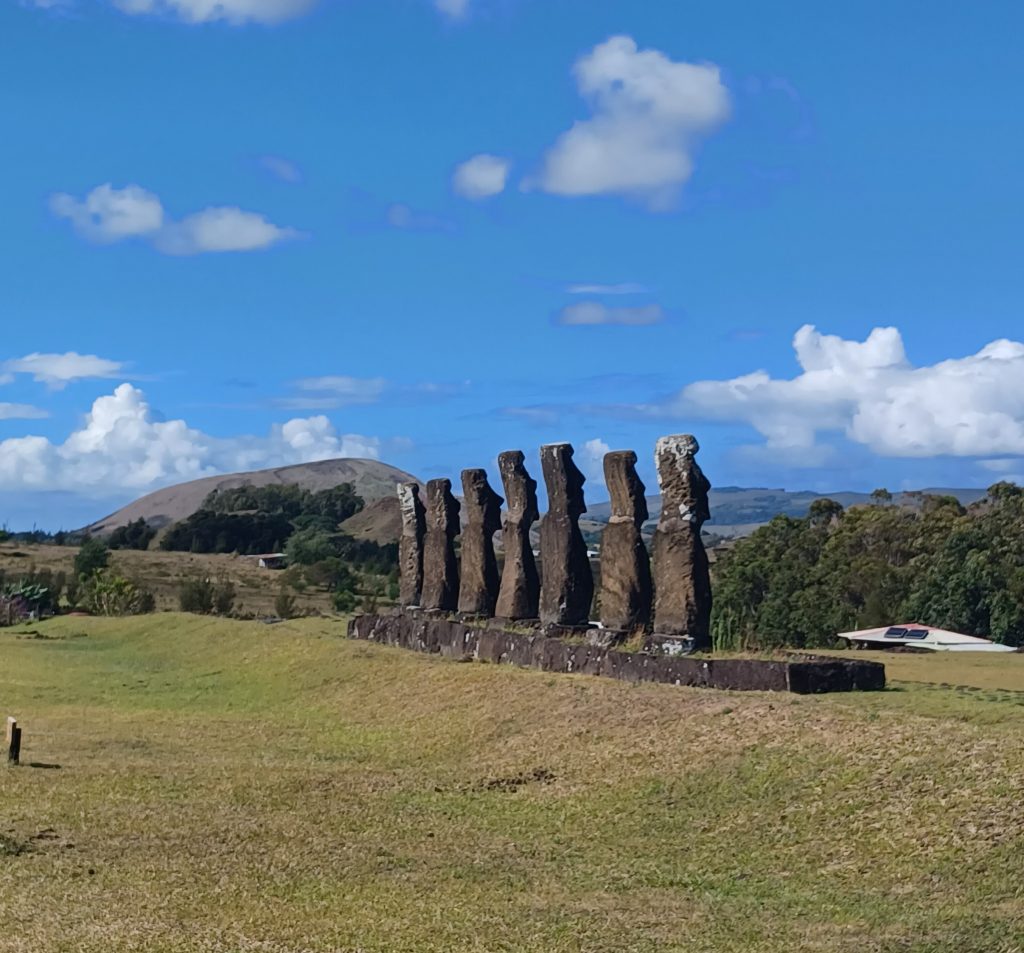
Ahu Akivi, where seven huge heads and torsos sit solemnly atop their ahu, is the next stop. Not directly on the coast, but a mile or so inland, unlike the other ahu, and located several miles from the Rano Raraku quarry. There they were carved from tuff and thence transported here. Ahu Akivi was built as an astronomical observatory on an east-west axis, and the moai face the sunset precisely at the times of the Spring and Autumn equinoxes. A sacred site then. National Park permits stamped at the entrance and we wander in.
The seven moai, of more or less equal height, gaze out onto the Pacific Ocean, unlike the others on the island, who look inland. The sun, not being in the best position to enable photographing the moai from the front, we snap them from behind. Etched onto their backs are tattoos, which in old times would show what their occupations were, Yoyo tells us. Interesting. These moai were reassembled by an American, William Mulloy, in 1960.
I venture to ask whether there are any female moai. Stupefied look. Must be a silly question. No. Male chiefs presided and it is they that are represented by the moai. Silly me. As if. Mind you, this has been contradicted by some, who say there are some female representations, notably at Ahu Vinapu, which we will see later.
Puna Pau
The civil war between the north and south clans, which resulted in the toppling of the moai, also separated their top knots (pukao) from the main statues. The top knots were made from red scoria, found in another quarry at Puna Pau, to which we now head.
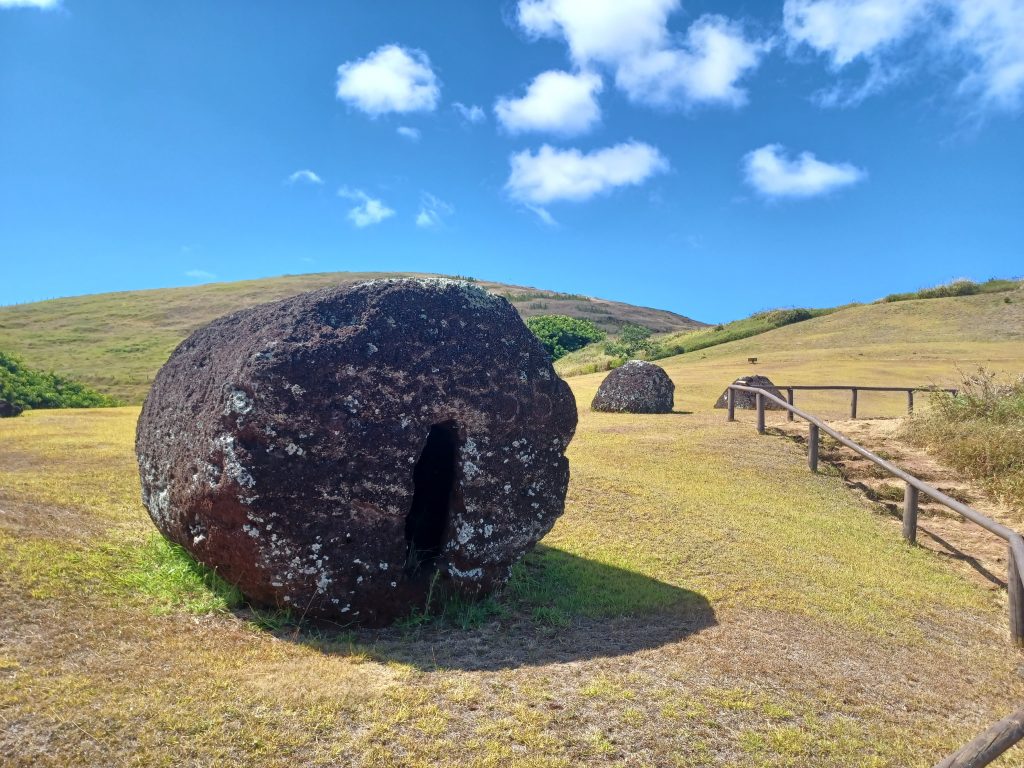
The quarry is within the Puna Pau volcano and the pukao, shaped like cylinders, are strewn all over the place, some bunched at the bottom of the hill. “The shape makes it easy for them to roll down”. Clearly. A German archaeologist etched numbers into the pukao in an attempt to categorise them I suppose. Number 35, pictured, has a narrow opening half way down, supposedly to slot it atop the moai head. Tracings of carvings are to be found on some of them.
The pathway up the hillslope to the quarry is covered with non-slip material in places over the red slippery earth. Hand rails too. We toil up said slope. Not much to see in the quarry, it being smothered by vegetation right now. There are, we are told, ancient tools underneath and other interesting artifacts.
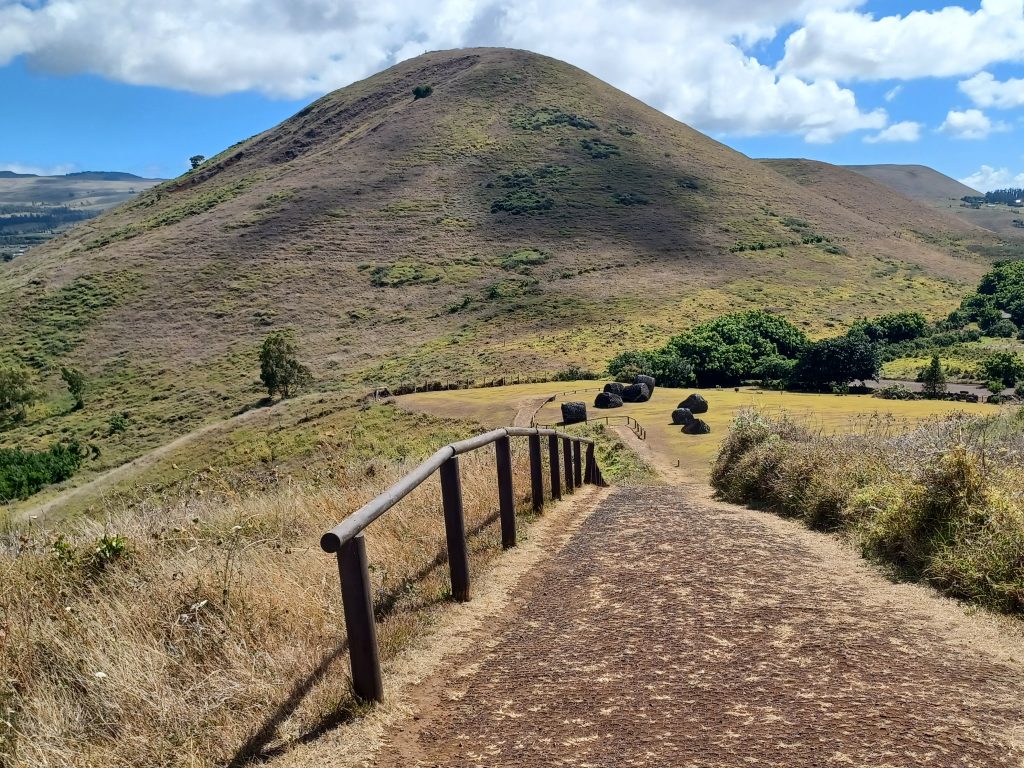
Good view from here. We can see the Peace boat cruise ship anchored off the coast and the habitations of Hanga Roa behind. When he grew up, Yoyo tells us, the town only stretched about half the distance that it does now with a population of around two thousand. It is now nearer ten thousand. Many come here for the tourist trade but “foreigners are not allowed to stay here unless they marry a local”.
The island relies vastly on tourism, says he, which did the citizens no favours during the Covid 19 pandemic. Trade has picked up a lot since then, and the number of visitors vastly exceeds the number of locals. I get the feeling that our guide takes a dimmish view of this tourist influx, despite the revenue it brings. Currently there are fourteen flights in to the island per week. Almost 500 people were aboard the LATAM flight I arrived on. And we were preceded, the same day, by another aircraft from Santiago of a similar size.
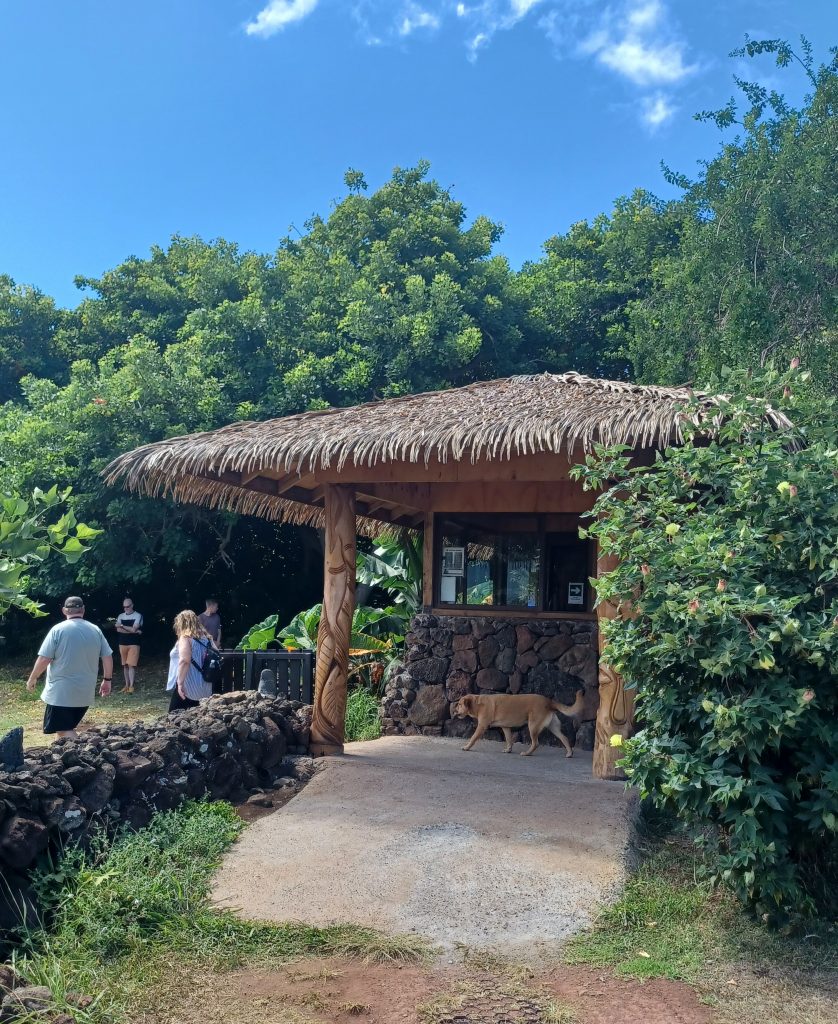
Anyway, having now had our fill of pukao, we skid back to the bottom of the slope to exit in front of the National Park Office permit stamper. Housed in a wooden building supported by posts adorned with fish carvings holding up what appears to be a palm frond roof. “Ah, the roof is made of plastic imported from Canada,” Yoyo states. I would have thought that would be a state secret. Rather spoils the impression of rustic huts and sustainability. Looks realistic though. A dog patters by in front of the hut. No permit stamp necessary.
Ahu Vinapu
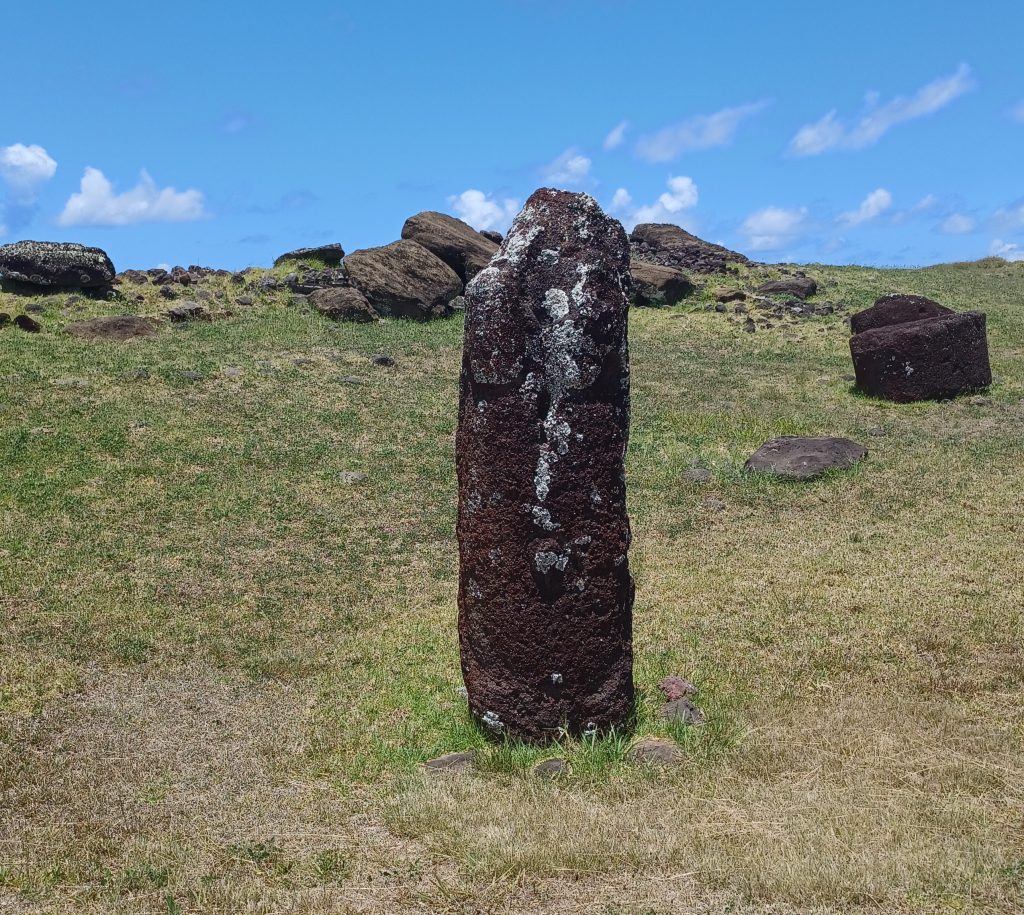
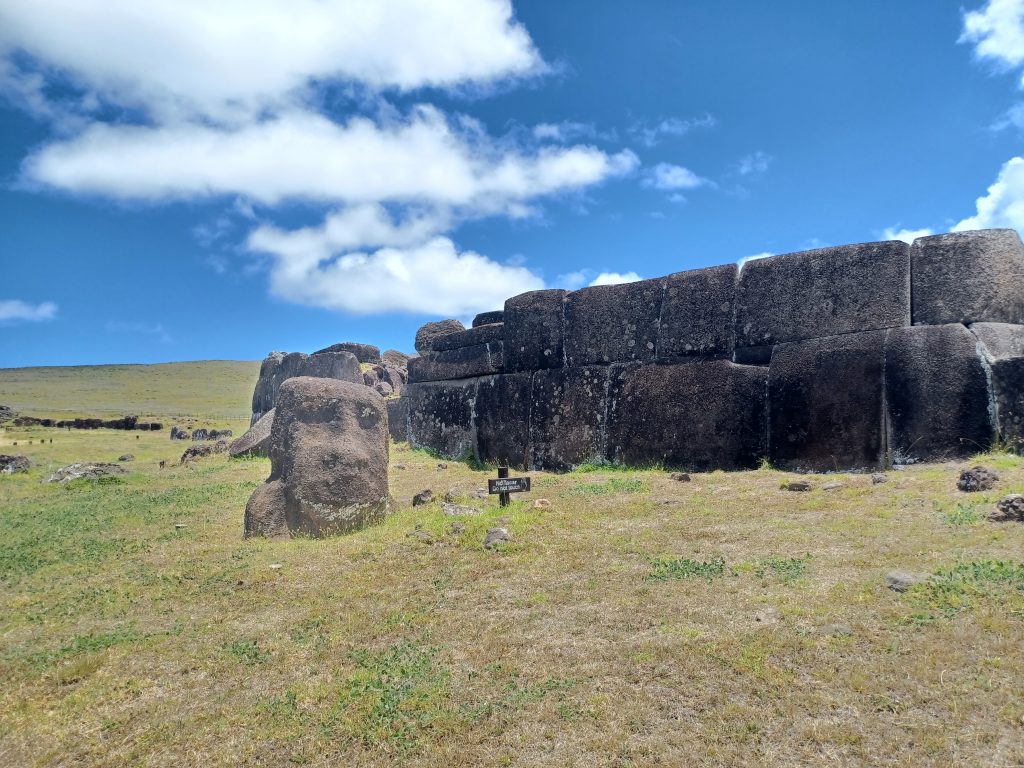
We continue our drive on potholed tarmac and/or unmade roads, taking in mouthfuls of red dust flying up in the wake of the minibus, which our young driver is zealously following. Perhaps he is unaware of the choking qualities of said dust churning through the open windows. Anyway, we arrive at Ahu Vinapu, where there is a strange headless and, apparently female, moai, consisting of a reddish column much eroded and made of the same stuff as the pukao from Puna Pau. Bears no resemblance to the male moai.
The story goes, we are told, that a visiting Englishman, sometime in the 18th century, was a bit fascinated by this statue and sketched what he thought he could see carved on the front of it. These included the female sex symbol, fingers, two breasts, and two heads. Yoyo tries to trace the breasts and an arm and a V shape at the bottom. Bit tricky to make it all out. Requires some imagination. Not quite convinced. Anyway, a missionary, who was endeavouring to convert the natives, took offence at the Englishman’s drawing, representing the moai, and requested the locals to remove the two heads. They did.
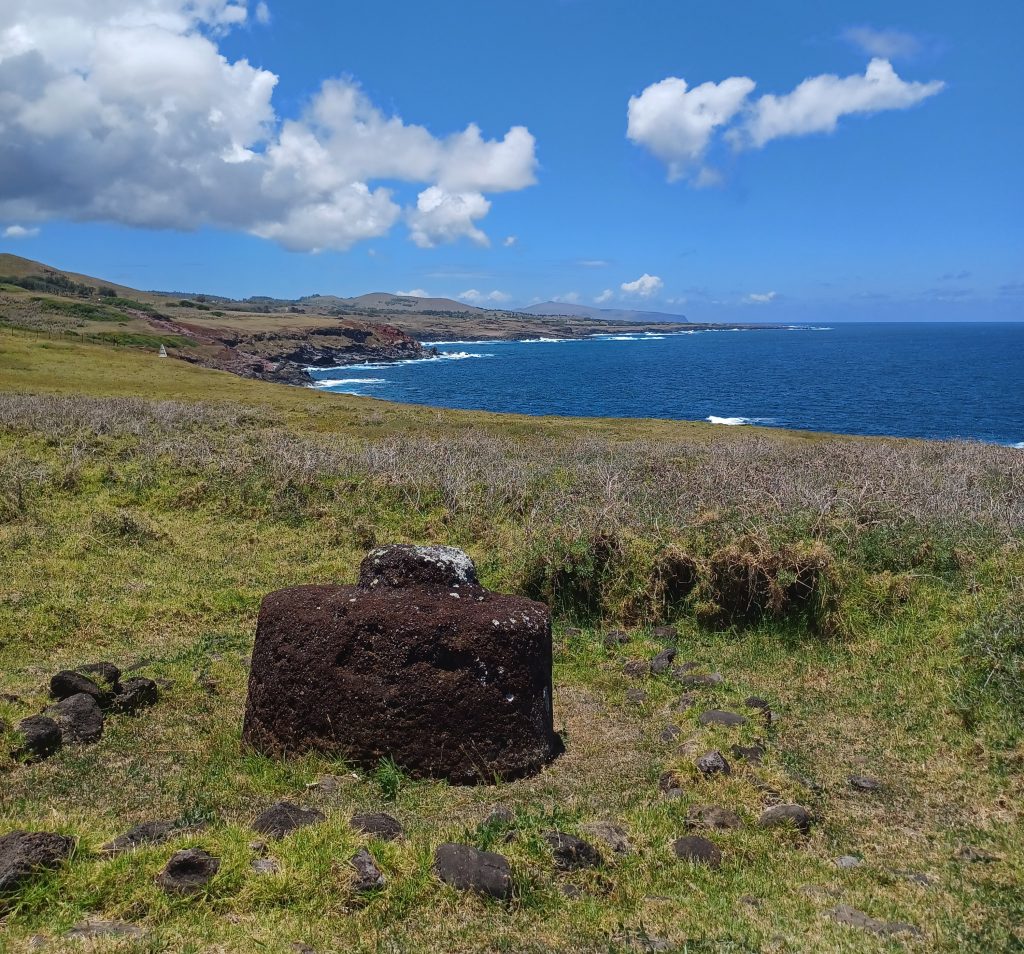
A pukao squats close by surrounded by a circular low boundary of scoria chunks and some toppled moai lie facedown on the grass. Another glorious view over the Pacific Ocean and blue sky. Fluffy clouds scud about. Bit windy. Got to hold onto my hat. Long peaked. What with hat, the binoculars bouncing around my neck, sun glasses dangling from a red string, and phone in my free hand, in a force 6 or 7, it is all a bit tricky to snap pictures.
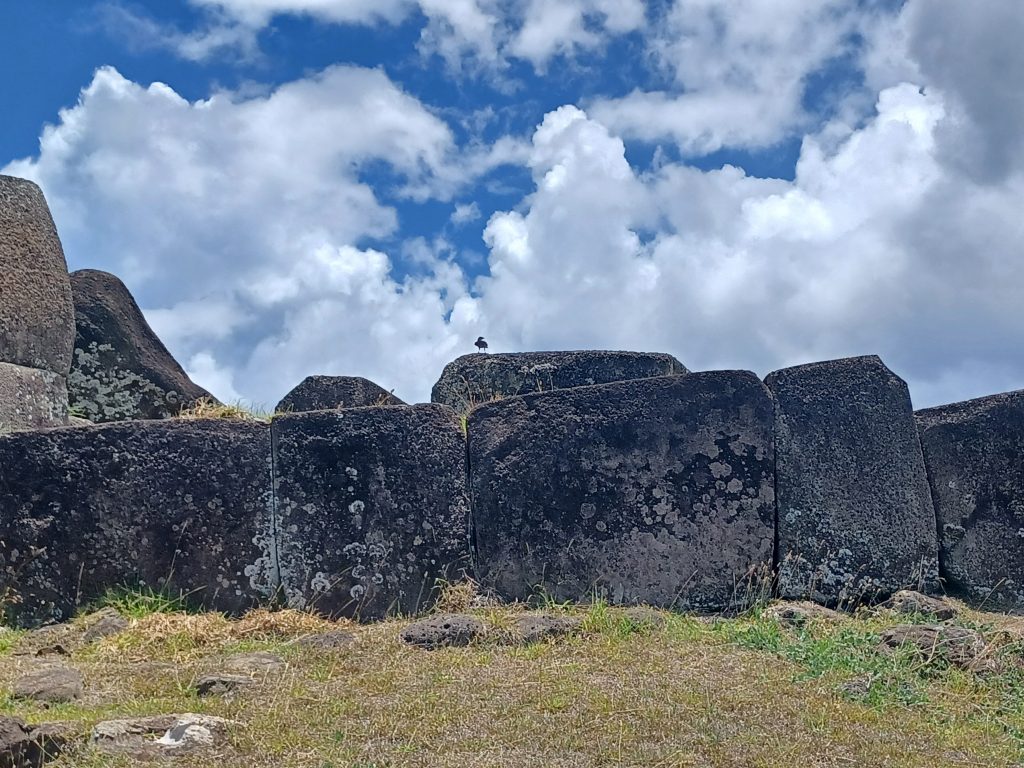
Anyway, we wander along a bit further to inspect another ahu. The local diuca finches are flitting everywhere, perching upon it and chirping. Manage to photograph one atop the tightly assembled stone blocks of basalt of this ahu. So well fitted together that some believe that this megalithic platform was built by the Incas. This theory has been discredited. At the back of this structure would have been placed the remains of the ancestor in a stone box. No moai atop this one. All toppled. Just a few scattered around, one partially buried.
Rano Kau
Thence to Rano Kau, a volcanic crater on the southwest of the island. Over a kilometre in diameter, it is a staggering sight with its freshwater wetlands inside. Blue and green shades with the sparkling sea beyond. Plenty of fruit trees surround the wetlands, which the locals scramble down into the crater to pick. Not permitted for tourists to descend therein. Steep sides. One can hike round the rim if one wants though. Reminds me of the crater on Faial (see Azores) that hikers can tramp round. This one is more beautiful to behold though.
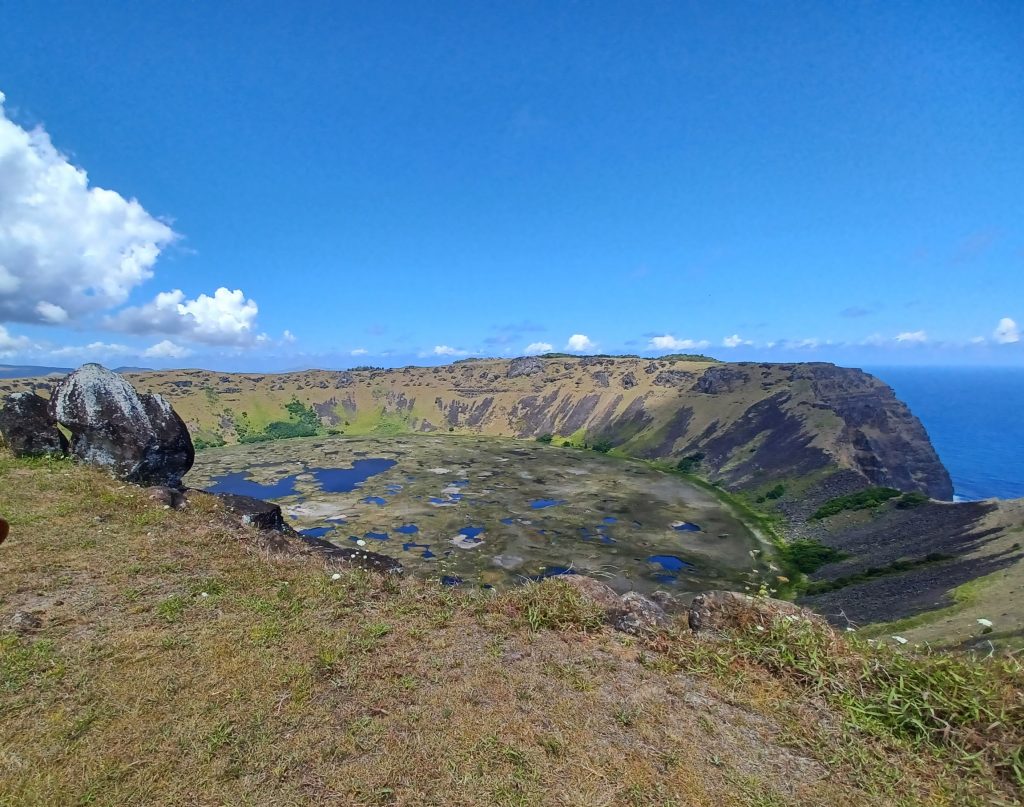
No fish in it, it seems. Otherwise I guess there would be birdlife. Not many of them around, birds I mean. Just those pretty little diuca finches hopping about everywhere and the handsome chimango caracara bird of prey, several of which I have seen scouring the hills. Trouble is, they prey on other birds.
Orongo
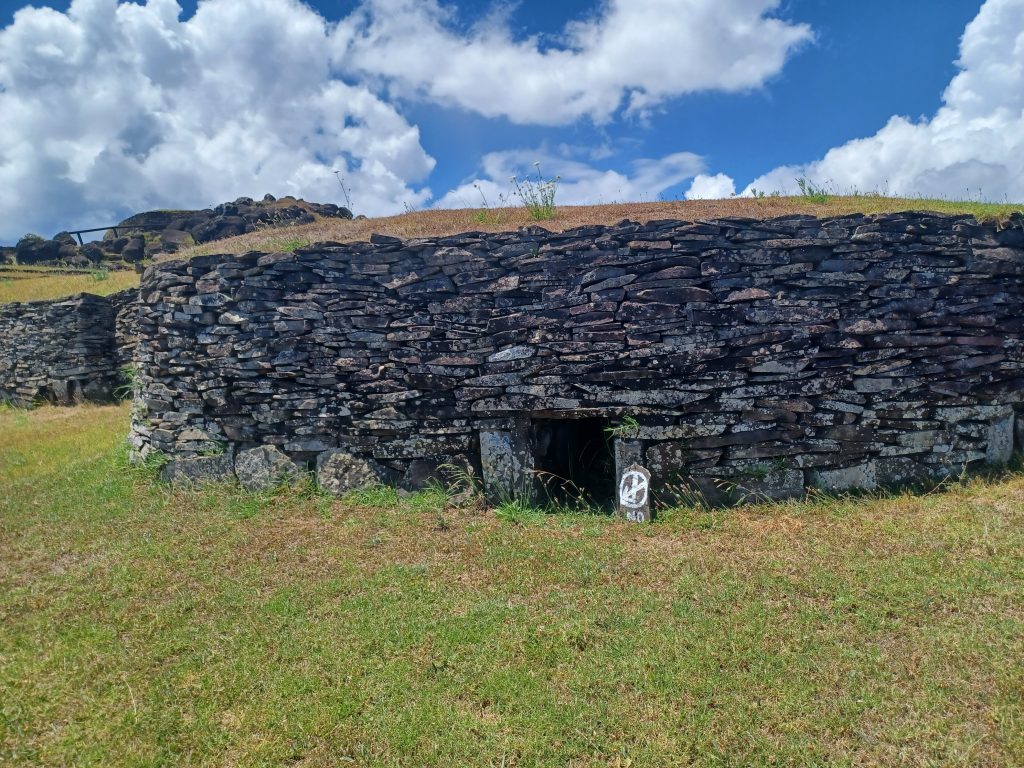
After the trees had disappeared in the 17th century and Ariki Mau had proved powerless to do anything about the drought or whatever the natural catastrophe was, the cult of the moai was replaced with that of the Birdman or Tangata Manu in the Rapa Nui language. The ceremonial village where this cult’s rituals, dedicated to the creator god, Make Make, were carried out, was based on the west side of Rano Kau crater on the edge of a narrow clifftop. Named Orongo. The village consisted of 53, now reconstructed, houses of flat stones. Very small doors, I notice. There were paintings inside on the walls, we are told, in natural red, black and white pigments, of anthropomorphic figures, ceremonial oars and boats.
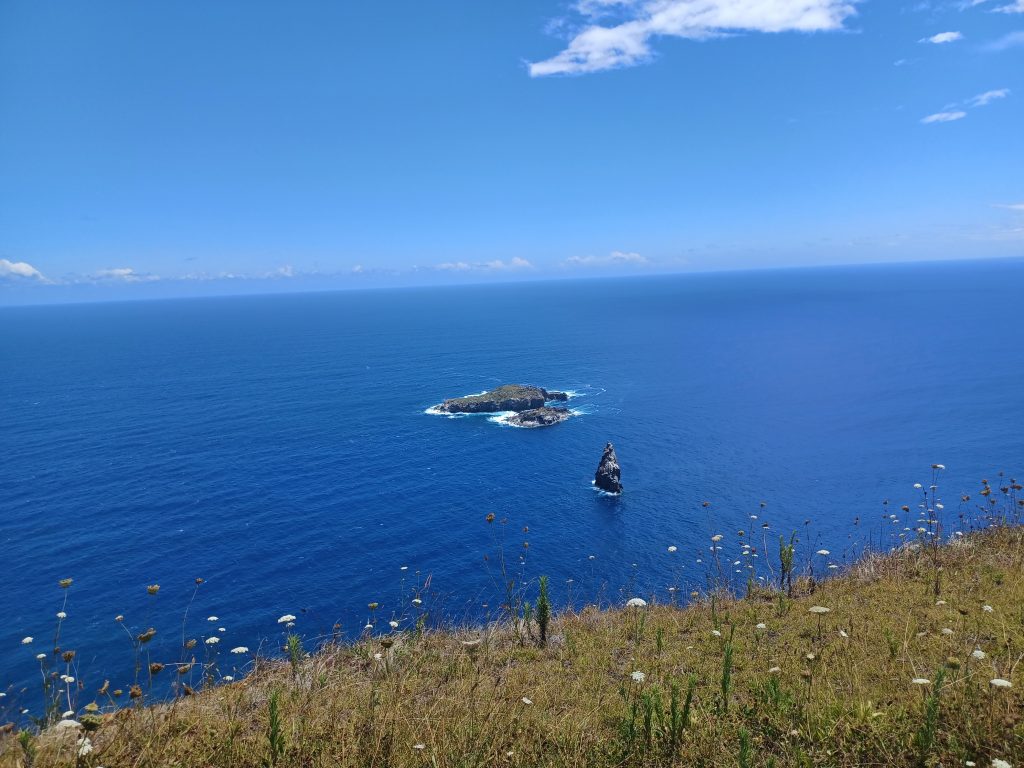
Orongo was occupied in Spring to prepare for the annual competition in which young men, some being representatives of various chiefs, would clamber down the steep cliffsides and swim across to Motu Nui island, over one kilometre away, to grab the egg of a sooty tern, a migratory bird. Assuming a safe arrival, having dodged sharks, not fallen down the cliff or drowned en route, these competitors could be on this tiny island for days, even weeks, awaiting the arrival and nesting of the birds. He who brought an intact egg back first, guided by Make Make, was the next Birdman for the year. He, being closer to the gods, achieved a high social status with associated privileges and gifts. He was in seclusion in one of the houses for the year, apparently.
There are hundreds of petroglyphs here on the rim of Rano Kau. They depict Make Make, the Creator God, and Tangata Manu, the Birdman, as well as all sorts of birds, turtles and fish and other motifs. The Birdman is depicted in three petroglyphs in a crouching position with hand outstretched holding an egg. He is carved with the head of the frigatebird, a significant bird in Rapa Nui culture.
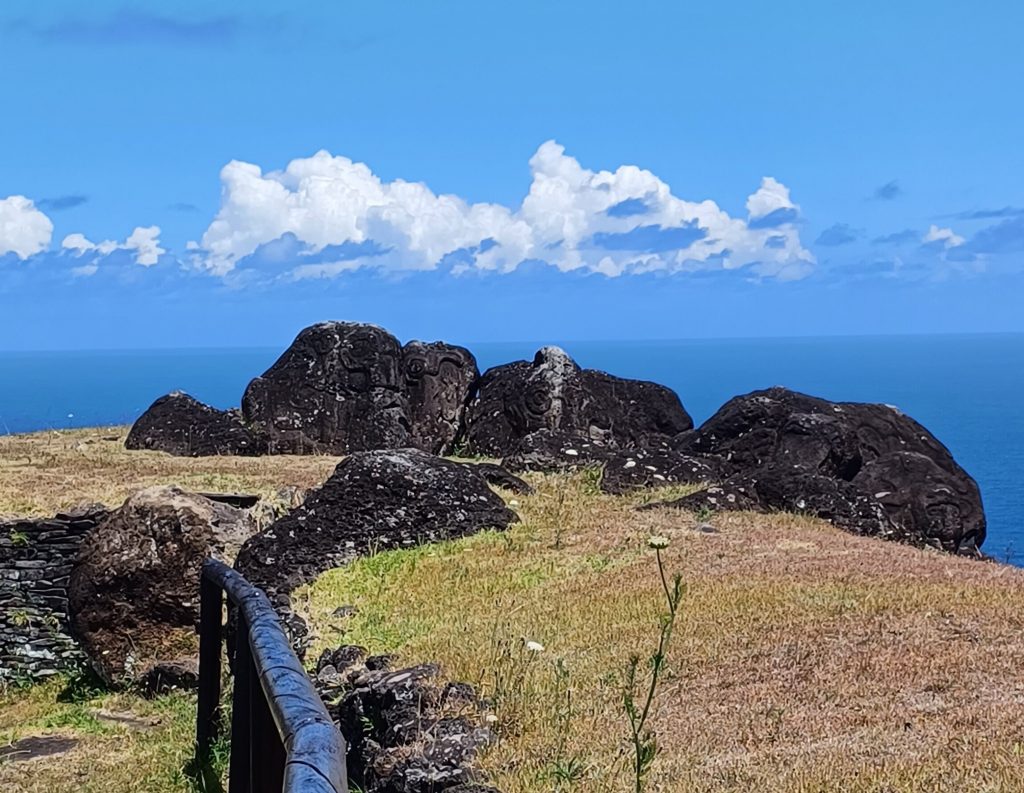
Visitors cannot get close up to the petroglyphs due to their vulnerable position on the cliff edge here. Have to observe them through my binoculars. There has been a landslide recently in the cliffs below them.
Anyway, it is thought that the demise of the Birdman cult probably started in the mid 19th century with the arrival of Catholic missionaries. Furthermore, Peruvian slavers captured about half the population, some of whom were nobles, even the king, to work in the guano fields. This coincided with the demise of the birds. It seems the frigatebird had probably been overhunted for its feathers, as well as its eggs, thus the competitors ceased to hunt for its egg, replacing it with a sooty tern’s egg, a more abundant species. The chimango caracara also assisted in the decline of the bird species. The last Birdman competition took place in 1867.
Further up the hill once stood a particularly significant moai, Hoa Hakanania’a. Yoyo points out the place. This moai was purloined by the British and is now in the British Museum. It was undoubtedly used in the sacred rituals of the Birdman cult, having carvings on its back, including Tangata Manu, a sooty tern and two ceremonial oars, along with female genitalia on its head. It was one of the few moai carved from basalt, versus the softer tuff that the majority were carved out of, and stands nearly two and a half metres high.
Hoa Hakanania’a was taken away aboard the good ship ‘Topaze’ in 1868. It is referred to by the Rapa Nui people as ‘the Stolen Friend’. Atop the cliff is a wooden copy along with some reconstructed houses with palm frond rooves.
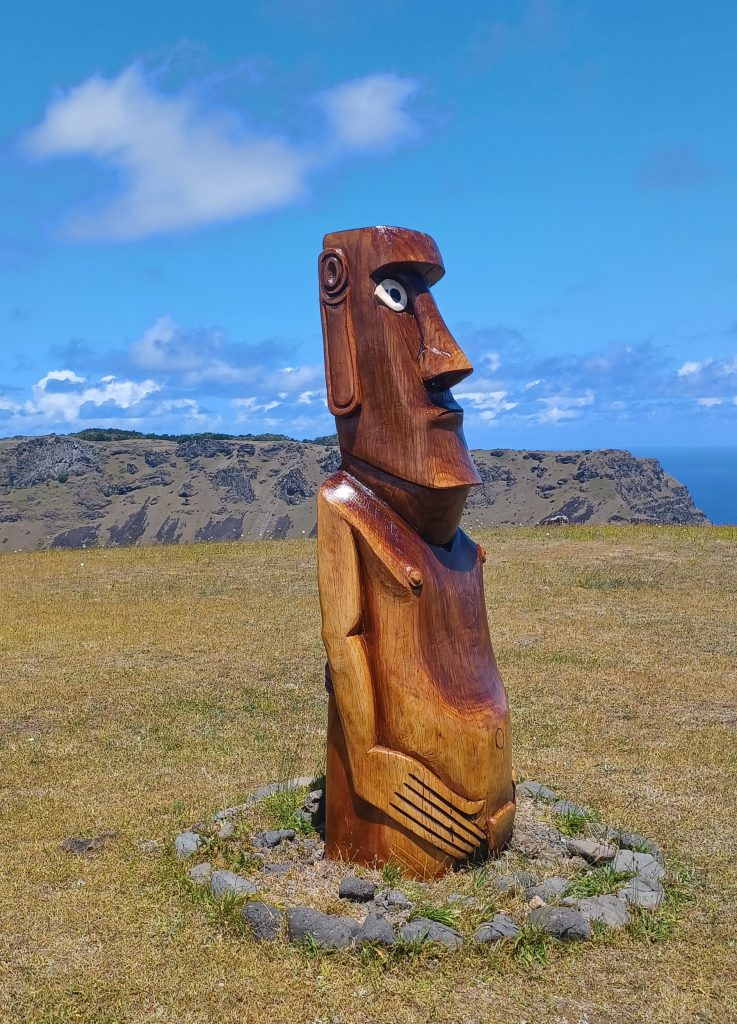
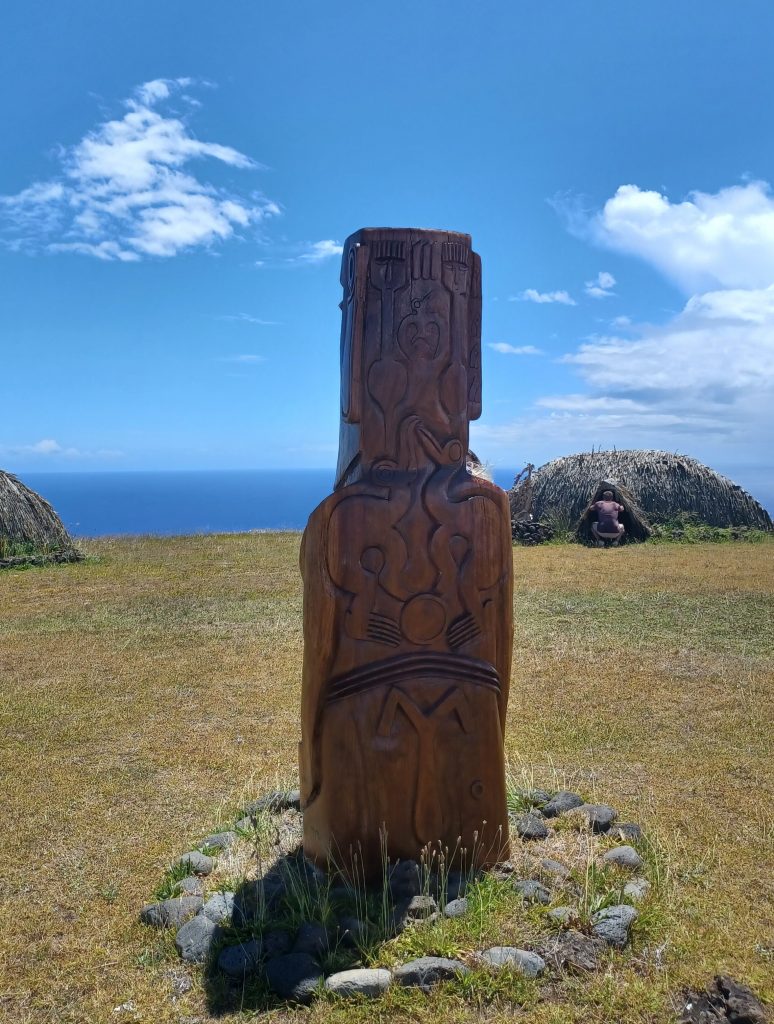
There were about twelve moai altogether, which were removed by foreigners to other places, such as New York, Paris, Belgium, New Zealand. Furthermore, says Yoyo, somewhat aggrieved, a group of Americans in the 19th century came and chopped off all the paintings and carvings inside some of the houses and moved them to foreign shores.
Wander slowly back to the transport. The tour is now over and we head back to the bright lights of Hanga Roa. Profuse thanks for a wonderful two days and I am dropped off at the white wicket gate of my hotel. Back in my hotel room, I notice the dead cockroaches have disappeared.
Tahai archaeological site
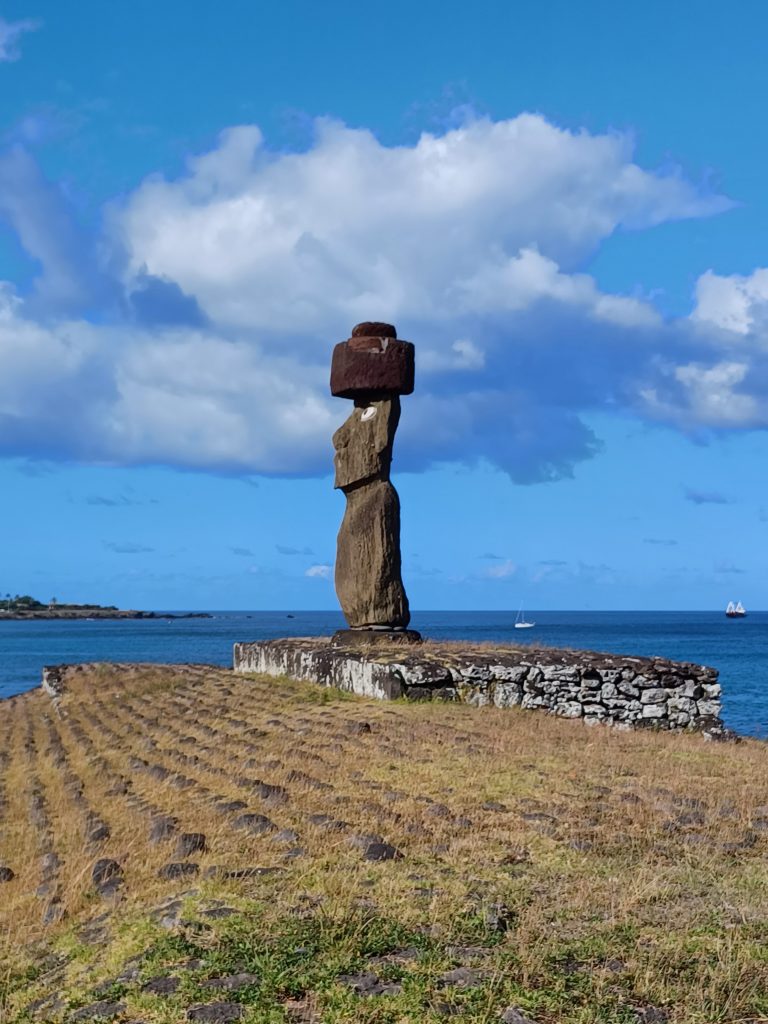
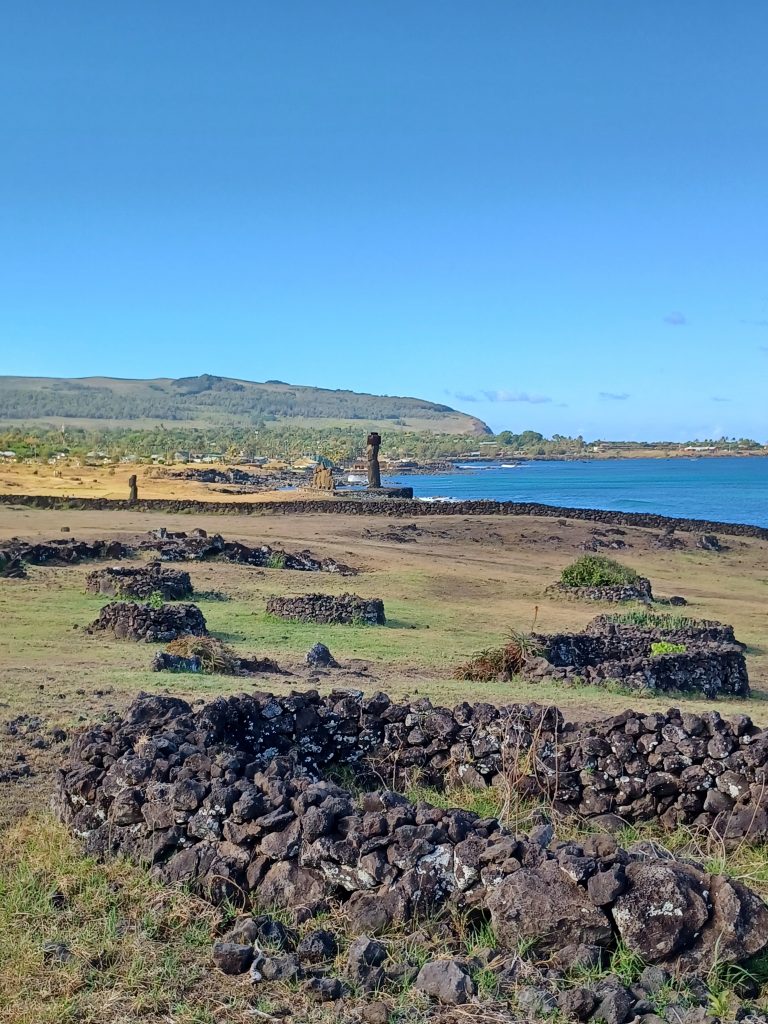
Unlike many tourists, who have a quick flit over to Rapa Nui for a two day tour and then zip back to the mainland, I have booked five nights on the island. Thus time to wander at leisure today. Marvellous. Make my solitary way down to Hanga Roa’s harbour and then head north a bit along a coast path towards some other moai. There are three ahu here in the Takai archaeological area. The most prominent, splendidly isolated on the headland, surveying his little empire, is the restored Ahu Ko Te Riku. The moai sports a scoria topknot and eyes of white coral with a vivid obsidian pupil. Nearby is an ahu with the weathered remains of six more moai. Further on, the area is criss-crossed with the basalt remains of old houses, some elongated, some round.
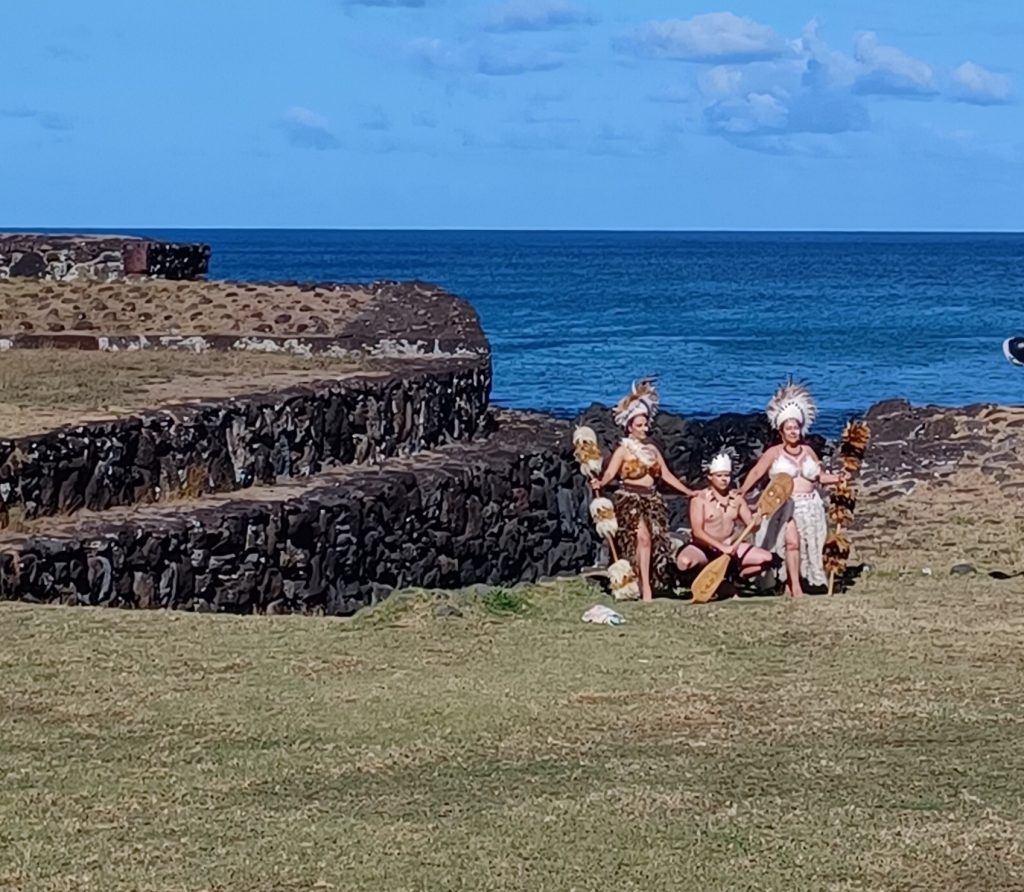
As I wander back, I find myself in the midst a couple of photographers and a group of figures in ballet costume. They are members of the Kari Kari ballet troupe doing some kind of promotional thing. Splendid in their feather headdresses and skirts. Make a note to go to one of their performances.
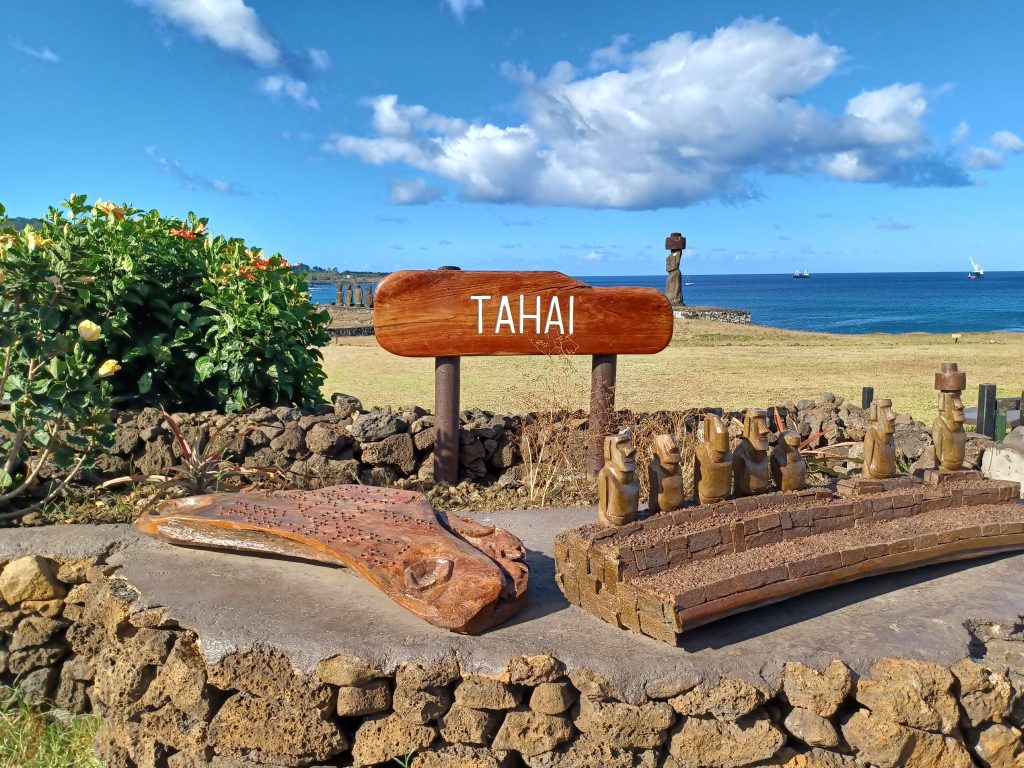
Then, sidling by the harbour, I pass vendors selling trips to the islands off the south west coast. I always enjoy a boat trip. Purchase a ticket for this afternoon.
Boat trip to Motu Nui
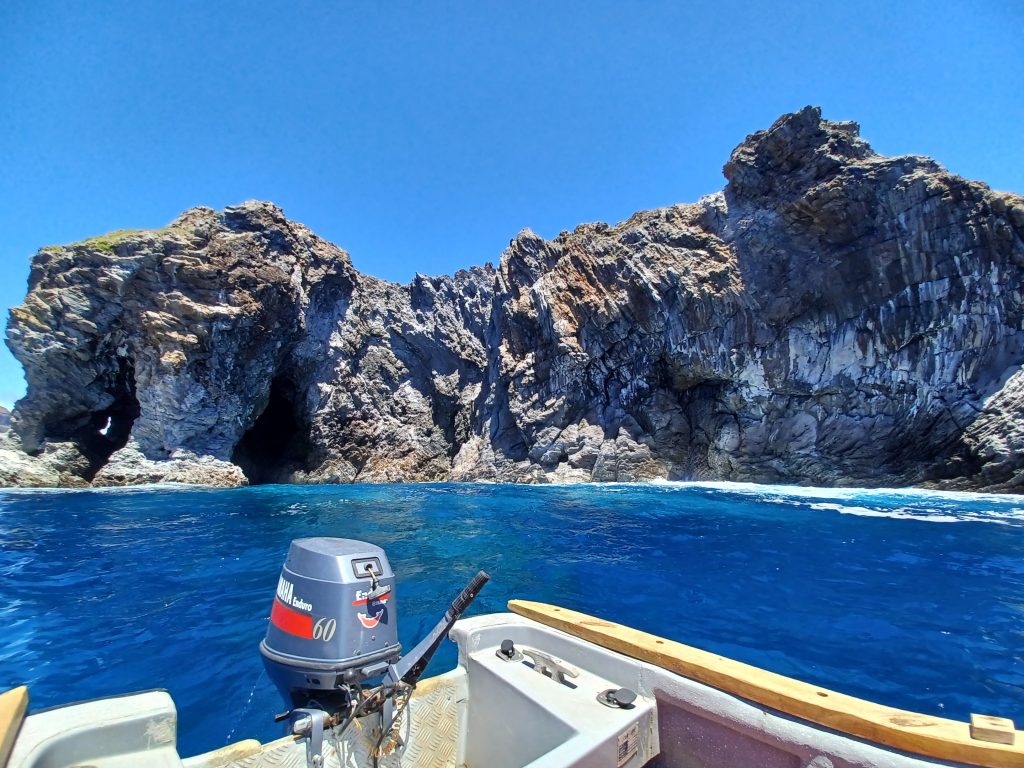
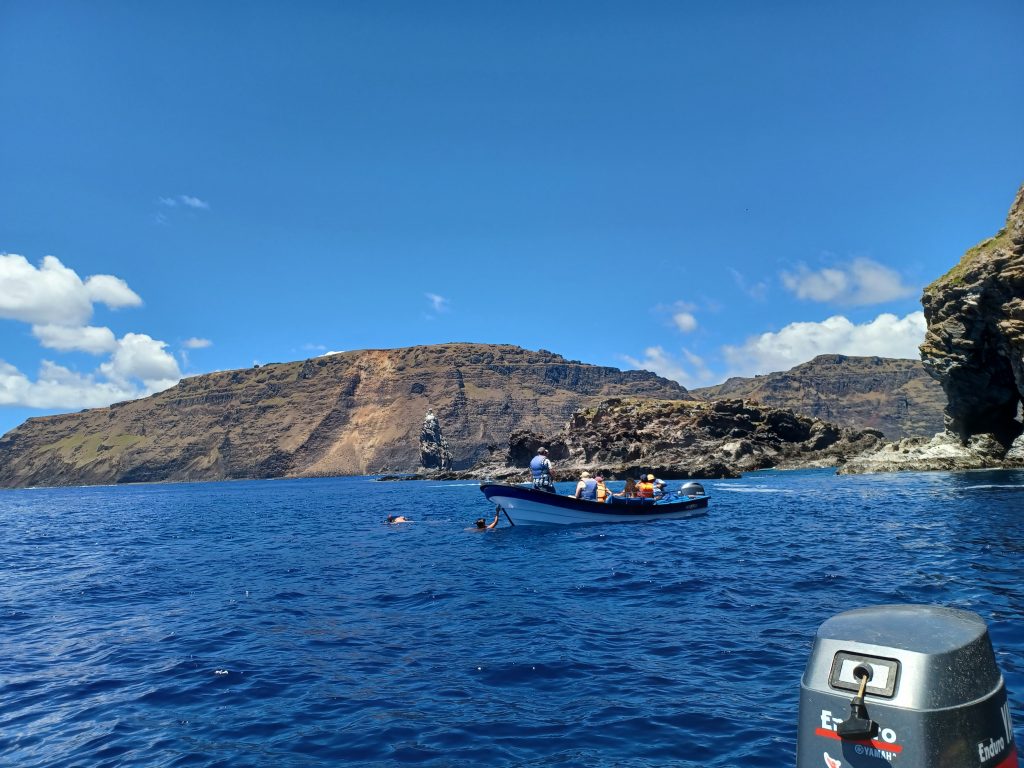
After refreshment in a handy coast-side café of a giant glass of pineapple juice and a fried tuna steak, I take the little boat trip to Motu Nui. This is the island to which the swimmers swam in the competition to be the Birdman. The young be-whiskered skipper puts on the throttle to zoom out of Hanga Roa, navigating between the exposed rock tops. Bit of a swell once we pass the Rano Kau crater on the south-west point. Boat crashes up and down. Splashing the occupants. Must have been a tricky task to swim here. No wonder he who became the Birdman was given so many privileges.
Too late for the sooty tern’s first egg, I muse. Not even sure the bird still nests here. Spot a frigatebird, though, with its long tail, ranging over the cliffs. These birds are visitors to the island now but once nested here. Much sought after for their feathers. Several brown noddies flying about and diving into holes in the cliffs, and black/brown and white birds with longish yellowish beaks on top of the island, which I can’t identify. Boobies perhaps? Binoculars not good enough to make them out. The skipper doesn’t seem to know.
Below the boat I can see black and white striped fish fluttering about over the coral. Some of my fellow boaters plunge into the water into the more sheltered part of the cove here, donning snorkels and flippers to gawk at them up close. I am happy to observe the flying species. From this calmer bit of the cove, one can see the landslide in the cliffs atop which is Orongo with its petroglyphs and the fantastic Rano Kau crater. Our boat messes about a bit around the rock outcrops before zooming noisily back, surfing on the wave tops to the harbour.
Kari Kari Ballet show
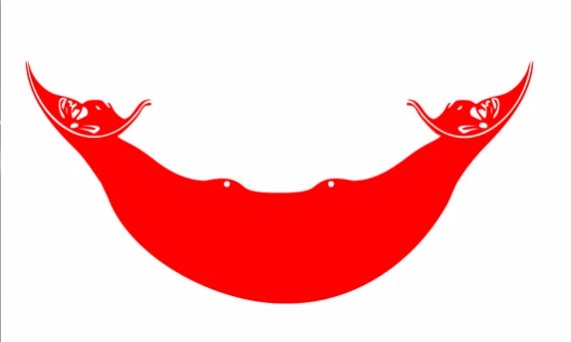
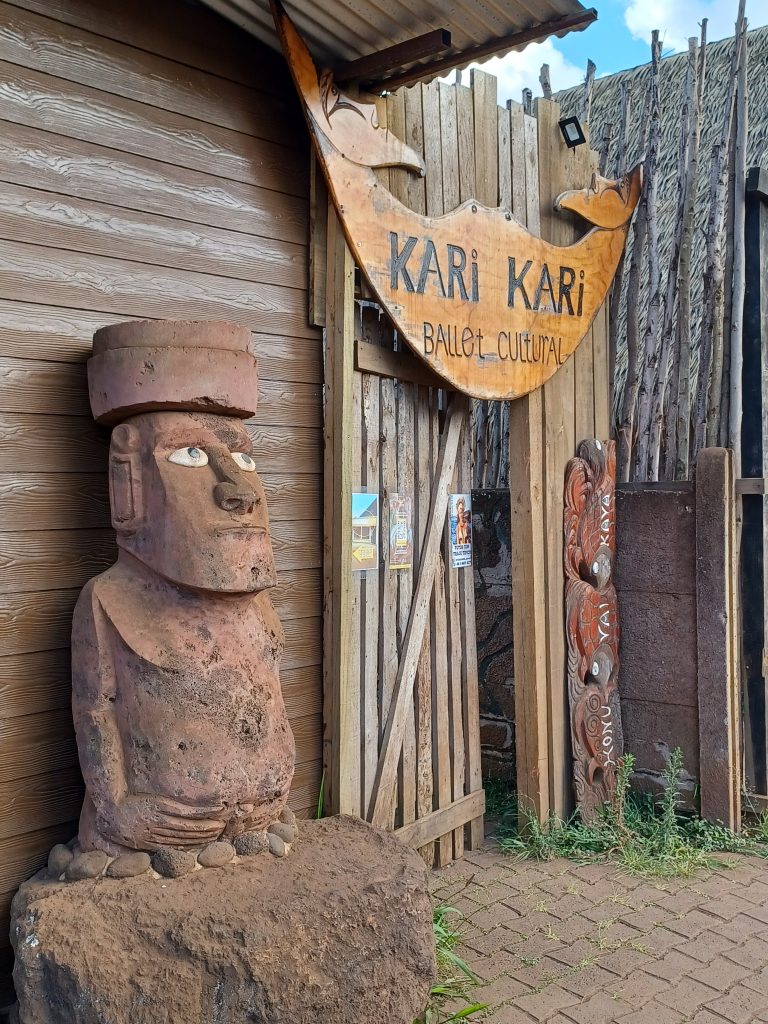
Evening brings the promised cultural show with the Kari Kari ballet. Close to the hotel. A long eared moai guards the entrance, and the sign board is in the shape of a Polynesian canoe, the same as that depicted on the Rapa Nui flag. Plenty of tourists rolling up for the performance. Face painting is on offer. To get one into the spirit of the thing. A bevy of attendees cluster round the makeup artists, then return to their seats ‒ which are hard benches rising high before the stage ‒ with white and green daubs of face paint and such. Drumming and strumming begins. Get your jugs of juice and beers, settle down and enjoy.
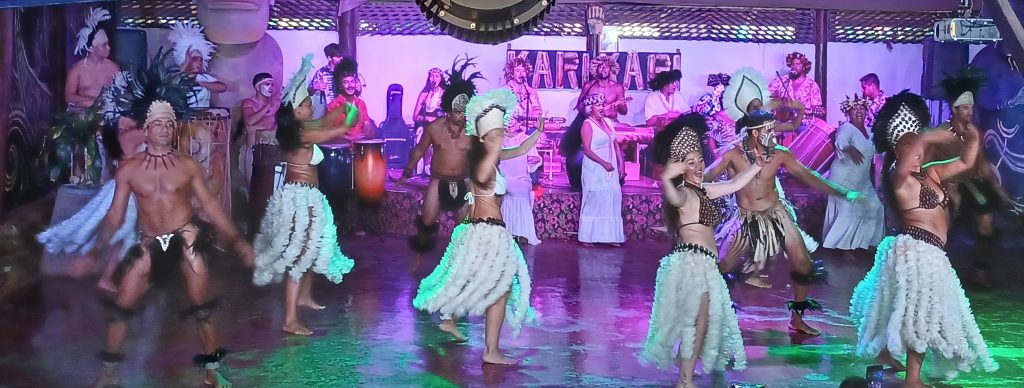
Splendid all round, it has to be said. Men dressed in feathers (wonder if they are plastic like the palm frond rooves) over their vitals and feather head dresses. Strutting and thrusting and leaping all over the stage. Profuse perspiration. Women in Hawaiian look-a-like white ‘grass’ skirts and bras or coconuts over their breasts, bellies and bottoms swaying. And songs belted out by ladies and gents of every age. No coy blushing flowers here. All to the loud beat of drums, strumming of ukeleles, and tinkling of melodious accordions.
All immensely entertaining until it comes to audience participation. The be-feathered men descend the stage to grab willing women to dance with them and the be-skirted females do likewise, luring enthusiastic men. Not wishing to ascend that stage under any circs, I put my head down and hope. The grey hair helps undoubtedly. They leave me be. Some of the audience perform pretty well actually. An elderly chap unbuttons his shirt and flings it aside with gay abandon, wriggling and jumping like the best of them. The show comes to an end amidst much applause.
A suitable climax to my Easter Island adventure.
Leave a Reply