
Constanţa
I am heading out of the capital now to make my way eastwards to the Black Sea. I take the metro to the Gare de Nord railway station (yep that’s right ‒ named after the French station in Paris). Grimace as I eye the queues at the ticket desks. An employee with kindly countenance helps me purchase a ticket at a machine. “Multsu mesc”. Thank you.
Embark the train. A rather pleasant journey of about 140 miles ensues, albeit I am facing backwards. The day is sunny and bright. Fields of swaying poppies and golden grain flit past; the odd rolling hill, green vegetable crops and a few streams. Pastoral scenes. The train criss-crosses the Danube in a few places as we approach the coast. Broad reaches here. I spot a couple of barges, glossy white egrets and gulls hovering about.
Arrive at Constanţa station. A stout Romanian chap with stubbled chin and crumpled shirt approaches me. “You want taxi?” Yes. Agree a price. Get into crumpled car. Not an official taxi methinks. Only takes a few minutes to my hotel, the elegant Peninsula Boutique Hotel. Paid far too much for the taxi. Plus ça change. Anyway, the friendly receptionist smoking outside on the steps welcomes me over the threshold. It is too early to check in so I park my case and shoot out to explore.
Ovid Square
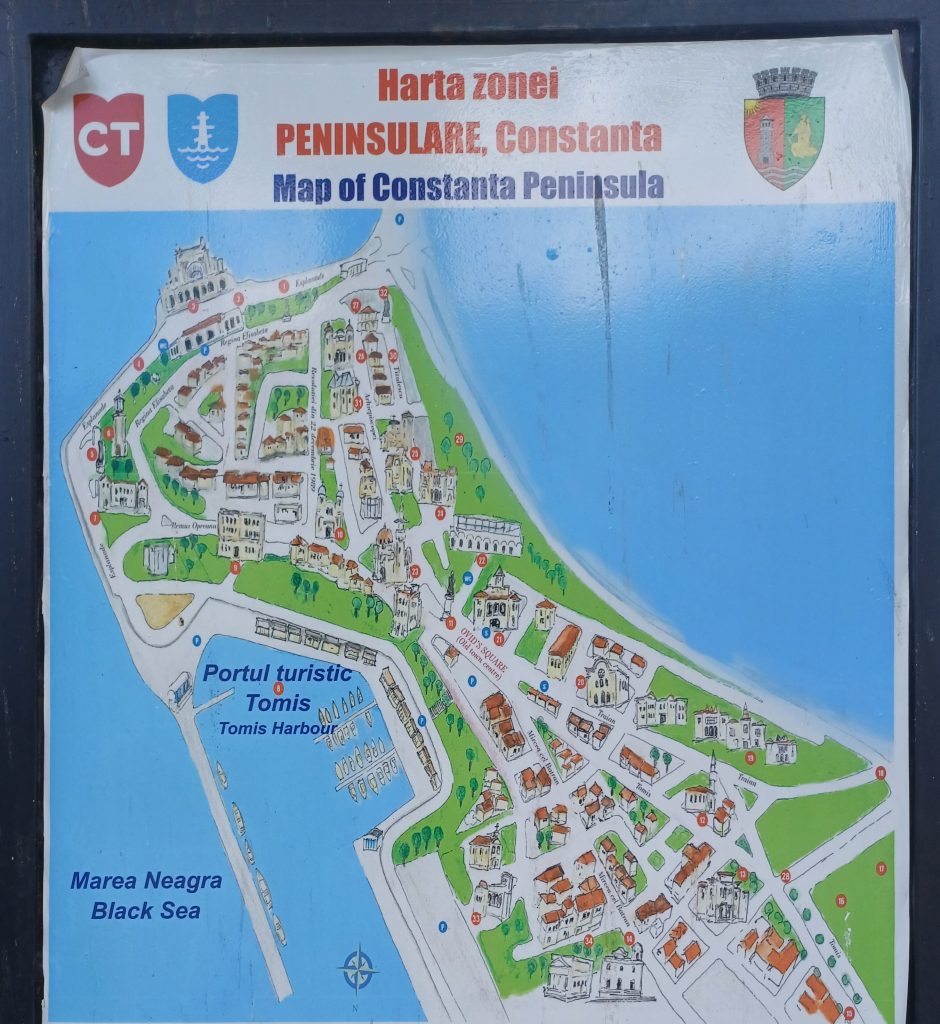
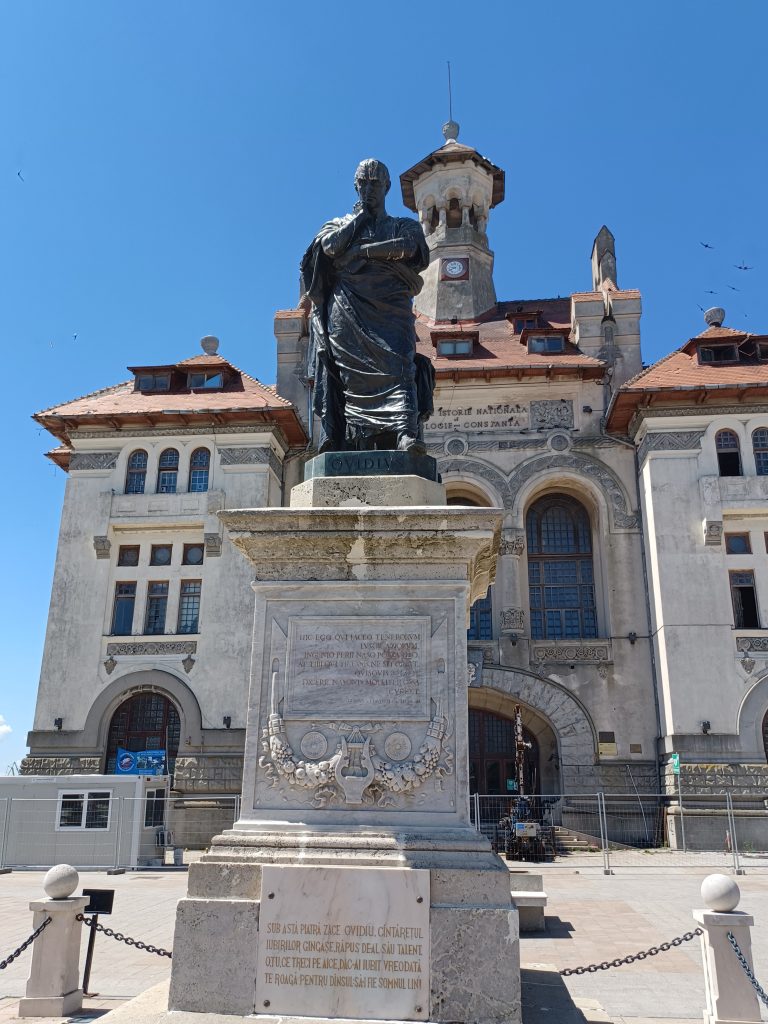
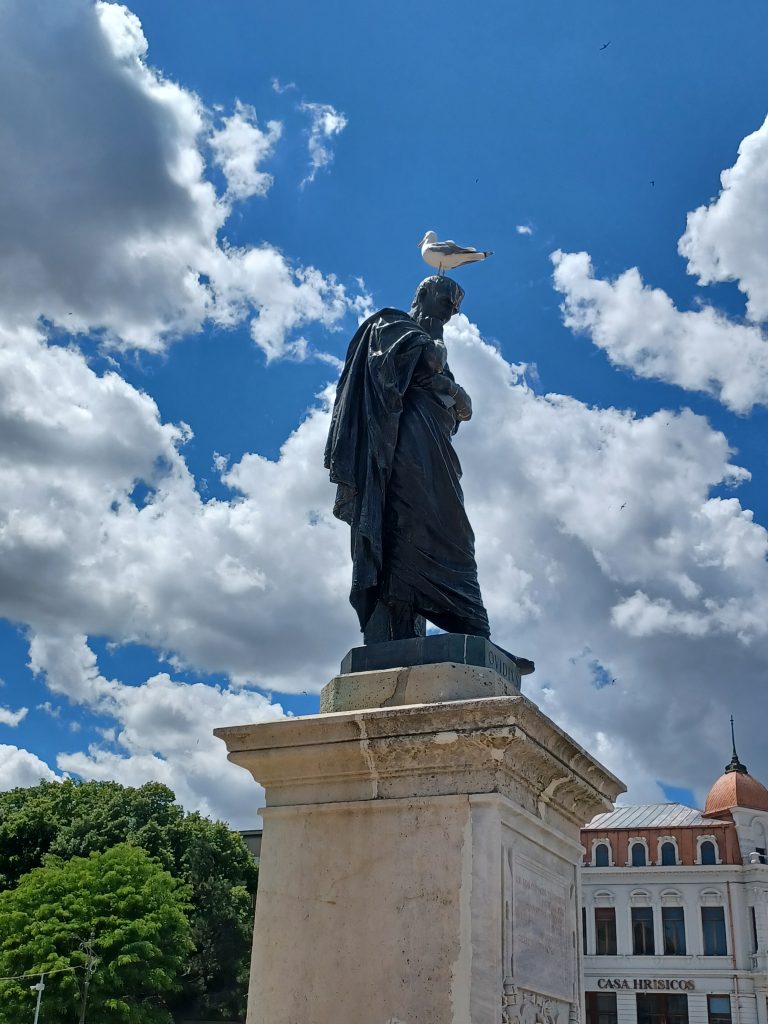
Head down Constanţa’s main boulevard, cafés and souvenir shops lining both sides, to the central and spacious Piața Ovidiu, Ovid square. Here stands a bronze statue, by Italian sculptor, Ettore Ferrari, of the Latin poet, Ovid with slightly guano-ed head. An irresistible perch for pigeons and gulls. He ponders the scene. Ovid, he of ‘Metamorphoses’ fame, spent his last years in the ancient city of Tomis (now Constanţa) in Romania’s easternmost province of Dobrogea (or Dobruja), having been exiled from Rome in 8 AD by the Emperor Augustus. His statue was installed here in 1887. Behind him is the National Museum of History and Archaeology. Handsome building. Looks a bit run down though.
Tomis Harbour
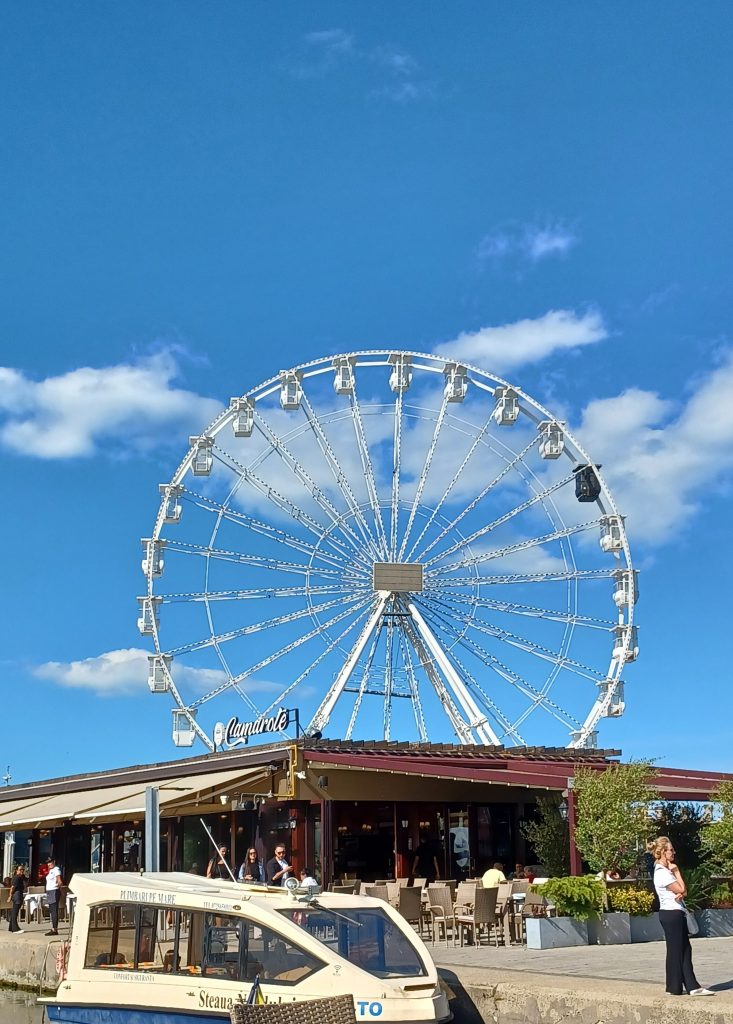
Opposite the museum, across the other side of Ovid Square, are steps leading down to the tourist harbour, or Tomis Harbour, within which lie white plastic motor boats and yachts, and wooden pirate ships. To the right of the harbour a large white Ferris wheel. First impressions are exceedingly positive. I find an attractive café and therein lounge with a latte for a while. A friend of mine appears in the distance. He hails me.
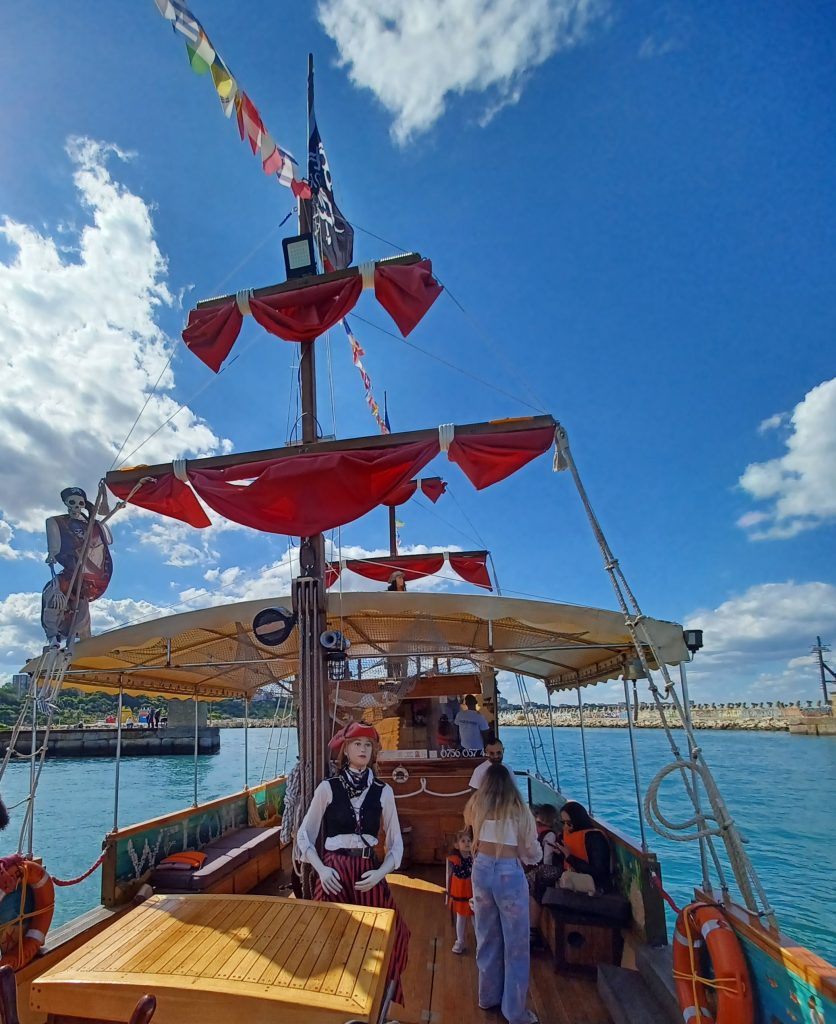
We met on the Transylvania trip and agreed to meet up here. Good stuff. Always more fun to explore with someone else. Together we descend the few flights of steps down to the harbour and make a beeline for the pirate ships. Well, why not. Select the one where the music blares not quite as loudly and obnoxiously as the others and approach a pirate on the quayside. “When are you leaving?” “When four or five people”. OK. Hop on and are soon chugging out with a couple of skeletons, pirates and a few live humans. The skull and crossbones flies jauntily atop the mast.
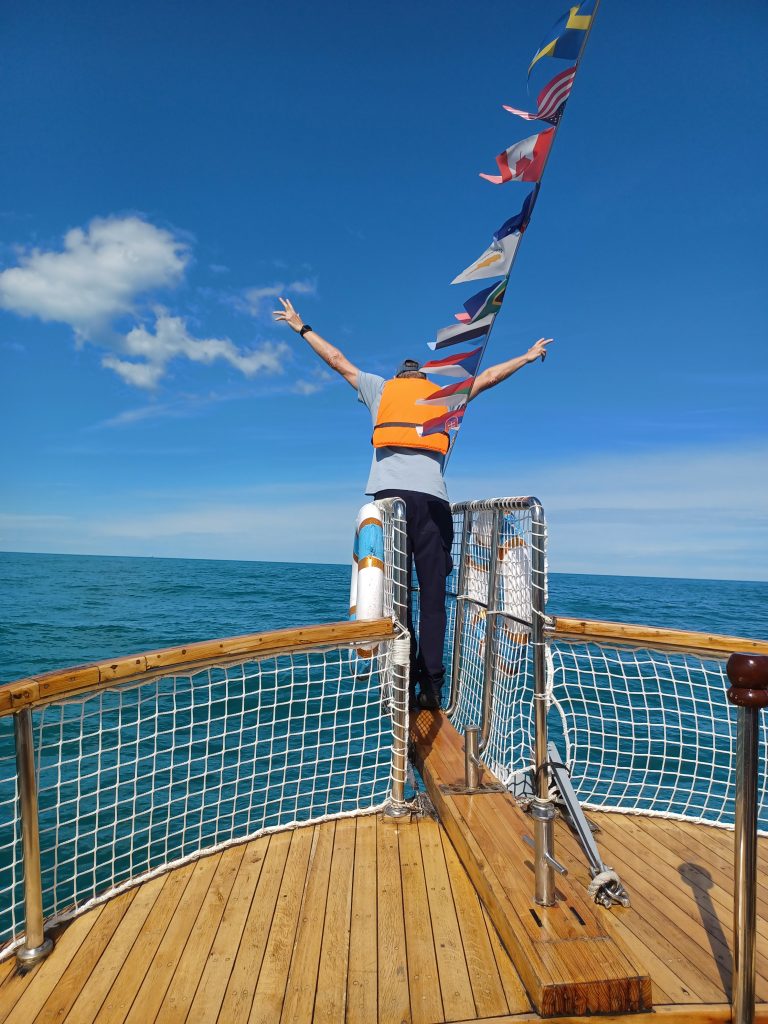
There is quite a swell out here on the Black Sea and the pirate ship plunges up and down. This swell does not perturb the inevitable selfie takers, who take turns posing on the bowsprit. Beyond us are tankers and cargo vessels waiting to dock. And not so far away are the shores of Ukraine. Seems odd that there is a war going on further along this coast. My crumpled taxi driver had told me that a Ukrainian drone exploded offshore here not so long ago. But nothing of that kind disturbs us today as we enjoy the rolling sea and the salty air. Our voyage lasts a mere thirty minutes before the ship turns about to return to the harbour.
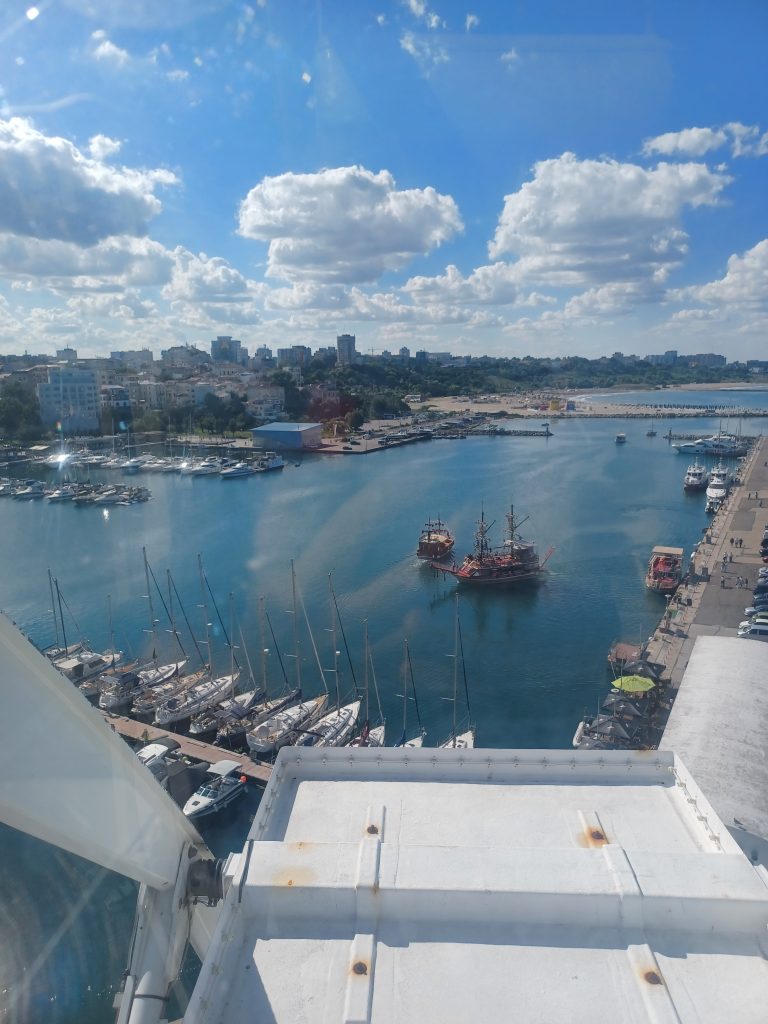
To the right of the entrance, an area of Soviet blocks stands atop wooded slopes above a beach and, to the left, that enticing Ferris wheel. My new friend and I cover the few short steps from the ship disembarkation point to the white wheel, actually the ‘Tomis Eye Ferris Wheel’, for a spin. Literally just one spin is all one gets, be it ever so slow, to survey the scene from on high. Splendid view of the bustling water front and the white chairs preceding us over the top. All good fun.
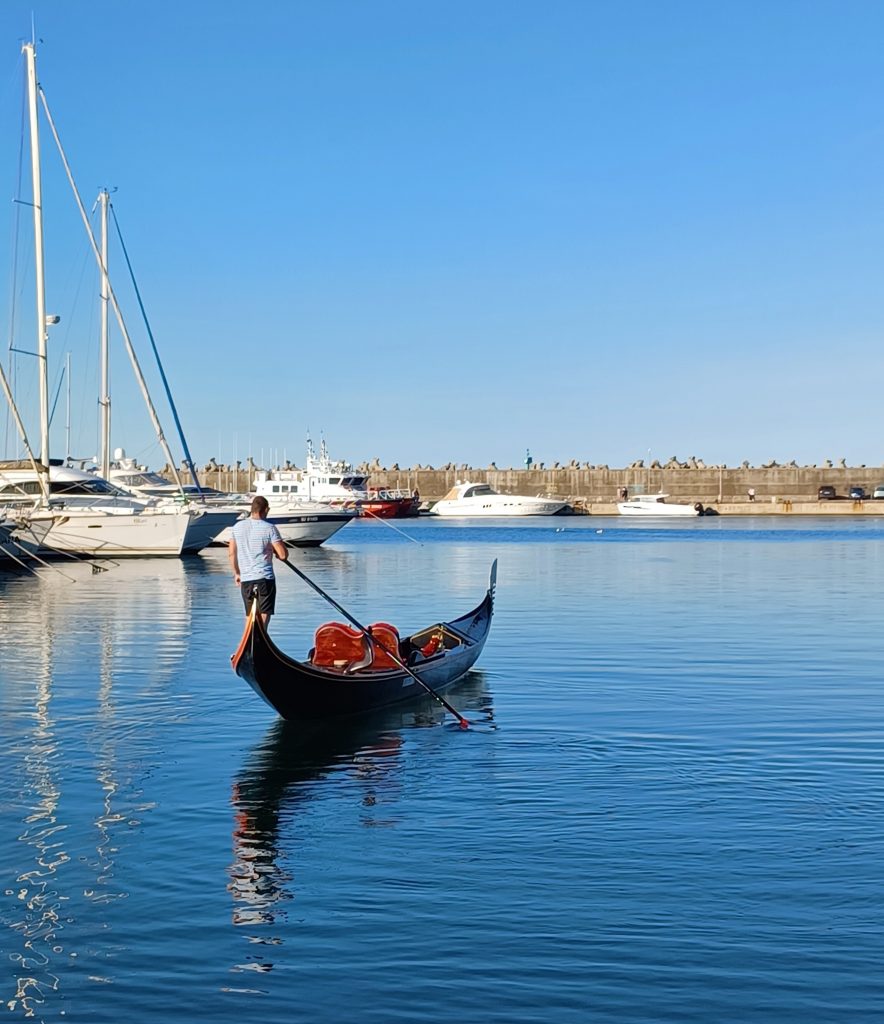
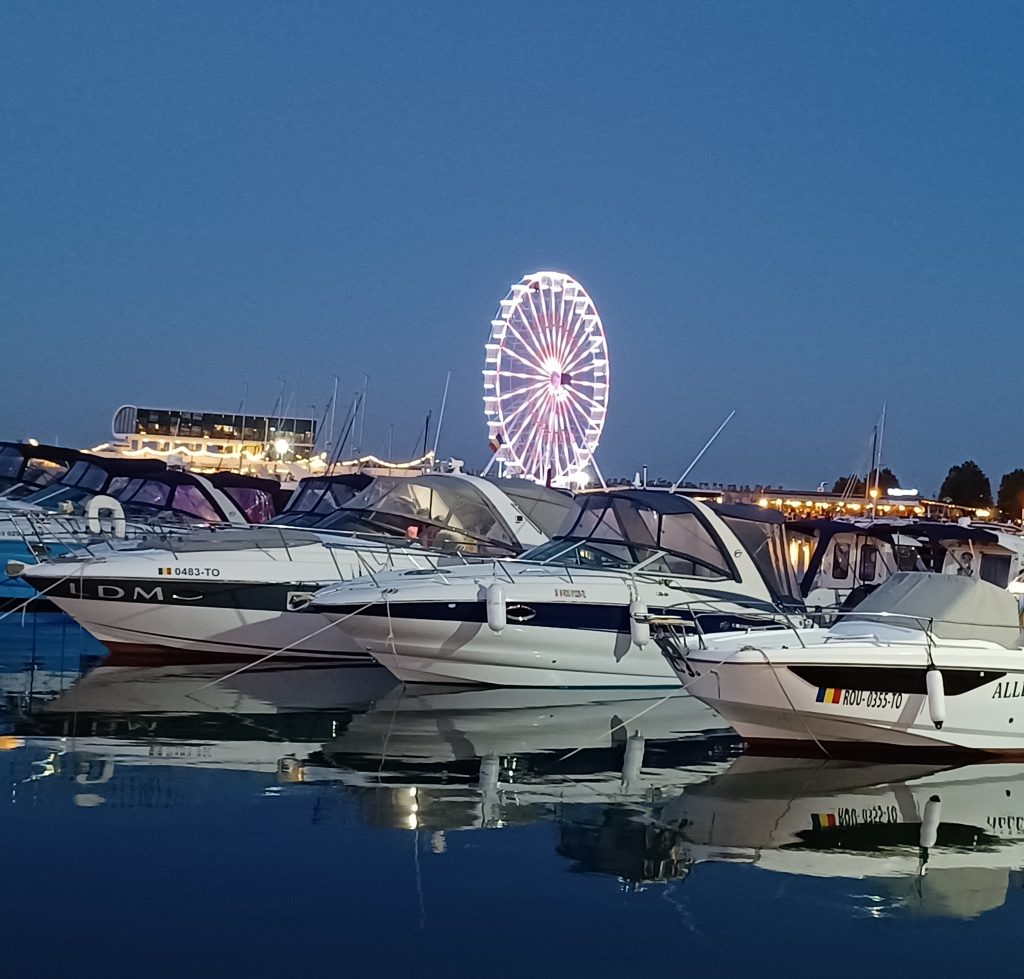
Wine time now and we seek out a suitable bar/restaurant for a first drink in one of the myriad watering holes on the harbour. Then mosey off to a different one for dinner. Fish seems appropriate. Delicious. More Romanian wine. White. Lot of discussions about travels, life and music. My congenial English friend is a musician it turns out. Plays clarinet and saxophone several nights per week in a band in the USA near Yosemite. He shows me a video of him and band on Youtube. Impressive. As we chat, a Venetian gondola poles in, prowls about a bit and poles off again. The sun starts its descent. Order another bottle. Excellent nectar. The Tomis Eye Ferris Wheel lights up. Boats lie still, reflected in the calm dark waters of the harbour.
After some while, we depart this place, stagger up the steps and wander up the road towards my hotel. Part company with my friend. He goes his way, I mine. Make my way past the alert receptionist to my huge room in the attic. The lift takes me up to the third floor whence I have to hoof it. Soft king bed. No sound save the slight buzz of the aircon.
Royal Mosque of Constanţa
It appears I have booked breakfast in the hotel but am seldom hungry in the early morn, not noticing hunger pangs until I have been up and about for a couple of hours as a rule. But having paid for said breakfast, I suppose one ought to totter down to try it. Thus, I make my way to the breakfast room. Firstly two large cups of tea are conveyed my way, followed by some yoghurt, fruit salad, croissant and local honey. Hmm pretty good. Sufficient. And now I have the whole day to explore the town. I intend to take it lazily. Potter my way down to Ovid Square. Wave to Ovid. A gull squats on his head. Pass through the square. First stop, the mosque: the Royal Mosque of Constanţa or Carol I Mosque.
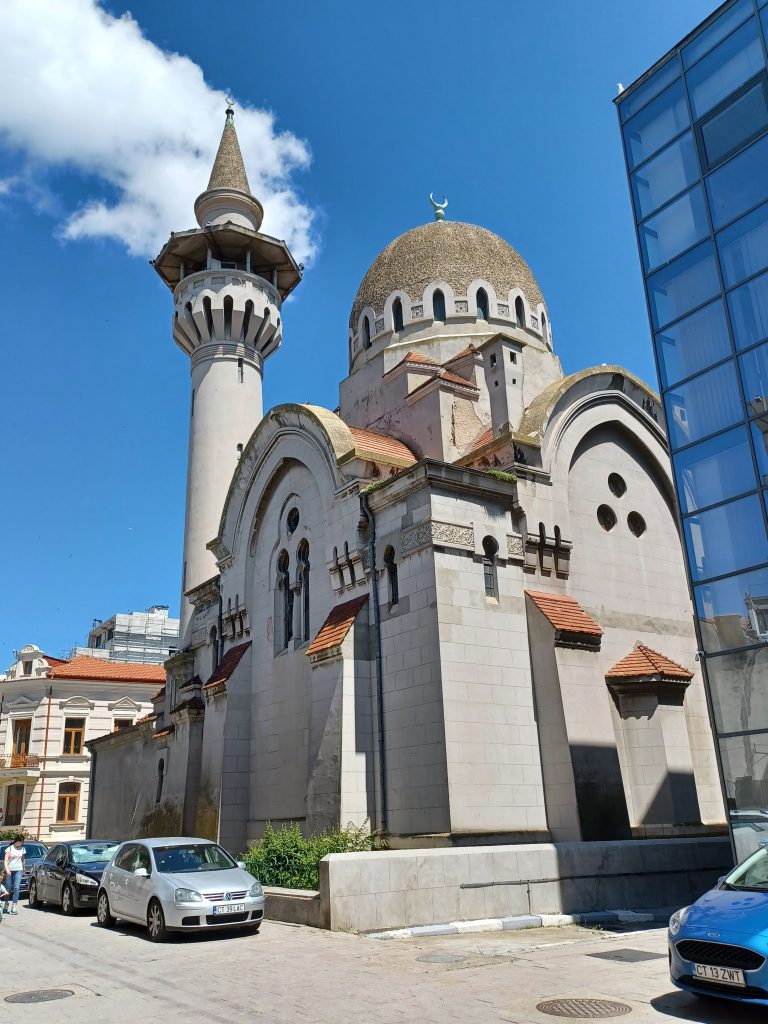
Lovely interior. The mosque that was here first, erected in 1823 by Sultan Mahmud II, I read, was destroyed. It was rebuilt during the reign of King Carol I, and under his initiative, between 1910 and 1913. It is ‘an important architectonic monument and the most important edifice of the Islamic cult in the city’. And ‘the first building made by bricks and armed-concrete in our country’. Interesting.
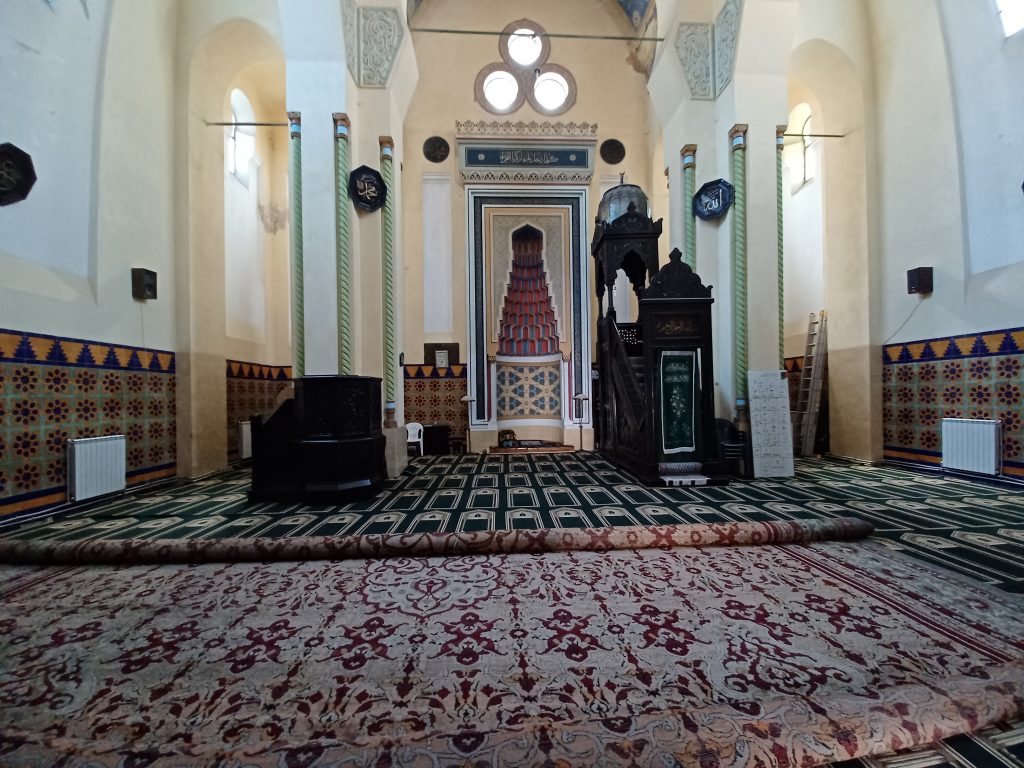
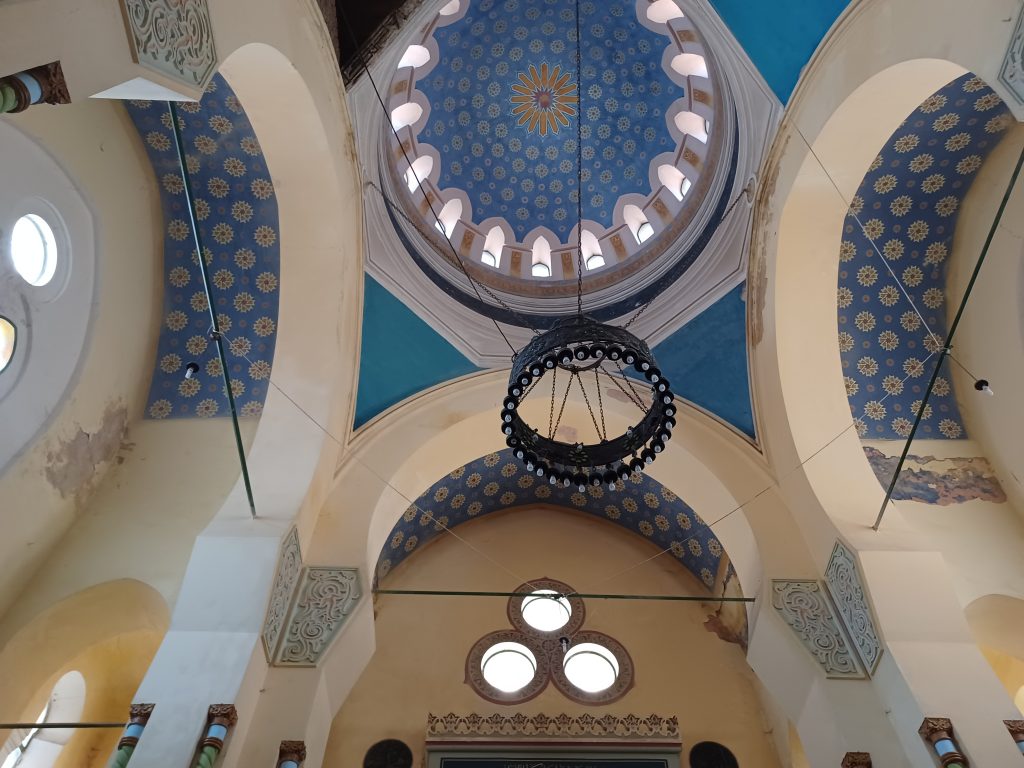
Shall I climb the 140 steps to the top of the 47 metre high minaret? Yes. That yoghurt with honey has imparted some energy. No effort. From here I can view Constanţa’s old town and surrounds. Smashing view from all sides. Close up is the mosque’s dome with crescent moon on top, and a large loudspeaker through which the Muezzin´s voice is amplified during the five daily calls to prayer.
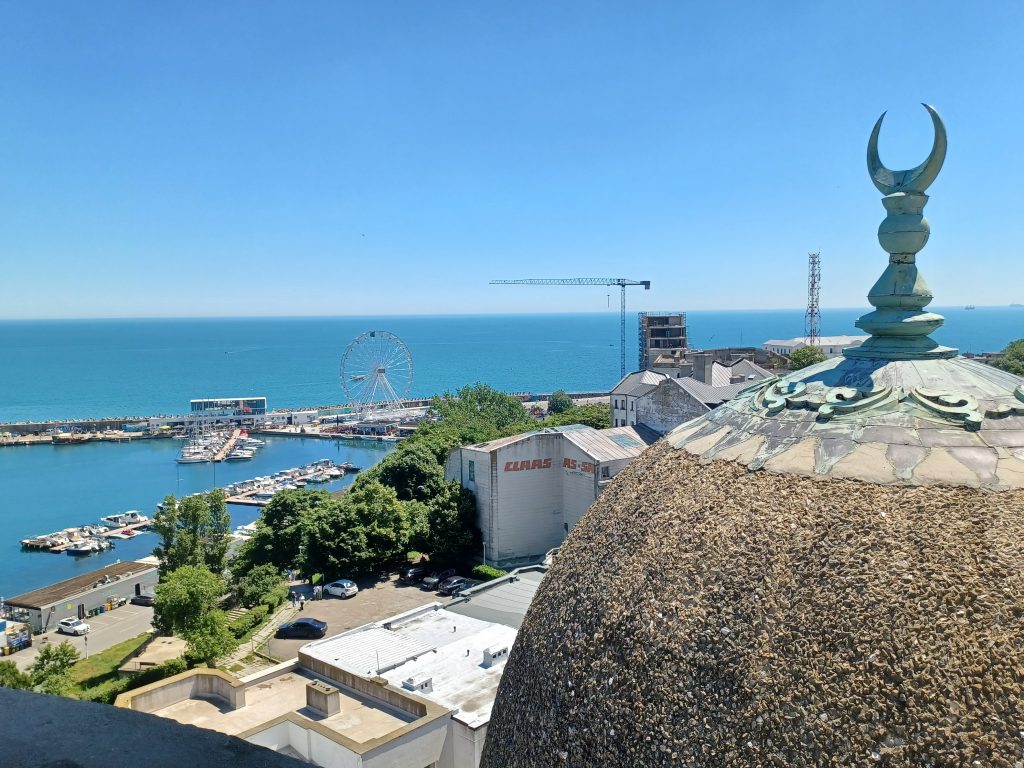
Three golden domes of a church glint in the near distance, as well as the tourist harbour with the Tomis Eye, Ovid Square, the newer docks and other grand buildings including an edifice with statues of lions round the top of it.
Orthodox Cathedral of St Peter and St Paul
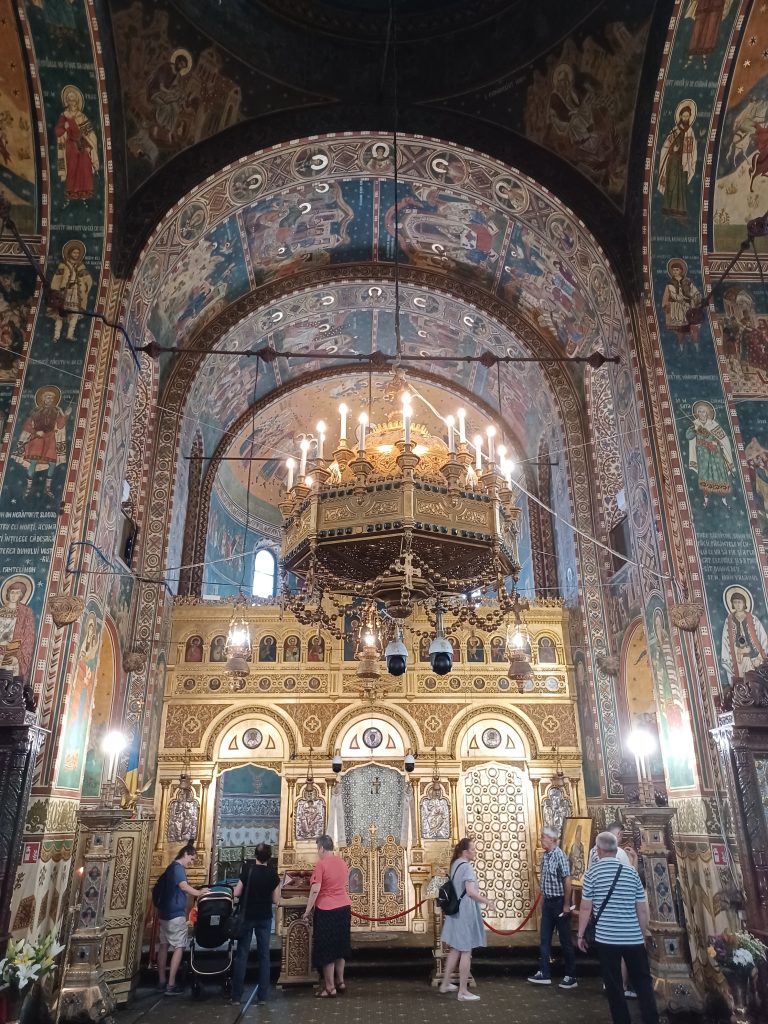
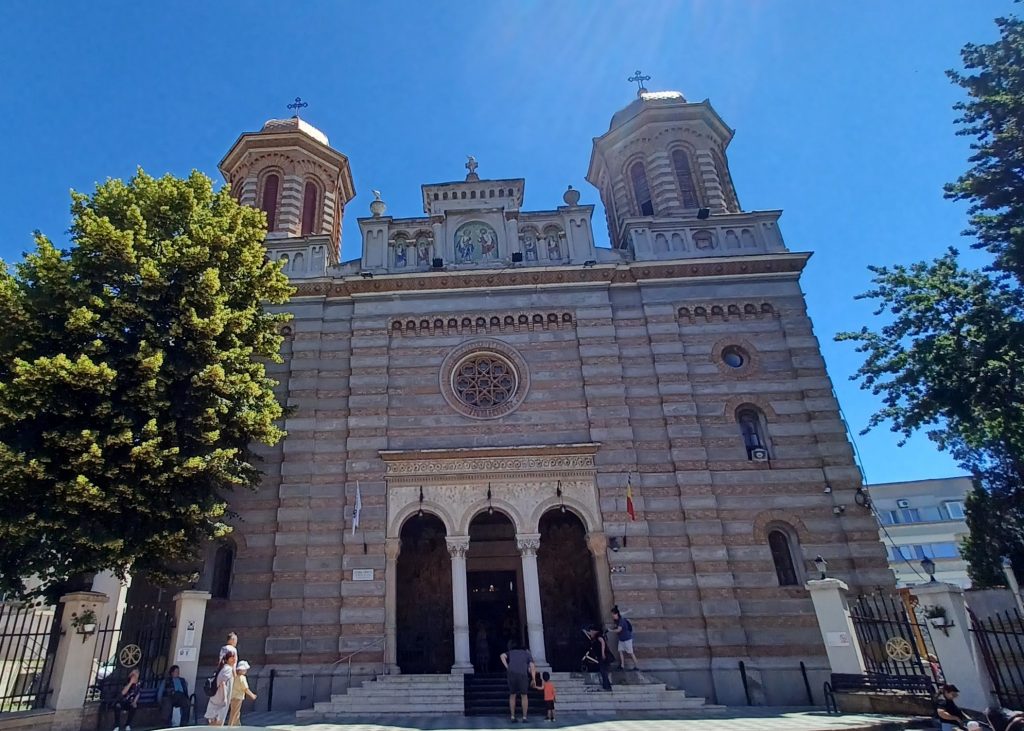
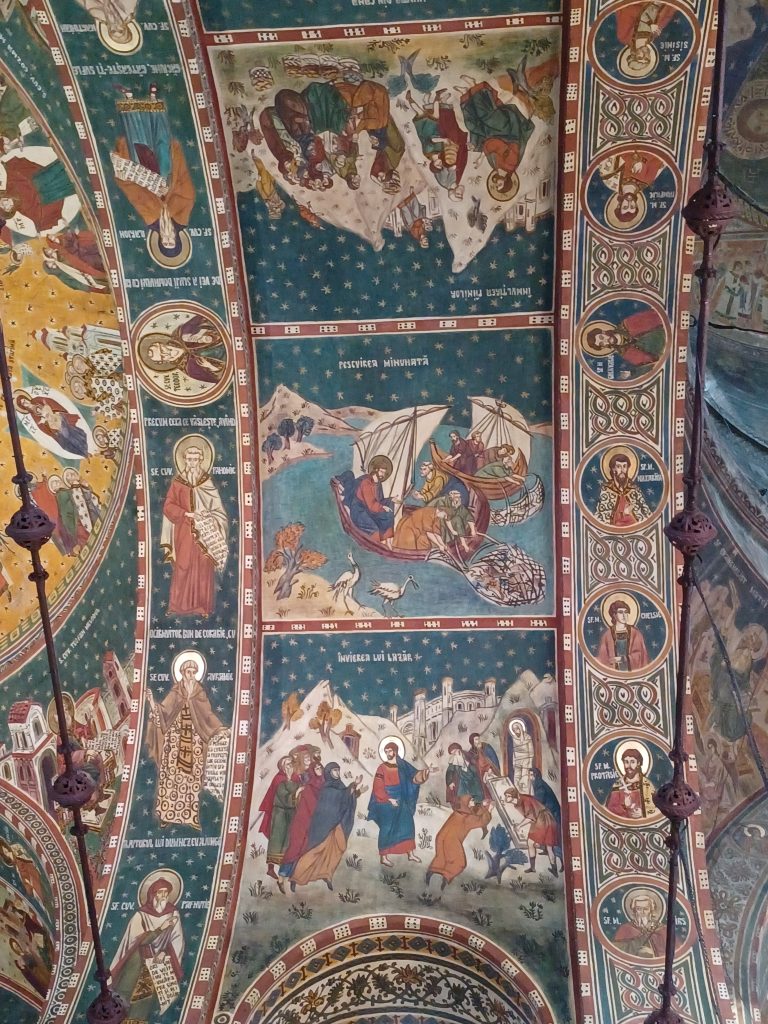
Skuttle down the steps of the Mosque and resume my way toward the sea front and, what turns out to be, the stunning Orthodox Cathedral of St Peter and St Paul, the golden domes of which I could see from the minaret. I stop in front of it. A priest sits by the doorway. Ascend the steps and enter. Wow! It is breathtakingly beautiful within. Every inch of space from the domes to the floor is covered in frescos depicting saints and stories from the Bible. Bright colours: blues, yellows, reds. Romanian worshippers cross themselves. Most Romanians are religious, I understand, and most people here are local. Only a couple of tourists are taking photos. No issue. Another priest stands behind a red rope next to the iconostasis. A huge chandelier hangs from the ceiling. Truly delightful décor. One of the loveliest I have ever seen. And a lady I had met in Bucharest had told me not to bother with Constanţa and did not recommend the place!
Wander off in a daze. Outside the front of the Cathedral is a site which was excavated in the early 1970s. The excavation revealed some ruins of ancient Tomis, including dwellings and a street intersection dating from the sixth century BC to the seventh century AD. Seven basilicas have also been found here. Tomis, I read, was one of the first Christian centres in Dobruja where 35 people were martyred.
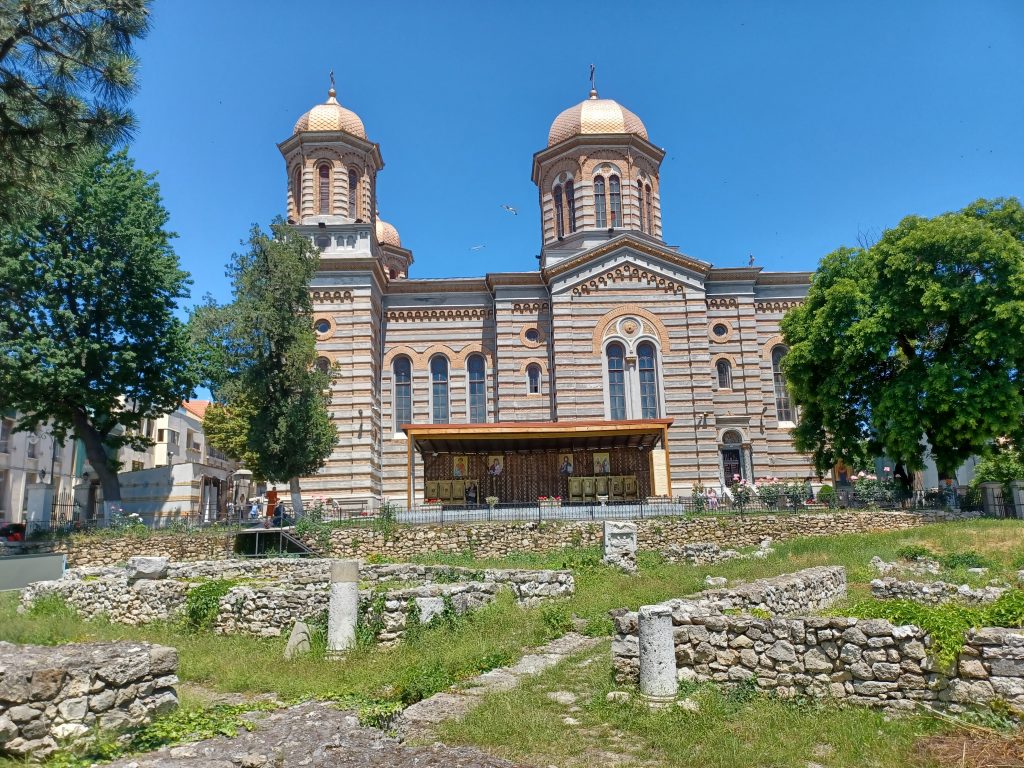
According to the info, the Bishop of Tomis participated in the first ecumenical Council of Nicaea in 325 during the reign of Constantine the Great.
Constanţa Esplanade
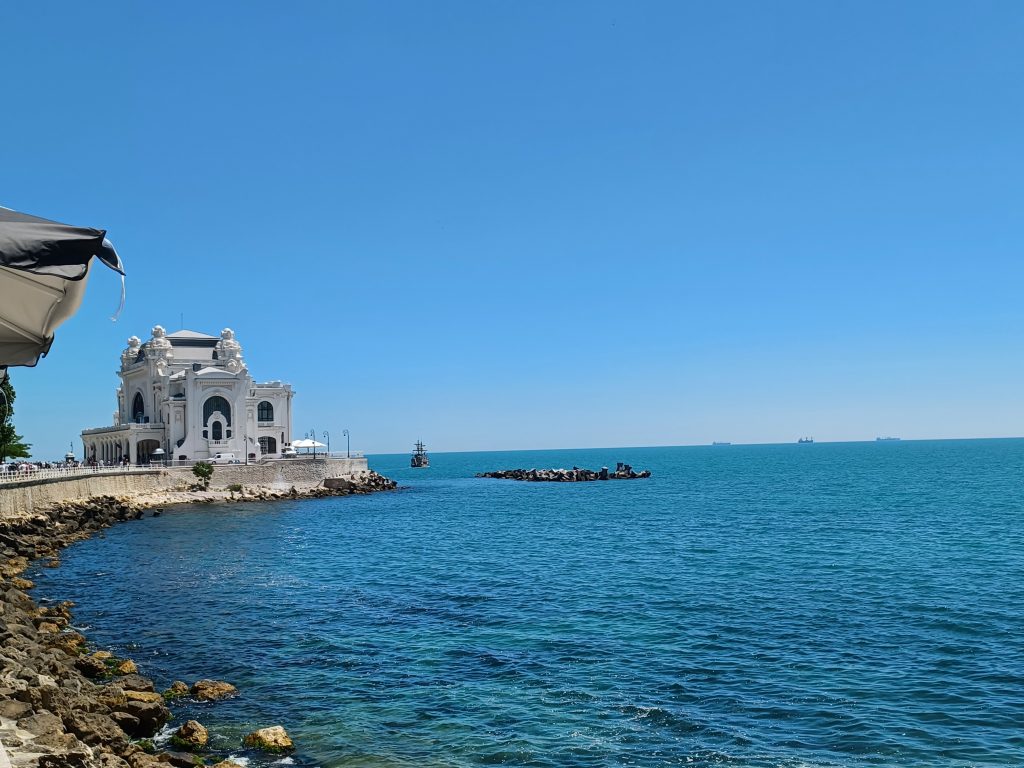
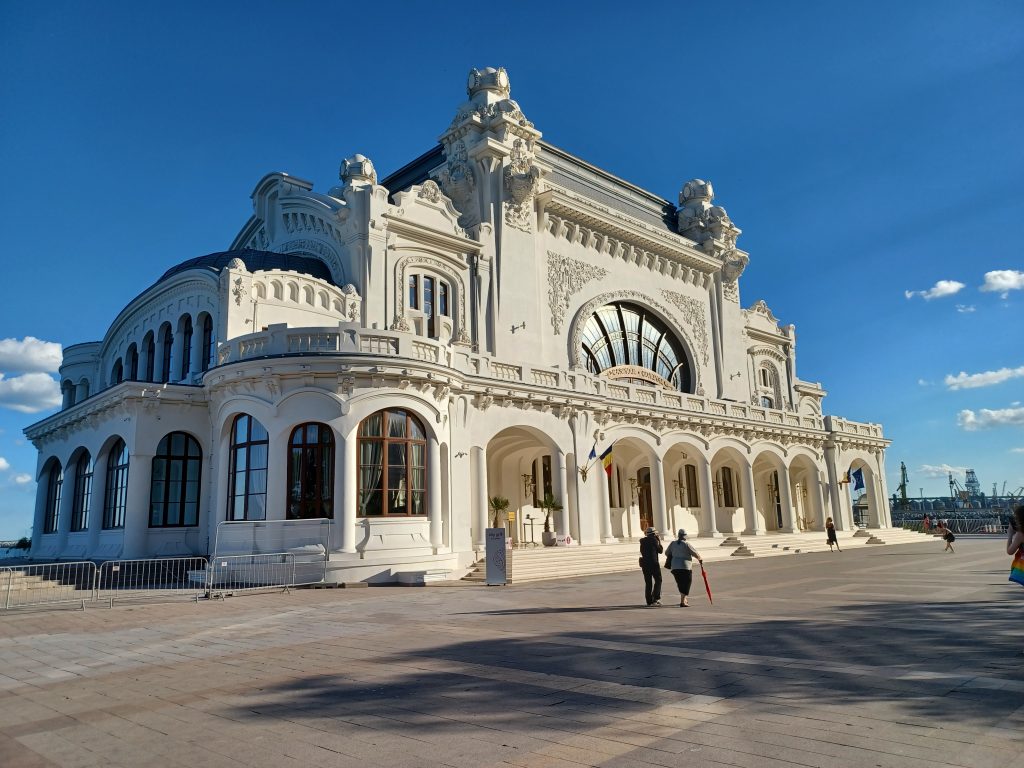
From ancient Tomis, I wander down flights of steps towards the docks and onto the broad esplanade. Perched on the edge of the Black Sea, the recently refurbished casino gleams glorious and white, a perfect gem. Pirate ships and yachts appear behind it emanating from Tomis harbour. I sit in a café by the wall and contemplate the bright unclouded scene.
One can imagine that in such a spot, in this once remote settlement on the fringe of the Roman empire, Ovid wrote his exile poetry, five books of elegiac poems, ‘Tristia’, (Sorrows), bemoaning his fate and yearning for Rome. For example: “…Our native soil draws all of us, by I know not what sweetness, and never allows us to forget…” Well, today, I have to say, modern Tomis is not a bad place to be exiled in, despite what lures there may be to our usually damp native soil of England.
After coffee, I approach the casino entrance to buy a ticket and am pointed to a machine on the esplanade. Ah. Manage to buy one, without too much difficulty, for an allocated time slot later on.
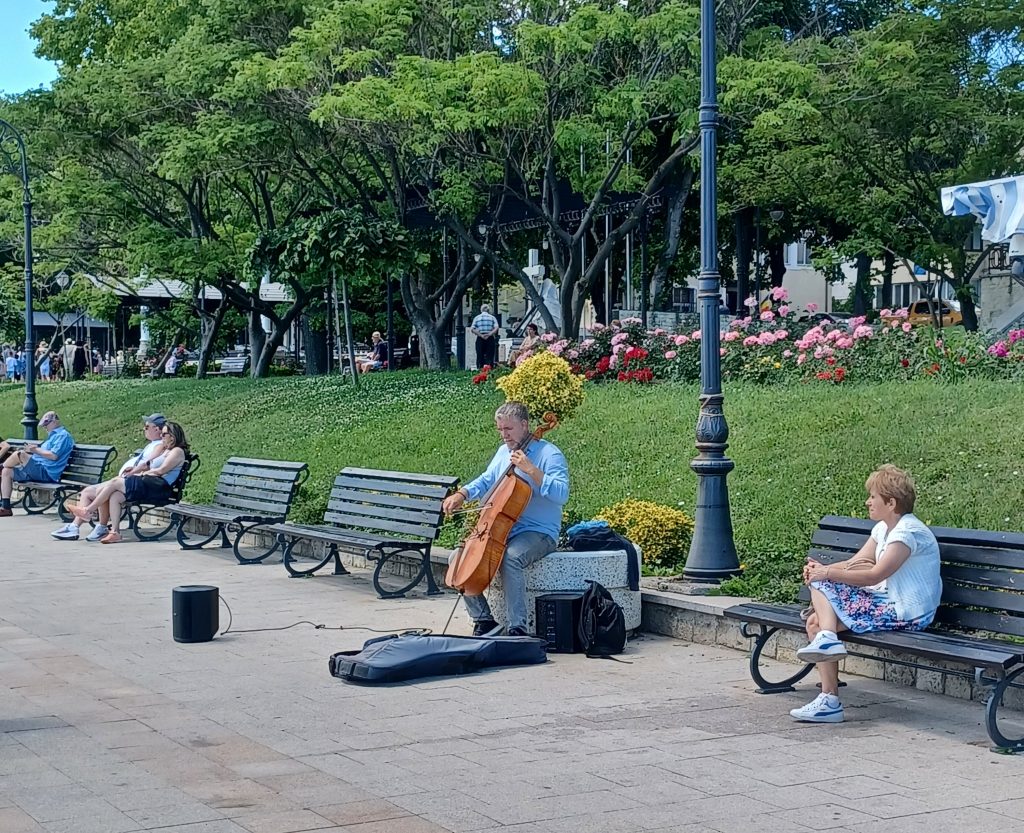
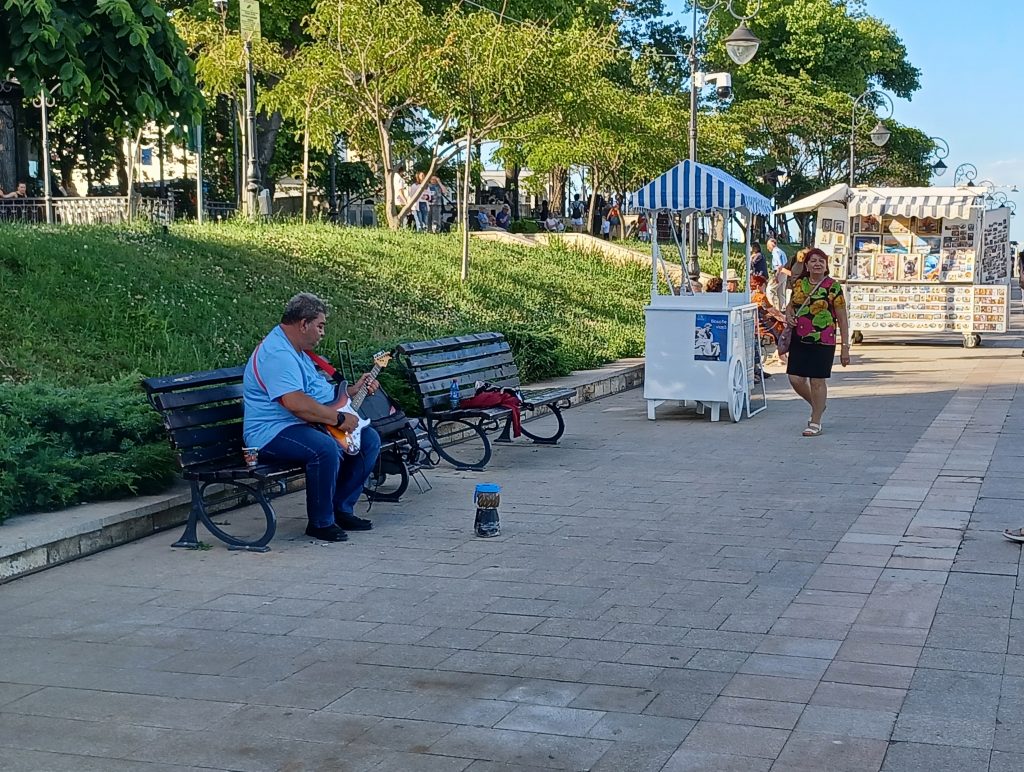
Meanwhile, I wander along the esplanade past small booths with displays of paintings by local artists, and ice cream stalls, listening to musicians playing at various spots all along it. A cellist sends tingles down my spine, with his soulful playing. I put a note into his cello case, already well stuffed with bank notes. A violinist, a singer, an accordionist, a guitarist. All hoping for generous donations to their coffers from the many assorted folks strolling along on this sunny Sunday: mums and dads, boys on scooters, girls on roller skates, babies in prams, couples arm in arm. I think of my English musician friend. He could do well here. Gulls soar overhead – the yellow legged variety, and the odd cormorant, and lots of swallows and house martins flitting above the ancient buildings. All just as it was decades ago. In fact, during the fashionable inter-war years, cruise ships called here and people of many nationalities made ancient Tomis their base. A highly sought after Black Sea resort. I love it.
Genovese Lighthouse
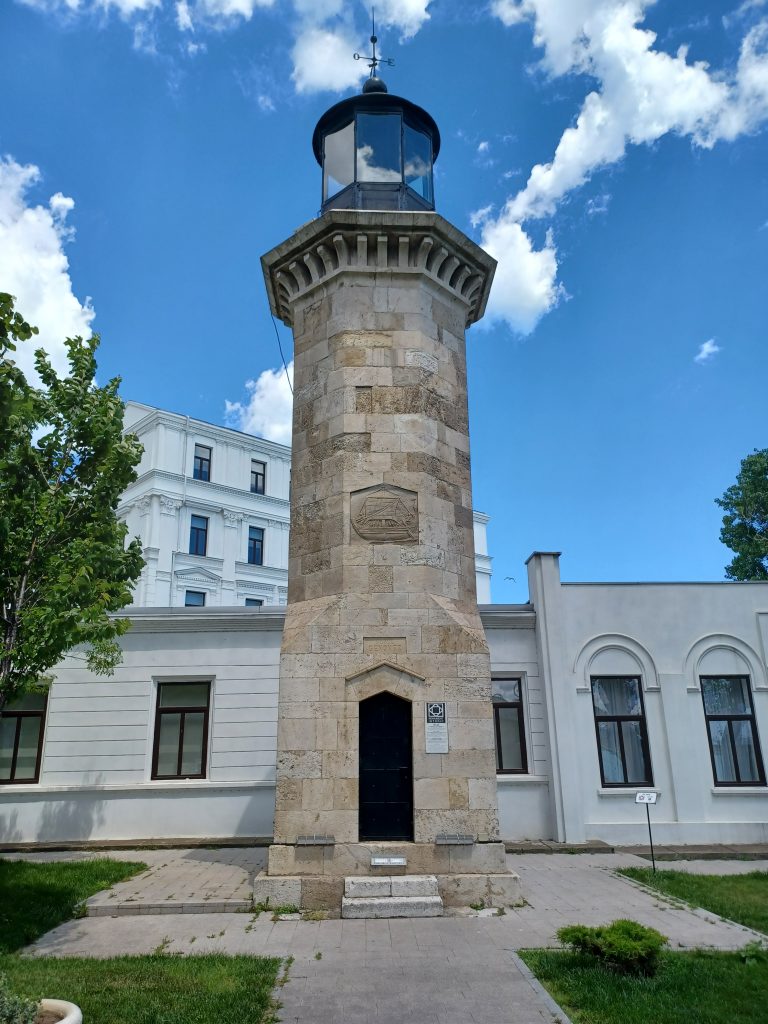
Further along the esplanade where it bends nearly 90 degrees towards Tomis harbour, I reach the smallish ‘Genovese’ lighthouse. This is the oldest in Constanţa and was built by an Armenian, apparently, for an English company, the ‘Danube Black Sea Railway’. ‘Farul Genovez’ is inscribed over the doorway. Interesting. Inaugurated by King Carol I in 1879, the lighthouse was used until 1913, when it was replaced by another, which was installed upon the mole of the commercial harbour. I stare up at it for a bit, then head back along the esplanade, my time slot to visit the casino fast approaching. Pause to purchase one of those paintings of said casino from a local artist before entering the building.
Constanţa Casino
The casino, a masterpiece, built in art nouveau style, was inaugurated in 1910. Bombed during both world wars, it suffered much damage. Extensive reparations were carried out between 2020 and 2025. Just in time for my visit then. The casino used to be the place where fashionable folk, including Royalty, liked to be seen: parading in their finery, smoking, gambling. An exhibition on the ground floor displays photos of the old gaming tables, billiard halls, ballroom and entertainment centre that it once was. The casino was also used at one time as a restaurant and, during WWII, as accommodation for German troops. There is also an area here devoted to Queen Marie, who, after her husband, King Ferdinand, died in 1927, was ‘politically marginalized’. She was a good artist, e.g. of painting and sculpture, and some of her art works are displayed here.
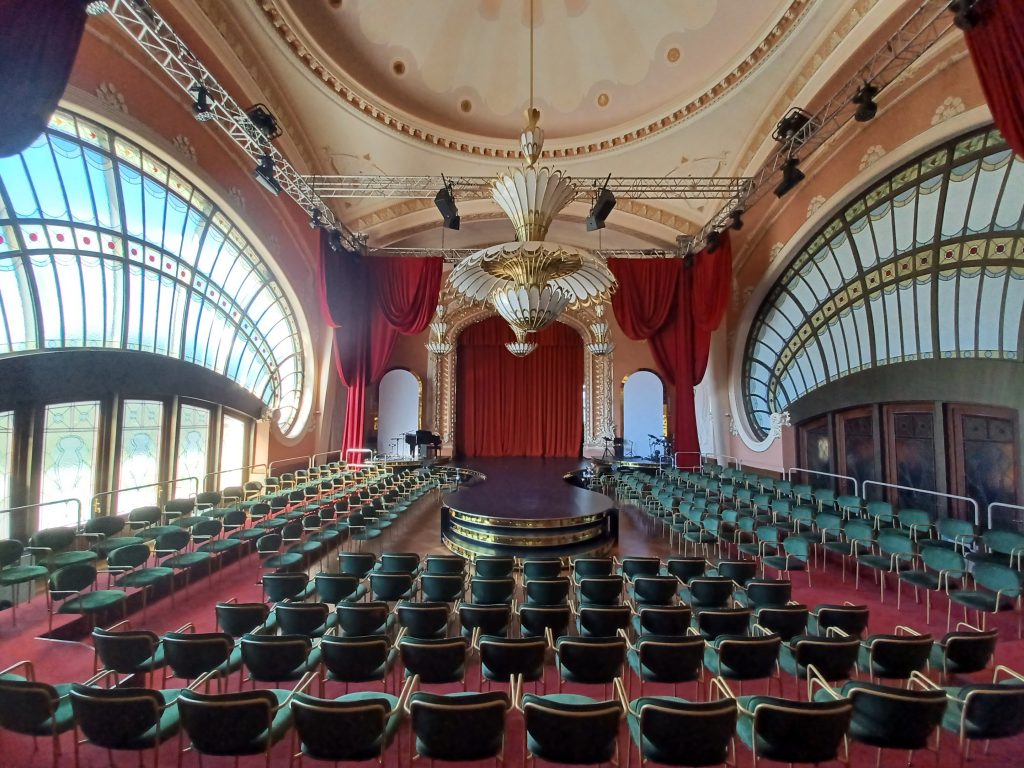
I venture upstairs to a splendid concert hall and spend a bit of time soaking up the atmosphere before going back downstairs. Find my way into the recently restored café/bistro, and find a table on its terrace overlooking the Black Sea. This café only opened in May, I understand. Sip a cocktail and watch the waters.
Eventually depart and wander hotel-wards. I find supper in one of those cafés in Ovid Square. Pot plants round about and Turkish music to accompany more of that fruity Romanian nectar. A cracking day.
Danube Delta
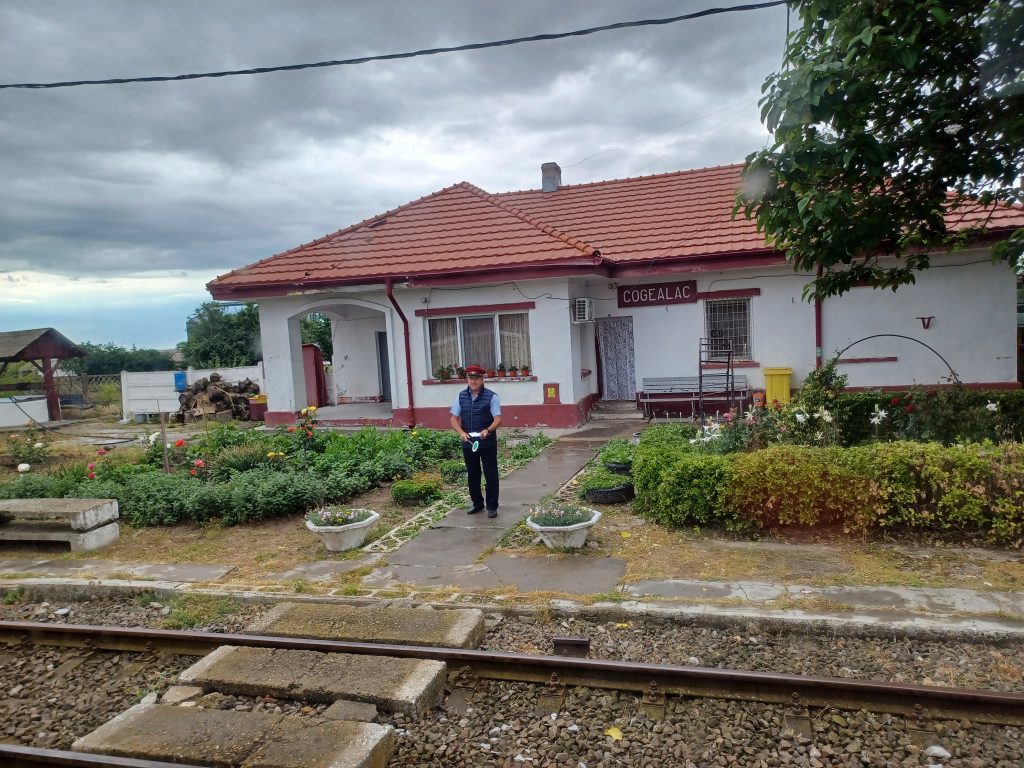
Today I am taking two trains to Tulcea, a large port in the Danube delta. Depart Constanţa and change trains at Medgidia onto the slow train. Only a few passengers aboard. The train chugs through the Romanian countryside stopping at various halts, some of which are in better repair than others. But all of them have a well-dressed be-uniformed guard waving the train through with his stick.
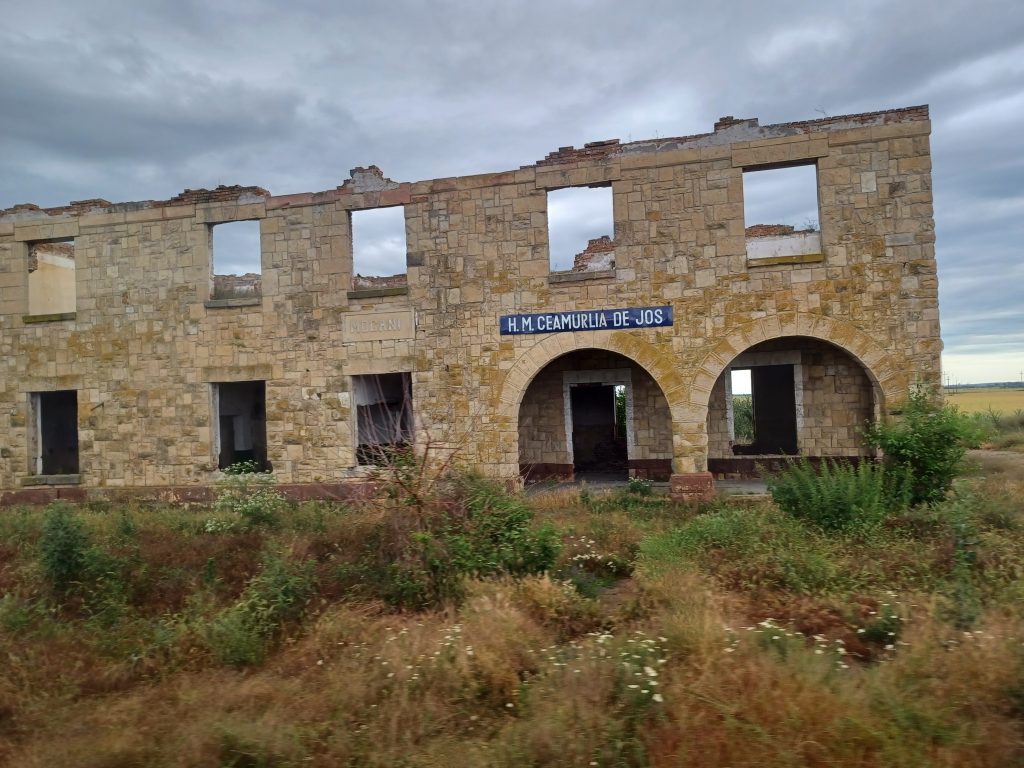
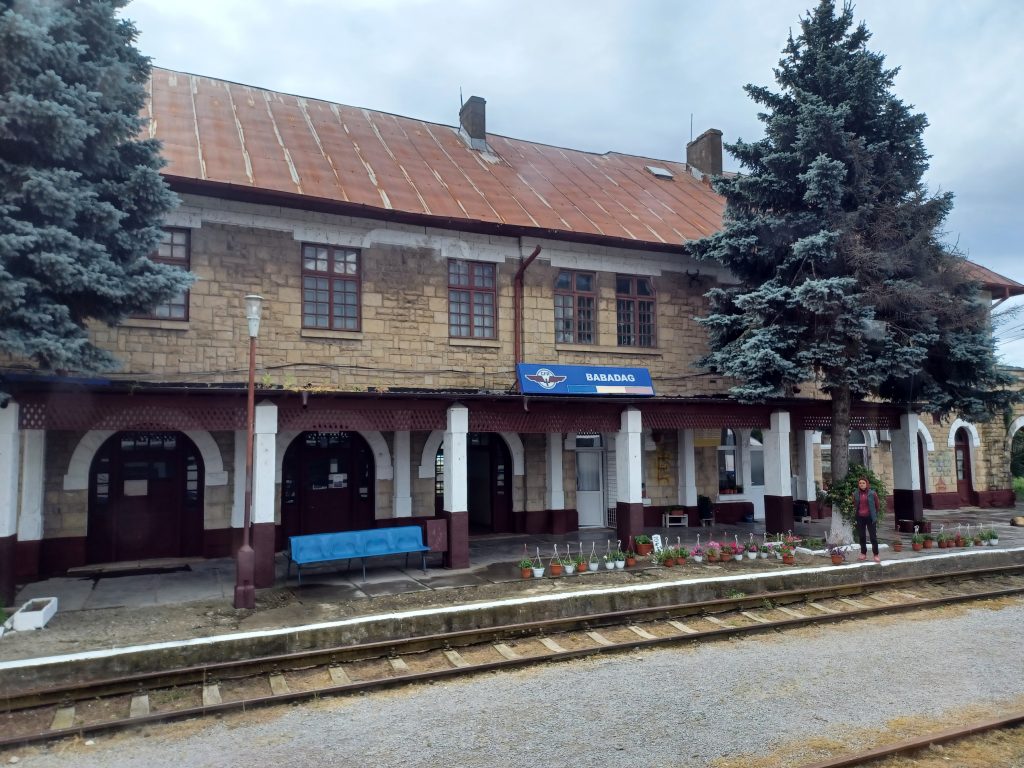
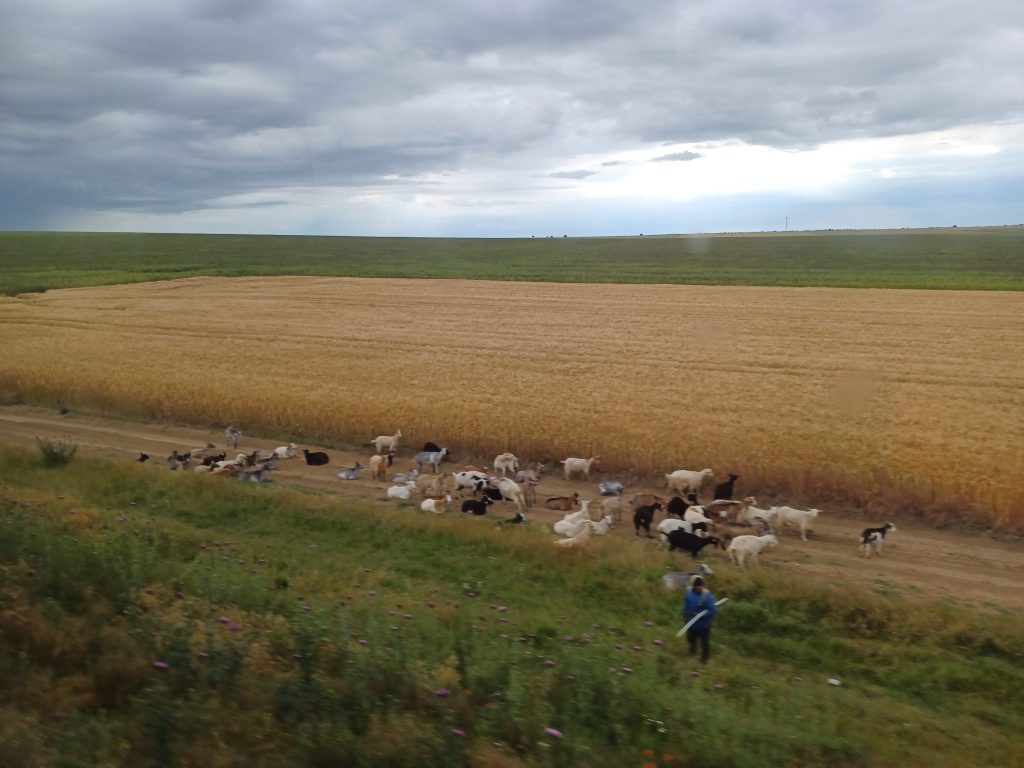
The train passes fields full of ripening corn, lined with strips of wild poppies, lemon yellow flowers and thistles. Birds dart out of the undergrowth. And magpies, sparrows, a hoopoe, and a white tailed eagle are spotted. Flocks of sheep scarper as we shuttle past, their shepherds watching on. Bucolic stuff.
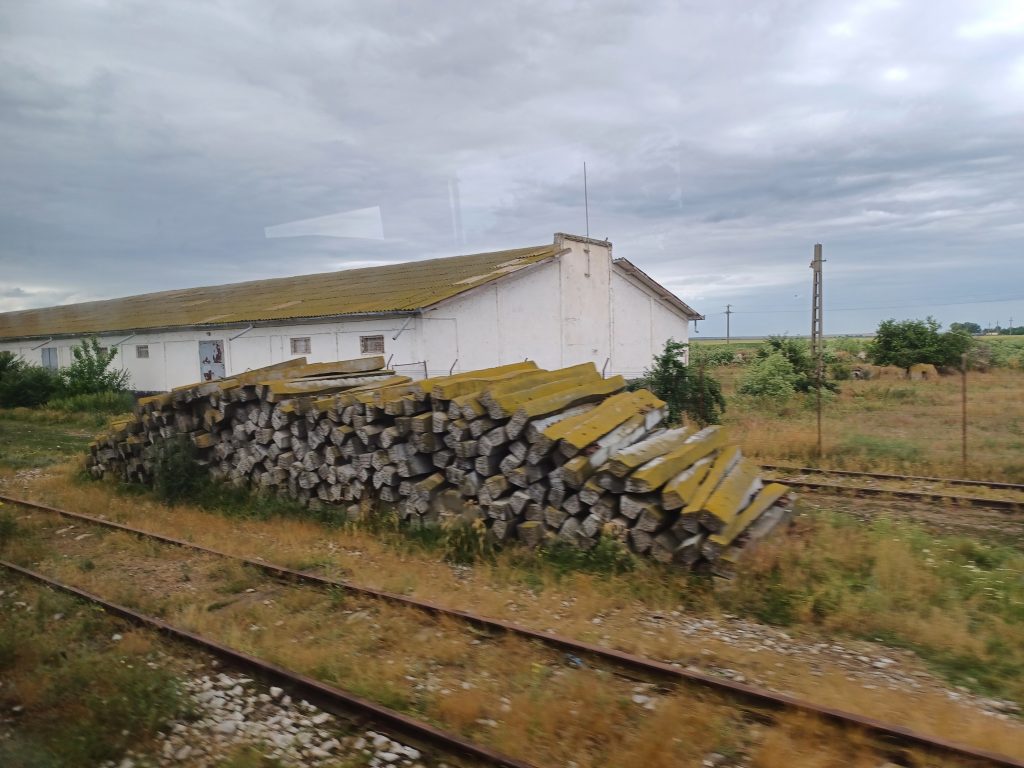
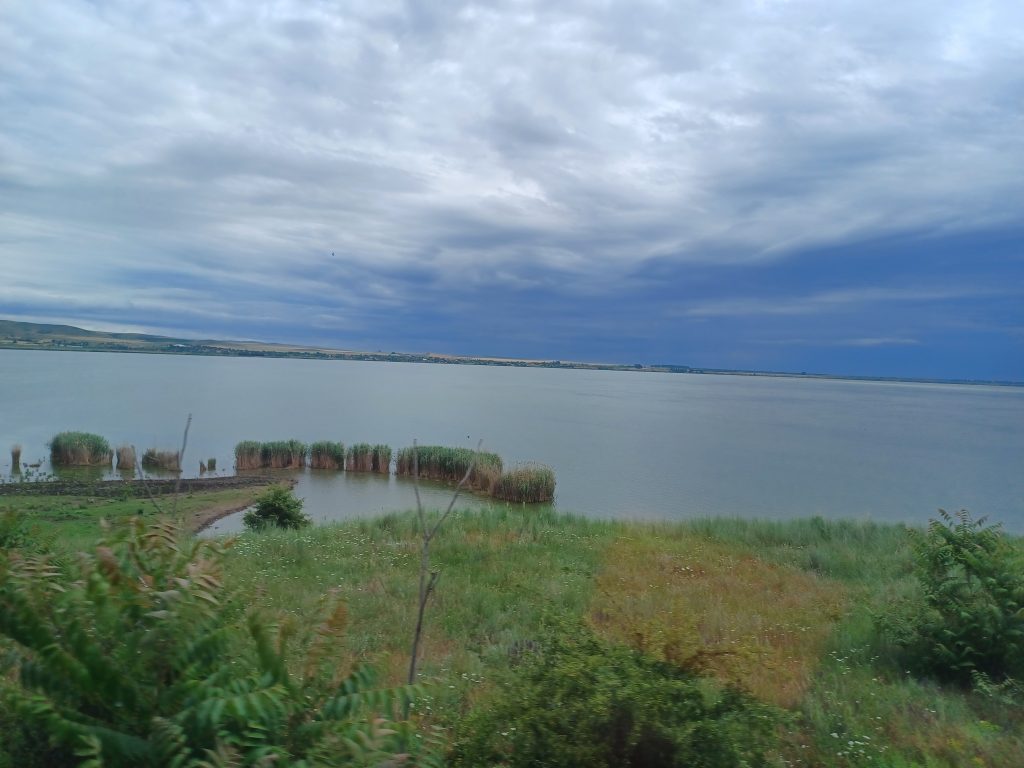
We pass old, empty and disused warehouses with large concrete girders piled outside, presumably once manufactured within. I see some of these later on, used in wall construction. In all, a placid few hours watching the scenery from the big windows. And soon, the first signs of the Danube delta with its lakes and waterways appear. The whole of the delta is a UNESCO World Heritage Site and consists of well over four thousand square kilometres of wetlands. Bird watchers rejoice!
Tulcea
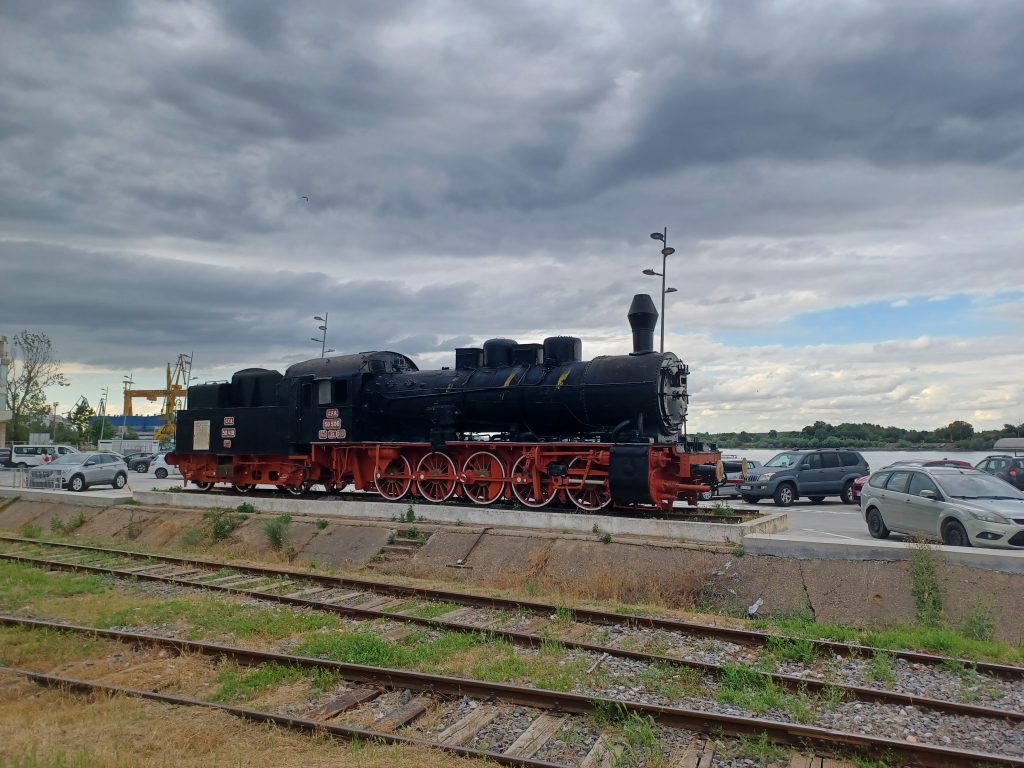
Finally arrive at Tulcea station where the train shunts to a halt. Opposite on a raised bit of track within a car park is an old steam train brightly painted black with a red chassis.
I descend onto a pebbly weedy area and wander across to the station building, the idea being to purchase a ticket to Bucharest airport a few days hence. Nobody speaks English here. I try Italian, as Romanian is a Latin language. It doesn’t work. French? No. OK. Manage to make myself understood though to the smiley and energetic black haired lady at the counter. Writing down the time and date helps somewhat. The trip from Tulcea to the airport will take many hours with two changes and does not depart until mid-afternoon.
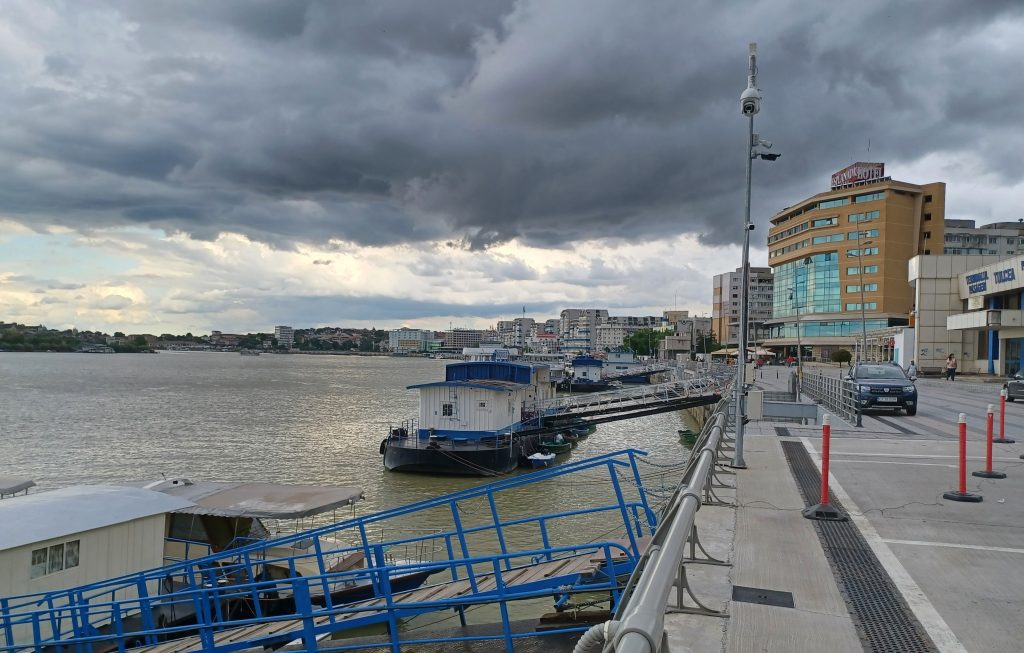
Not ideal, I muse as I head along the broad promenade on which my hotel stands somewhat unglamorously close by. This is not Constanta. Instead of attractive old buildings we have unsightly Soviet blocks. And instead of pirate ships are passenger vessels of every shape and size advertising boat and birding tours. No street musicians but loud pop music accompanies the dodgem car ride and and a bouncy castle, down which children are slithering. Brooding black clouds do not augur well.
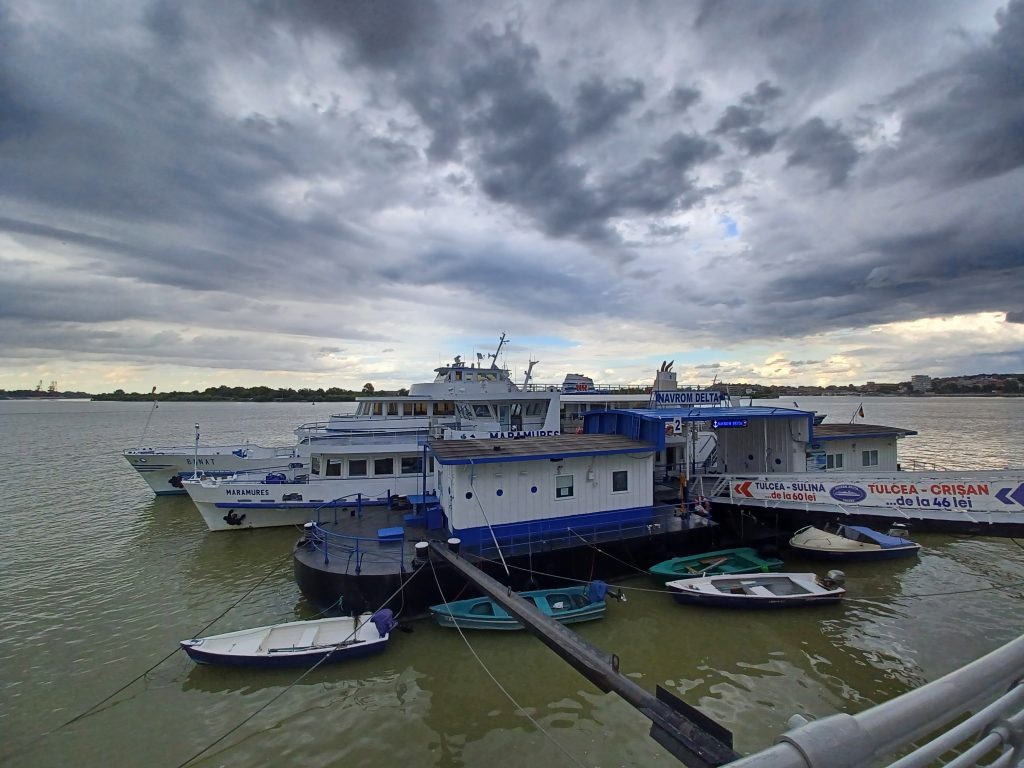
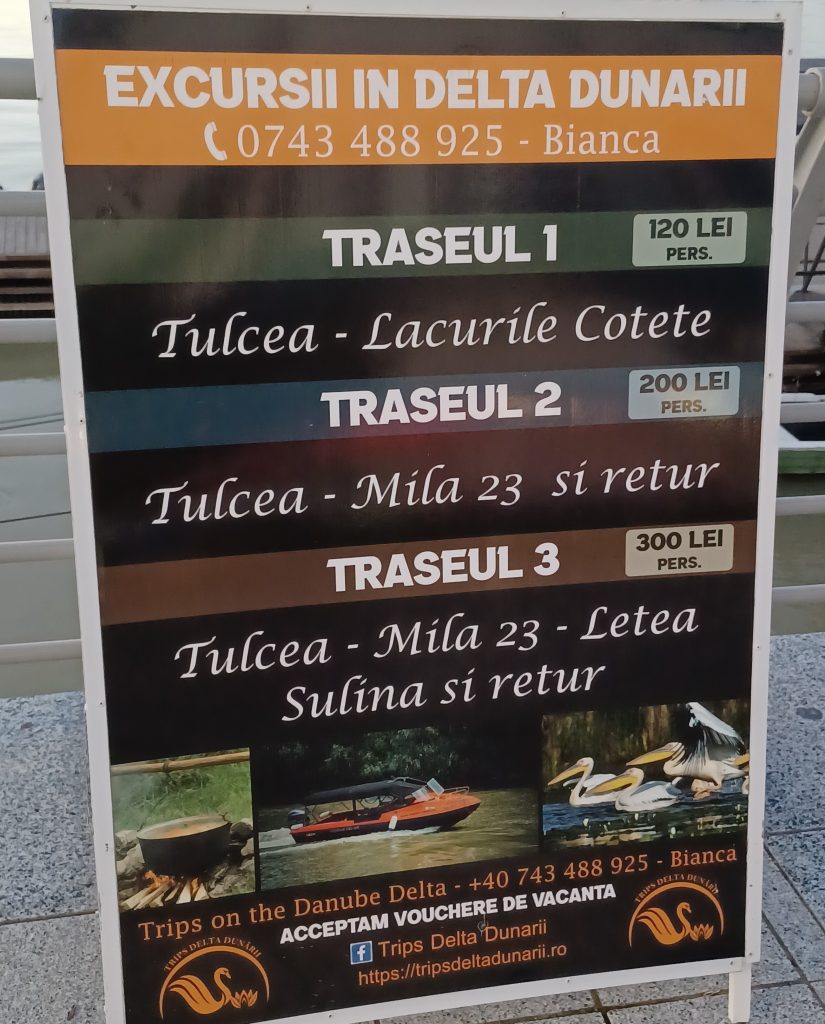
Too early to check in but the hotel can organise bird watching tours on the delta. So I book a full day on the morrow. Splendid. I then head off down the promenade to seek out the mooring where my boat will be. Find it along with a notice board advertising all sorts of Danube Delta excursions.
Preliminaries accomplished, I carry out an exploration of the town. Wander through a park, and look for a zebra crossing or equivalent to cross a busy road the other side of it to the shops. Extraordinarily tricky it is to find a crossing point. Eventually dash across a road well away from where I wish to cross. But, I spy a tourist information office here, in the window of which is a poster advertising airport shuttle buses. Enter. End up purchasing another ticket to the airport. Said airport bus departs at the very reasonable time of 11:00 and takes me directly to the airport. That’s a bonus. Although this unfortunate predilection of mine to sort out things well in advance means I now have two tickets in hand for transportation to the airport.
There is an Orthodox church sitting grandly by. Soul requires soothing. I enter in for a spot of the spiritual in its cool, glorious spaces. Then exit to seek out the coach park from where the airport bus departs. Somewhat more relaxed now. Independent travel is all well and good but, had I been on a tour, such issues as means of conveyance would have been sorted out long before by someone else in a darkened room.
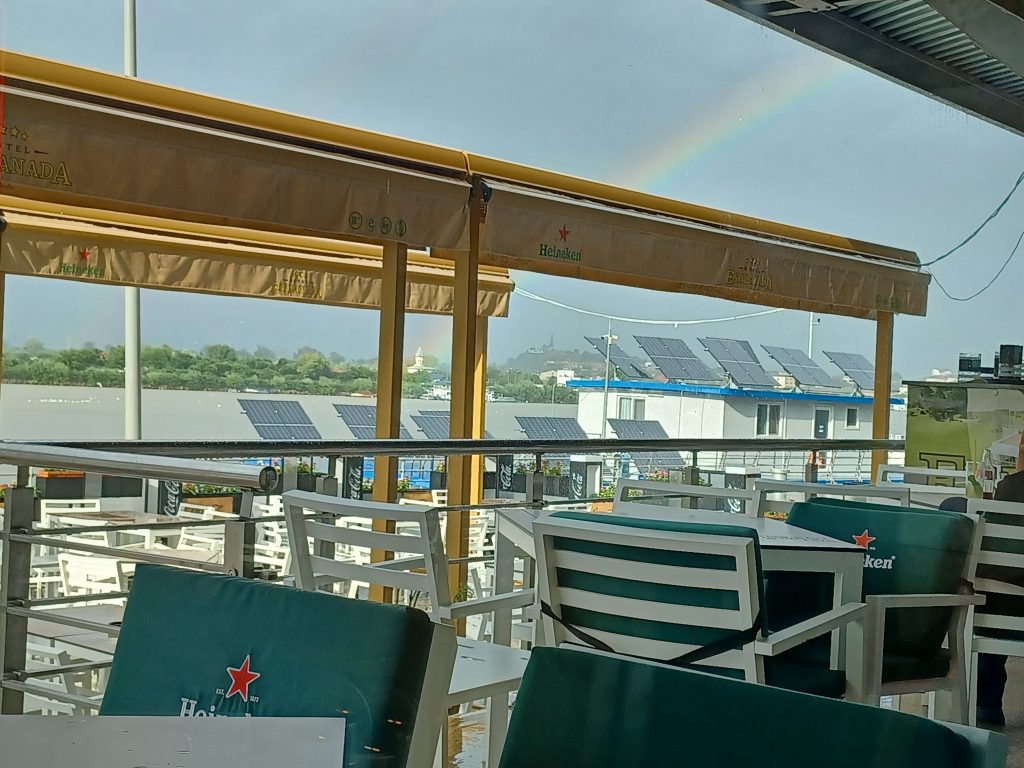
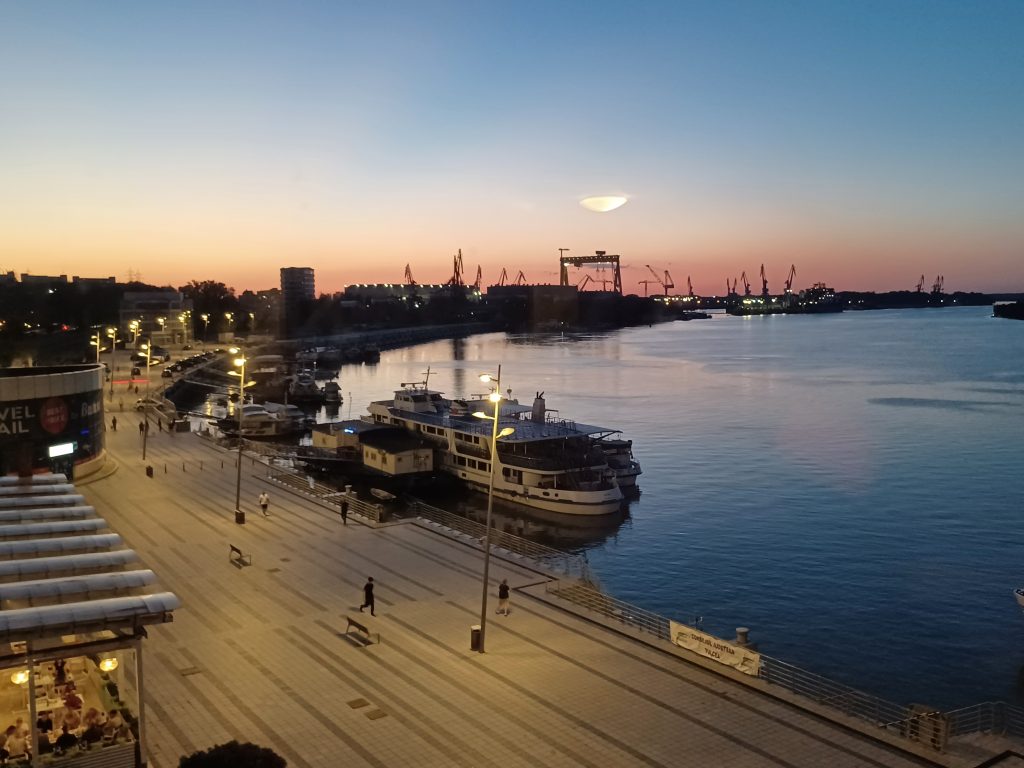
The clouds threaten rain. Lowering and black. Back at my haven of rest, I choose to eat dinner indoors. The heavens open. The staff run round outside gathering up cushions and a rainbow emerges above the roof. After the downpours the skies clear and things look pretty upbeat as the sun sets over the Danube and its vessels.
Danube Delta Boat Trip
Up earlyish and I head down the promenade to the boat. Our vessel is a long slim orange craft with soft canvas top and sides attached to the gunwales with fasteners. Seats about twelve people. On the stern is a huge outboard motor.
I am the first to turn up. Not unusual. Eight of us altogether. Soon zooming off at full throttle along a main Danube artery, slowing down for the guide/driver to give some occasional info in Romanian and English. Pass a boat that once belonged to Ceaușescu, now belonging to the state. Once out of Tulcea, the channel bifurcates and we head up the northern or Chilia branch, navigating a labyrinth of narrow channels, between broad expanses of open water.
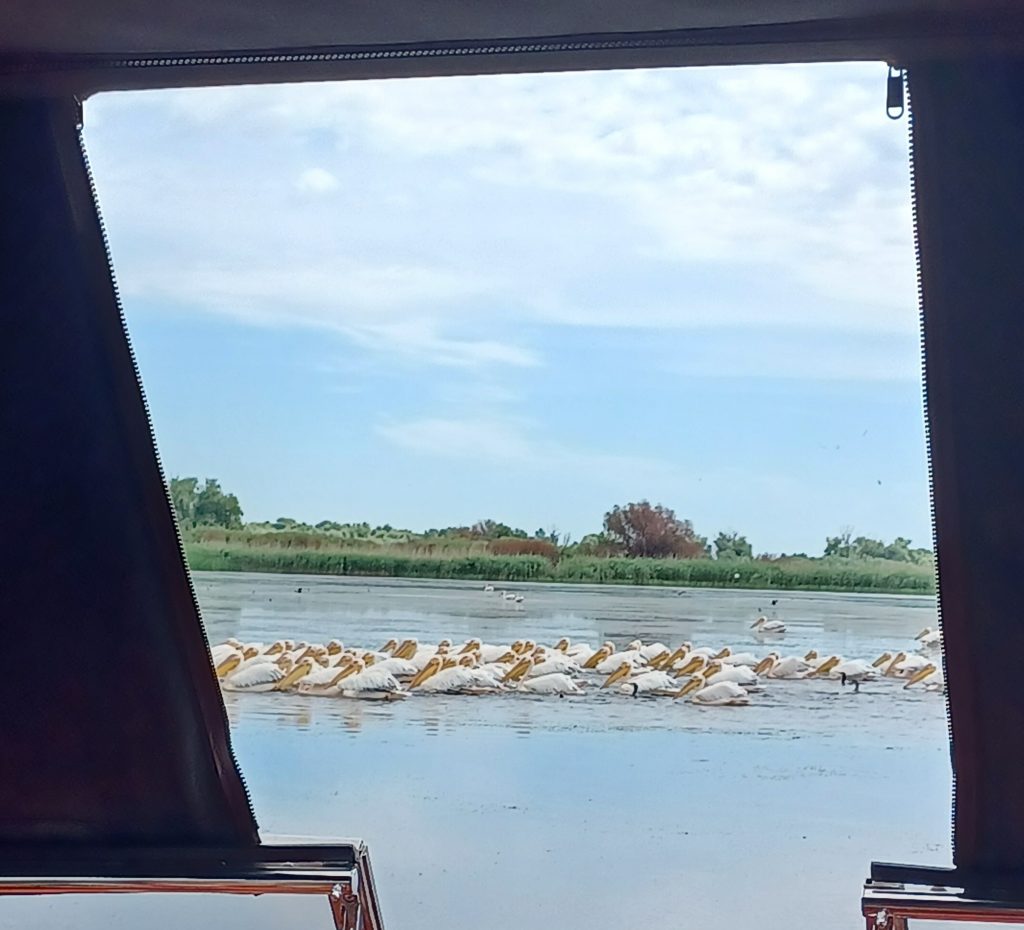
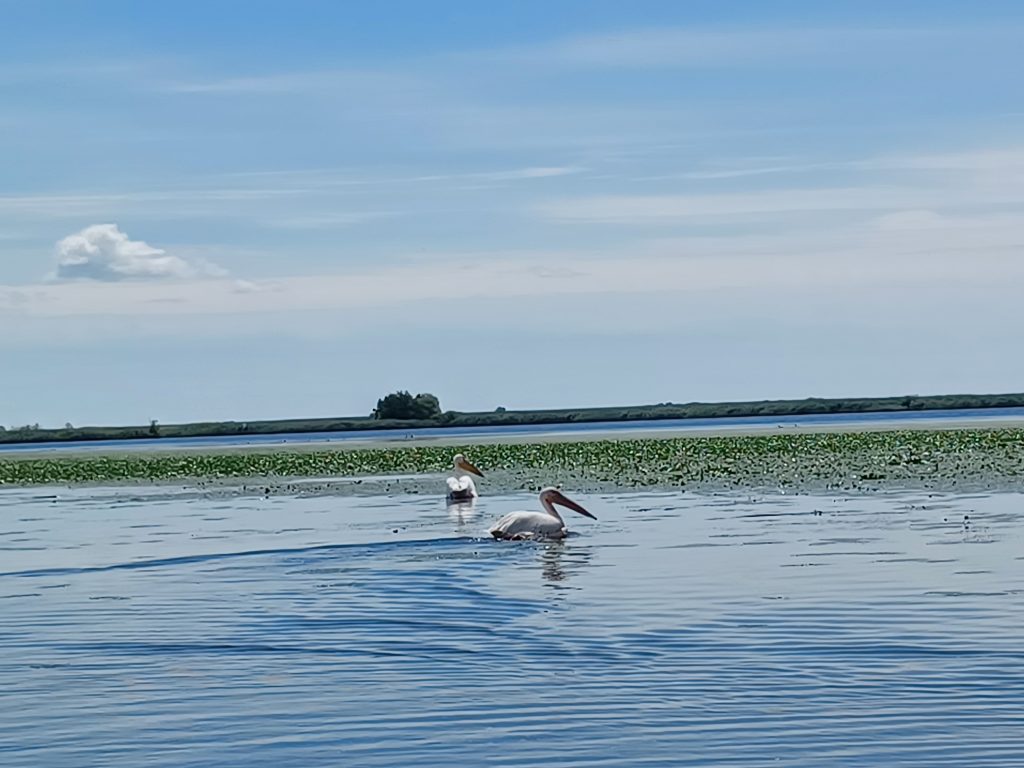
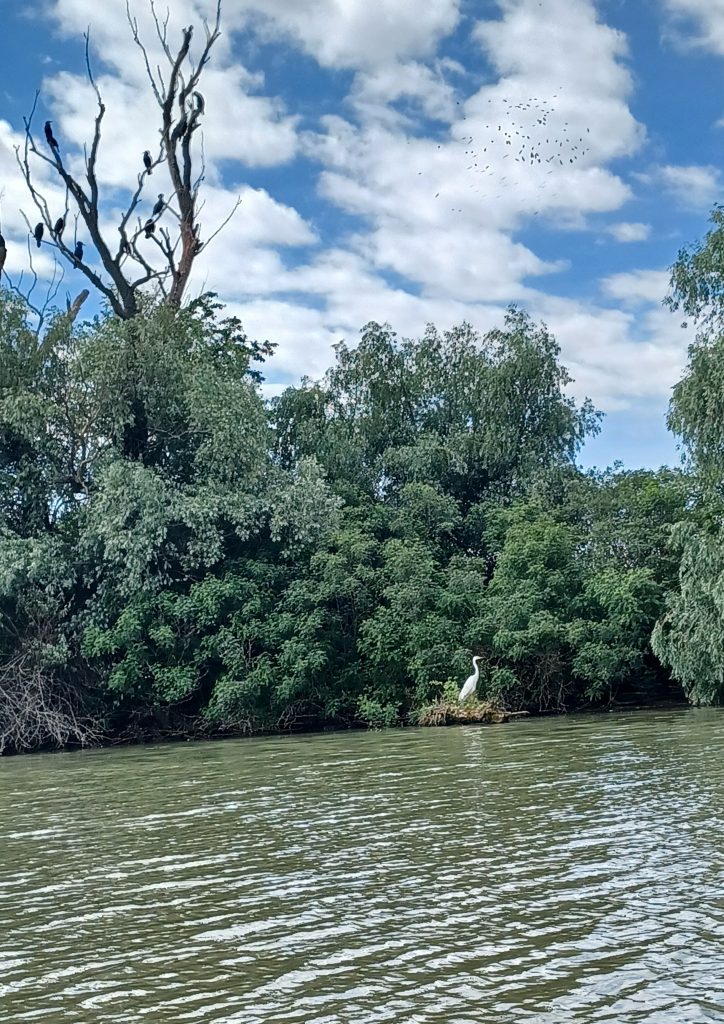
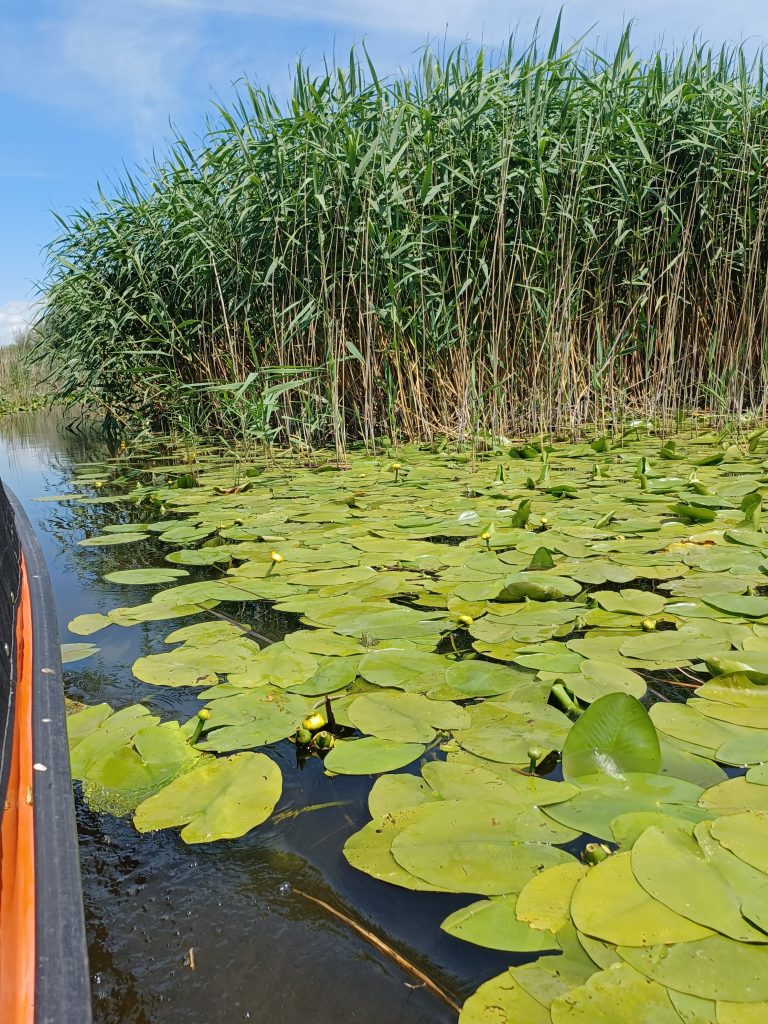
Pelicans in large numbers are fooling about on the lakes, and cormorants are all over the place. The guide laments that there are far too many cormorants. In their thousands. They destroy the trees with their guano. This is because their guano contains much uric acid. Ghost forests of dead trees ensue. Furthermore, the cormorants eat a lot of fish and deplete the fish stocks. The season for fishing has only just begun, says our guide. Carp and perch are species that proliferate here. The waters are very clean, lot of water lilies in places, some yellow, some white. The boat stops amidst a patch. A large green frog squats motionless upon a leaf. Eyes bulging with a startled look. And there are masses of reeds. Huge expanses of them. Havens for bird life.
First stop is at Mila 23, a small village on an island in the river. It’s a pretty place. Long queues for the washrooms. Then some time for refreshments. Purchase coffee and stroll about for a bit, watching the pelicans in the distance. No sign of rain. It all dropped last night. Sunny and clear and perfect.
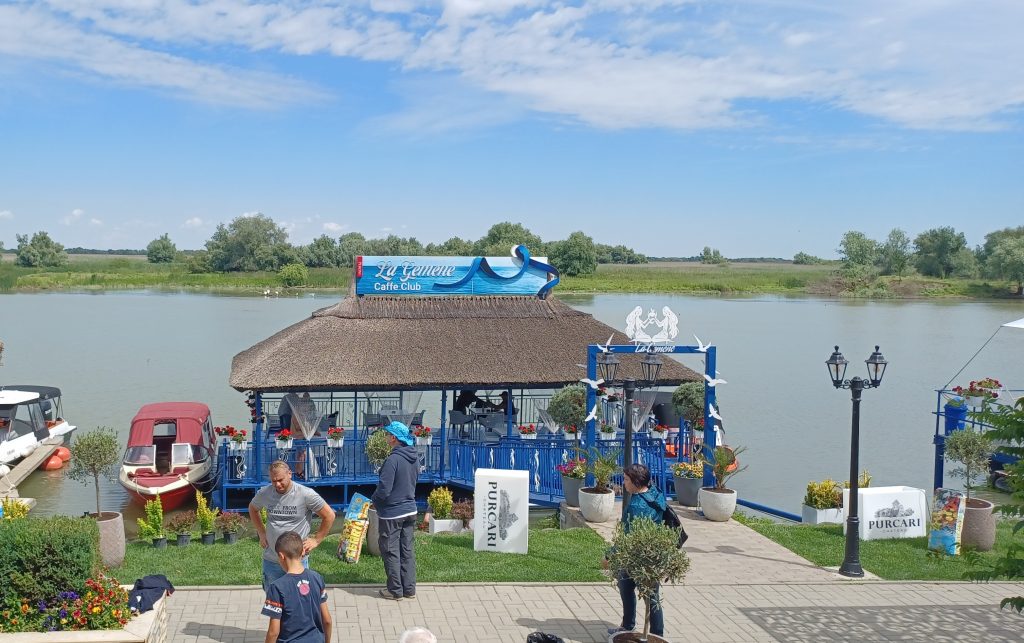
Thence to resume our zoom across wide open reaches, followed by edging up narrow channels, the topsides scraping the reeds as we pass. Nonchalant cormorants cluster in the trees above. I spy a kingfisher as it darts ahead of us and a catch a momentary glimpse of a cattle egret in its chestnut breeding plumage. A great white egret strolls elegantly in the shallows, grey herons, gulls, terns; and pelicans circling above with their heavy-ish slow wing beats. Quite a picture.
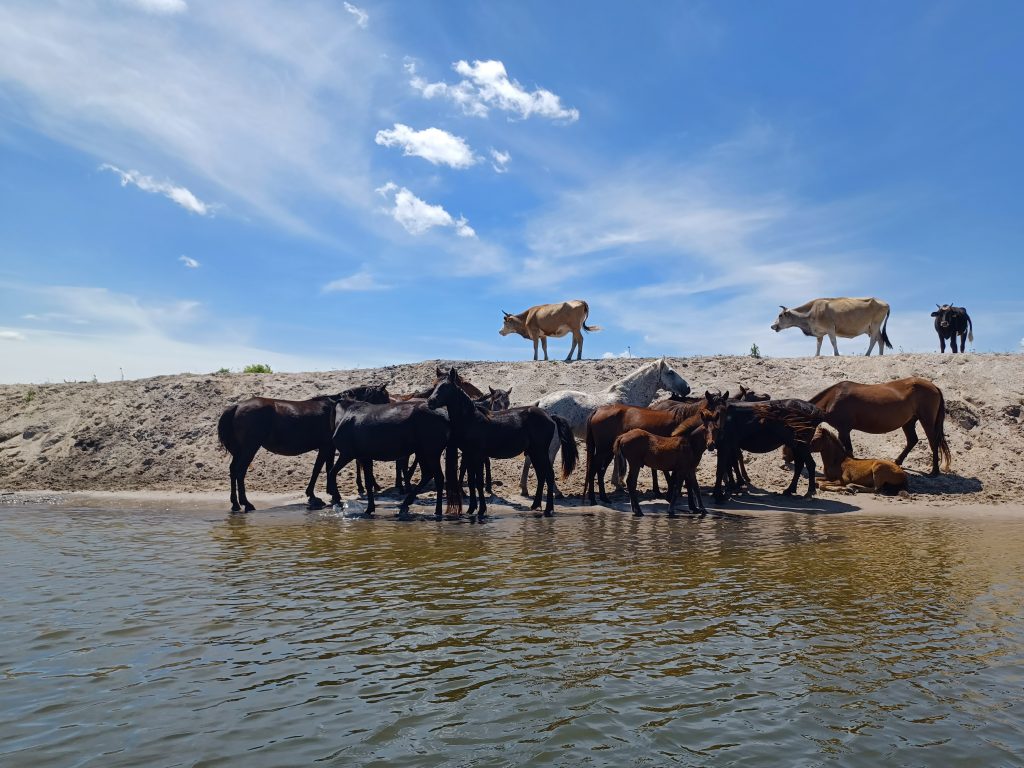
Race off. A bit too fast to spot smaller species of birdlife. Pity. Bet those trees are harbouring all sorts. We see the large ones though and wild horses and cows. Some of the animals are coming down to the river to drink and cool off. Chestnut horses, sleek and flighty; brown cows, somewhat more docile. Captivating. The boat slows down to pass. The wild horses live in Letea Forest, a subtropical forest, about half of which is a protected area. We are offered the opportunity to visit by wheeled transport but nobody seems interested. Anyway, we have a good look at said horses frolicking about by the river.
Lunch has been specially ordered for the group in Letea, another small village where nothing much goes on, save fishing and some animal husbandry. Lunch: fish or chicken, is tasty, served with white Romanian wine, water and a pre-prandial glass of the local plum liqueur. Down in one. Hic. Get to know the rest of the group. Amiable bunch: German, Romanian, Italian and Arabic speakers.
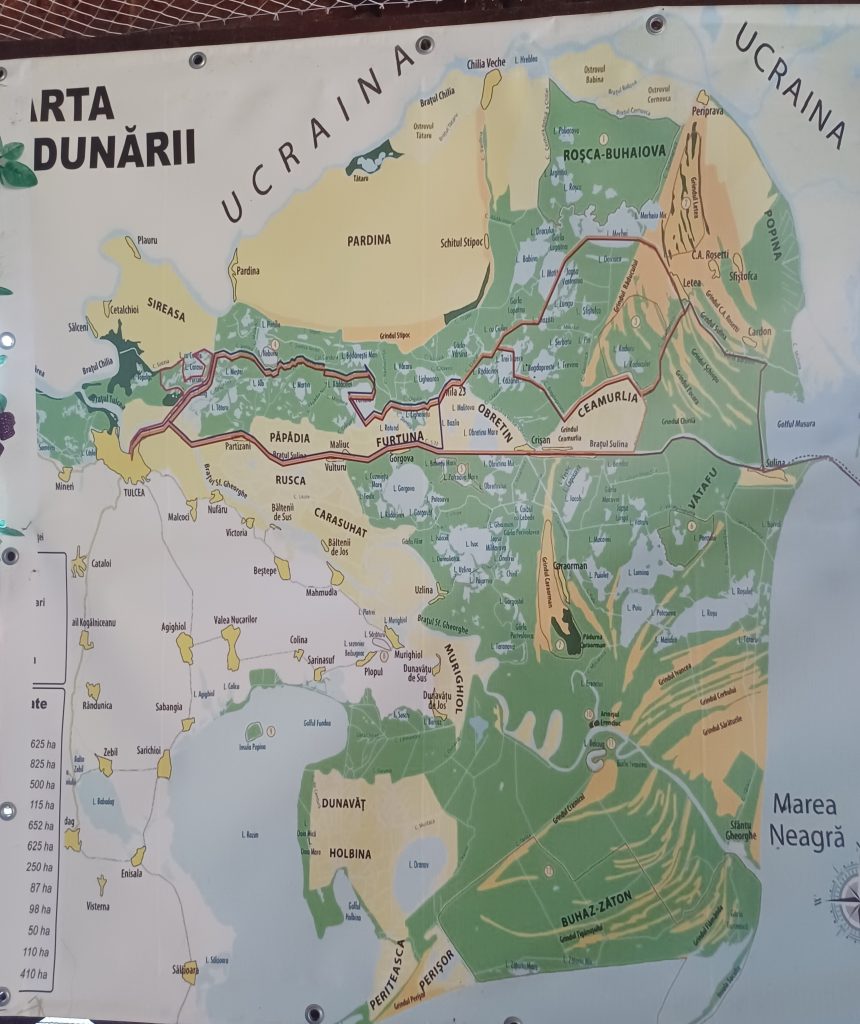
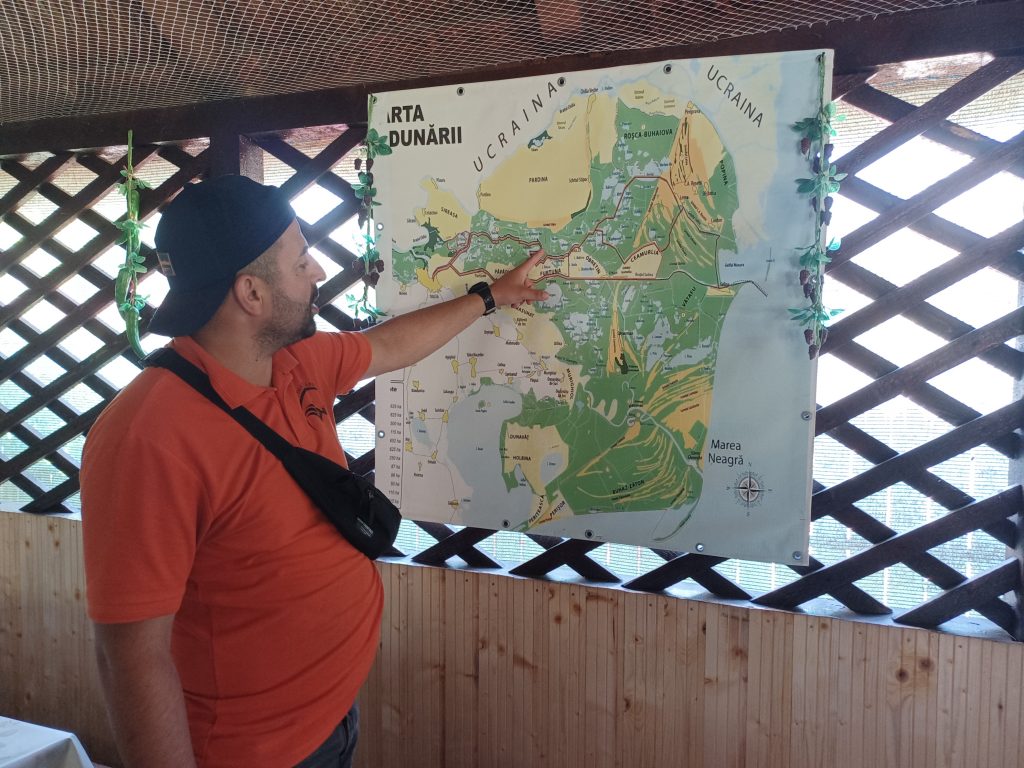
On the wall in one of the visitor spaces is a large chart of the Danube delta. The delta is the second largest in Europe after the Volga delta, we are told. Our guide shows us the route we have taken, north through lakes and narrow channels. The northern Chilia branch forms the border with Ukraine. The Sfântu Gheorghe is the southern branch with the little fishing village of Sfântu Gheorghe at the mouth, and the Sulina branch, which we are travelling on now, is in the middle. The chart here highlights the northern and middle branches. The plan now is to head from Letea to Sulina and, hopefully, out into the Black Sea.
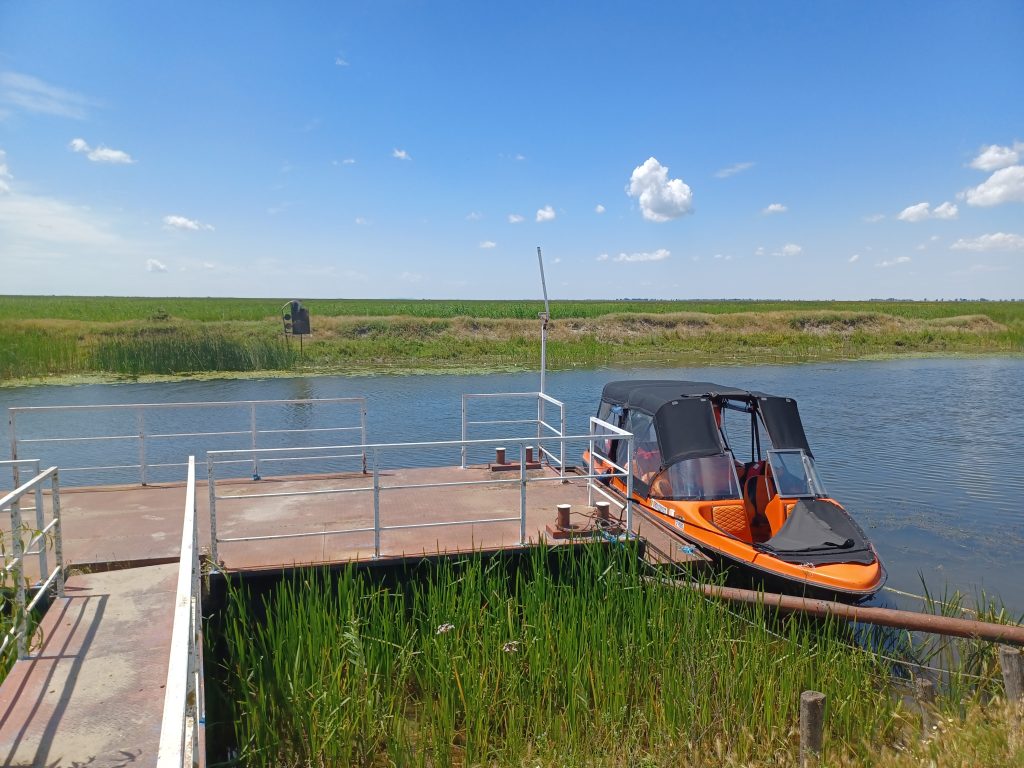
Speed off again to Sulina. As we approach the river mouth, we pass an old lighthouse built in 1870, now obsolete, and a newer one closely guarded by the military due to the Russian war with Ukraine. Cormorants perch on the boulders at the end of the mole, which marks the easternmost point of the EU. The weather is good so we are duly wizzed out through the moles into the Black Sea. And dolphins are cavorting out here in the swell. Much glee from the boat occupants.
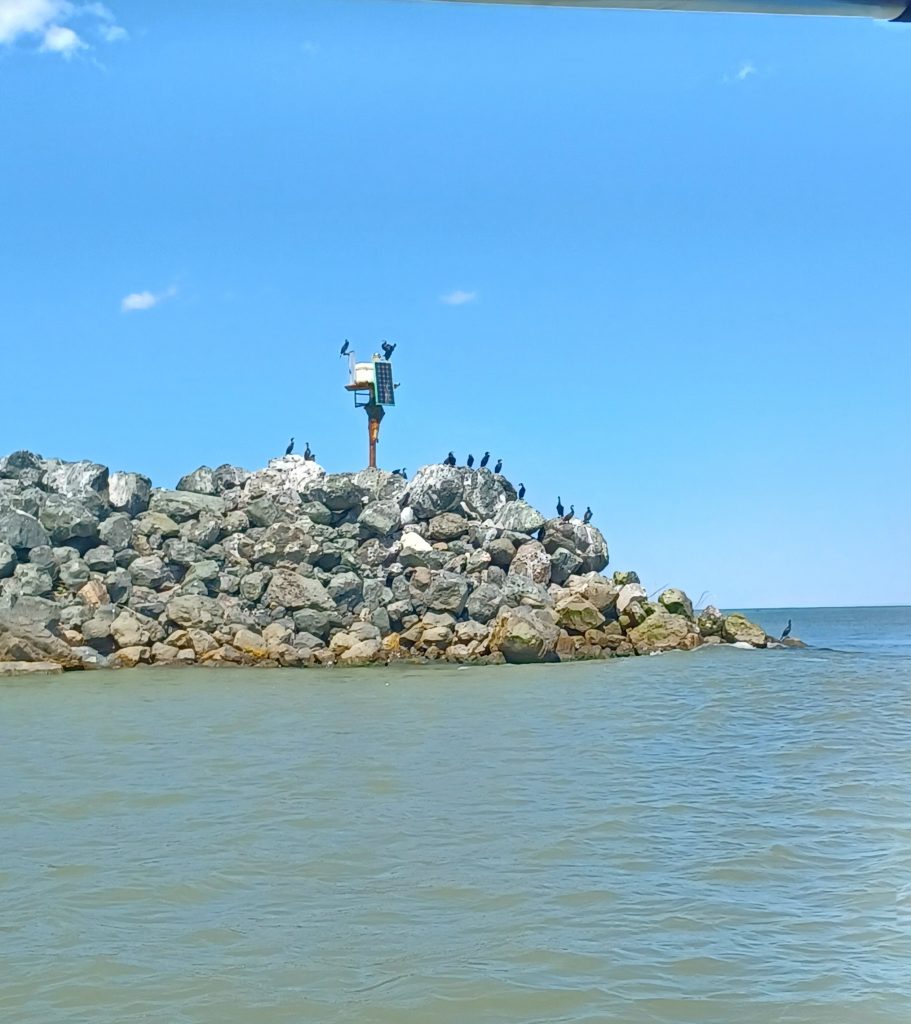
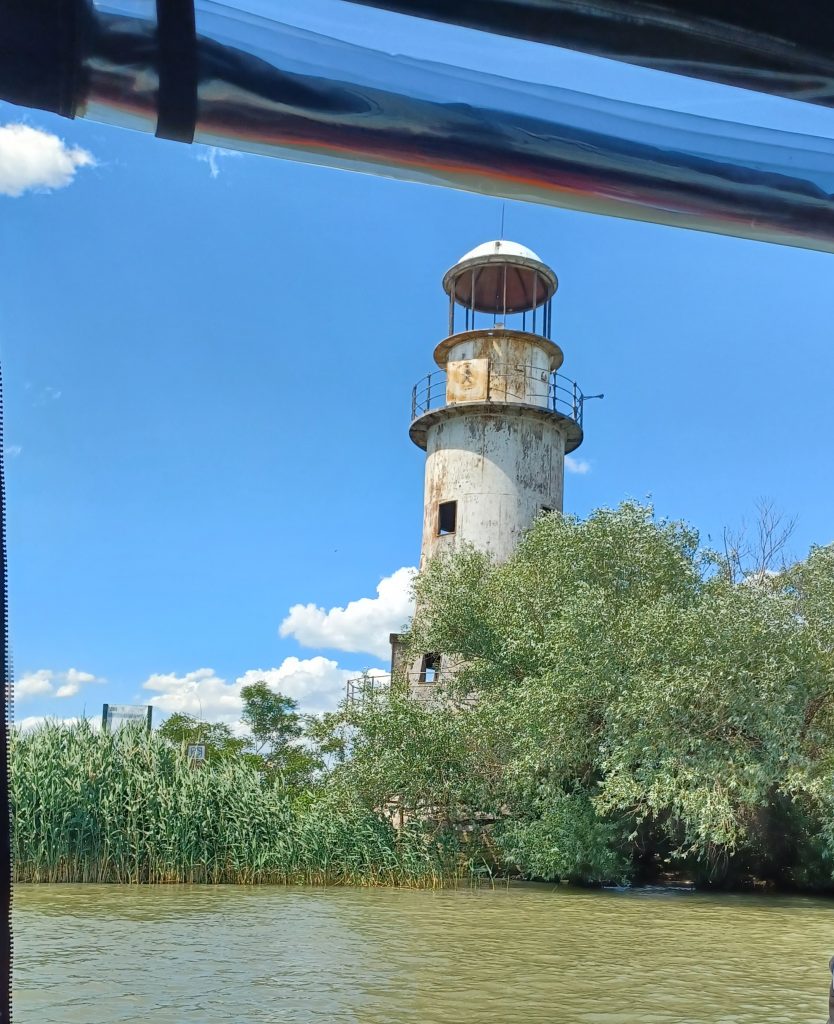
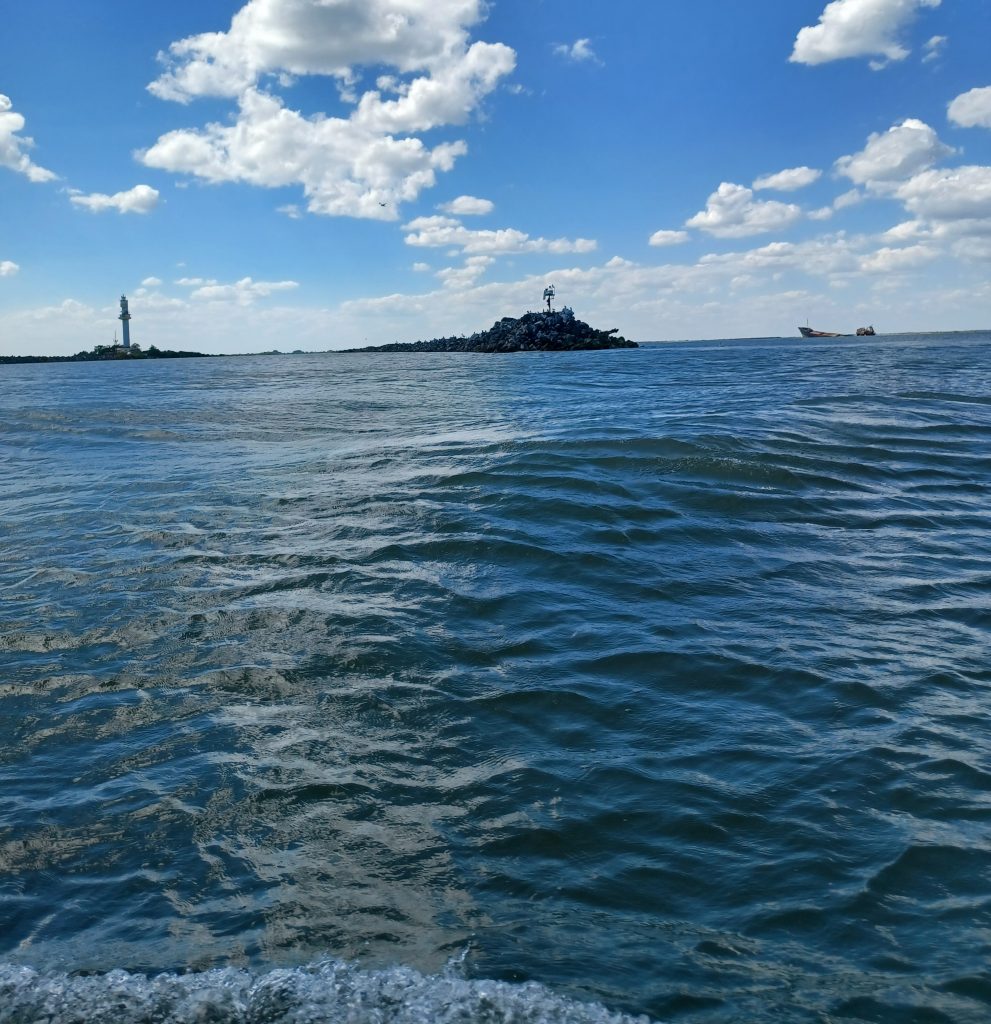
The boat rides the swell with the dolphins for a while before returning up river between the port and starboard buoys. We moor up close to Sulina Beach. Nice little mooring. Bird song. Can actually hear it when the engine is, at last, switched off. Scents of flowers. “You have two hours. OK?” OK. Our guide has told us that tourism is not great right now due to the Russian war and, on arrival at the beach, it is far from full. And there are fewer boat trips. Lucky for us as it not too crowded. Not so lucky for those who rely on tourist income.
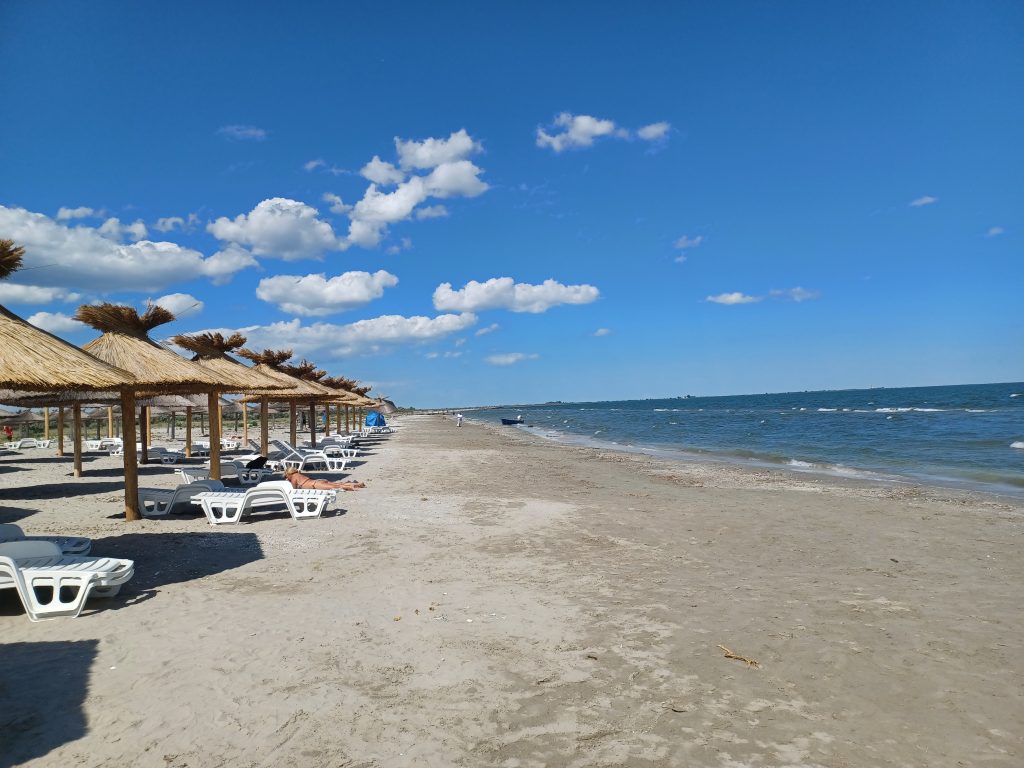
It is very windy on the beach. I mooch about a bit and recline on a wooden sunbed, shaded by a thatched canopy. Watch a party of folks going for a swim. Then partake of coffee in a café. Employees hang about the mostly empty tables.
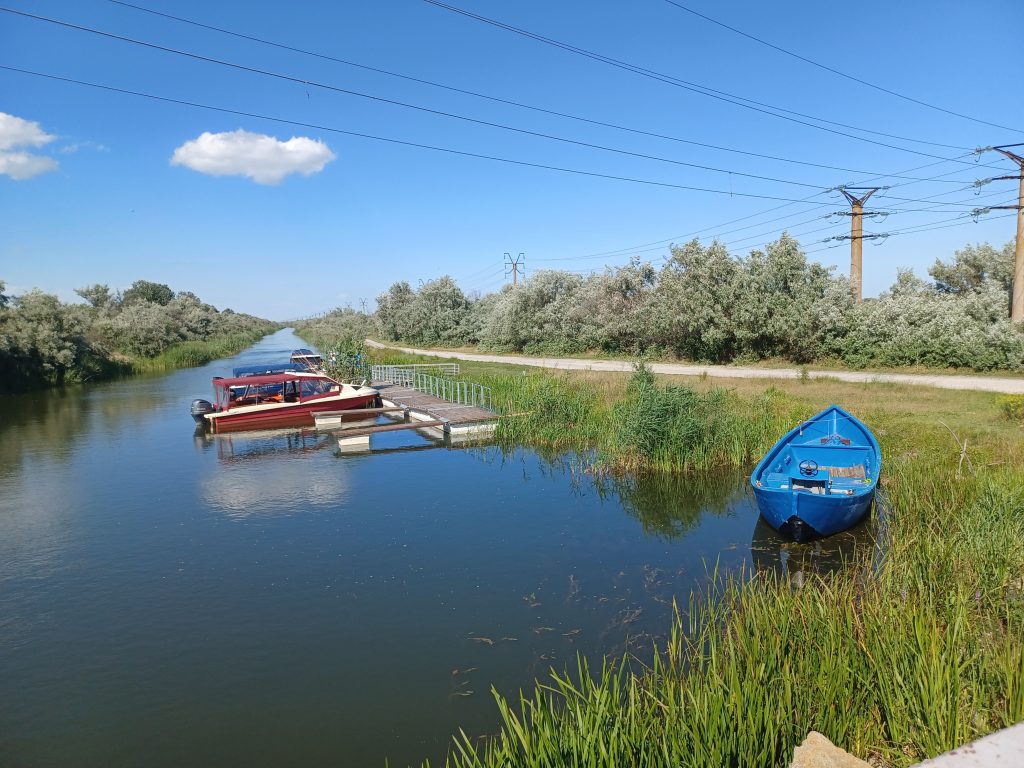
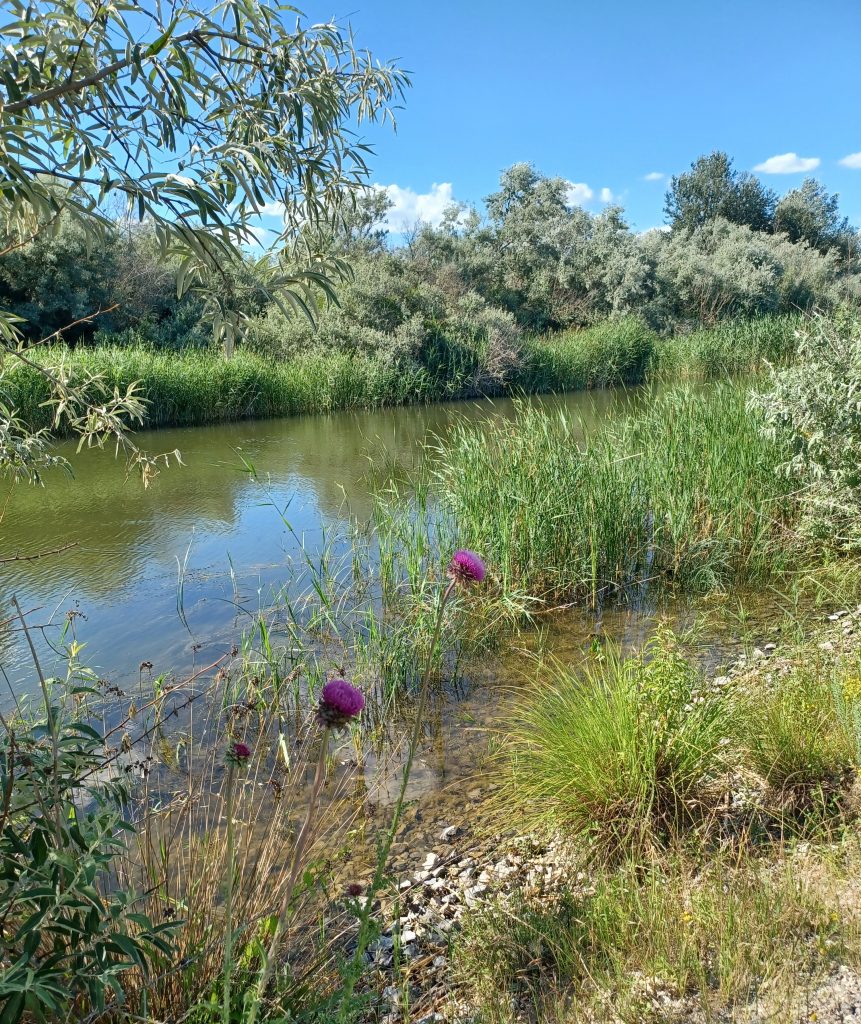
I am hoping to spot a few more birds. Have brought my binoculars with me for this purpose. And this is the first time they have had an airing since I have been in Romania. Thus, I wander at a leisurely pace back up the sandyish path to where the boat is moored. Still and serene here. I stand motionless for some while peering into the thick vegetation, binos at the ready. Dreamy sort of surroundings. Painter’s paradise. Purple thistles, grasses, reeds, lilies, leafy trees. And the still and sluggish waters of the Sulina branch reflecting the foliage. And birds twittering from hidden perches. I seek in vain.
We board the boat once more for the homeward trip to Tulcea on the Sulina branch. A straight hour and a half fast motor for about 75 kilometres, I gather. Brace ourselves. Sunshine and spray. Storks appear on top of poles. We pass Hora Hill, upon which rises a granite obelisk, the Independence Monument. This commemorates the incorporation of Dobruja into Romania after the War of Independence against the Ottomans. King Carol I it was, who laid the foundation stone in 1879.
Our driver, somewhat jocund, approaches the waterfront at speed, throttling back for the last meter or two. Unsteadily disembark. Helpful hands reach out to assist folks out of the boat. Thank yous, au revoirs and the like. Reel slowly along the pontoon and up the gangway to the promenade and hotel-wards. That’s enough excitement for one day.
And next day, I leave Romania. Off to new pastures.
Leave a Reply