

Well, if Georgia was all about wineries and Orthodox churches and monasteries, Armenia is all about wineries and Apostolic churches and monasteries ‒ with a bit of brandy thrown in. Stage three of my trip to the Caucasus begins with the border crossing into Armenia from Georgia. Another change of coach, guide and driver and we are off, driving through the hills and alongside fast flowing streams of the Lesser Caucasus range.
As well as the shortish northern border with Georgia, the Armenians share a border with the Turks to the west; that separate Azerbaijan enclave to the south-west (soon to be joined to the main part of Azerbaijan by the Trump Route for International Peace and Prosperity (TRIPP corridor (see Azerbaijan, part 1)); a small section with Iran to the south and the main part of Azerbaijan, including the disputed Nagorno-Karabakh region to the east. The borders with Turkey and Azerbaijan are both closed. Hence the route of the tour going into Armenia via Georgia.

Haghpat Monastery
The Haghpat Monastery, a UNESCO heritage site, is the first stop. Situated in a serene setting high up on a promontory within the Lesser Caucasus looking over the Debet river. Built from basalt between the 10th and 13th centuries. A separate bell tower, dated 1245, perches higher up the hill. We roam around the outside admiring the stonework, etched with carvings, whilst inside the cavernous precincts, we revel in the ancient architecture with its columns, archways and carved capitals. Cool. In both senses.
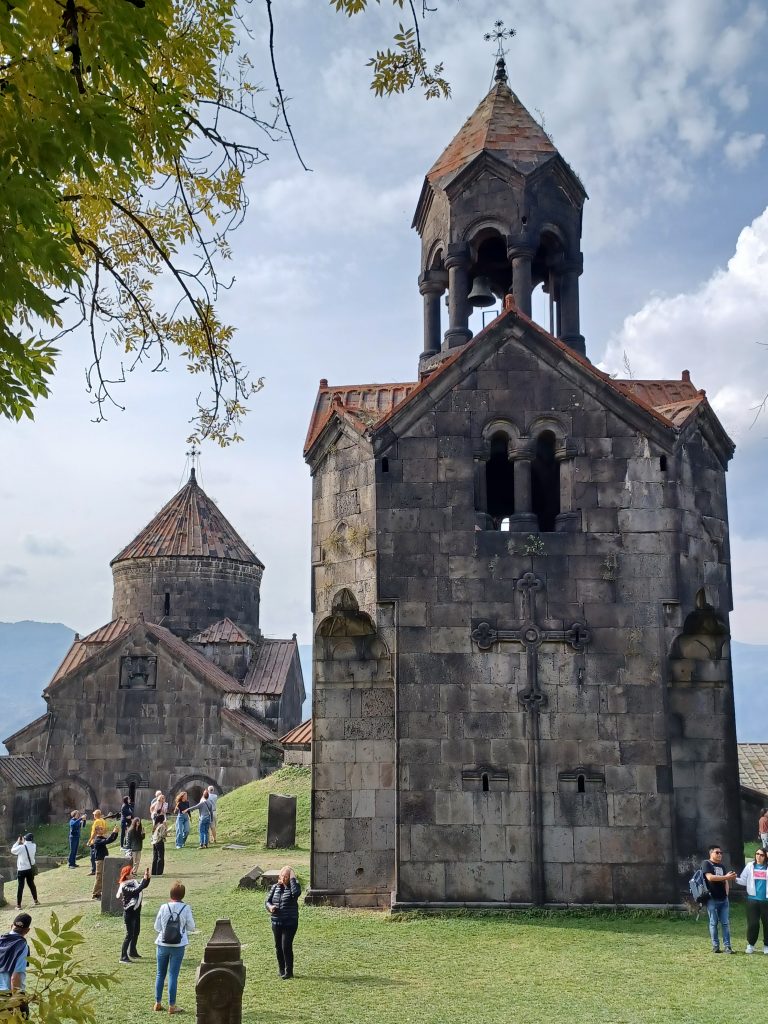
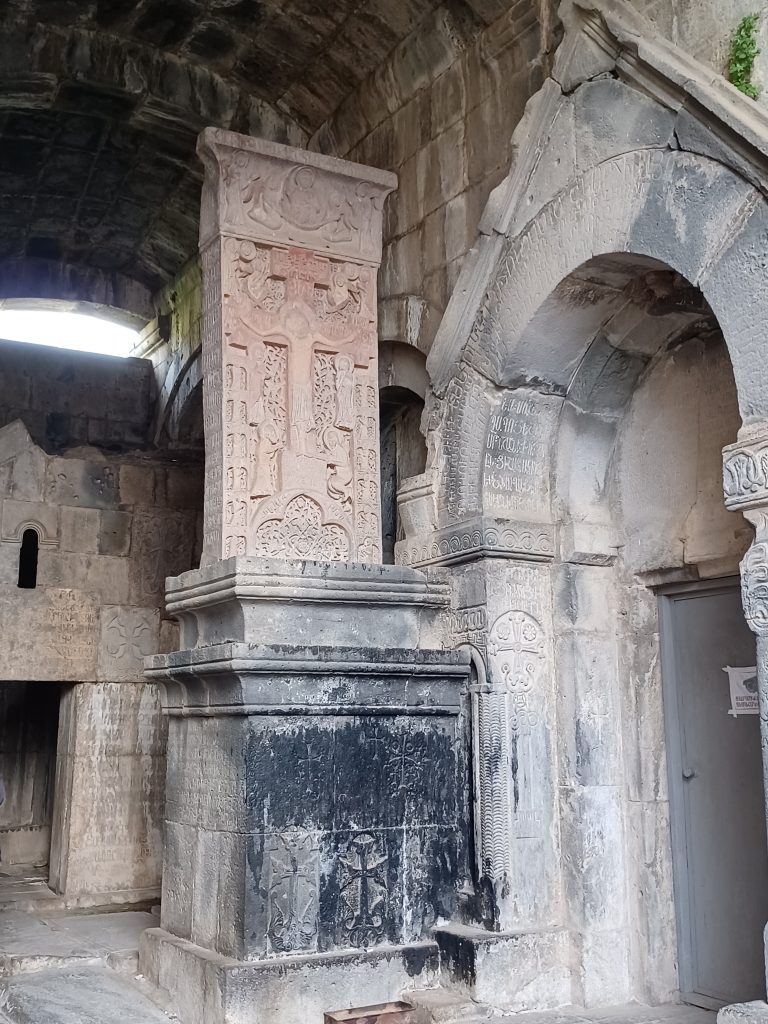
Frescos and elaborately carved cross-stones, known as khachkars, adorn spaces. And large paving slabs line the floor. Daylight gleams through the oculus in the dome. Saint Gregory the Illuminator it was, who converted the Armenians from Zoroastrianism to Christianity. One of the churches within the complex is named after him. More about Gregory/Grigor later.


The monastery has suffered much damage in the past due to invaders and, especially, earthquakes, such as in 1130 and the more recent one in 1988. This earthquake was huge, 6.8 magnitude, and completely destroyed the town of Spitak, which we pass after resuming our drive along the serpentine roads southwards. Spitak has been totally rebuilt since. This is an area which is affected by much seismic activity, as with the other Caucasian countries of Azerbaijan and Georgia. We continue for some miles.
Aroused from gazing nonchalantly out of the window, my attention is drawn to the mountain approaching on our right. “This is the highest mountain in Armenia, Mount Aragats”, we are informed. 4090 feet high. The name means Ara’s Throne. There are four peaks altogether, which look like a throne, hence the name. Snow sits on top.
Yerevan
And so to Yerevan, Armenia’s largest city and capital. The city has been constantly fought over, including by Persians, Ottomans, and Russians, who finally took it in 1828. Armenia formed a part of Imperialist Russia until a brief period of independence for a couple of years, before it became a Soviet Socialist Republic (SSR) in 1921 until 1991. The same fate as befell Georgia and Azerbaijan.
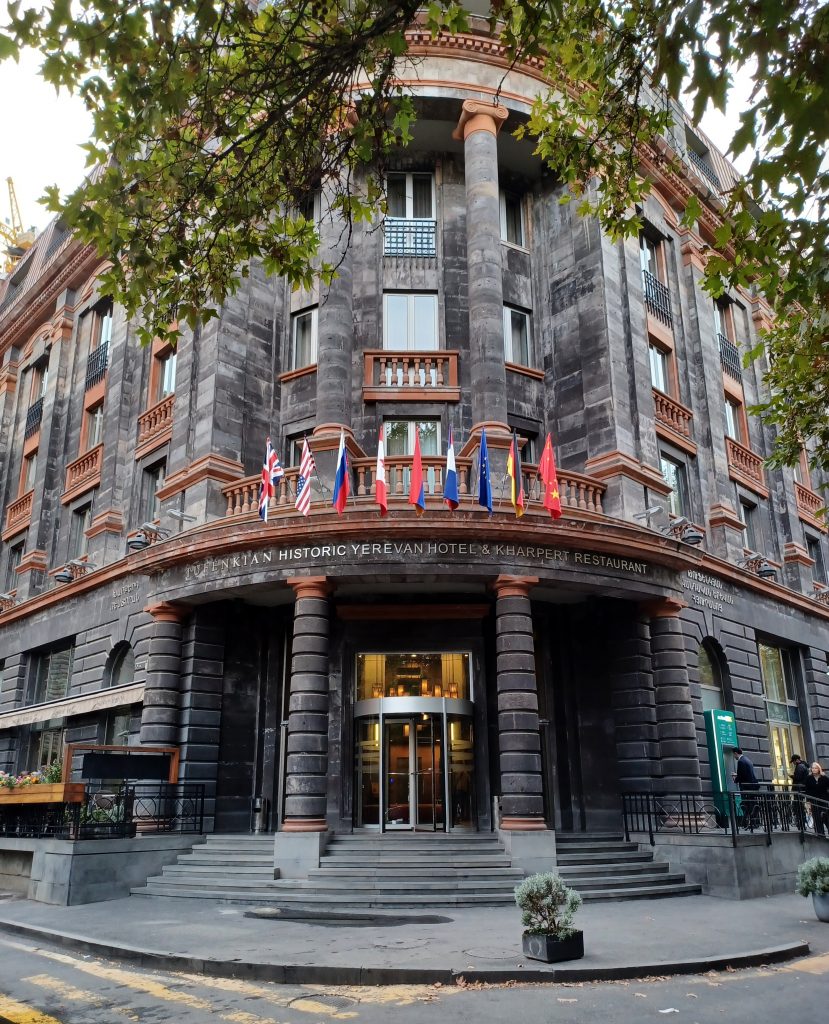
The Tufenkian hotel, where we are sojourning for a few nights, is in the centre. Rejoice! Makes a change to be able to stroll out into the old city from the hotel. Unable to in either Baku or Tbilisi as the hotels were simply too far out. The hotel is late 19th century, built of basalt, and I have a nice big room overlooking the Vernissage outdoor arts and craft market. Downstairs is a sort of showroom displaying Armenian carpets and a fine restaurant. From the hotel excursions will take place ‒ to the east, west and south of the city. Jolly good.
I wander towards the craft market, which sells all sorts of hand made products, such as carved wooden pomegranates, carpet bags, ceramics, brandy glasses, jewellery, paintings, book marks, textiles…A few interested folks are perusing them. A guitarist is playing here. A melodic finger picking piece. Drawn towards him, I stop and listen. Atmospheric. Early evening. There is a slight chill in the air. Good time of year for peaches and pomegranates, I muse. A small fountain gently plashes.
The market is close to the main Republic Square. I amble thither. Used to be called Lenin square with a large statue of the revolutionary in the middle of it. Removed after independence. The buildings round the square are 20th century made of tuff in the Neo-Classical style.
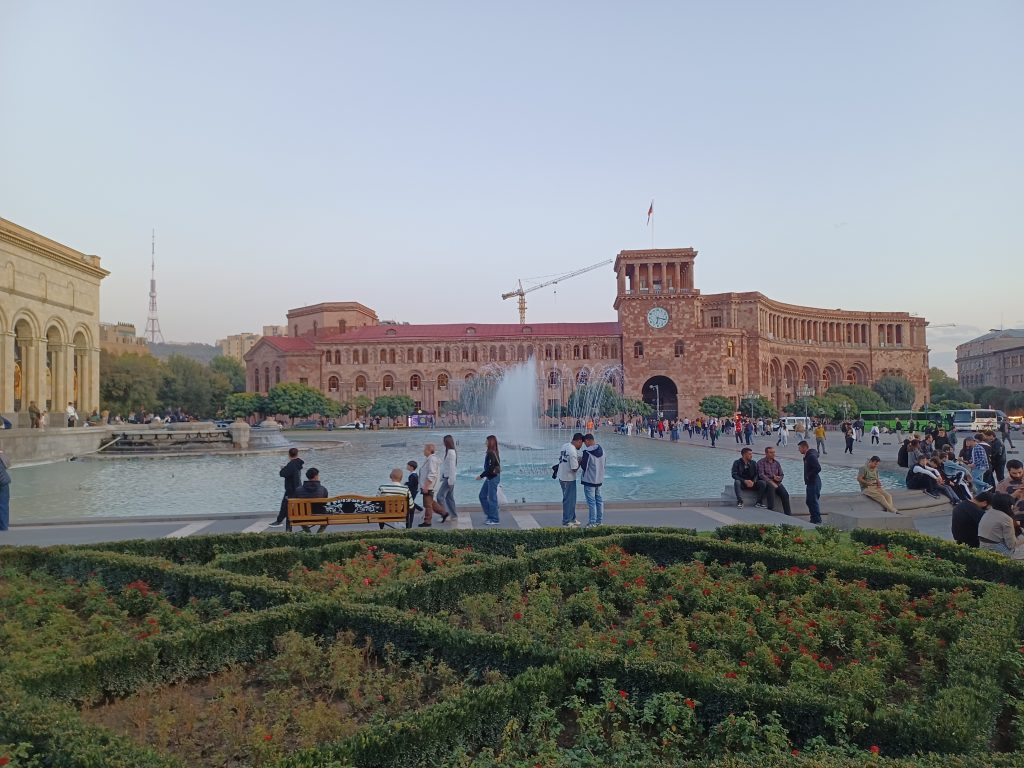
I sit down to take in the scene and warm myself on the warm steps in front of the National History Museum overlooking the large pool with fountains in the centre of the square. Stay for some while and watch the sunset. A flock of birds sallies by and the fountains are dancing and the lights are switched on in the old Soviet built clocktower on Government House.
Eventually, heave myself up and make a slow way back to the hotel. Supper with some of the single solo females on the tour. We gather in the Tufenkian’s restaurant. Takes some while for supper to arrive. But there are redeeming features: in the form of Armenian wines and loads of laughs. This has become regular thing in the restaurants and cafés of the Caucasus.
Mount Ararat
0900 start for an excursion today. Proceed on the main highway south east of Yerevan. Much traffic is entering the city. Once outside we pass nondescript houses, bits of old industry and patchworks of stony ground. All very flat. We are on a plain within a ring of mountains. The main one of which is Mount Ararat, 5137 metres high.
We stop to take photos of the snowy peak – actually two snowy cones, a large and a smaller, emerging from the haze behind the vines. The Khor Virap monastery beckons in the distance on a smaller hill below. Our guide bemoans the fact that Mt Ararat was once part of Armenia but is now within Turkey. The mountain is sacred to the Armenians, and is said to be the mount upon which Noah’s Ark landed after the Biblical flood.
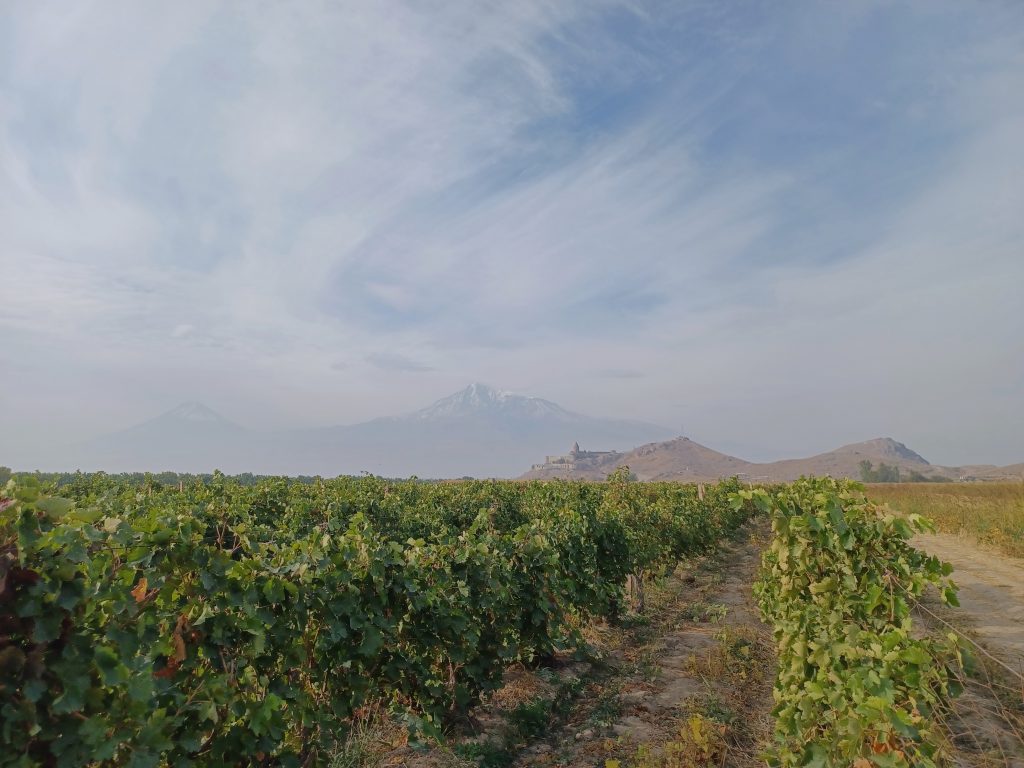
Apparently its fate was decided in a deal between Lenin and Kemal Atatürk in 1921 in which twelve provinces were lost to Turkey. Unfortunately for the Armenians, borders with Turkey being closed, they cannot even visit their sacred mountain. In fact, Armenia used to be a whole lot bigger than it is today as so much of it has been lost. This would account for the fact that only three million Armenians live in Armenia, while seven million live outside, mostly in Russia, USA and France with some diasporas in Azerbaijan and elsewhere. 95% of the current population within Armenia is Armenian, thus pretty much monoethnic, we are told.
We drive past telegraph poles with stork’s nests atop, except the storks aren’t there at the moment. They have buzzed off to warmer climes but will be back here to breed in spring on their airy perches.
On the plain are fruit trees: apricots, peaches, pomegranates, apples, pears. Several Armenian flags fly. “The red colour is for struggle and blood; the blue for peace and the orange represents hard work plus apricots”, our guide explains. Interesting. “The apricot is one of the symbols of Armenia”. This is because it grows so well and has done so for 3000 years, she continues. Alexander the Great is supposed to have taken the apricot back to Greece, where the fruit was known as the Armenian apple. The Latin name, though, is prunus Armeniaca, i.e. Armenian plum. The flag, as with those of Georgia and Azerbaijan, was resurrected in 1991, having been used during Armenia’s two years of independence between 1918 and 1921.
Khor Virap Monastery
Anyway, we continue to the Khor Virap monastery, which is close to Armenia’s southern border with Turkey. The story goes that Saint Gregory the Illuminator was imprisoned here after King Tiradates III found out that his (Gregory’s) family had killed his father. He was thrown into a deep pit (translates to ‘Khor Virap’). Gregory was released however, after thirteen years, and subsequently baptised the King, who declared Christianity as the state religion of Armenia in 301 AD. This was the first country in the world so to do, and twelve years before Constantine legalised Christianity in the Roman Empire. Afterwards, Gregory established many churches and inspired many with his teachings, resulting in widespread conversion to Christianity. This first Christian country was situated at that time between Zoroastrian Persia and pagan Rome.
Gregory the Illuminator is considered the first primate of the Armenian Apostolic Church, which was established through the preaching of Christ’s apostles, St Thaddeus and St Bartholomew (the latter, who was martyred in Baku), hence ‘apostolic’. It is sometimes referred to as one of the Oriental Orthodox churches, which includes Egyptian Coptic and Ethiopian, to distinguish it from Eastern Orthodox. The Nicene creed is the main statement of faith, and was adopted at the first Council of Nicaea in 325 AD. Gregory the Illuminator’s son it was, who represented the Armenian church at the Council. Gregory died soon after and his relics are contained in Yerevan’s Cathedral.
We alight at the bottom of the hill and hike up the narrow road to the monastery. All these Armenian churches seem to be built on top of hills, as are many in Georgia, in dramatic settings. This one is built of tuff. And inside is an altar with an Armenian carpet on the floor and frescos of the Virgin Mary, who is venerated in the Armenian Apostolic Church as the Holy Mother of God. Outside is a similar door with carvings around it and chunky basalt blocks of stone, as in the Haghpat monastery. A black basalt belfry stands in contrast to the orangey coloured tuff of the main building.
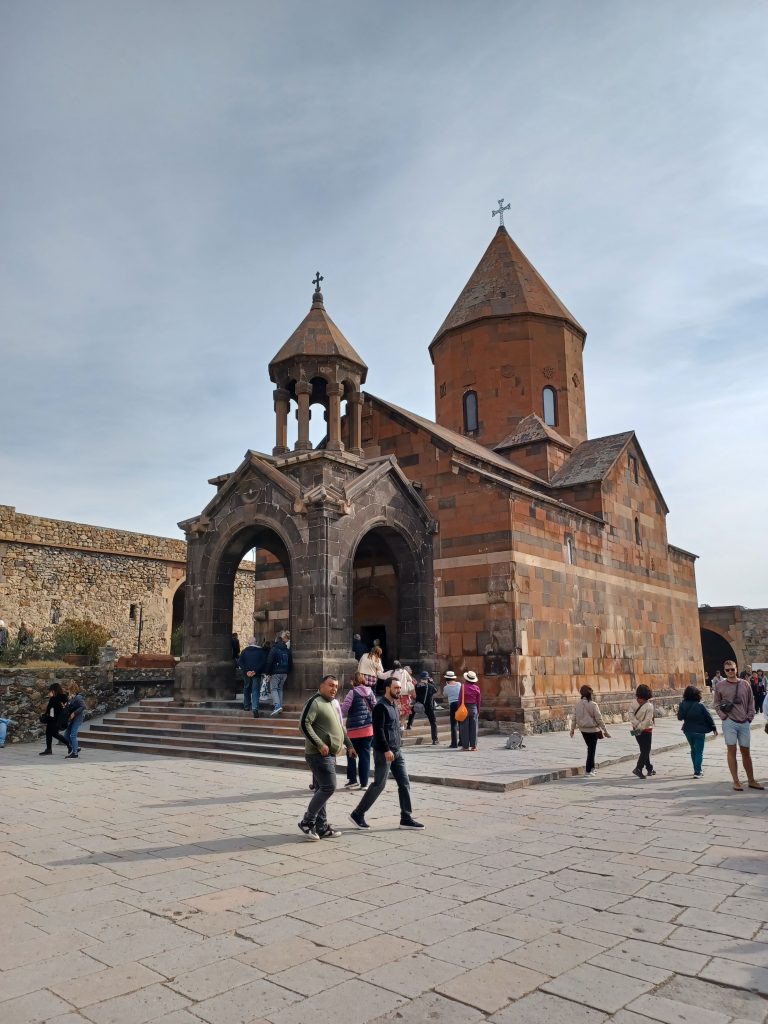
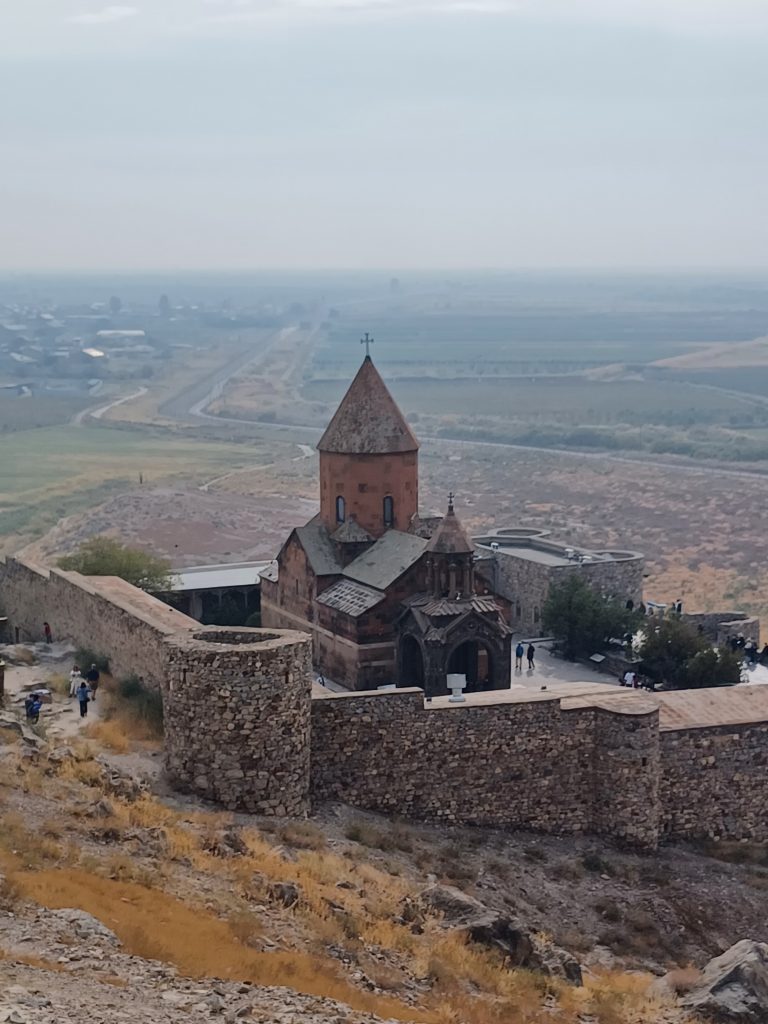
I clamber up the rocky slope behind to the flag atop the hill and look down upon the monastery with its defensive walls and towers. The plain below shimmers in the haze, with the road and buses and bushes and the Turkish border in the distance.

Areni
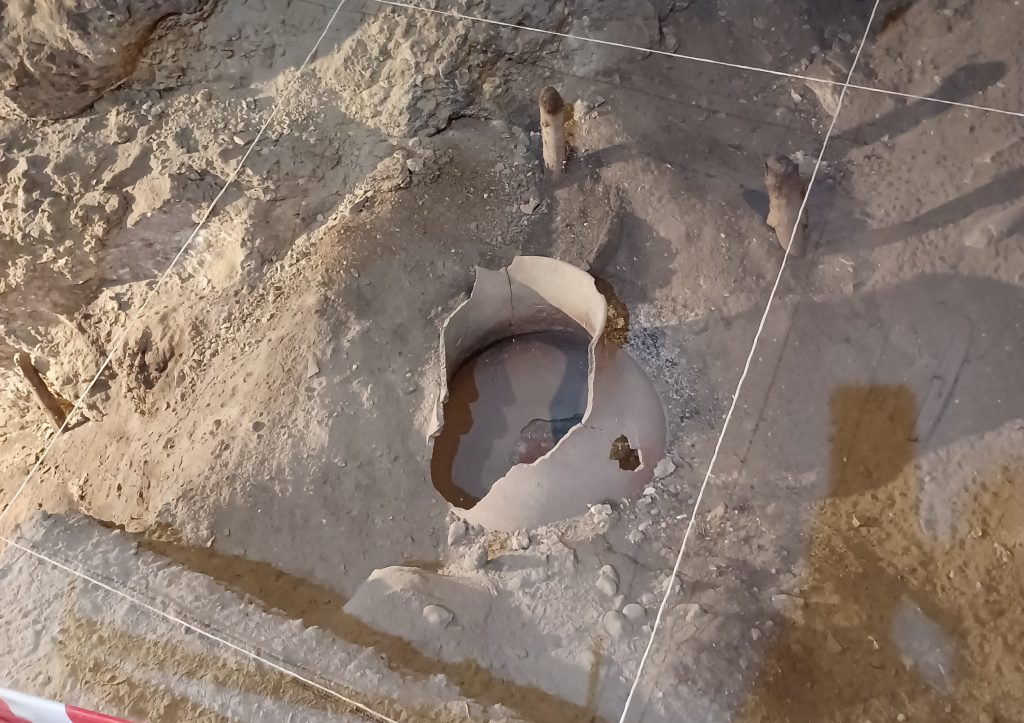
It is but a short distance from here to the small town of Areni. Known for traces of ancient wine making artifacts. Here we climb up steep steps, passing empty wine vessels lying along the path-side, to Areni cave. It was within this cave in 2007 that archaeologists found the remains of chalcolithic habitation and wineries dating from 4000-3800 BC, i.e. about 6000 years old. Finds include fired vessels and wine making paraphernalia, according to a notice, along with other artifacts, such as textiles, which have been preserved well due to the humidity in the cave. These wineries are the oldest in the world, it is claimed, and thus Armenia can be said to be the cradle of wine making, i.e. before Georgia. Try telling that to the Georgians (see Georgia, Part 1).
Our guide tells us that three skulls were found here in spherical clay containers, maybe of daughters, as sacrifices to ensure a good grape harvest. There is also a leather shoe, the oldest in the world apparently. I was to see it later in Yerevan’s museum. Wonder who wore it. One of the sacrificial daughters perhaps.

Descend the steps gingerly, then slither down the stony path heading for lunch in a restaurant within the Areni winery. The restaurant is sited alongside the Arpa river, which flows in a deep canyon. Lunch consists of lavash (flat bread), aubergines, tomato and cucumber salads followed by barbequed chicken and sliced fried potatoes. Tuck in heartily.
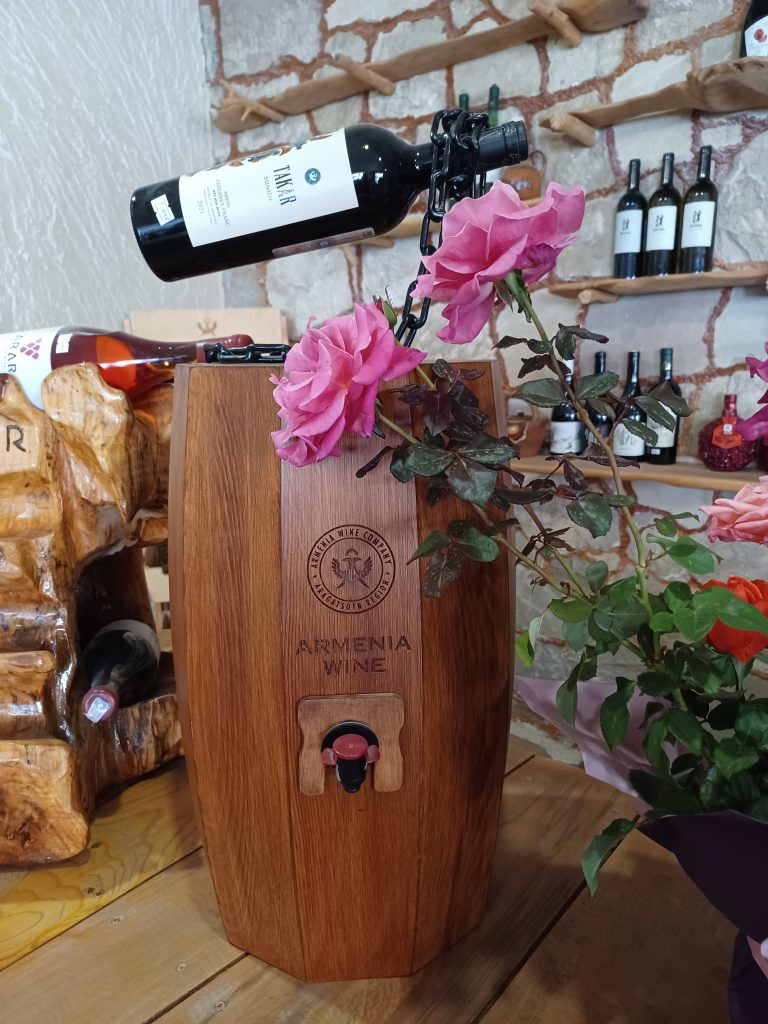
And after lunch comes a wine tasting session. Reminiscent of our first day in Georgia. Three Armenian wines are here imbibed: a white, a rosé and a red. Noah was supposed to have taken a vine from the Garden of Eden and planted it in Armenia after he exited his Ark. Good man. And along with the apricot, wine is another national symbol. Blissfully indulge in this nectar, which is accompanied by cheese and lavash. Primed thus for the imminent exploration of another monastery.

Noravank
This one is called Norovank, meaning New Monastery, and it was once the residence of Orbelian princes, a 12th-13th century Armenian dynasty, who ruled over territories in southern Armenia. The monastery was founded by Bishop Hovhannes Orbelian in 1205. Now a UNESCO World Heritage site. The drive to it passes through the steep sided Amaghu river canyon, reminiscent of Todra gorge in Morocco (see Morocco, Part 3).
It is near the border with Azerbaijan on a lofty site with spectacular sandstone hills around it. Here on the plateau within fortified walls are two churches, a chapel and some beautifully carved stone khachkars. The original Surb Karapet (Saint John the Baptist) church was built in the 9th century with one single nave, while the newer one atop the ruins is Surb Stepanos (St Stephens) church. He, St Stephen, was stoned to death for his faith.
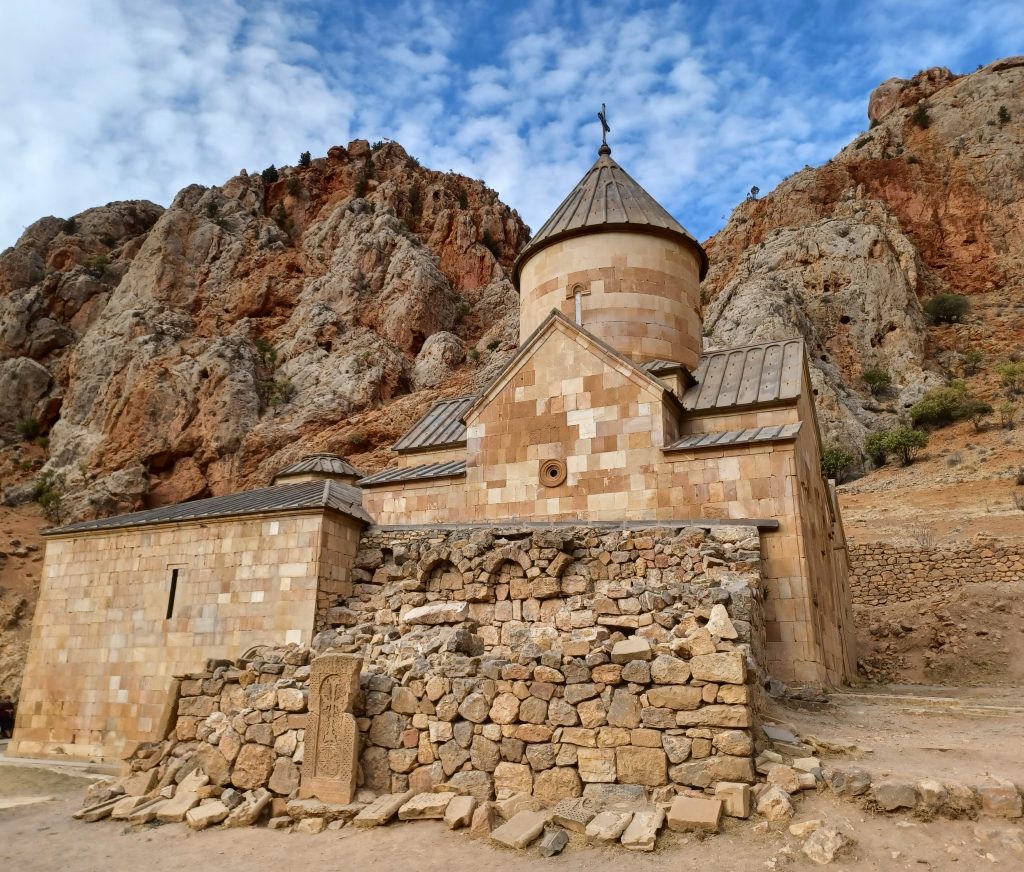
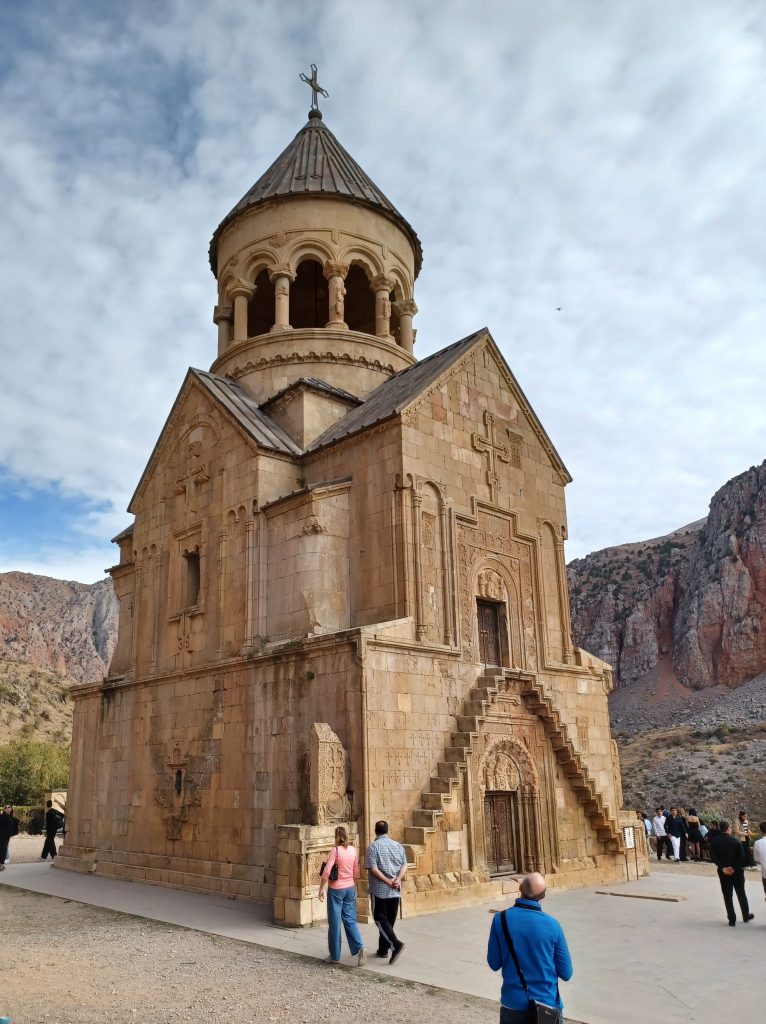
Noravank was built of sandstone, altogether softer and more welcoming than the bleak basalt of some. The main two storey church was built in the 14th century and was named Surb Astvatsatsin (Holy Mother of God). The lower level is the mausoleum and the upper level the church. It was designed by the Armenian master architect, Momik in 1321. And there is also a chapel, Surb Grigor (Saint Gregory) chapel, which was erected later that century as a mausoleum for the Orbelian nobles. Unusual to have burials inside rather than outside the church, it is pointed out.
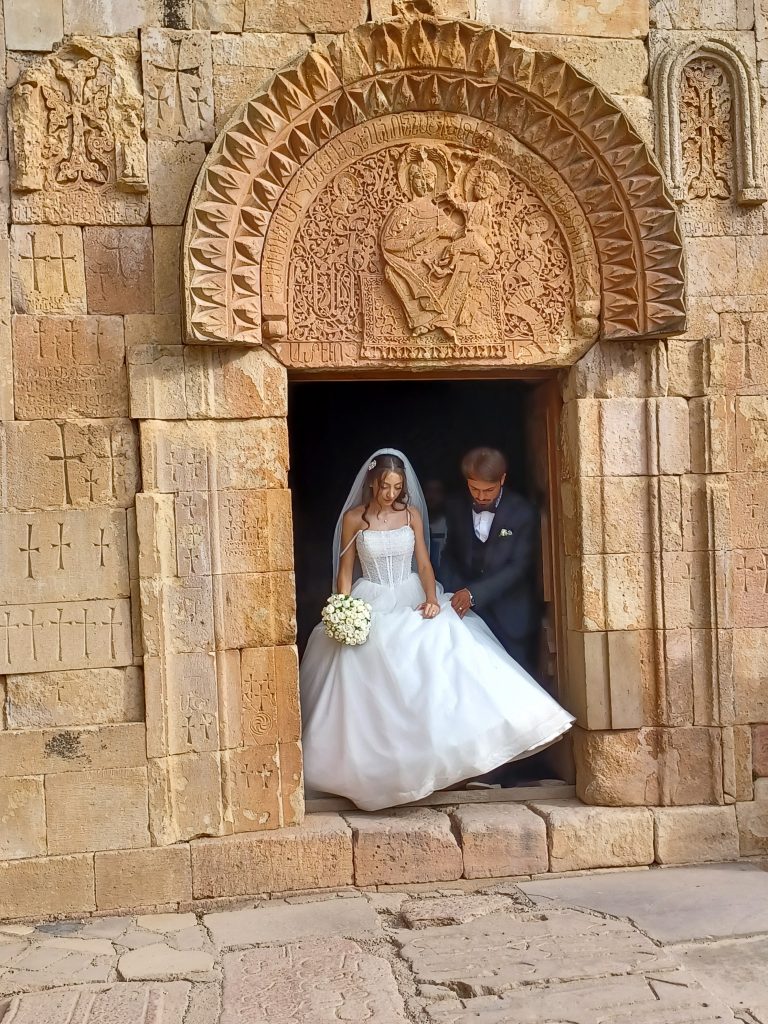
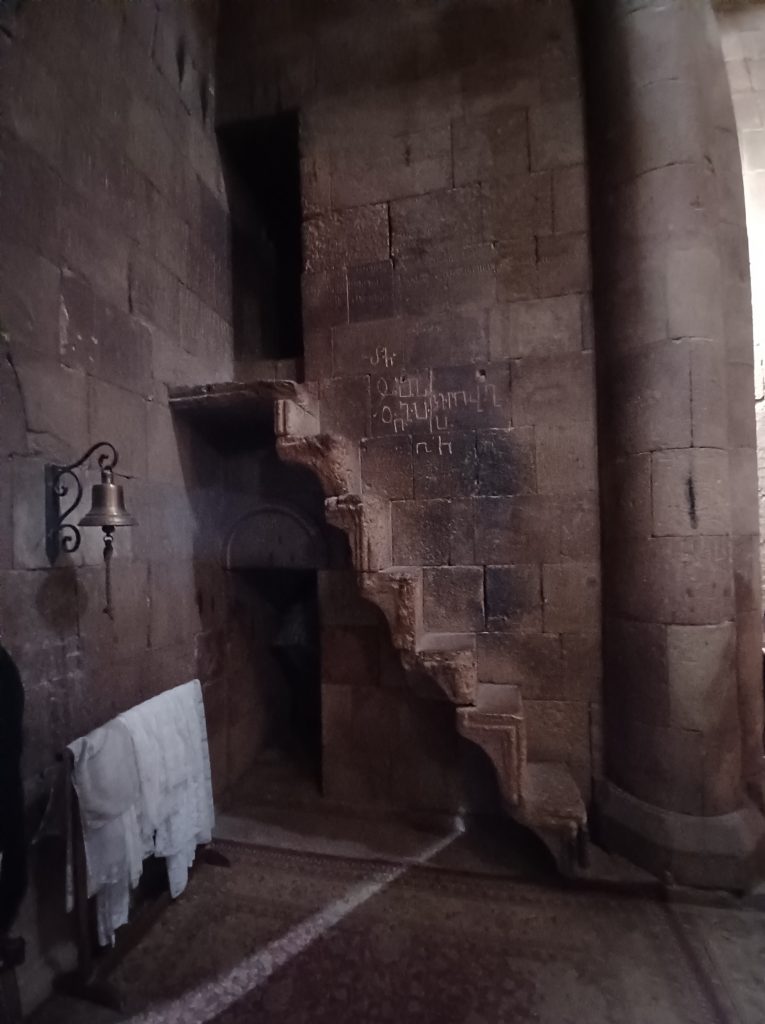
There are intricate carvings over doorways, for example, one of God the Father with the head of John the Baptist, another of Christ with the Apostles Peter and Paul, and one of Mary with Christ as an older child. This latter represents wisdom, according to our guide, and is over the doorway of St Stephen’s church. There is a wedding going on in this church today. And a happy smiling bride and groom emerge through the doorway to a symphony of camera clicks. We enter after the bridal party have exited. Tiny stairs inside lead to the monks’ cells and a scriptorium which was used in the 10th century. A purple dressed lady rests her arms upon the altar.
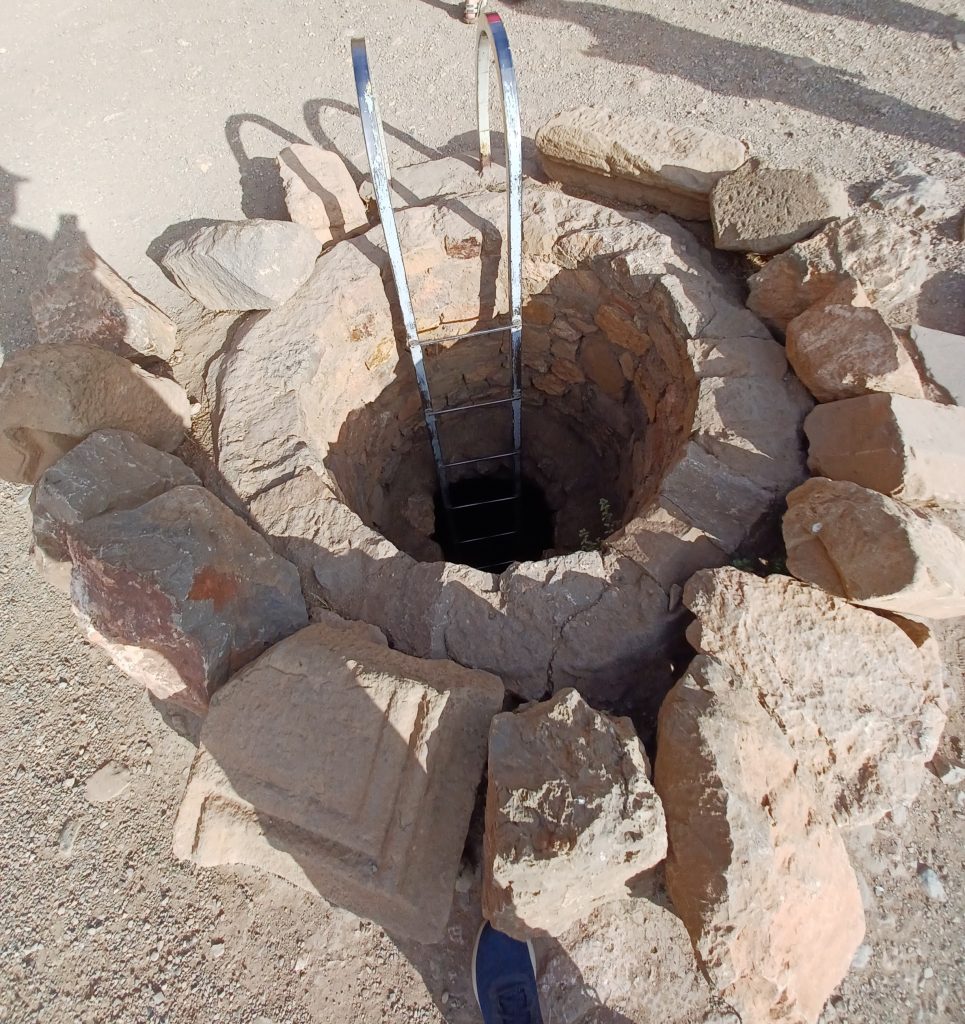
Within the grounds is a well with a ladder descending into it. Curious though I am by nature, I resist the temptation to descend therein. We head out of the monastery, passing several stone khachkars with their carvings of crosses lining the path. The monastery was destroyed by an earthquake in 1840 and deserted, according to an information board. But was completely restored in the late 1980s.

And so back to Yerevan. Our driver, sullen, impatient sort of chap, constantly flashes his lights. Click click. He clearly has an aversion to following other vehicles. And overtakes everything in sight ‒ from red grape laden trucks to oil tankers and cars proceeding slower than he would like. Becomes a trifle irritating.
Yerevan
Museum of Armenian Genocide
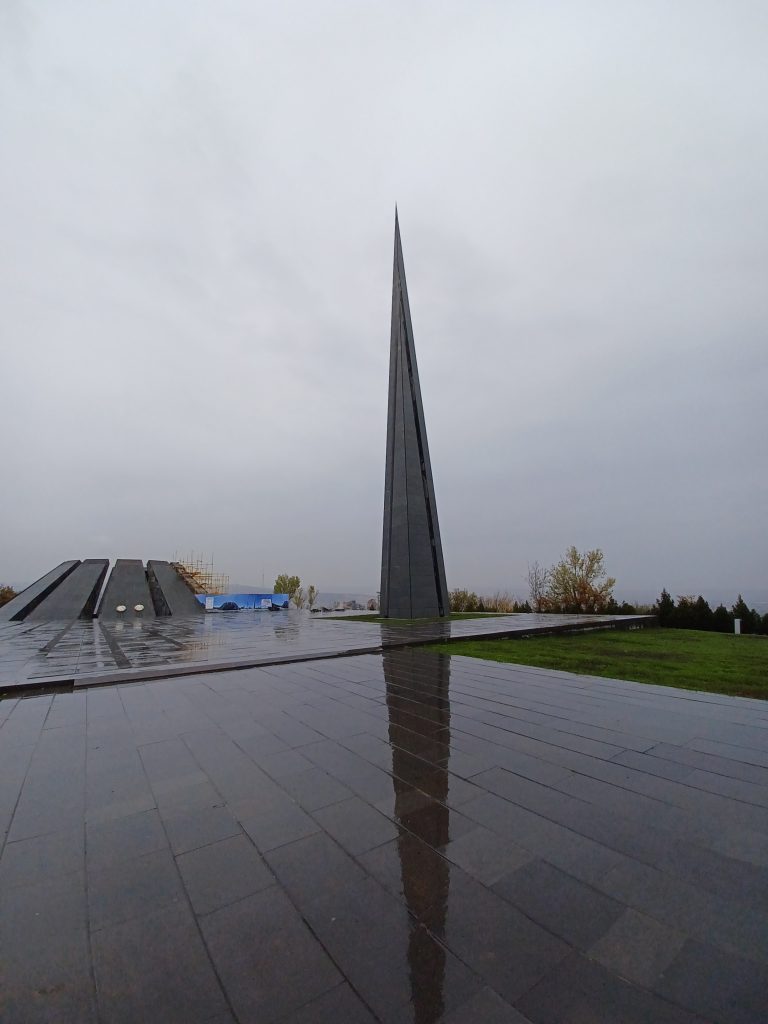
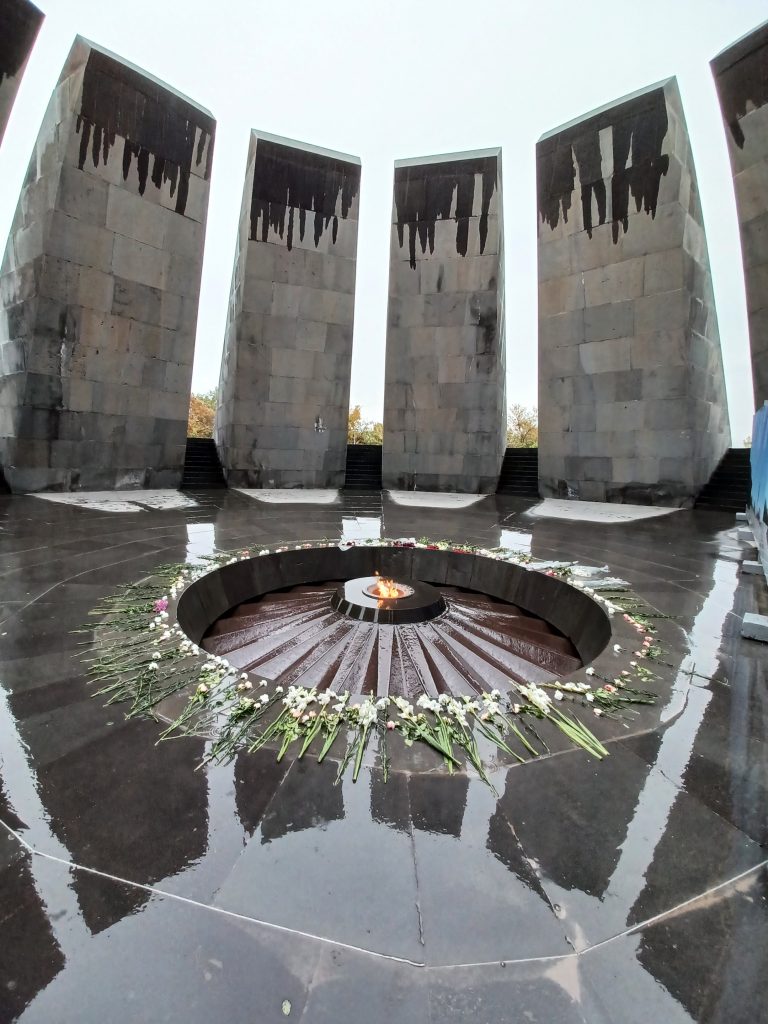
Raining. First stop of the day is the Museum of Armenian Genocide. Oh dear. Sited on the west side of town close to the Hrazdan river on a hill in a small park with woods round about. From the glistening wet paving stones rises a tall slender spire, the Memorial Column, built of basalt 44 metres high. And to the left of this a structure, known as the Temple of Eternity, made up of twelve basalt slabs in a circle, representing Armenia’s twelve lost provinces. As before mentioned, Lenin and Kemal Atatürk made a peace deal, which resulted in Armenia losing much of its land, including Mt Ararat and the onetime capital, Ani. The slabs tilt inwards shielding an eternal flame. We shelter under a tilted slab, while our guide explains the significance of the Genocide Monument. Built in 1965 and dedicated to the 1.5 million Armenians who were deported and massacred by the Young Turks, she tells us.
The museum itself actually opens at 10 a.m. We arrive at the entrance a bit early, owing to inclement weather inhibiting the desire to peruse the peaceful grounds with its alley of trees and Memorial wall. But the museum doors remain firmly closed as we cluster round the outside, before finally creaking open at the witching hour. File in soggily and hang wet clothes in a cloakroom.
Proceed to view the sombre exhibits, which show that during WWI in a period mostly between 1915 and 1916, but also a few years afterwards, about one million Armenians were massacred. Others died on death marches following deportations from, then, Constantinople, and around 200,000 woman and children were forced to convert to Islam. Western Armenians suffered in particular. The country being located between two Muslim states: Turkey and Azerbaijan, meant that those two could not have direct contact. Therefore the policy was to eliminate the intervening Armenians.
Many people knew about these massacres, according to the information given, especially those on the same side as the Ottomans in WWI, such as Germany. Stories of the genocide leaked out, however, via journalists, missionaries, diplomats and other officials, plus from those who managed to escape. Testimonies from some of these provide proof of the genocide. And copies of the newspaper headlines from the time are displayed on the walls, including reports on orphans, deportees and ravished women. Our guide is tearful.
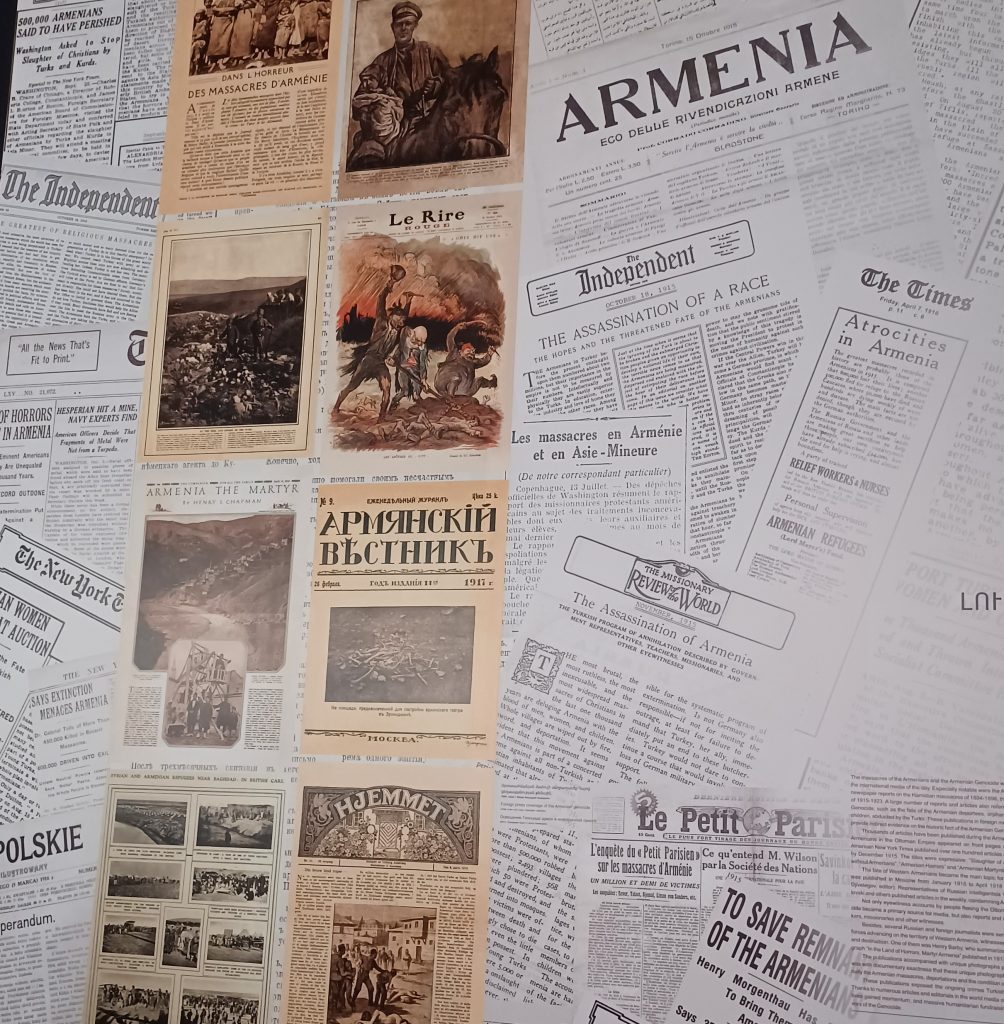
Notably, Adolf Hitler picked up on the fact that nothing much was done to punish the perpetrators of the genocide and was to say, presumably as some kind of premeditated justification of his later mass exterminations, “Who, after all, speaks today of the annihilation of the Armenians?” This came at the end of a speech in 1939 before the invasion of Poland.
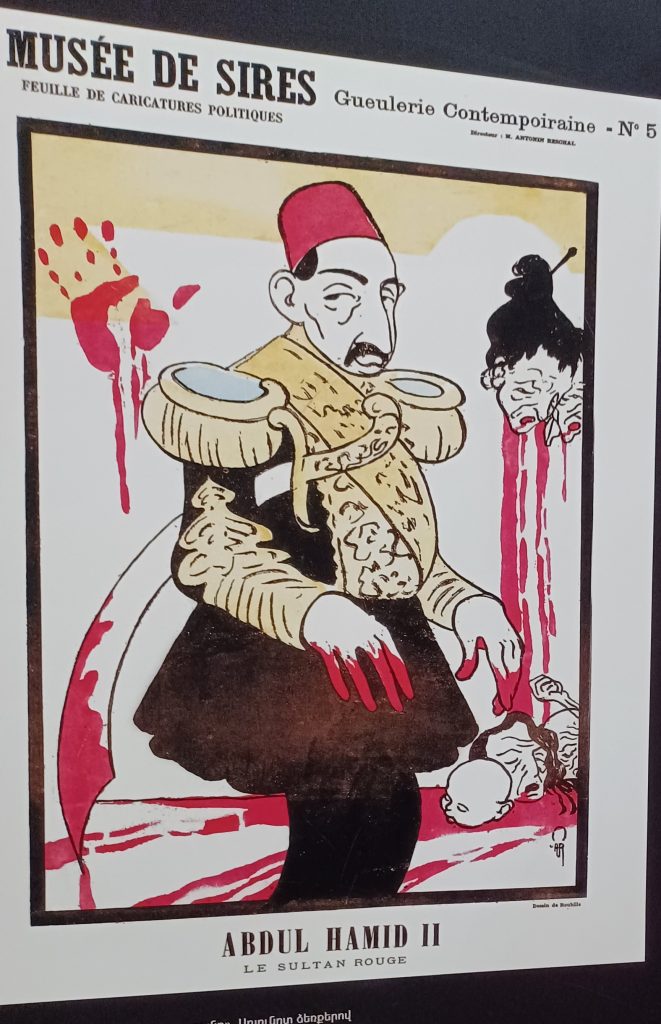
There had been massacres of Armenians even before the Young Turks during WWI. Thousands of Armenians had been massacred in 1885 and 1886 including 6,000 who were resident in Constantinople. This was during the time of the ruler Abdul Hamid II, who believed that the decline of the Ottoman empire was in large part due to the belligerence of the Christians. He is shown in the museum in a political caricature with blood on his hands.
Later there were various revenge attacks by Armenians on the perpetrators of the genocide, rather like the Israelis in their relentless pursuit of the Nazis, who carried out the holocaust.
France, apparently has recognised the Armenian genocide and there is a square in Yerevan named ‘France Square’ in grateful thanks. The USA has also recognised the genocide, while Uruguay was the first to do so in 1965. Other countries put political concerns first it seems. Turkey and Azerbaijan don’t recognise it of course. Nor, as yet, does the UK, preferring to refer to the genocide as ‘atrocities’ instead.
Ararat Brandy Company
Well, it is clear that some cheering up is required. The tour operator, with admirable foresight, has scheduled a visit to the Ararat Brandy Company for a tour and tasting immediately after the Genocide Museum. Mid-morning. Jolly good. Met by a thick whiff of brandy as we enter the pungent precincts of the cellars. Tipsy inducing without drinking a drop. A young lady gives the lowdown.
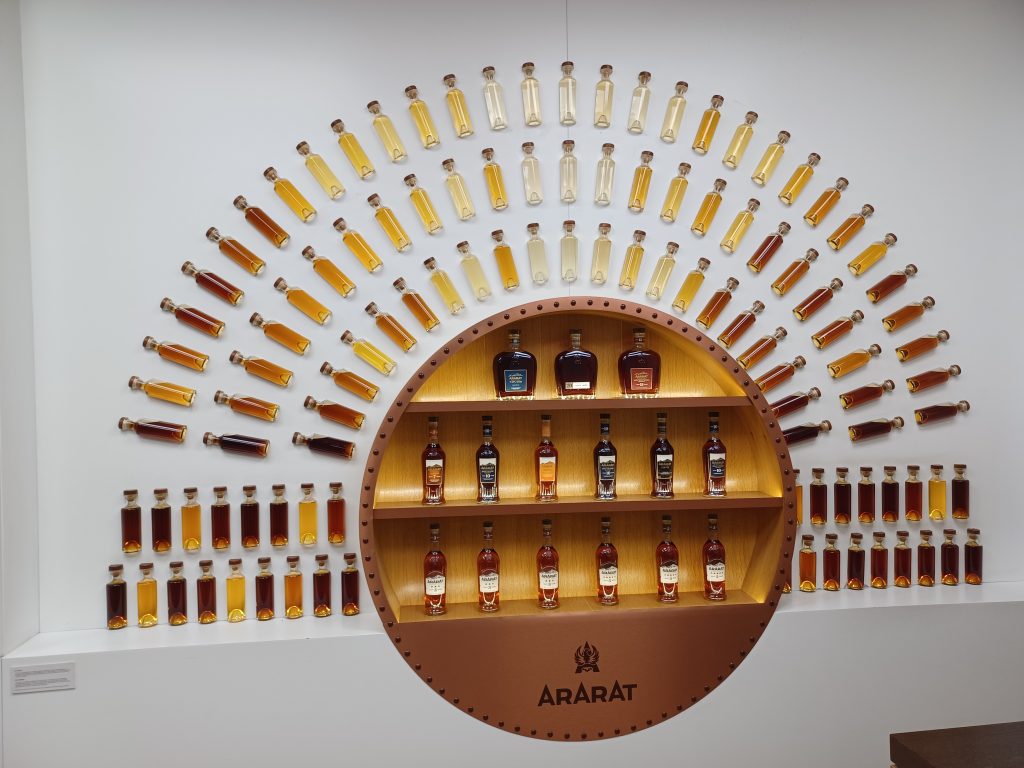
Learn that their brandy is made only from green grapes and aged in barrels of Caucasian oak. The company started making brandy in Armenia in 1887, and its symbol is the phoenix. Many displays. I particularly like the symmetrical arc of bottles. They look like the sun’s rays. One wall is smothered with medals and diplomas and awards for brandy making.
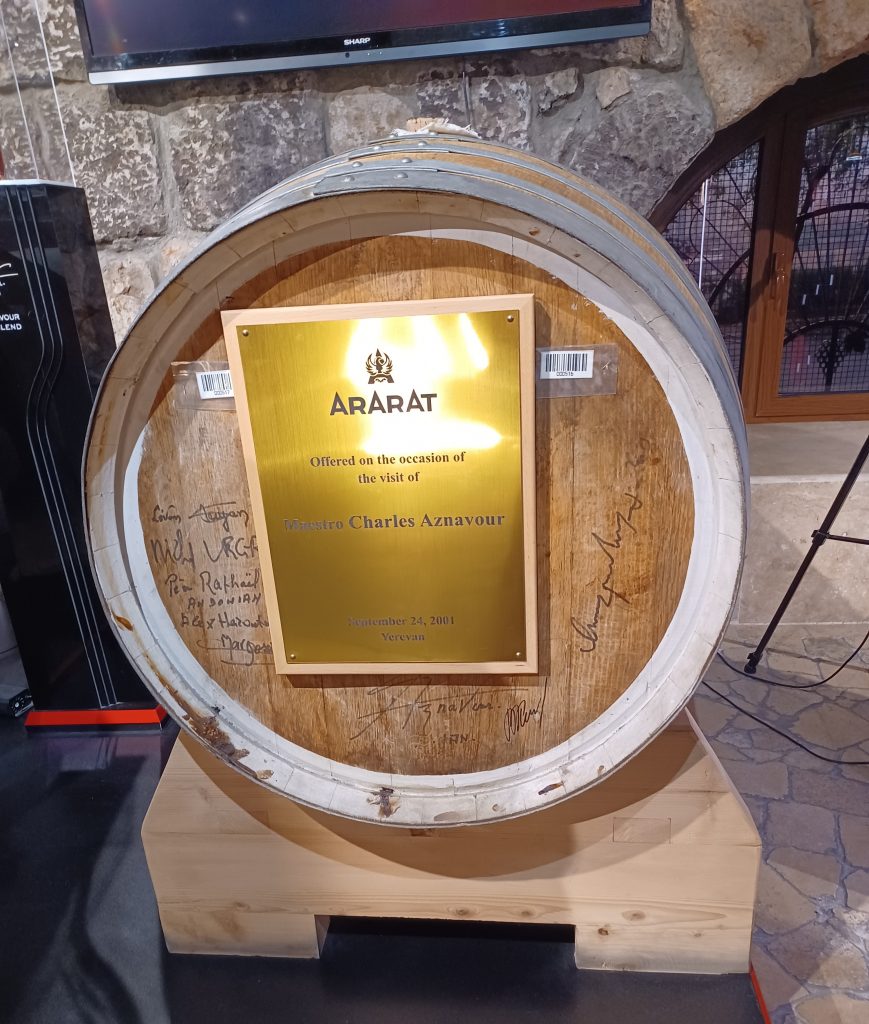
One notice informs us that ‘Like music, the brandy is composed of multiple notes that create delicate harmonies’. Poetic. Happy to go along with that. As have many before me. Barrels abound, many of which have plaques upon them with the name/s of famous visitors, including Lech Walesa, the Polish leader of ‘Solidarity’. Also Charles Aznavour. He it was who composed (along with Herbert Kretzmer), and made famous, the song ‘She’. Harmonious notes indeed. Perhaps he had had a swig or two before composing it. Most don’t realise that Aznavour had Armenian as well as French heritage. He visited the Ararat brandy cellars in 2001.

We enter a room where two long tables are laid with two already filled brandy glasses, glass of water and chocolates at each place. Sit down and wait expectantly. The guide takes rather too long to explain how to smell, swirl and observe the ‘legs,’ which take longer to slide down the glass with the older brandy, aged seven years, than the younger one aged three years. OK. Got that. Some surreptitious sipping going on before finally she raises a glass.
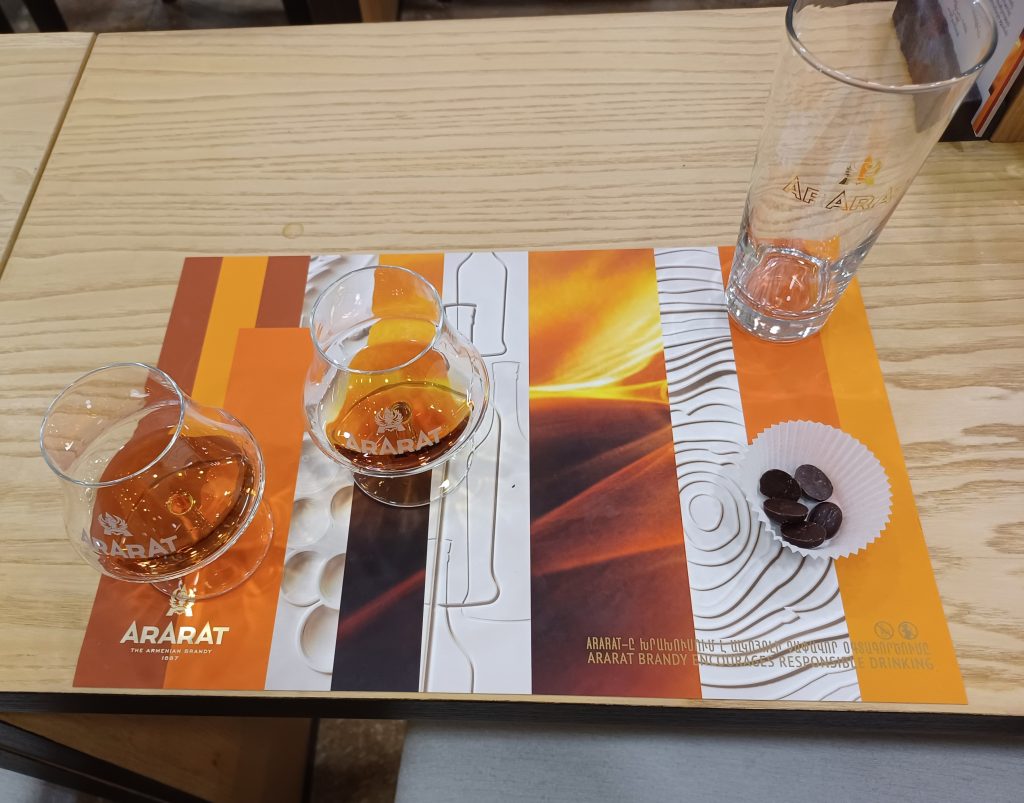
“Cheers” in Armenian. And we all knock it back. Well, some of us do.
Cascade Steps
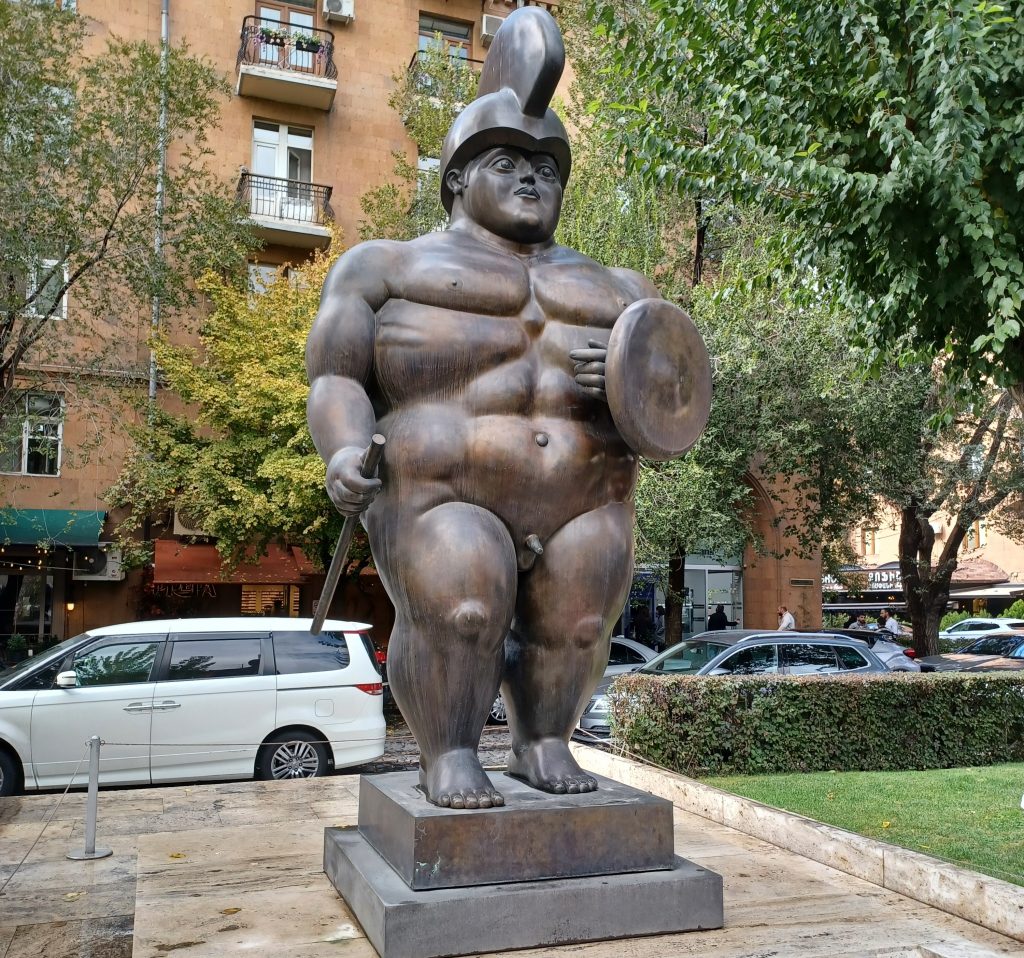
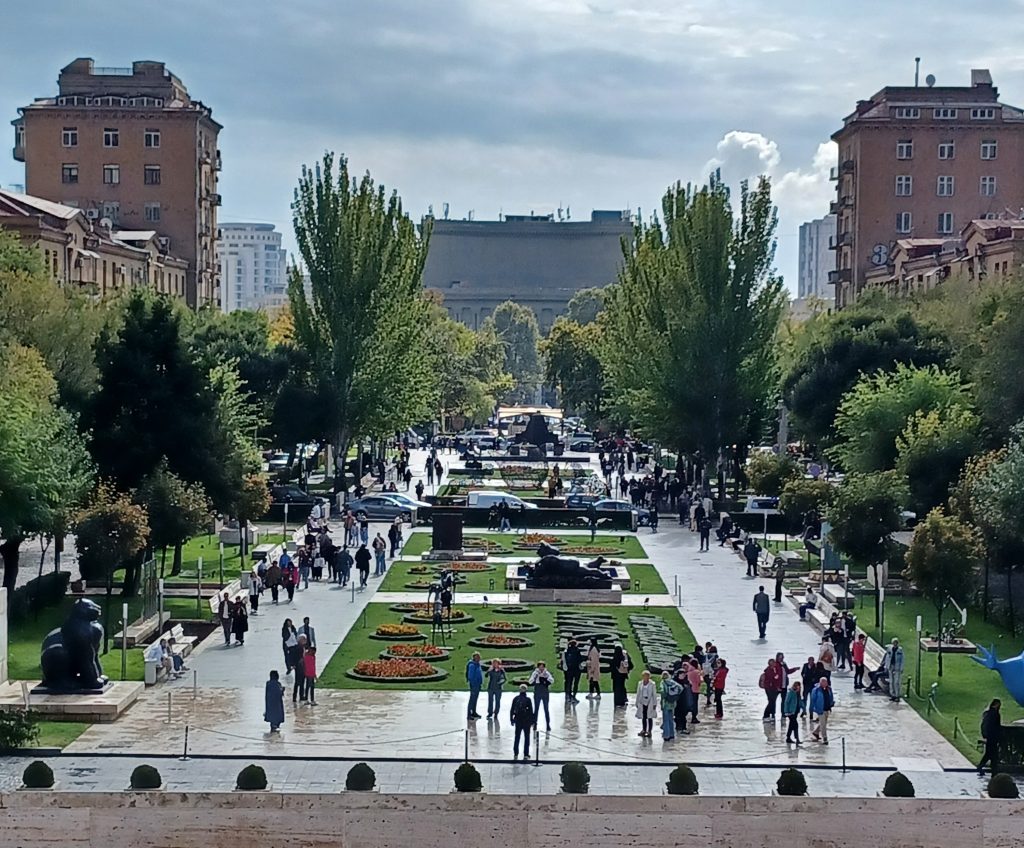
Thus fortified, a quick trip ensues to view the Cascade Steps. These are a series of stairways leading up to an obelisk atop a hill in the north of town. At the bottom of the cascade is a largish sculpture garden with some splendid contemporary artworks. And beyond is a sculpture of the famous Soviet architect, Alexander Tamanian, who apparently included the steps in his layout plan of the city in 1924, and after whom the sculpture garden is named. I am not quite sure what we are supposed to do in the thirty minutes allocated for ‘own time’ during which we are also supposed to find lunch: climb up the outside staircases or venture inside the building and ride the escalators. I opt for the latter. Ascend several, eying the art exhibits adorning spaces either side. Atop each escalator, I mosey outdoors to view a terrace with fountains and sculptures and bits of lawn and flower borders.
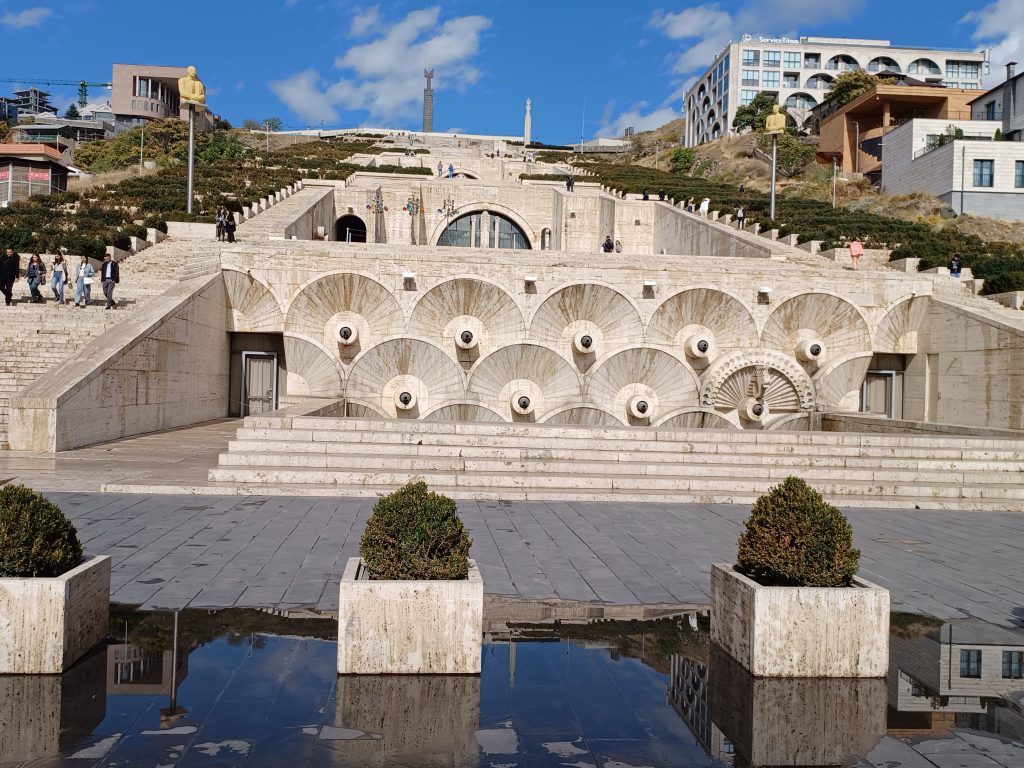
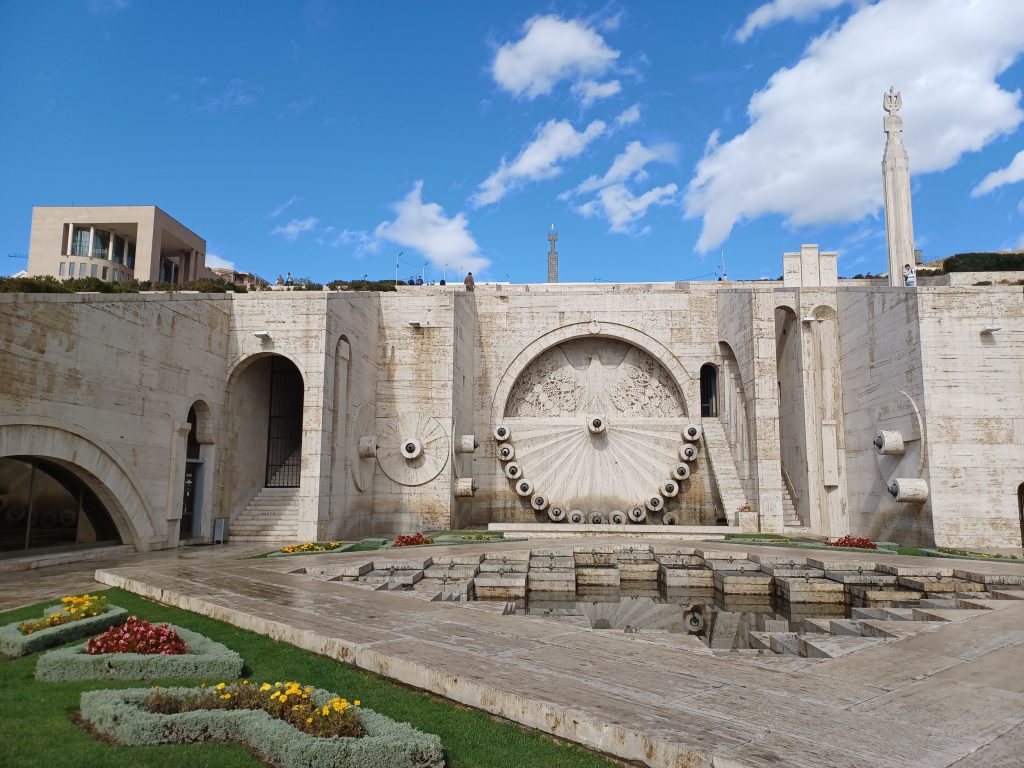
Then descend the steps outside. 572 of them altogether apparently. Good view from here. Sun drying up the puddles. Manage to grab a coffee and walk back with it through the sculpture garden to the bus. No time to indulge in eating
.
Matenadaran (Manuscript Museum)
Hastily board the bus. It is time to visit the Matenadaran, otherwise known as the Mesrop Mashtots Institute of Ancient Manuscripts. Here to observe old manuscripts from centuries ago, such as illustrated gospel books and bibles. The building within which these are contained is of imposing basalt with a statue of said Mashtots in front. Inside the door are three arches with a mosaic over the top. Floor is of polished basalt. Soviet era.
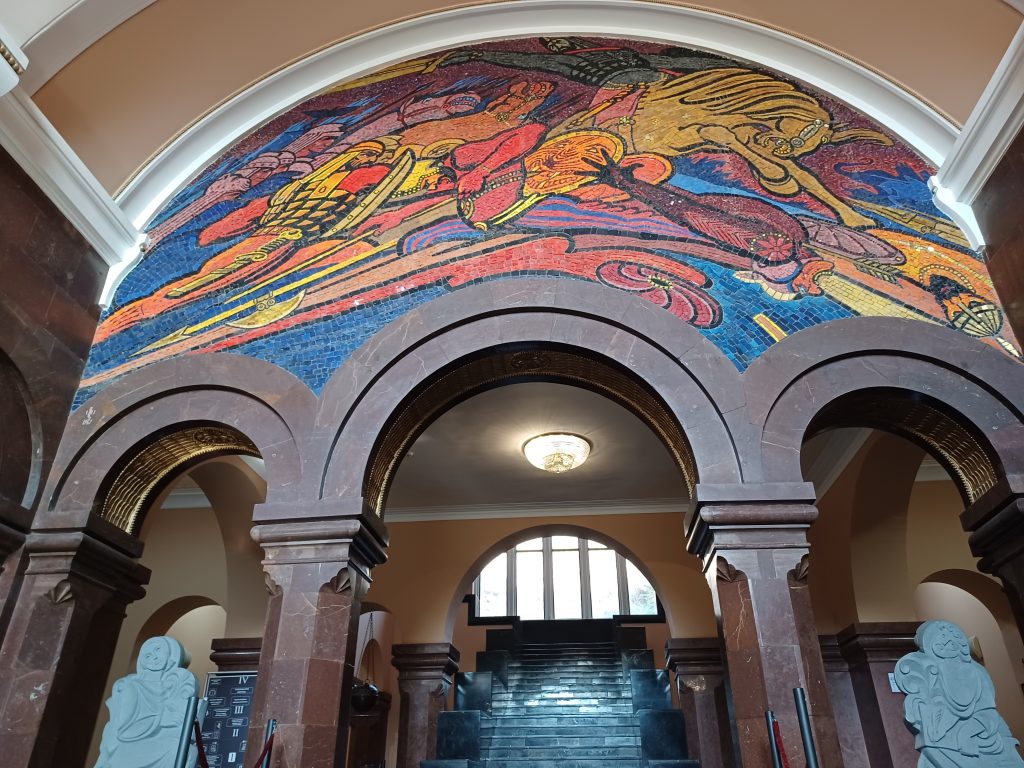

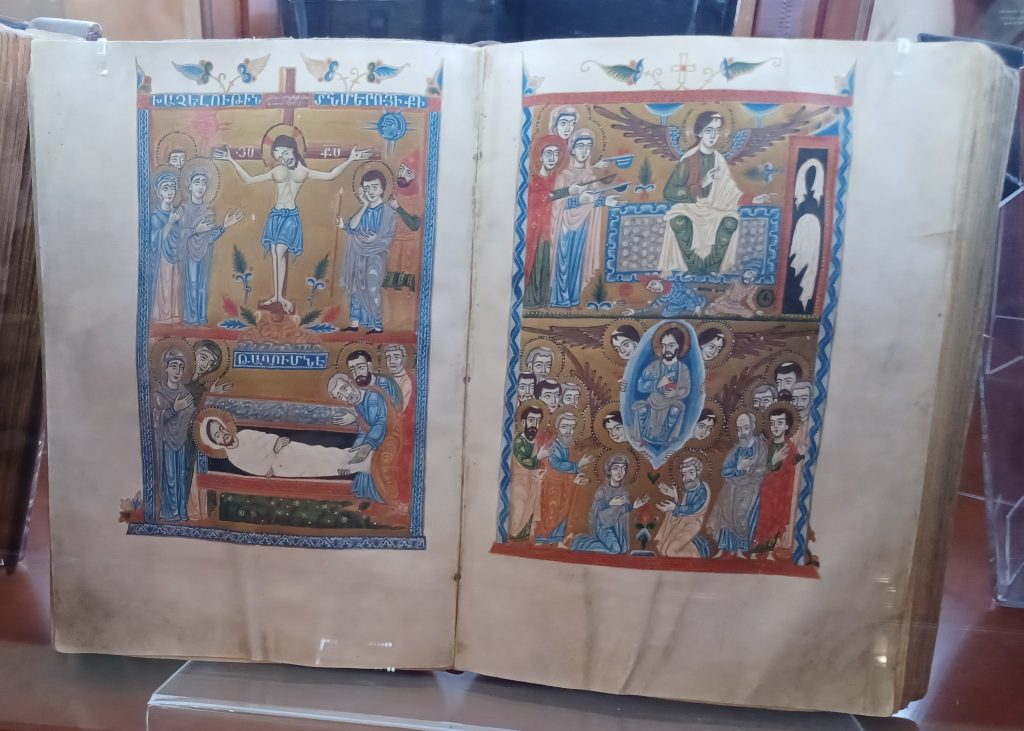
There are 17,000 manuscripts contained within the institute, along with thousands of documents and 3000 books. In a frame on the wall is the Armenian alphabet proudly displayed with 36 letters, though three more have been added recently. Saint Mesrop Mashtots it was, who created the Armenian alphabet in 405 AD, after which the Bible was translated into Armenian enabling the population to read the divine message in their mother tongue. The language is part of the Indo European branch.
The largest manuscript on view in the museum is made out of, I think the guide said, 400 calf skins and weighs 28kg. The tiniest MS, weighing 190g lies next to it. Some gospel books have bejewelled covers, another is of ivory. And an ancient map shows Colchis, Greater Armenia (in white), Iberia, Caucasian Albania and the Caspian and Black Seas, according to Ptolemy’s Geography of 2nd century. All displayed in glass cases. Very fascinating and educational.


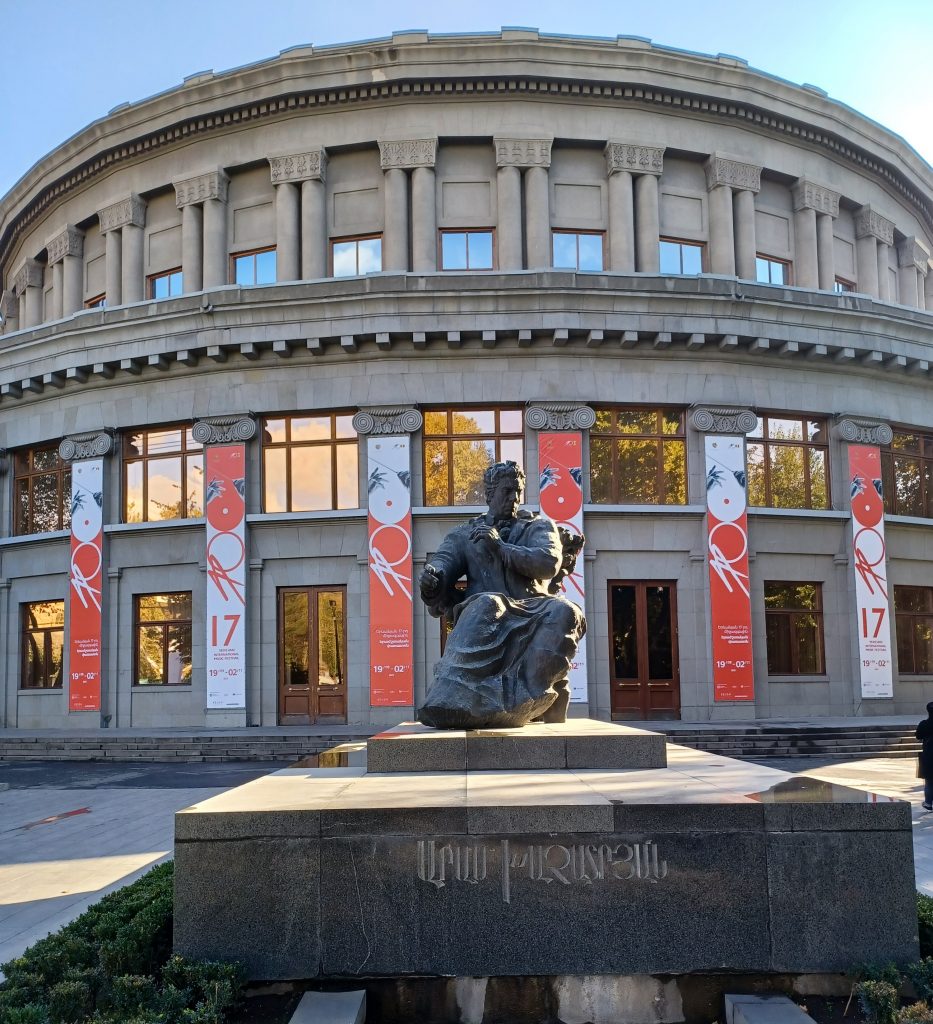
An optional walk back to the hotel follows. Few takers. Rather a nice small group though. Leisurely. Stroll past the statue of Aram Khachaturian, he who composed that rather lovely piece, used as the signature tune for the Onedin Line series. Anyone remember that? Its actual name is Spartacus. Rather fond of that music. Anyway, Khachaturian is seated on a pedestal in front of the Philharmonic Hall. Seems to be sweeping his arms about – conducting perhaps. On each side of this hall are statues of a poet and a composer.
We pass a copy of Lake Sevan in miniature, named Swan Lake, with a Megarian carpet mosaic in front of it. Then comes Aznavour Square, named after the singer, with his statue entitled “La Bohème,” surrounded by clapping bronze hands, in the centre of it. Bakers’ shops and cafés and restaurants; a piano player on the pavement; and signs of the zodiac around a fountain. The main site that we don’t visit is the Saint Gregory the Illuminator Cathedral. Having travelled miles to see some of the myriad churches which he founded, this seems a bit of a strange omission. This newish cathedral, consecrated in 2001, houses Gregory’s relics.
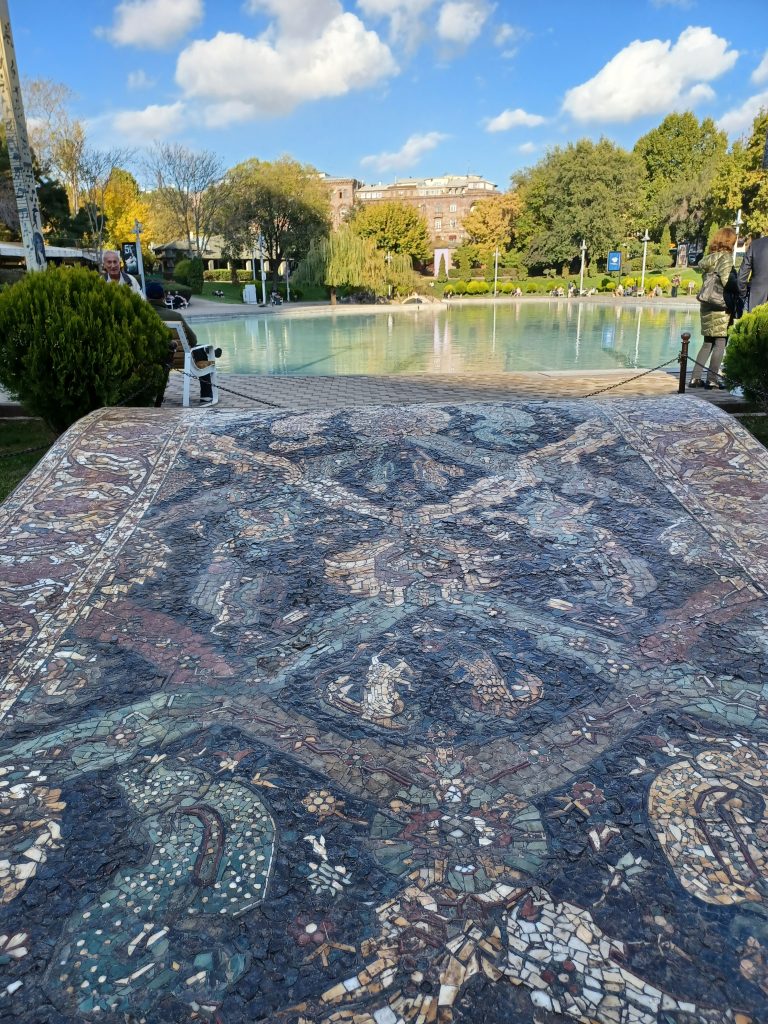
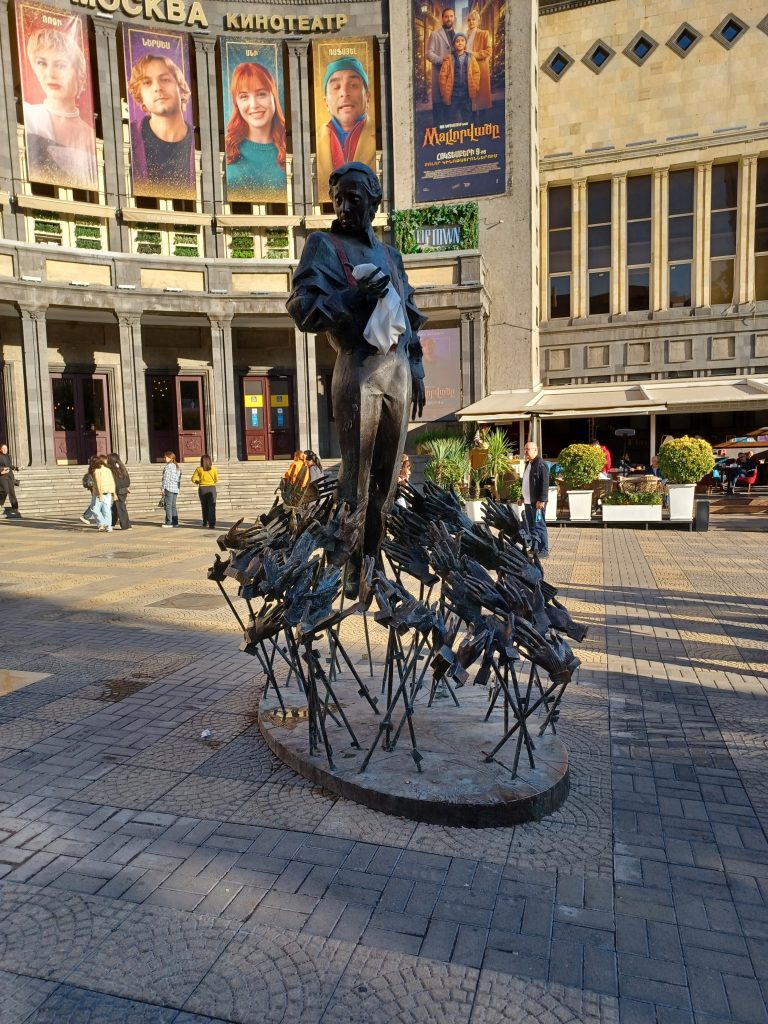
National History Museum
Have some free time now. Wander off to the National Museum in Republic Square to view the shoe found during archaeological excavations in Areni cave, Areni. The shoe is size 37, EU size, made from a single piece of leather. Dated by radio carbon dating to 3600-3500 BC. Good museum. All sorts of interesting ancient objects to be found including pottery and a prehistoric wagon from the 14th-15th century BC.
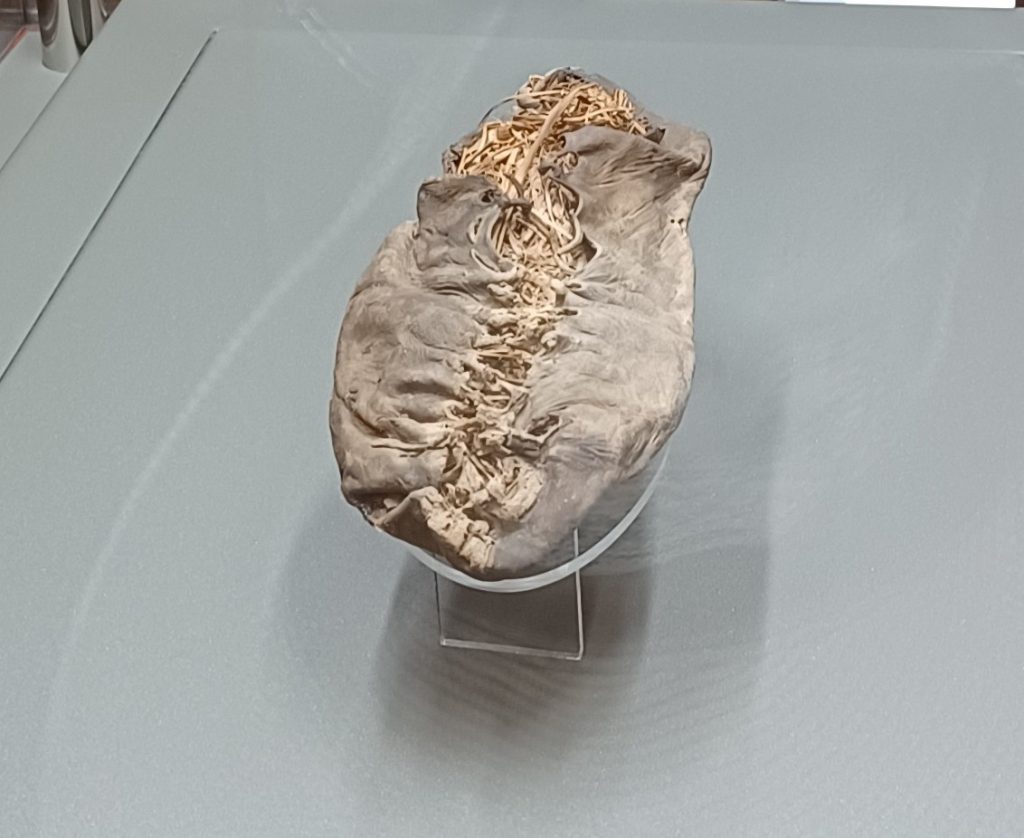
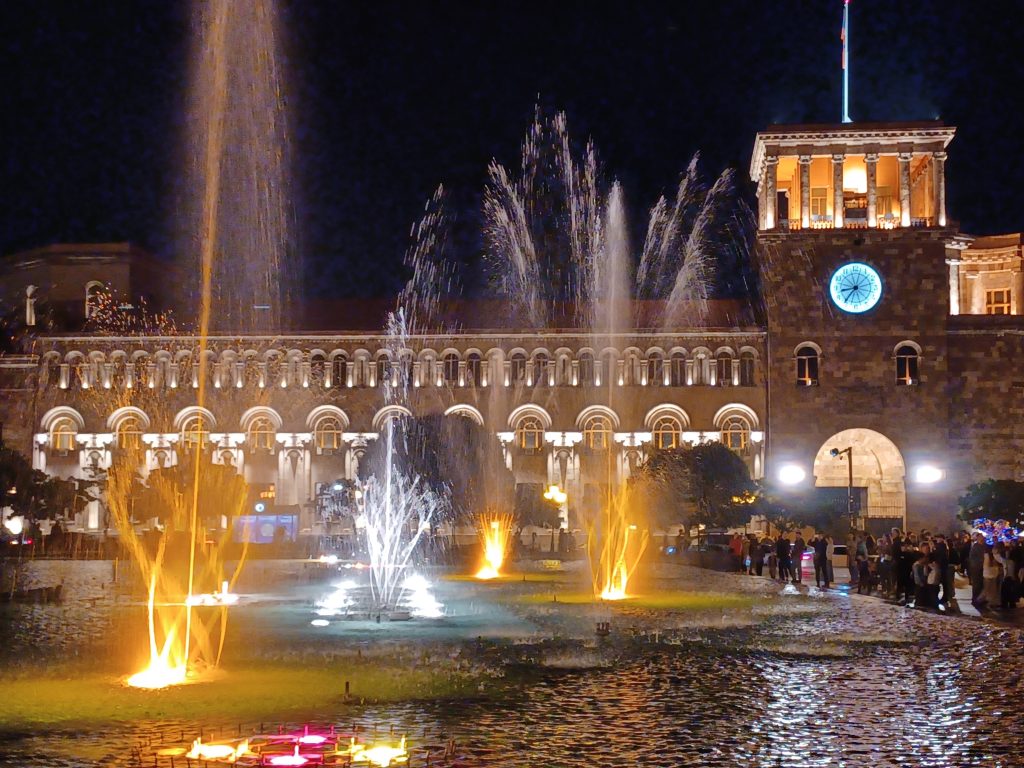
Later after dark, I return to Republic Square again to watch the dancing fountains lit up by myriad coloured lights in the large pool. Music accompanies the fountains. Radetsky March being one of them. Steel bands. Lively. Many people thronging here. Locals, travellers, school kids, babies in push chairs, drunks. Sitting, standing, lolling.
Conscious of an earlyish start tomorrow, I meander between the revellers and head for the peaceful precincts of the Tufenkian Hotel, there to put my feet up, somewhat sore after the day’s tramping round the sites of Yerevan, and put a brew on.
Leave a Reply