
The sights of Yerevan behind us, today we are driving west from the capital to see some more major sites, mostly of the religious variety. Various buildings and parks are pointed out en route, including a cemetery in which Armenian flags fly over the graves of every soldier who died in the Second Nagorno Karabakh war in 2020. Around 4,000 died in 44 days. I recall that monument on Baku Boulevard, Azerbaijan, consisting of 44 columns representing this victory over Armenia.
Robust tuff buildings from the Soviet period and other blacker basalt structures lead us through the fairly nondescript outskirts of the city to the first stop of St Hripsime Church.
St Hripsime Church
St Hripsime Church was built in 618 AD on the site of a mausoleum containing the remains of the martyred Saint. Hripsime also happens to be our guide’s name. Hripsime, a Christian of Roman origin and a virgin, was martyred by King Tiridates III during his persecution of Christians before said king was converted to Christianity himself by St Gregory the Illuminator.
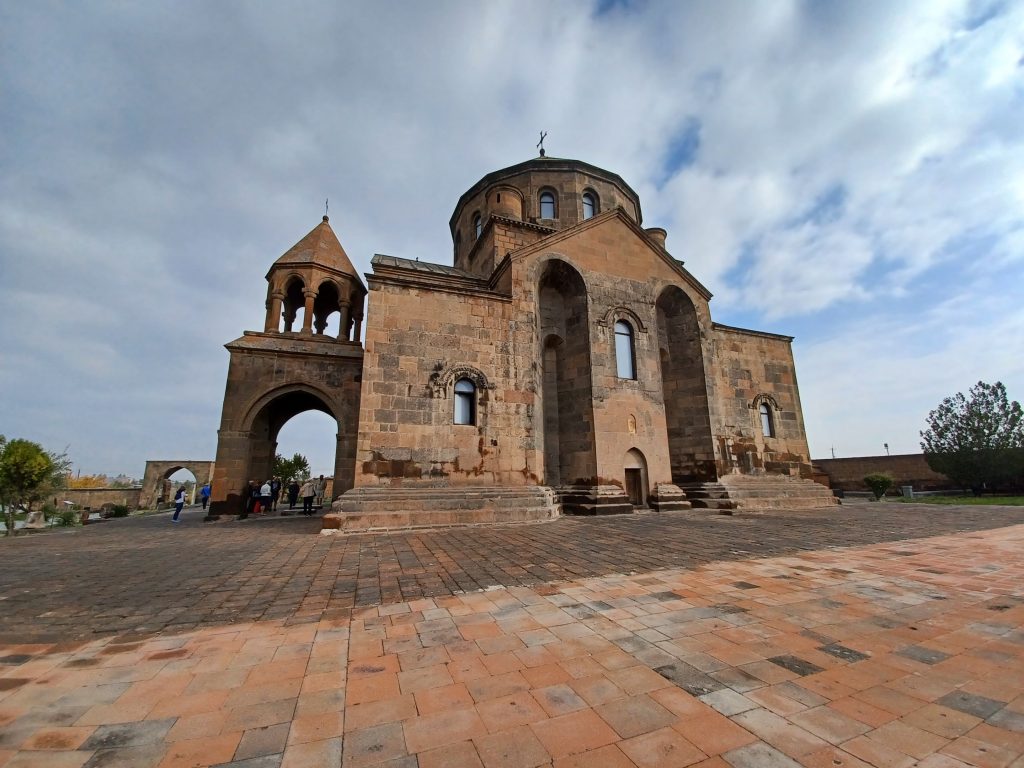
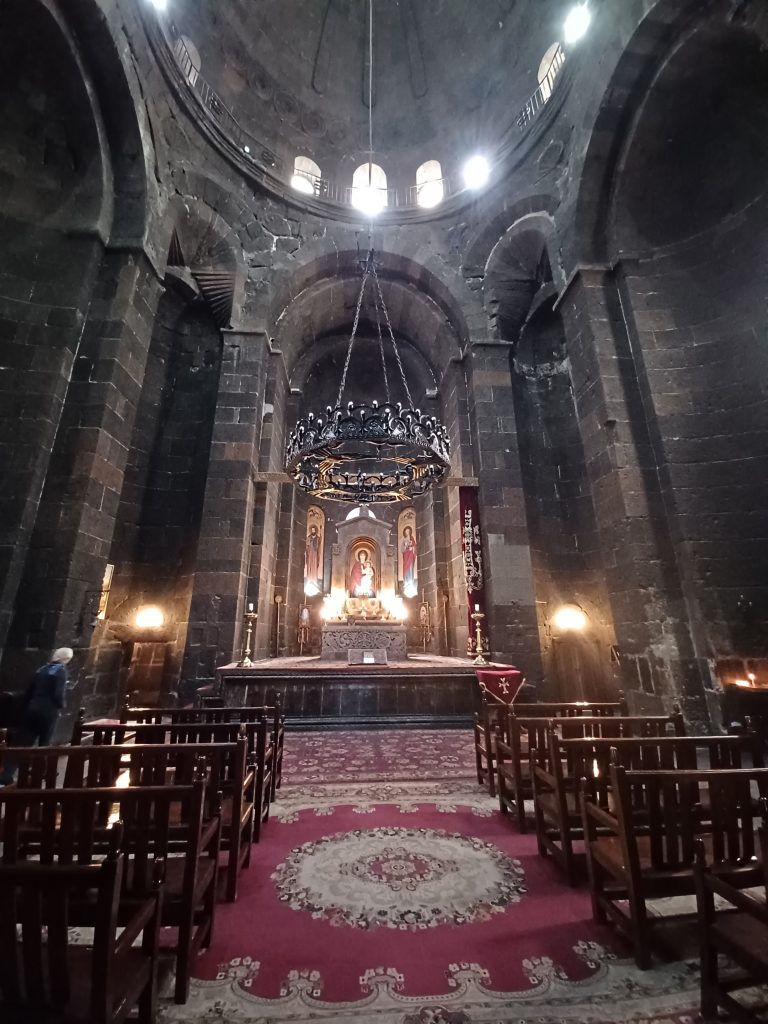
The church is built of pinkish tuff with domes and paving round it and a belfry. Inside is a simple altar with three paintings behind it and a carpet on the floor. We are told that, as writing was invented so early, there was no need to paint frescos or other decoration on the walls telling stories of the birth of Christ as everyone could read using the alphabet. Interesting. Thence we descend narrow steps to the tomb where St Hripsime is buried. Looks from a painting here as if she was stoned to death.

Echmiadzin
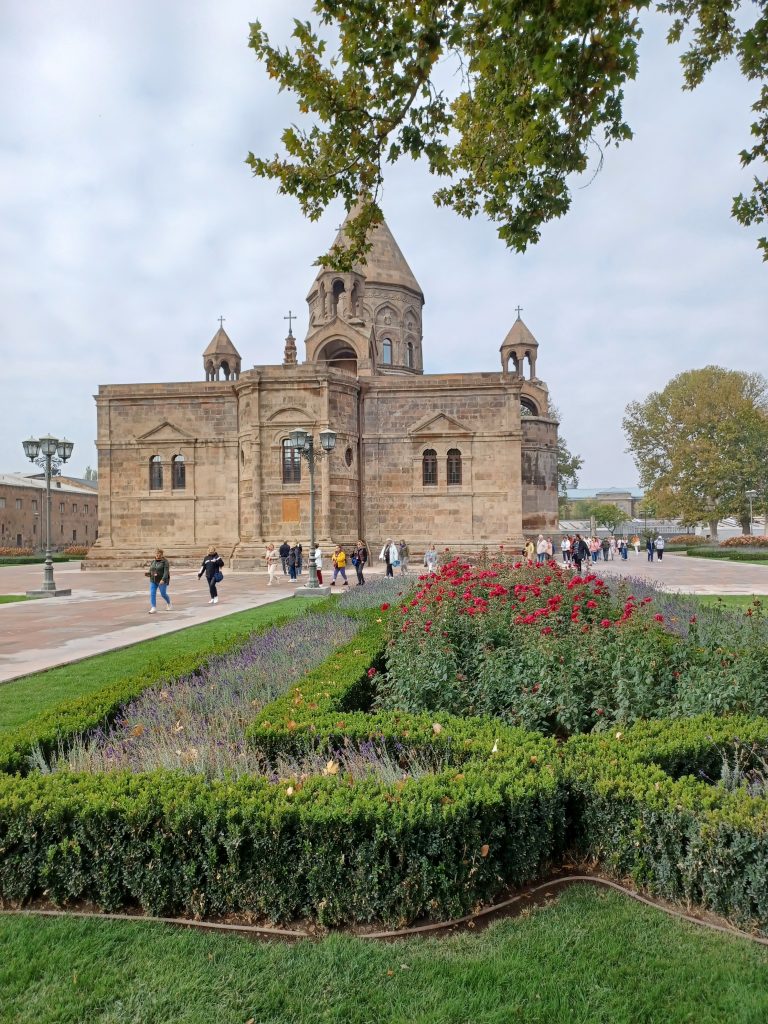
From here to the Mother Church of Armenia, dating to the 4th century and known, according to our guide, as the Vatican of Armenia or, more correctly, the centre of the Armenian Apostolic Church. The name Echmiadzin means the descent of the only begotten one, because St Gregory the Illuminator, in a vision, saw Jesus descend to this place and “struck the ground”, our guide informs us, marking the place where the church was to be built. As with many other Apostolic churches, this one is dedicated to the Mother of God and is on UNESCO’s World Heritage List. The khachkars here are also listed by UNESCO on its intangible cultural heritage register. Mesrop Mashtots, he who invented the Armenian alphabet, lived here.
Amble all around the interior. Not allowed to take photographs within this magnificent building with its carvings and gold leaf and paintings. The rules used to be more lax, I understand. Some male members of our group are wearing shorts. They are hastened out by the bouncers and return dressed in dhoti type blue skirts which cover their knees. Merriment from the girls. Once outside, we revel in the glorious surrounds, with rose bushes, neat lawns and plants. Aromas of lavender and warm foliage. Soon find a nice café for refreshment where, one by one, group members congregate to wax lyrical and all that sort of thing.
Zvartnots Temple

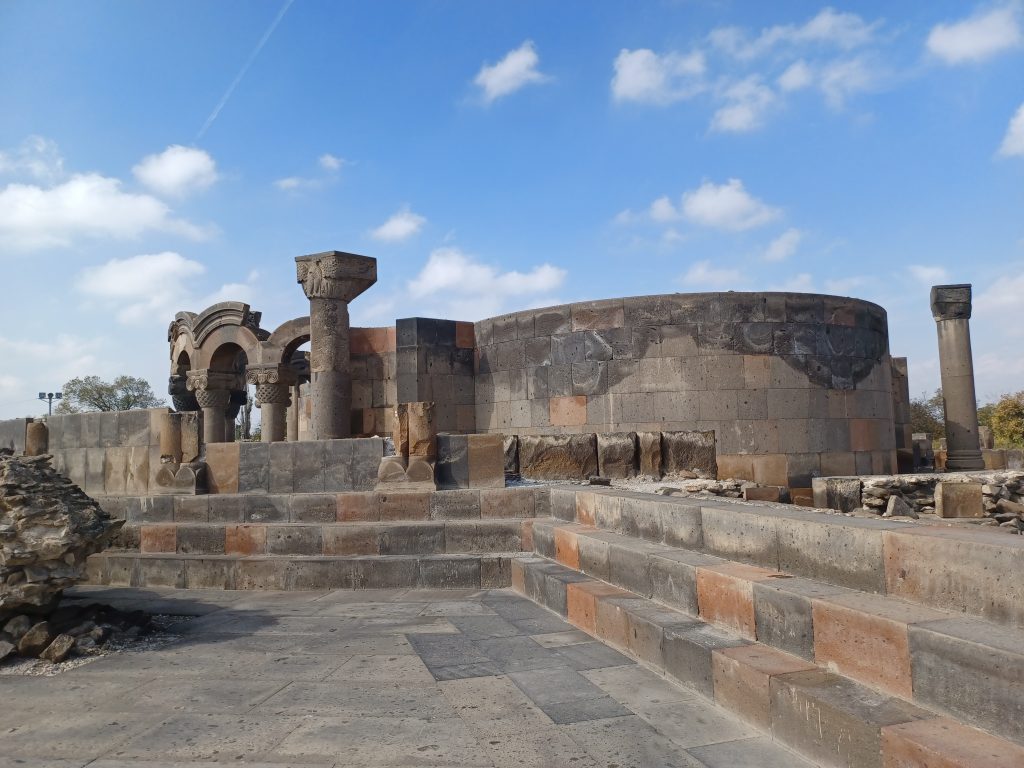
The 7th century Zvartnots temple complex is up next. Referred to variously as Zvartnots temple and Zvartnots Cathedral, as well as St Grigor Church. Built by Catholicos Nerses III and considered unique for its circular structure. Restored in the 1940s. A model in a small room shows what the temple is thought to have looked like. A three storey circular domed church. Drawings and other info on the walls enlighten the visitor.
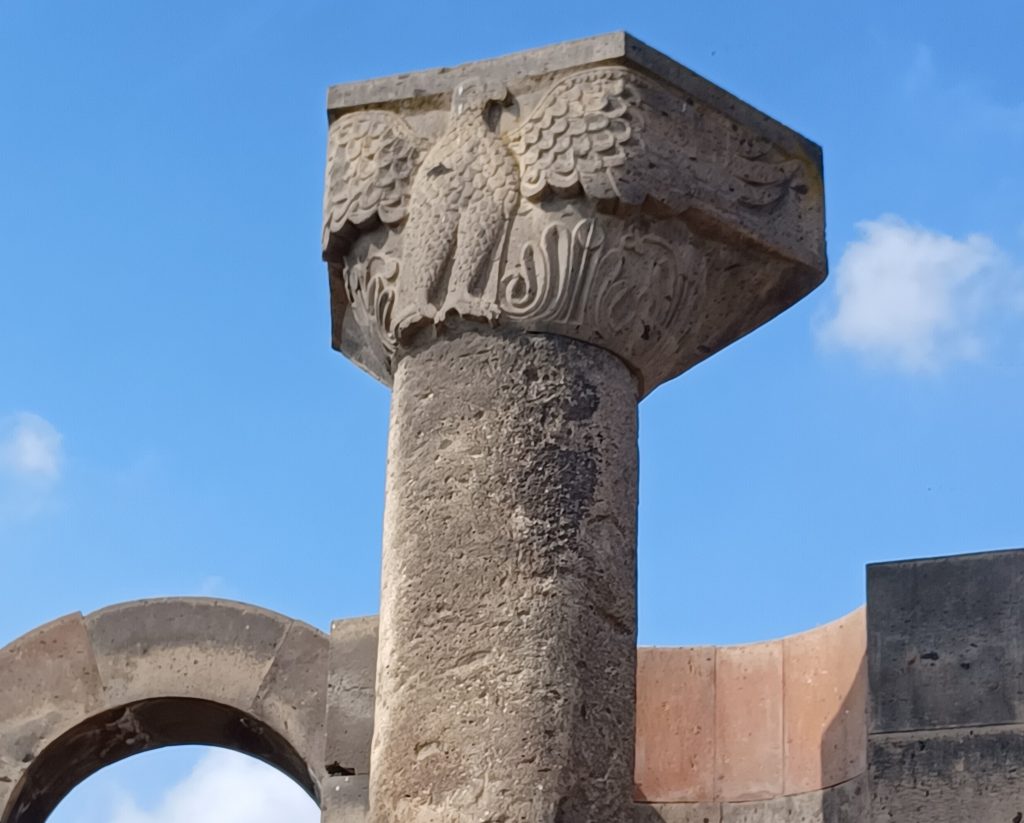
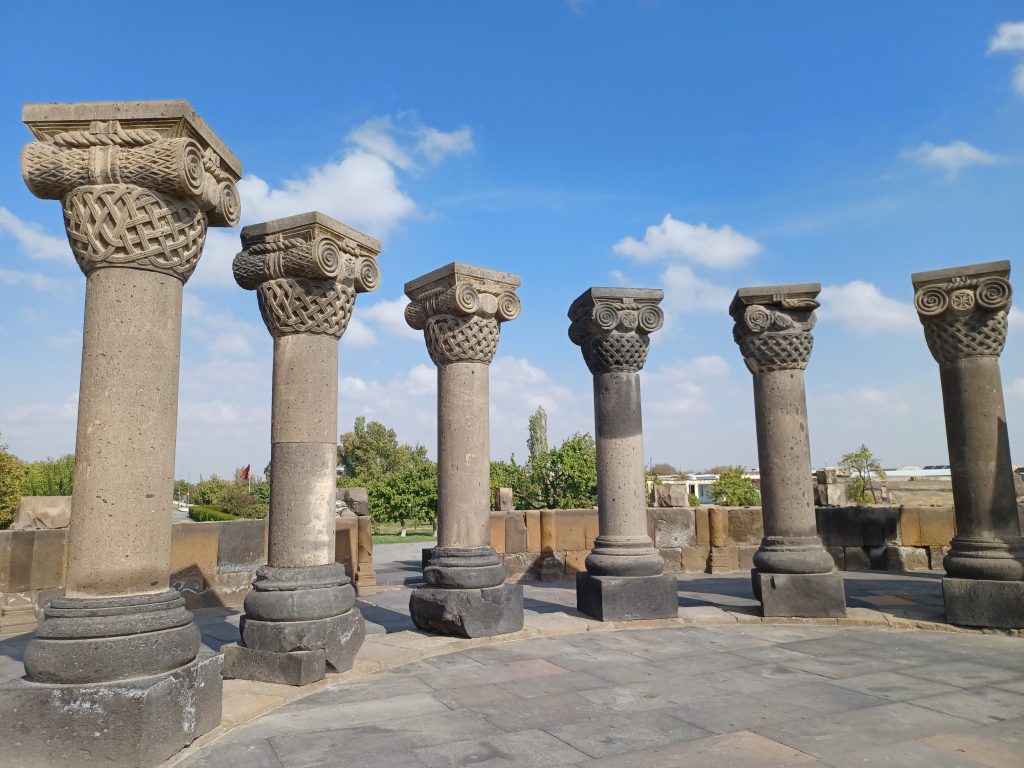
We exit the hall to explore the site. Bits of columns and basalt slabs lie all over the place. A restored sun dial appears. Decorated carved blocks. A bathhouse and, at one time, a palace, with banqueting hall and various living rooms. All rather intriguing. I like old ruins. Exercises the brain a bit to try to imagine how all the bits fitted together. Some columns with Armenian Ionic capitals have been restored. Some of the capitals have eagles carved on them.
In the middle of the temple area is a large depression with a grid over it. Within were once relics of Gregory the Illuminator. He was supposed to have met King Tiridates on this spot during the time that Armenia converted to Christianity in 301 – twelve years before Constantine declared the Roman empire as a Christian kingdom. Thus the Cathedral was built right here and consecrated in 652. Either an earthquake or constant raids by the Arabs destroyed the temple in the 10th century, so we are told. It has been on UNESCO’s World Heritage list since 2000.
Arishta
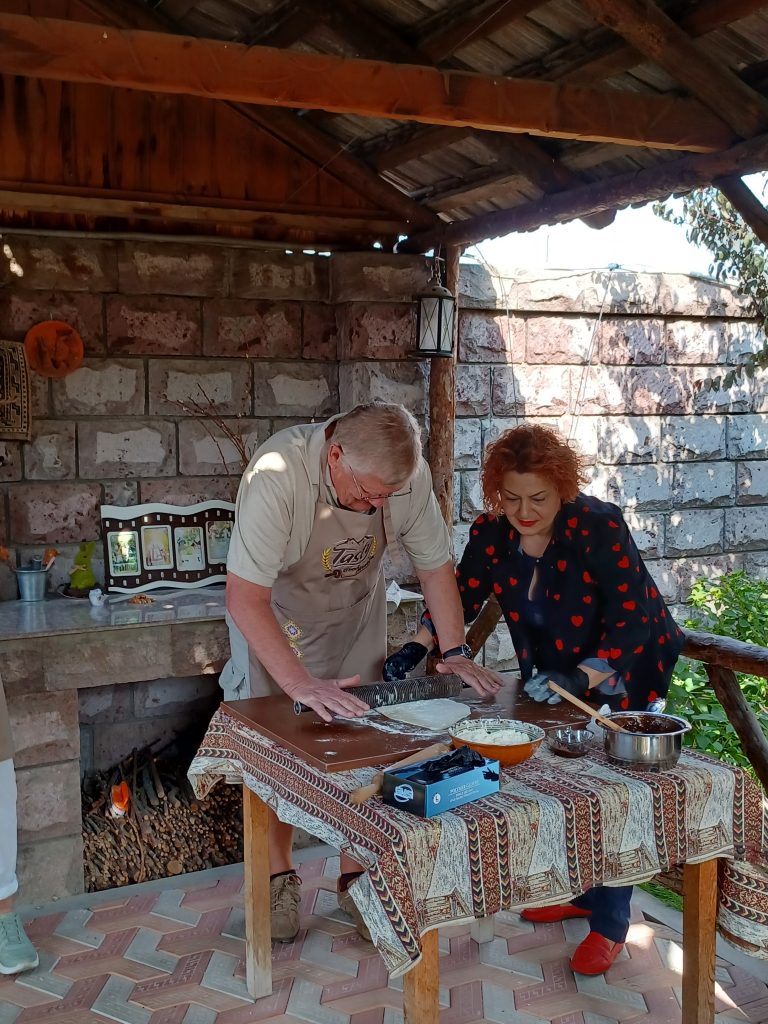
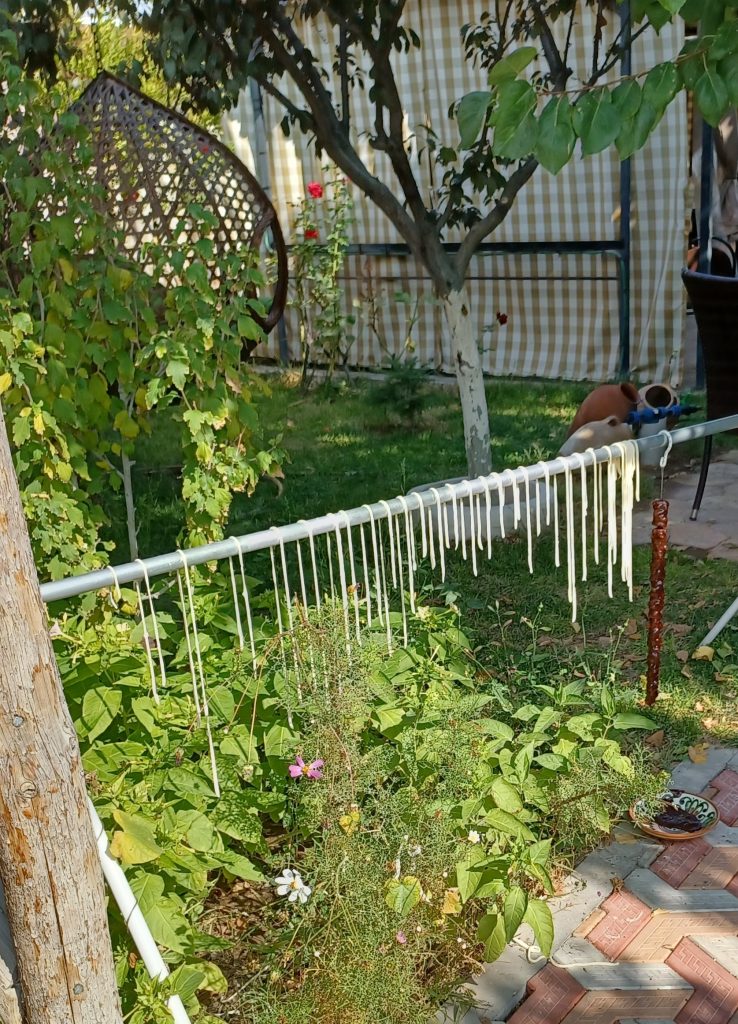
Off to a cookery class now. Somewhere close by in a village named Parakar. Anyway, it makes a change from all these religious sites. Am starting to blend them all together, like the pasta that our lady hostess begins to make. This is an Armenian pasta called ‘arishta’. Some willing members of our group gather round to participate. After the arishta is rolled out it is cut into thin strips and hung out to dry. That done, we are then invited to sit down to a large lunch with arishta ‒ naturally ‒, meat balls and salads. And homemade liquor to aid digestion.
Feeling somewhat mellow, the group is driven back to the city. As we wend our way, I notice large water melons squatting by wayside residences. Some time to while away once back in the metropolis, so wander over to the arts and crafts centre. Purchase a pomegranate, a wooden one painted a vibrant red. A good day.
Geghard monastery
Another day of superlatives today. Apart from feeling like death warmed up at breakfast after a fitful sleep. Bit zombie like for the first thirty minutes or so of the journey through the eastern suburbs of Yerevan. Parks and squares and statues come and go until, finally, we emerge into the countryside, in a landscape of yellowish greyish hilly grassland. It is not particularly inspiring, especially when we pass through an area of landslip. A whole village has been destroyed, as the land has gradually slipped down the slope. Some kind of geological aberration, according to the guide. The former inhabitants have been moved to the next village further along. Doesn’t stop them from growing fruit trees though. Fertile soils support pears and apples.
Drive high up into the Azat Valley, where a complex of rock cut churches, Geghard Monastery, was built in medieval times. With a defensive wall one side and the natural towering cliffs of the gorge on the other, the monastery lies on a magnificent site in an area of outstanding natural beauty.
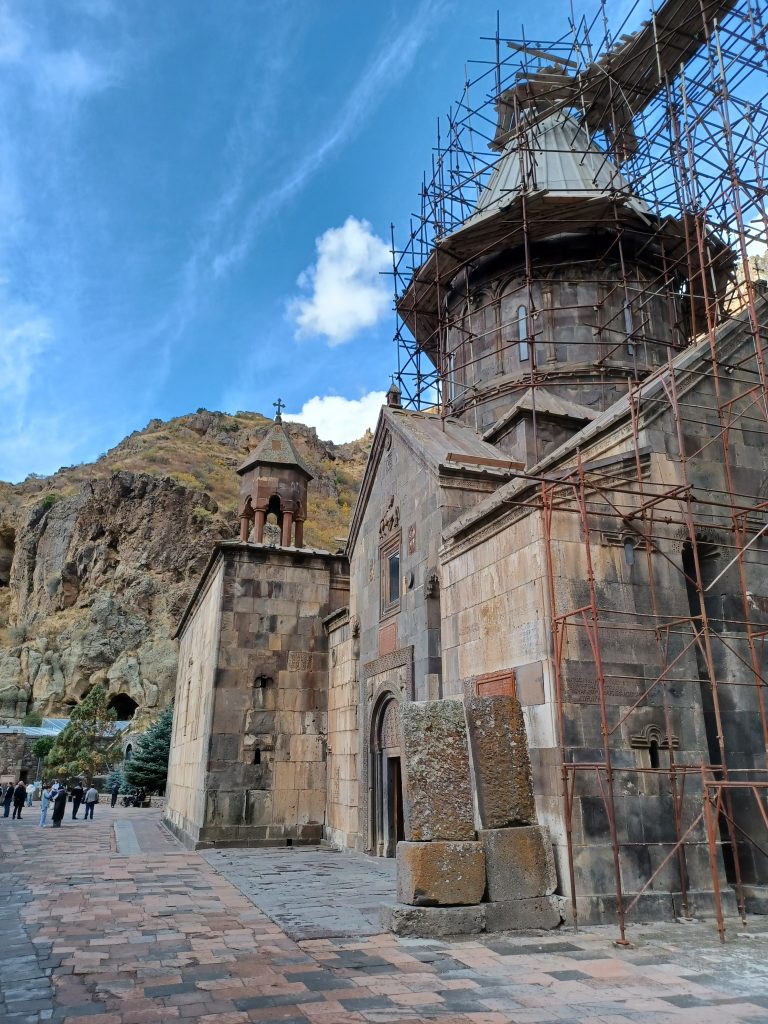
We clamber up cobbled slopes, with the sheer high rock faces of the canyon behind us. Yellow and green trees. One or two souvenir stalls. Lot of hiking trails here, I gather. Gregory the Illuminator, him again, established the first church here in the 4th century on the site of a natural spring. He is believed to have lived in one of the many cells/caves in the cliffs. Ascetic. The caves were reached via ropes and ladders. The current monastery probably dates from the 13th century, built by the Proshyan dynasty. The complex was an important pilgrimage site with a scriptorium, monks’ quarters and academy of music, along with shrines and churches.

And the monastery is said to have housed the Holy Lance, which a Roman soldier used to pierce Christ’s side while he was on the cross, to ensure that he was dead. The holy lance was brought to Geghard by the apostle, Thaddeus. ‘Geghard’ means ‘spear’. It is now housed in Echmiadzin Cathedral.
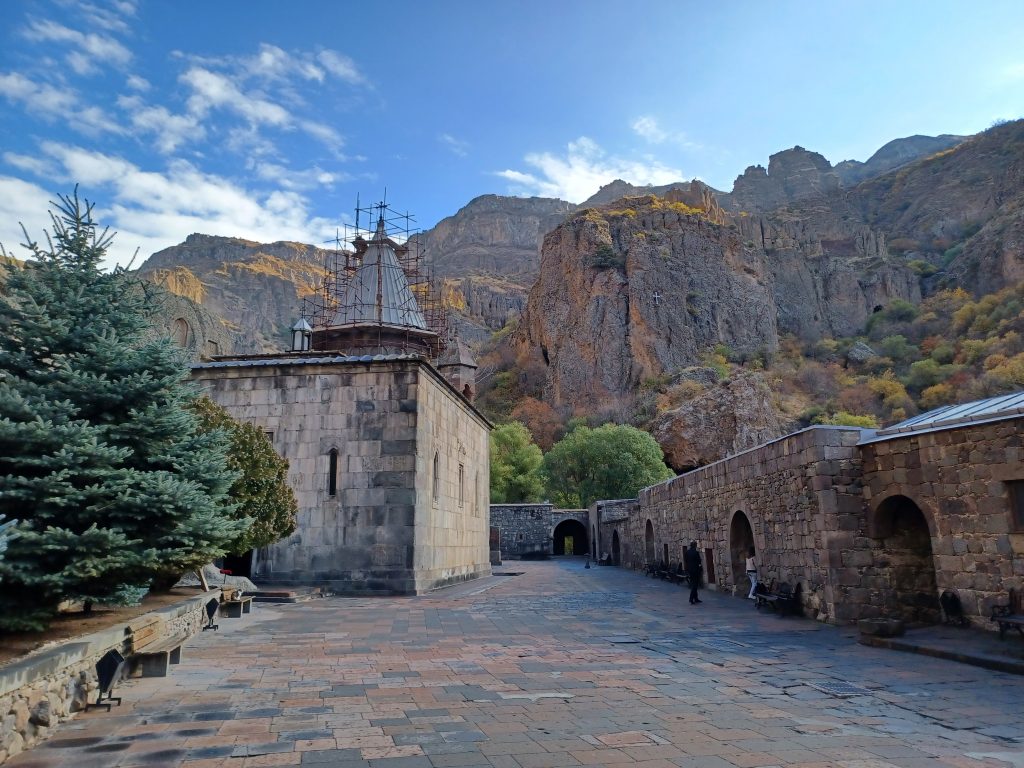
Sacked by the Mongols and the Timurids under Timur the Great, along with earthquakes, like most of the other monasteries in Armenia, Geghard has suffered much damage. The dome is being repaired right now with scaffolding over it. Mooch about the paving slabs for a bit breathing deep of the fresh mountain air and the pine-woody evergreen smells.
The guide leads us up a pathway to the second floor where we pass through a ten meter tunnel with khachkars on the sides and assemble in a dark space. We are due to hear some sacred songs sung by the ‘Garni Quartet’. They file in and take up positions. A dim light from the oculus in the dome shines down upon them. They begin to sing.
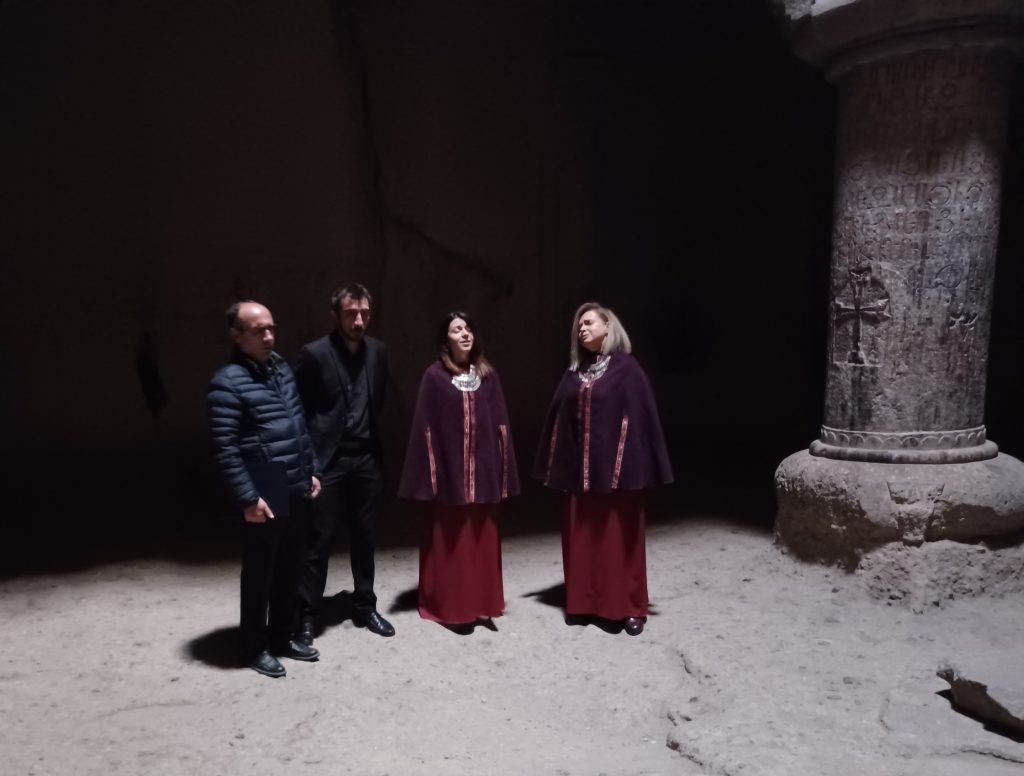
Their voices resonate around the church. Hairs rise on nape of neck. Knees weaken and all that sort of thing. Mesmerised. The final note lasts a few seconds. Hush. Then applause. Sublime. A spiritual experience indeed. I could have listened to them all day.
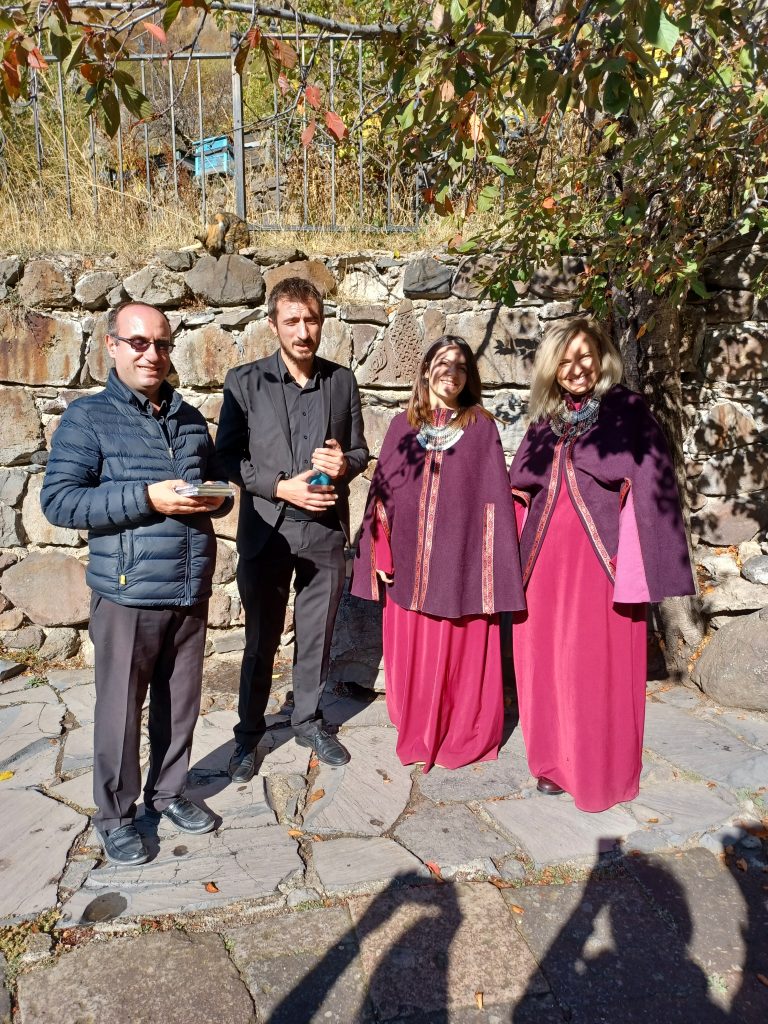
They file out while we wander around inside the church. There are pillars onto which Armenian writing and crosses have been carved. And grave stones on the ground. OK to walk on these, the guide says, as we try to avoid stepping on them. Something of their spirits may be conveyed to those who tread upon them, I understand. After a while, we exit through the rock cut tunnel and emerge into the daylight. The foursome are standing outside in the low morning shadows. We clamour to take their pictures and view their CDs. I buy one. But this was an experience not likely to be felt in the same way at home through a modern music system.

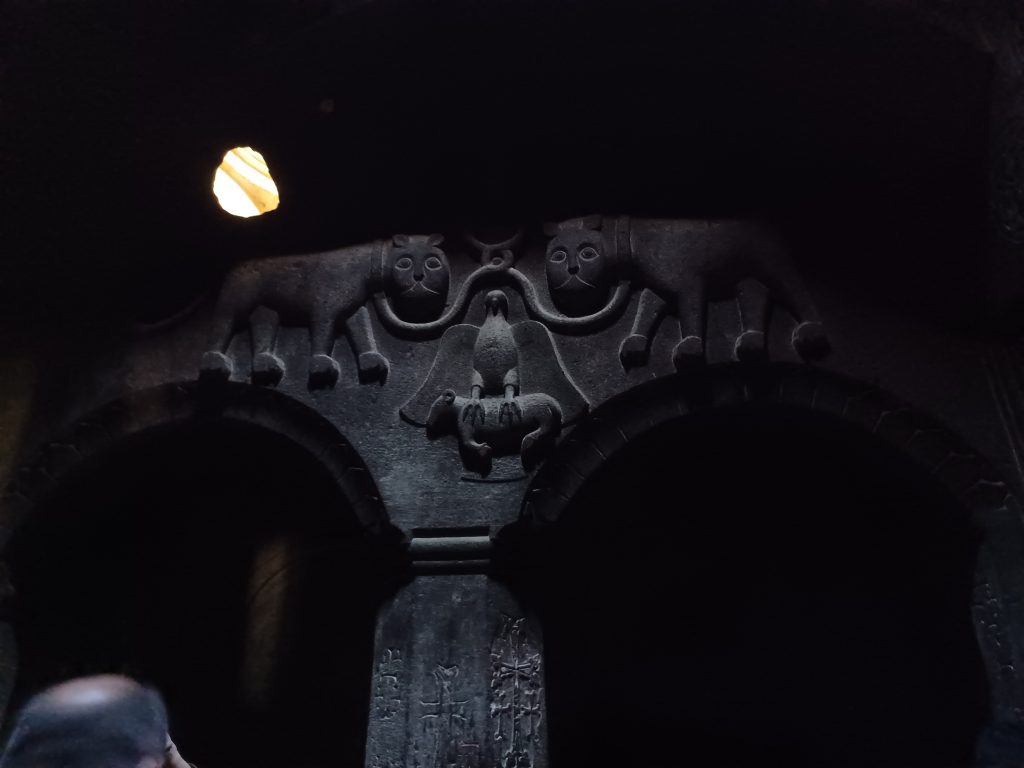
Take our leave of them and descend the steps before entering another part of the monastery. It is gloomy within but one can make out two lion carvings and an eagle in the spandrels, the coat of arms of the Proshyan dynasty. This family ruled in the 13th century until the Mongols took over in 1236. But they were the ones who began the construction of Geghard Monastery.

Thence we make our way to the chapel with the holy spring. The water collects in a small pool and runs through a channel in the floor, then disappears under the paving slabs of the main church. I dip my fingers in the water. As do others. After all, Saint Gregory the Illuminator would also have dipped his fingers in it way back in the 4th century. On the rocks behind the spring are carvings of crosses.
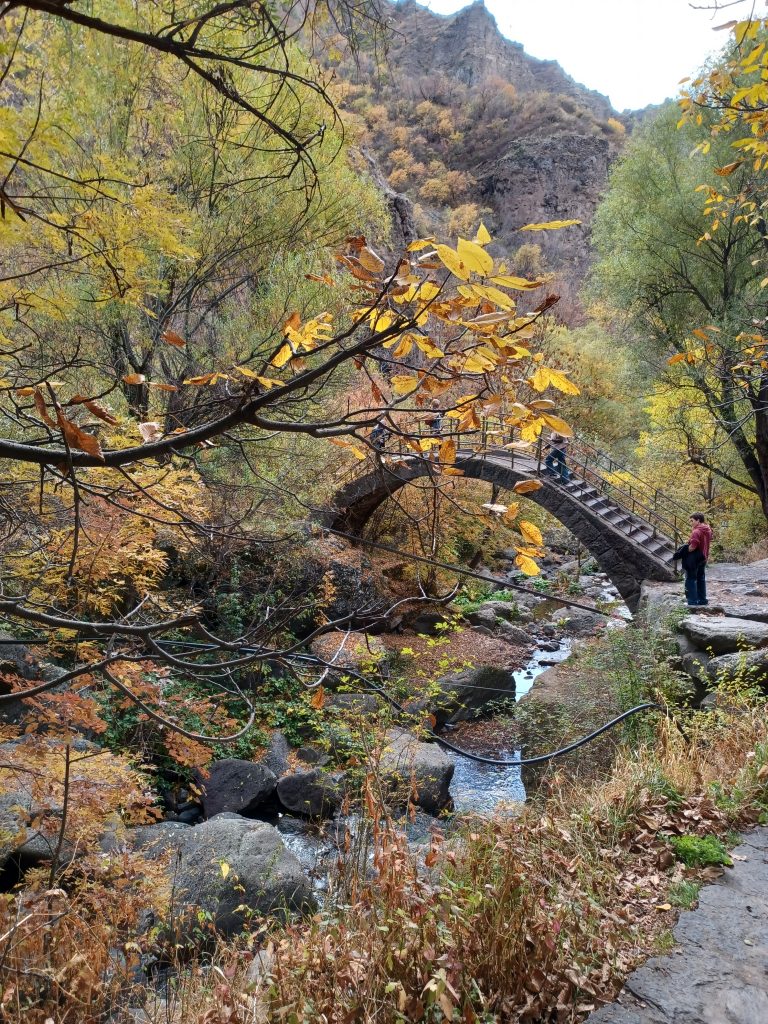
Exit these sacred spaces now into the fresh air, and amble around the woody precincts. A rustic stone bridge arches over a little brook burbling over rocks. Quiet, calm. Dappled sunlight. No wonder it is a place of pilgrimage still. And a major tourist destination. If there was a monastery in Armenia that I would visit again it would be this one. Still feeling a bit numb from the beauty of the singing and the soul of the place, I wander coach-wards again.
Garni Temple
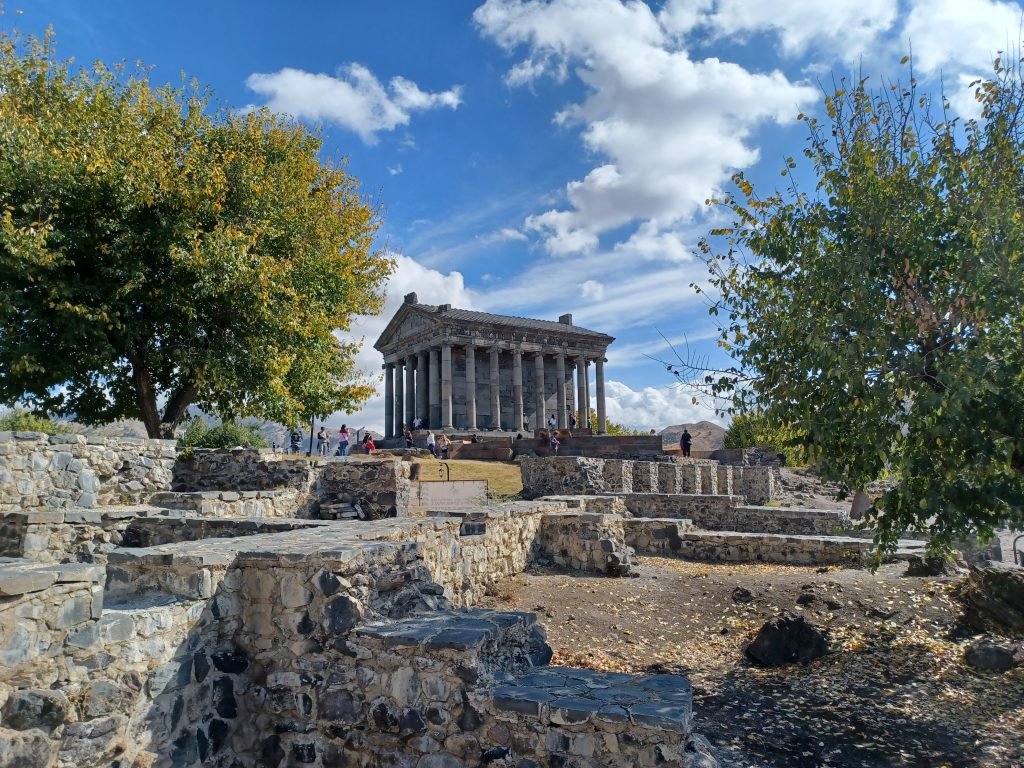
We are heading now to the temple of Garni. This is a pagan temple, which is dedicated to the Zoroastrian god Mihr, equivalent to Helios or Mithra, the sun god. Different. Built around the end of the 1st century from basalt and, according to our guide, the furthest point east that the Romans ventured. Some debate as to who actually built the temple. Some attribute it to King Tiridates I in around 77 AD, others to Tiridates III, he who converted Armenians to Christianity. No mortar used. Stones are joined with rivets. Anyway, it is perched on another stunning site, rising above the canyon below through which the river Azat flows. Those Romans knew a thing or two about siting their temples. Saying that, there was, apparently, a sanctuary below it dating to the ancient Kingdom of Urartu. The site includes remains of a settlement and defensive walls.
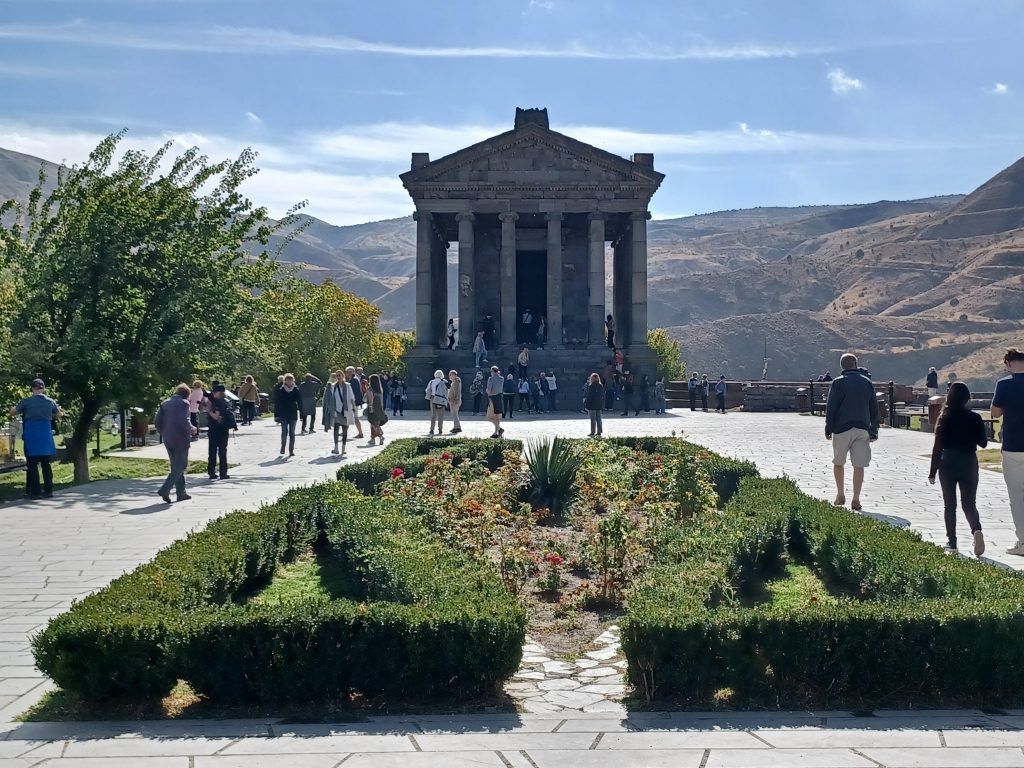
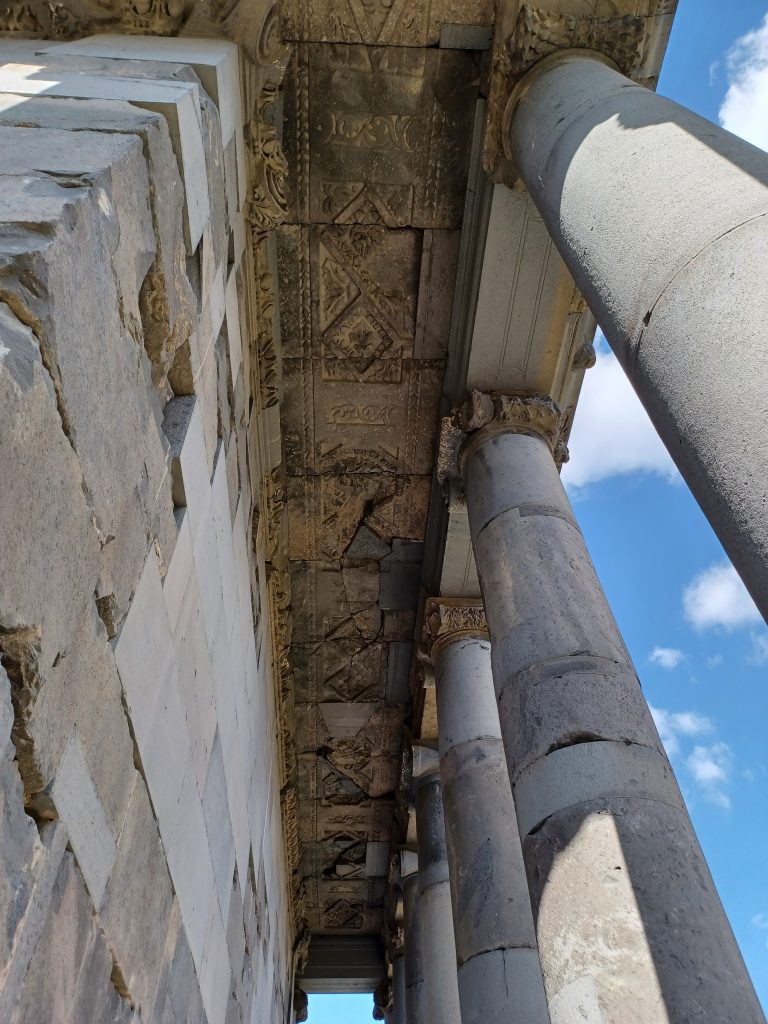
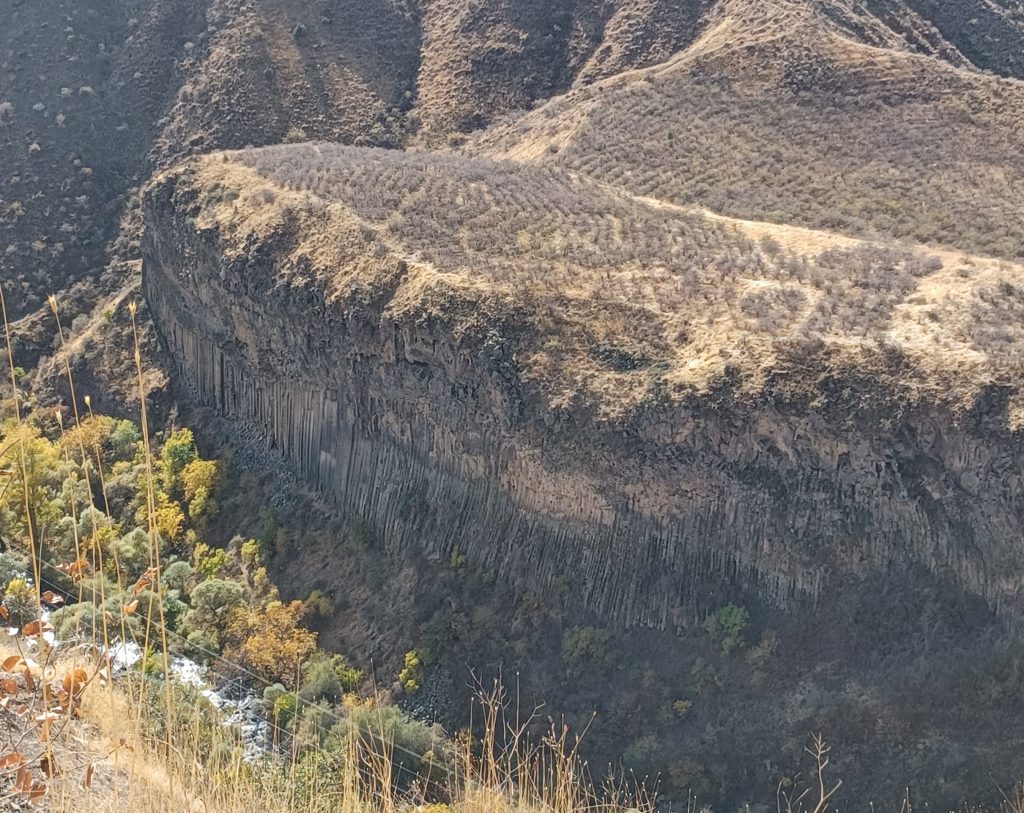
Ionian type capitals and decorations of Armenian grapes, acanthus leaves and pomegranates feature. And lions heads on the cornices. The temple stood until 1679, when an earthquake felled it, and was restored in the 1960s/70s. The original stone is dark basalt, the restored sections of lighter material. Extraordinarily high treads on the steps up to the temple. Notwithstanding, I clamber up and wander between the columns. Raise my head to view the decorations on ceilings and capitals. Terrific views over the valley below from here, including a natural formation of basalt columns in the cliffs.
Lavash
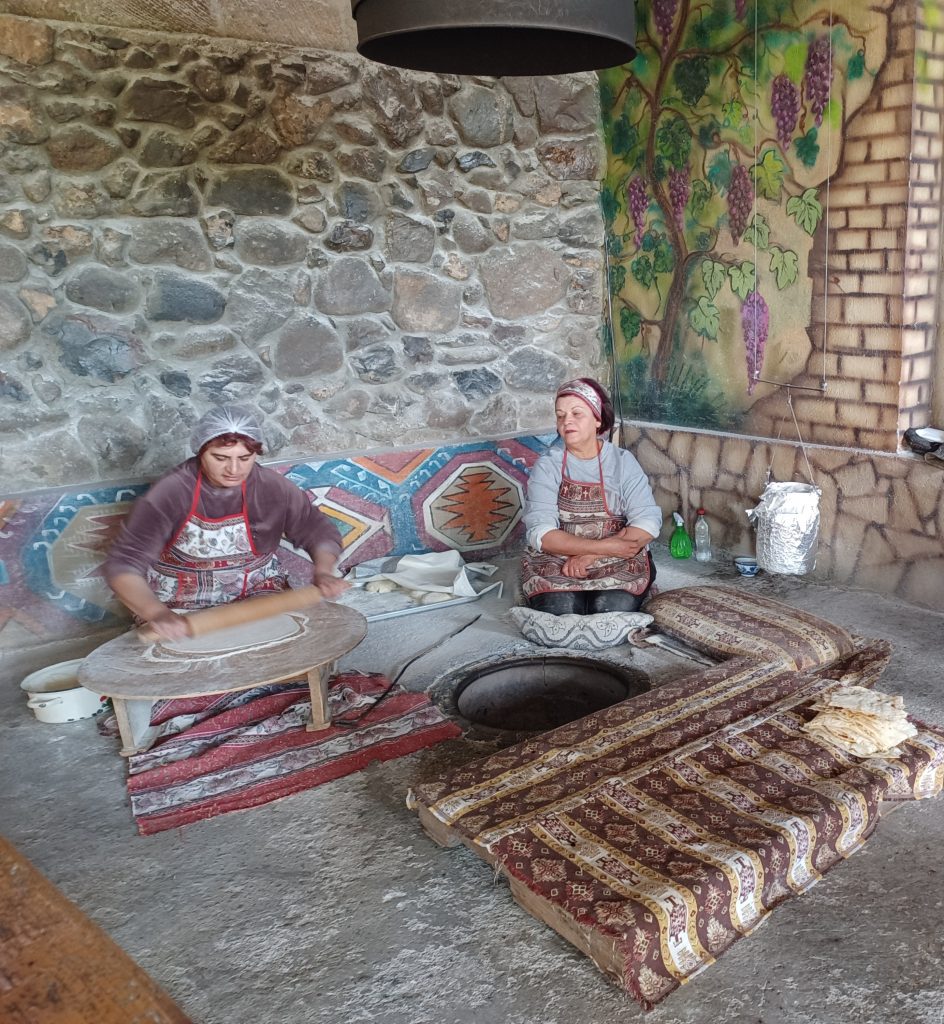
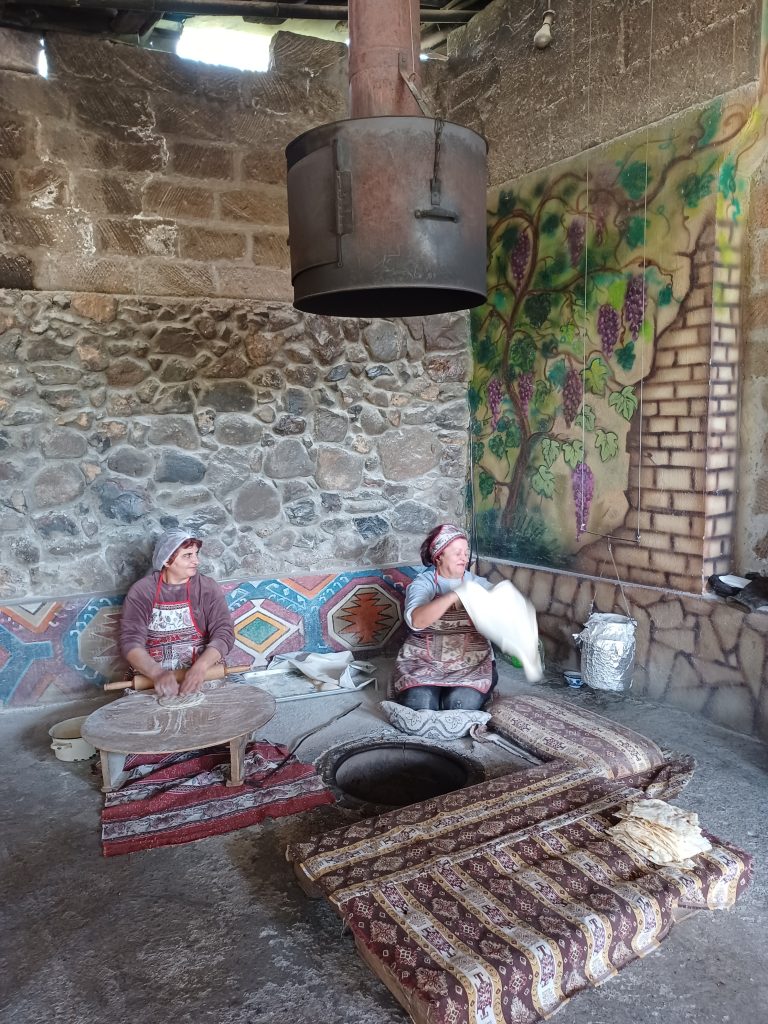
Group members are in sunny mood as we drive a short way to our luncheon spot in the garden of a local. Here we learn the art of lavash (a thin flatbread) making and watch said lavash being rolled and swirled about by enthusiastic ladies and shoved onto the sides of an underground clay oven. There to bake for a minute or so for us to savour along with some salty cheese and some kind of leaf.
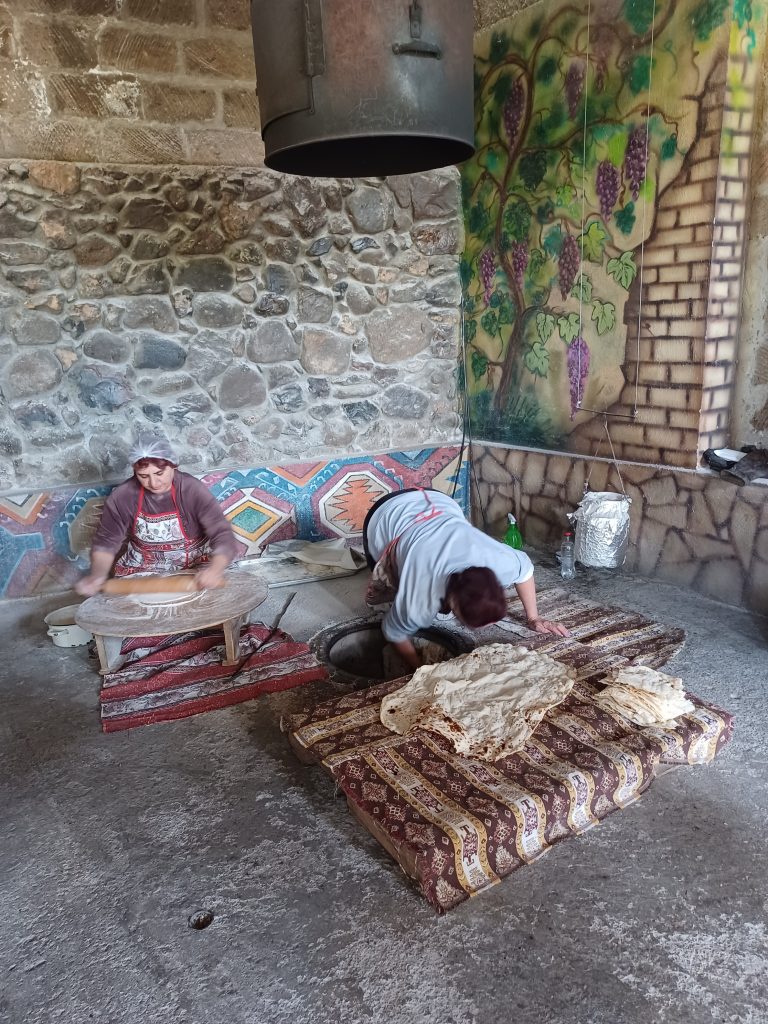
After this tasty appetiser, we settle down at a long table liberally spread with salads, beef with peppers, and tomatoes and potatoes. More lavash. Gets one’s gastric juices going. Sparkling water and soft sweet cake and grapes and apples to finish. Sun shines. Stroll round the pretty garden with its shrubs and dahlias and golden marigolds and a couple of swing chairs, inviting one to swing. I do.
Lake Sevan and Sevanavank
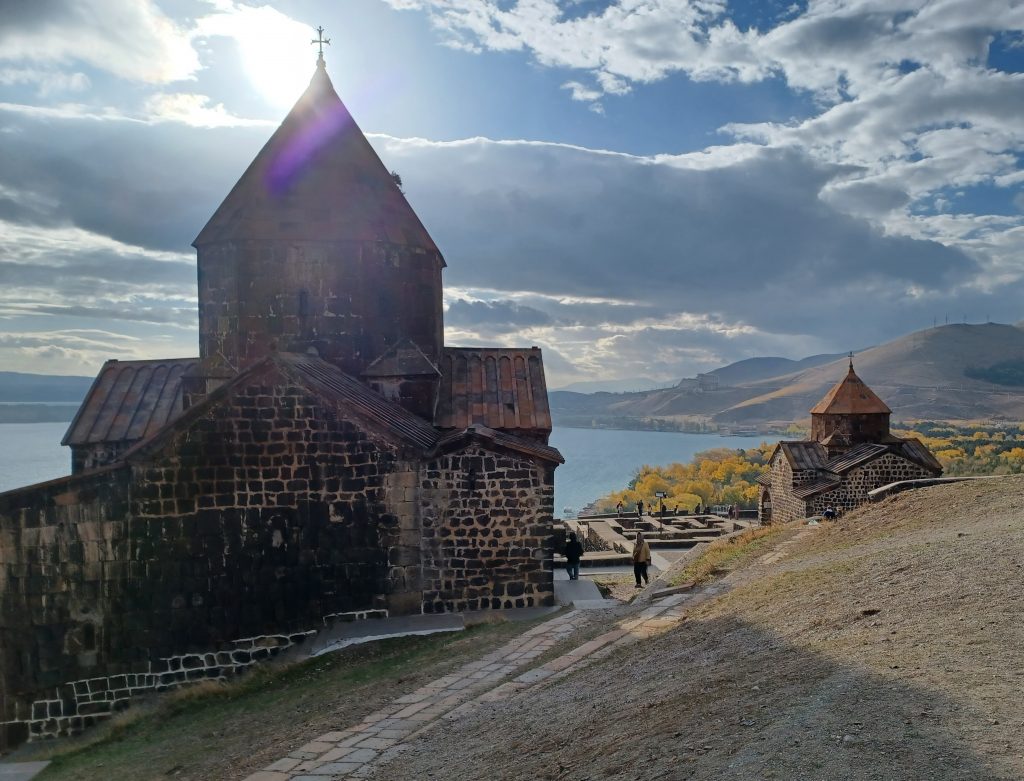
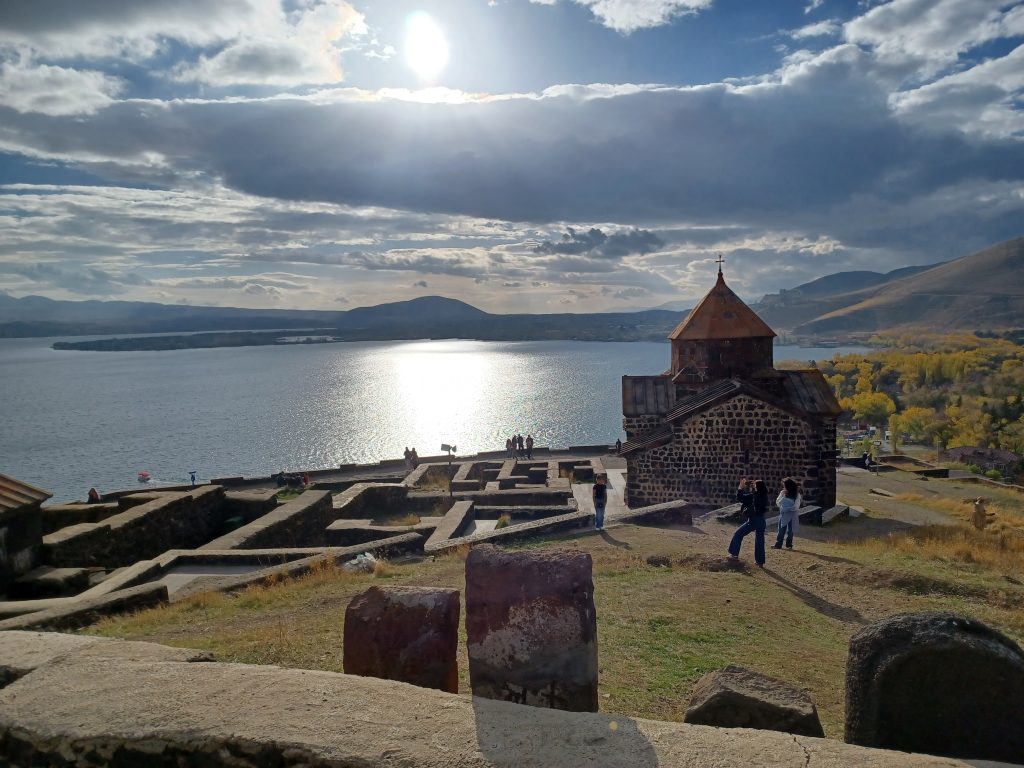
The last stop today is Lake Sevan, the second highest lake in the world after Lake Titicaca, we are told. Really? Said lake takes up about 1/6 of the whole country. Many uneven steps lead steeply upwards to a 9th century monastery, which was originally built on an island. The lake was drained deliberately by the Soviets, under Stalin, to use its waters for irrigation and hydro-electric power generation. With resulting devasting effects upon the fauna and flora. The water level dropped by twenty metres and the island became a peninsula. Recovered somewhat due to later policies and the lake is now a sought after tourist destination, with Armenia’s only beaches on its shores. Not all of us are equal to this climb up today. Pity. But these less steady members of the group are able to explore below.
Atop the hill are the two lovely churches of Sevanavank (meaning Black Monastery), standing sentinel over the dark waters of the lake. One church is dedicated to Surb Astvatsatsin (Holy Mother of God), and the other to Surb Arakelots (Holy Apostles). There are the remains of other structures and many khachkars on the site. Restored recently, I gather, the monastic complex once stored thousands of books and was a centre for education, culture and a scriptorium in medieval times. The monks fished in the lake, which still provides most of Armenia’s fish. As with other monasteries this one also suffered damage from invasions by Mongols, Timur the Great, Arabs, Persians and earthquakes. Superb setting. I walk up behind the monastery to observe the view of the lake and hills behind. An enterprising chap with a complacent white horse offers rides round the hill for any takers.
A tourist notices a scorpion creeping across the stony ground. Cluster round. Watch it with some curiosity. Its pincers are held in front and tail curved over with its venomous sting on the end. A fine specimen. Shudder. Someone prods it with a stick. Move off smartly. Me, not the scorpion.
Head down the slope. Sun shining on face. Reflecting from the water. Totally gorgeous. Clamber down the steps and mosey towards the lake shore. A few boats are tied up to a pontoon here ready to take day trippers for boat rides. That would be good. I always like a boat trip. And a yellowish restaurant perches at the end of the pier. Seems shut. Low season, I suppose. No boats out today either.

Board the bus again and head through Dilijan National Park. This is a splendiferous region with pretty villages and wooded hills all round and flowers and birds. Nicknamed the Switzerland of Armenia, apparently. We stay in a jolly nice hotel, sited on a hill amongst the autumn leaves. Farewell dinner and drinks tonight too. Cheery occasion.
Goshavank
On our way northwards now. And our last monastery, our 10th monastery/church/temple complex in Armenia, just a fraction of them, and indeed for the whole trip, is Goshavank, founded in 1188 by Mkhitar Gosh. Its earlier name was Gor Netik but after Gosh’s death it was renamed after him, i.e. Gosh’s Monastery. Mkhitar Gosh was an outstanding lawyer and scholar, according to an information board, and there is a statue of him outside. In medieval times, the monastery was ‘a celebrated center of spiritual culture and a scriptorium’. There were once thousands of manuscripts here and scholars from all over Armenia came here to study.

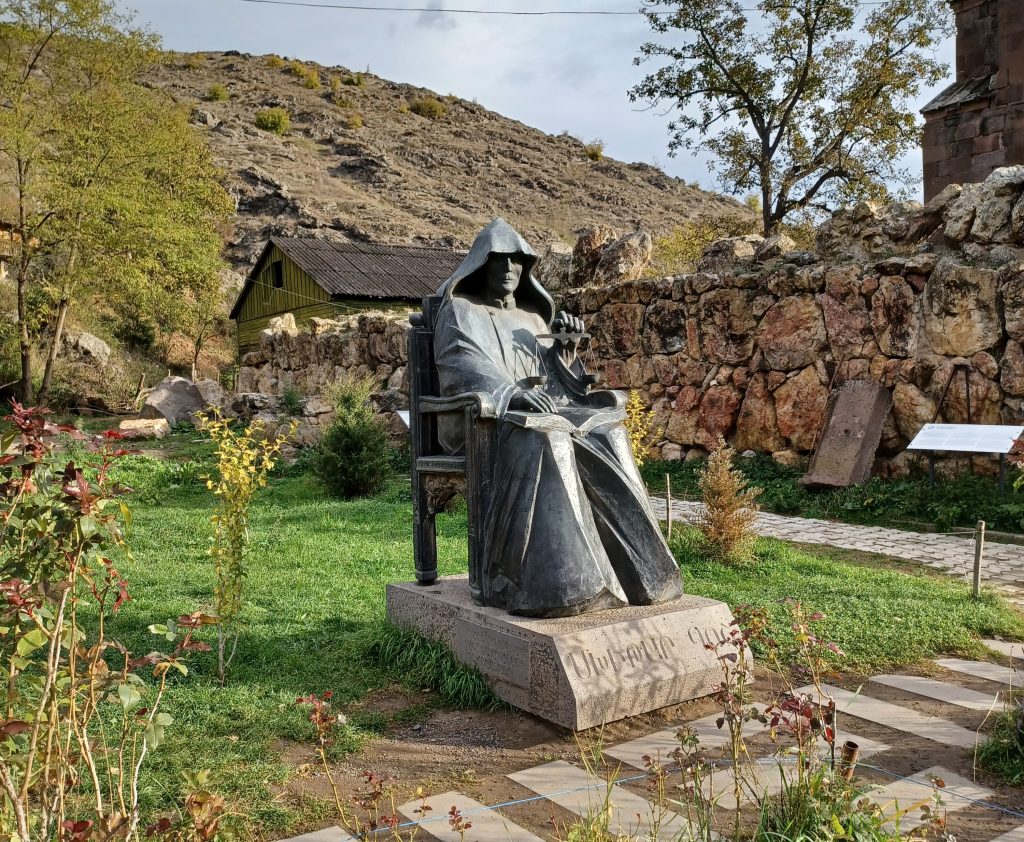
There are several churches in the complex, one of which is dedicated to St Grigor, St Gregory the Illuminator. Inside the dome of this church are niches which help to withstand earthquakes. Exquisite khachkars, intricately carved like lace, flank the entrance. I watch a white dove flitting from one to the other. Other churches are sited across the valley, where Mkhitar Gosh was laid to rest. Birds chirp in the misty distance. Scenic site within the Dilijan National Park.

The Road North
After Goshavank comes a long meandering road northwards. Our guide points out the fenced off border between Armenia and Azerbaijan and the soldiers in their guard posts atop the hills. This is the region of Nagorno Karabakh, which Armenia lost in the 44 day war in 2020. 120,000 Armenians moved out of the area, she tells us, and by the roadside are abandoned houses. Lovely scenery round here. Greener than further south.
Eventually we get to a food hall south of the border with Georgia to freshen up before departing Armenia for Tbilisi. Actually there are a fair few shops here and I buy some fridge magnets of Geghard Monastery. Back in Georgia, we will take the Turkish airlines flight home. Turkish Airlines won’t operate out of Yerevan to Turkey and the border with Turkey remains closed. “A diabolical situation”, says our guide. Am somewhat puzzled why some other airline could not have been found to fly us out of Armenia. Anyway, we have to recross the border.
And so our trip comes to an end. My experience on this tour has encompassed a whole range of emotions: from the spiritual to the flippant, from the depressing to the exhilarating. A whole range of scenes: churches, temples, mausoleums and mosques; mountains, forests, rivers and lakes. And topping it all the wineries, fruits and foods of the Caucasus.
Leave a Reply