
Hanoi
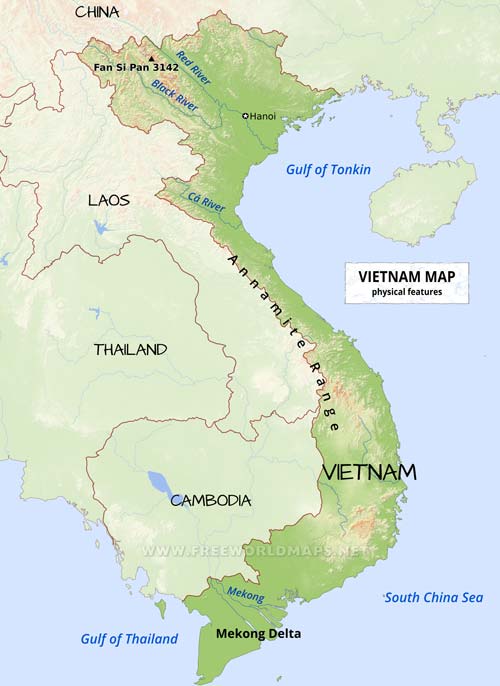
Hanoi. A charmingly chaotic city full of fascinating features, from the alleyways of the old quarter and its temples, to the grandiose buildings of the old French quarter. This capital city of Vietnam has been on my bucket list for some time. It is situated on the Red river, around which the ancient city of Thang Long grew in the 11th century. The river runs south from China, through to the Gulf of Tonkin. Vietnam curls around Laos and Cambodia in a sort of long slender ‘S’ shape, on the east side of the south-east Asian peninsula. It suffered a tumultuous 20th century with various wars, not least with the Americans from the 1950s until 1973, and with itself. In 1954, after the defeat of the French colonialist powers, it was divided into North and South Vietnam with separate capitals. It has been a unified socialist republic since 1976.
Ho Chi Minh Mausoleum
The supreme highlight today of a tour today is a visit to the Ho Chi Minh Mausoleum, a good march away from the hotel. Why this should be at the top of the list of places for tourists to visit in Hanoi, I know not. But it is clearly a monument to which everyone, from the tiniest kiddie to the hobbliest elder, has to pay homage. Ho Chi Minh, or Uncle Ho, as he is affectionately known, is Vietnam’s national hero, who led Vietnam to independence from the French. The French entered Asia in the late 1880s ostensibly to ‘civilise’ the local populations and ruled Vietnam from 1885. They held the countries of Laos and Cambodia, as well as Vietnam, collectively known as French Indochina, for sixty years and profited much from the exploitation of resources, much like the British imperialists did. During their sojourn here, many old temples and buildings were destroyed, and land seized in order to grow cash crops, such as rice and rubber, on large plantations. Also opium. The locals were not treated well. Hence the rise of Ho Chi Minh, who eventually succeeded in his ambition to eject them.
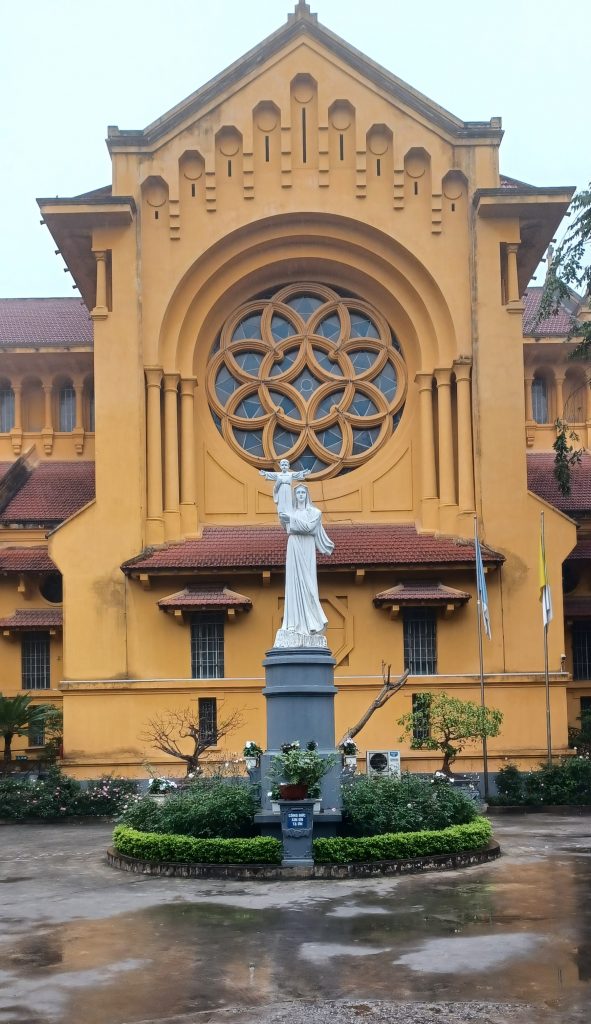
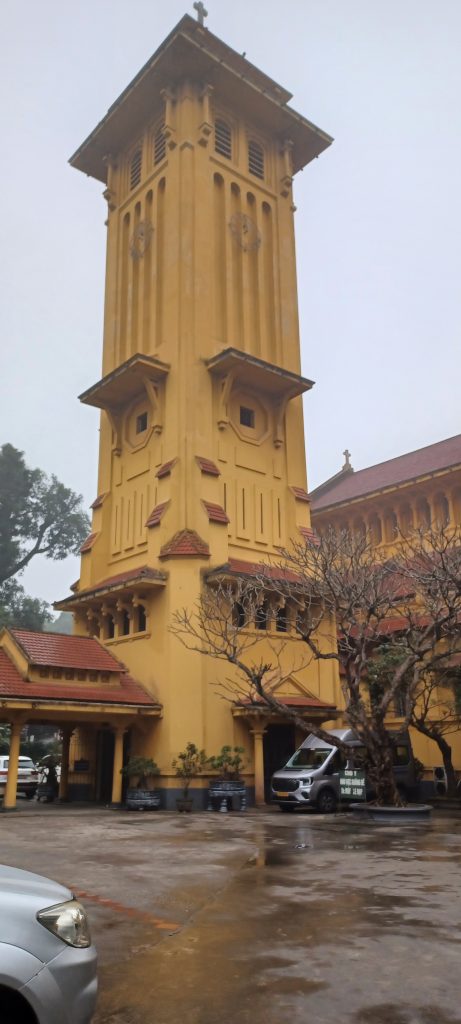
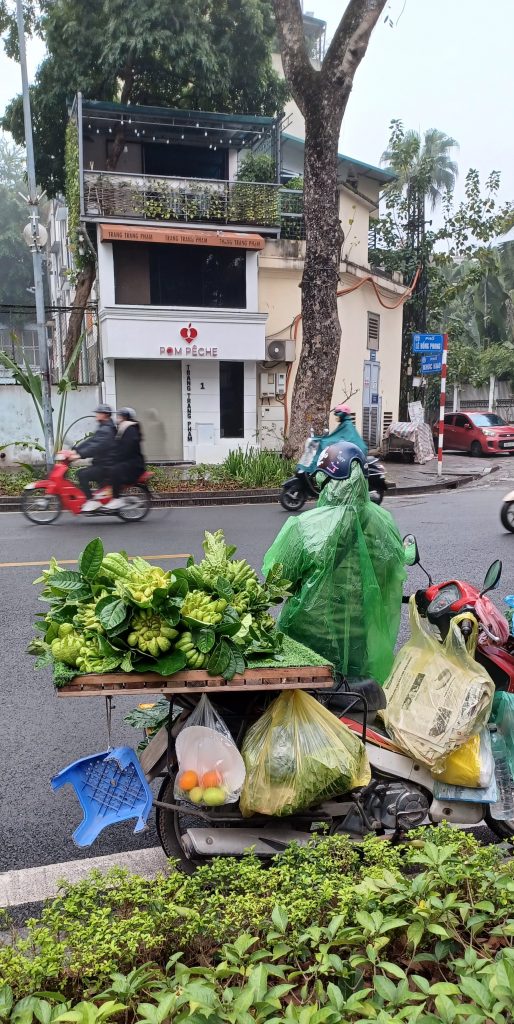
It is frightfully early. But already early morning traders are about, their produce slung over scooters on the roadside. And already, the traffic is horrendous. We pass the Cua Bac Catholic Church, built by the French in 1932, originally named Church of the Martyrs. This is one of three Catholic churches in Hanoi. St Joseph is the city’s patron saint and St Joseph’s Cathedral is located near Hoan Kiem Lake.
We can see the mausoleum from the road, but approach it by a circuitous route. Good job there is a guide. Anyway, we have to pass through security before emerging into Ba Dinh Square, within which is the mausoleum. Ba Dinh Square is huge, built by the French, and can hold 200,000 people. It was here where Vietnam’s independence was declared by Ho Chin Minh in 1945. Now used for parades and important events, as well as the annual flag raising ceremony on 2nd September, Vietnam’s National Day.
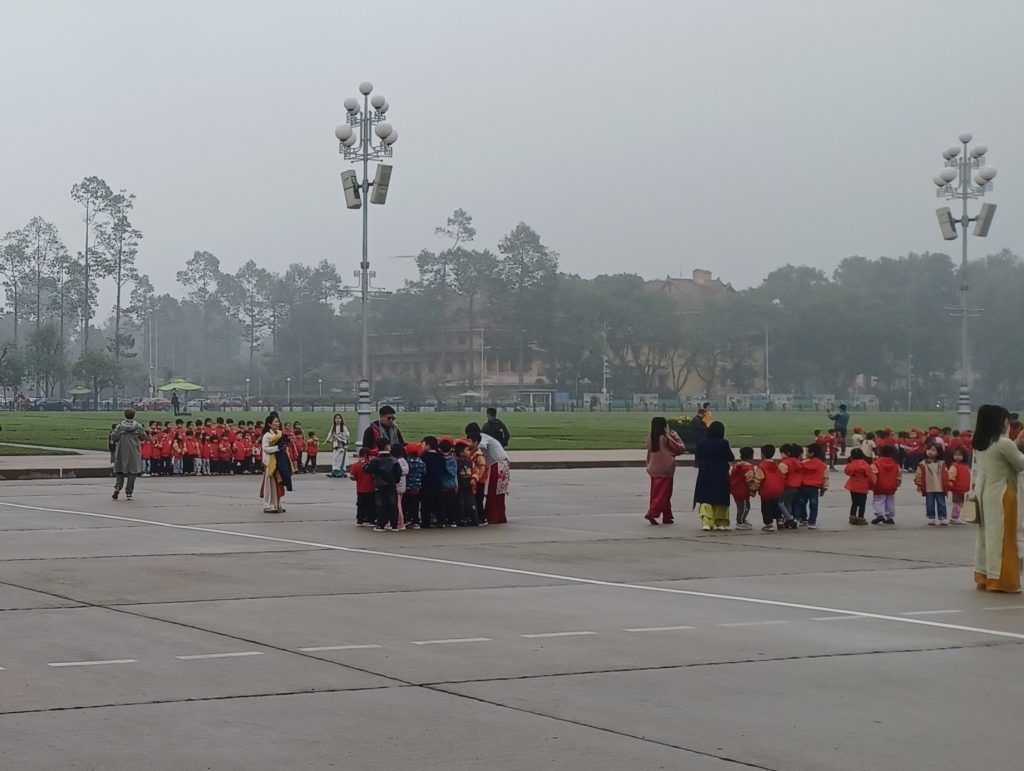
We form a slow queue. It shifts inch by inch toward the entrance to an enormous grey granite classical looking structure with a central part surrounded by square columns. Small children clothed in red jackets are waiting patiently in single file with their teachers. A large banner stretches along the top of a wall and flag poles with no flags.
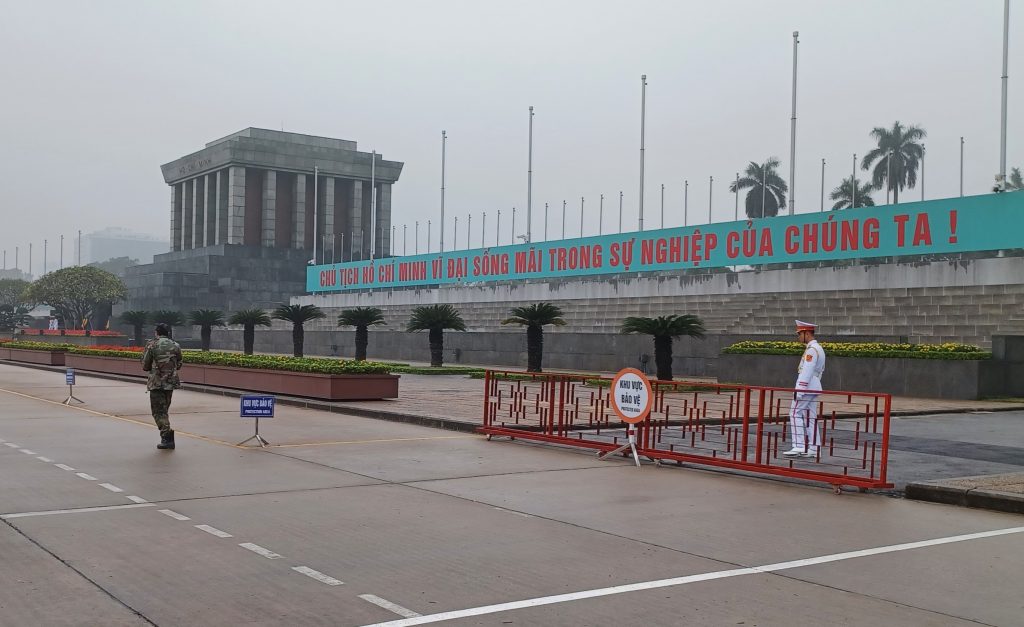
It is coolish this morning. Just as well because one has to cover ones arms and legs, i.e. dress modestly, this being one of the regulations for visiting this sacred place.
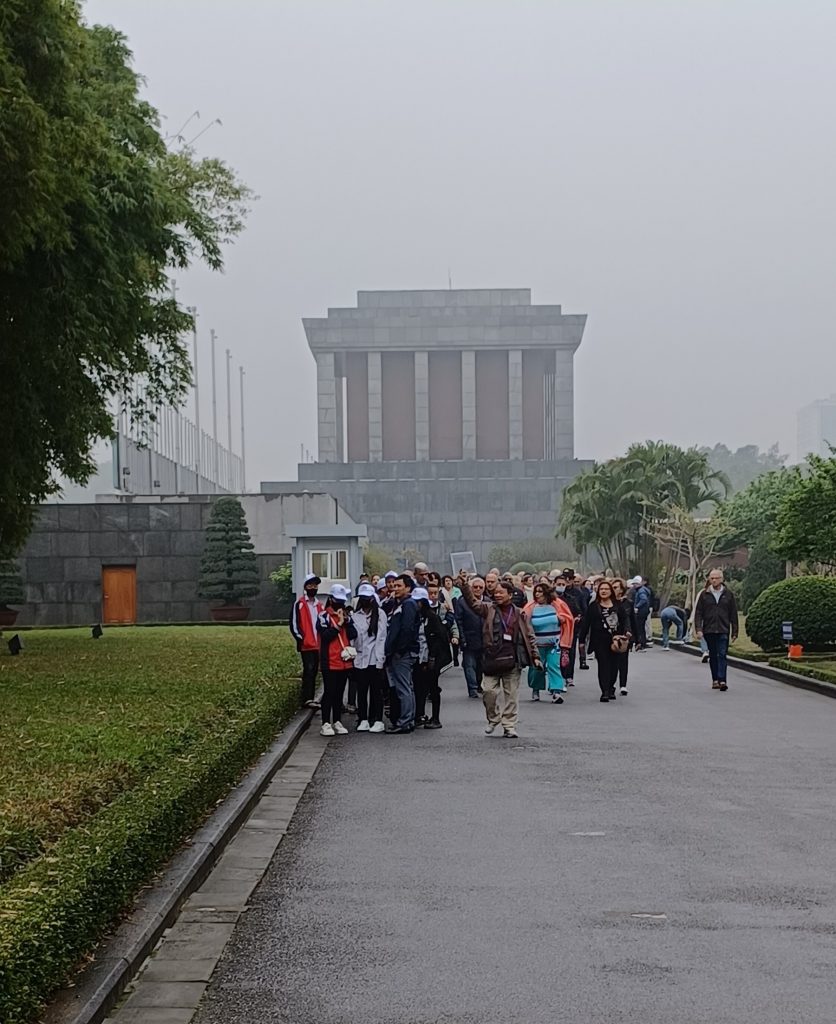
We watch and wait while ranks of dark green uniformed soldiers with their green forage caps with red band and gold braid file into the mausoleum. The guards are dressed in pure white. No photography allowed but that doesn’t stop some obsessed selfie takers. Potty or what. Especially with all those guards about. Anyway we eventually enter a marble chamber where lies the embalmed body of Ho Chi Minh, well preserved in his glass case. He died in 1969. He apparently wished for a modest cremation but the government thought differently, wanting to put him on public display.
Difficult, I suppose, to pay ones respects to an urn of ashes in quite the same way as an embalmed body. File dutifully past. A military guard of honour stands reverently by.
Once outside the hallowed precincts, on the opposite side of the mausoleum, photography is allowed. Noisy people mill about on the edge of the manicured grass and topiary.
Back in Ba Dinh Square the groups of school children are being rounded up by their teachers ready for the next stage of their tour today. Same as us no doubt. Behind them is a large area of grass, manicured into 240 square plots. Not permitted to walk thereon. But one can step upon the little pathways between.
Ho Chin Minh’s Houses: Stilt House and House 54
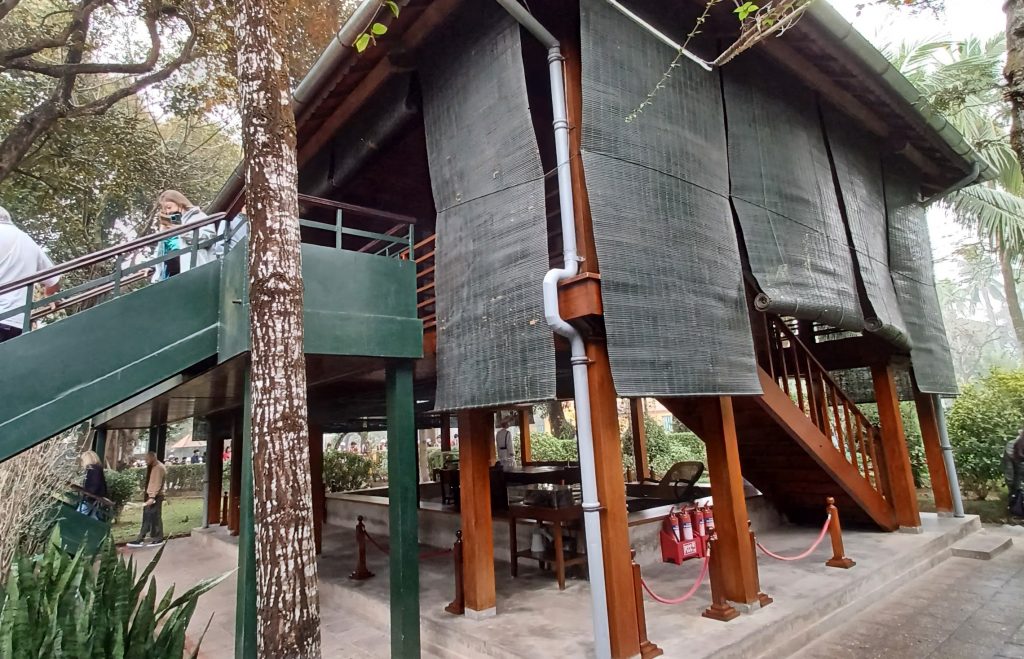
The tour resumes with a visit to the houses in which Ho Chi Minh once lived. But first we pass the Presidential Palace. The guide tells us that Uncle Ho desired a simple life. After the war with the French had ended in 1954, he came to Hanoi but did not wish to live in this large luxurious and splendid yellow palace, once resided in by the French leaders of Indo China. A grandiose symbol of colonialism. Rather, his wish was to live in a stilt house, based on the traditional architecture of some minority ethnic groups. The Politburo built him one, a structure made of wood on sturdy wooden stilts on the other side of a large pond, and he moved into it in 1958, staying there until his death in 1969. A tranquil oasis with fruit trees and flowers. Between the years 1954 to 1958 he lived in a modest yellow house, House number 54, by the pond. His other ‘residence’ was a camouflaged bunker, also in the palace grounds.
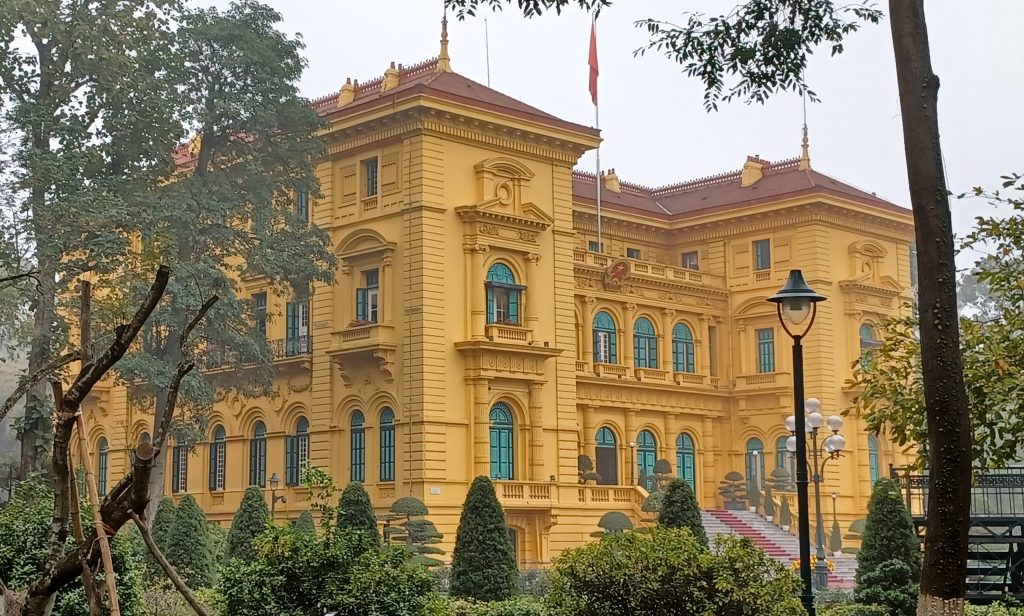
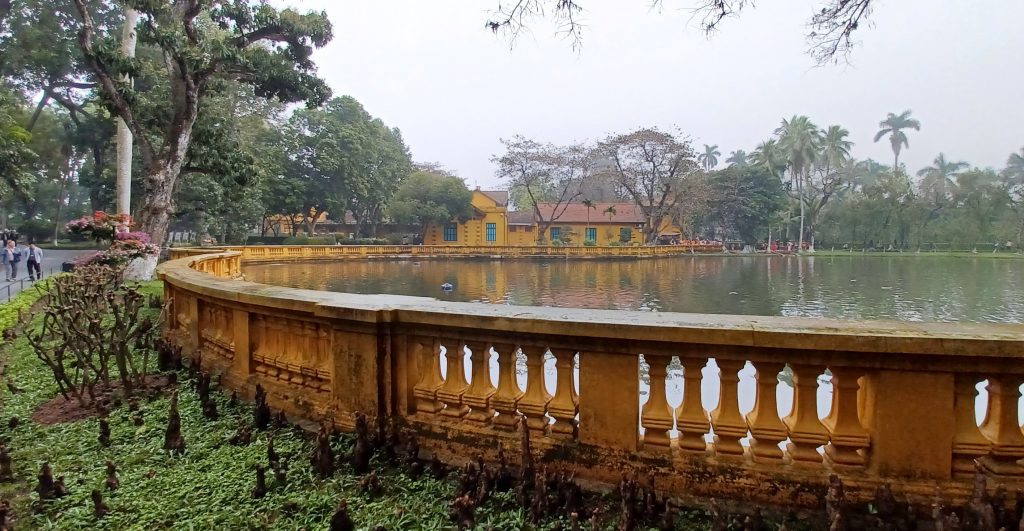
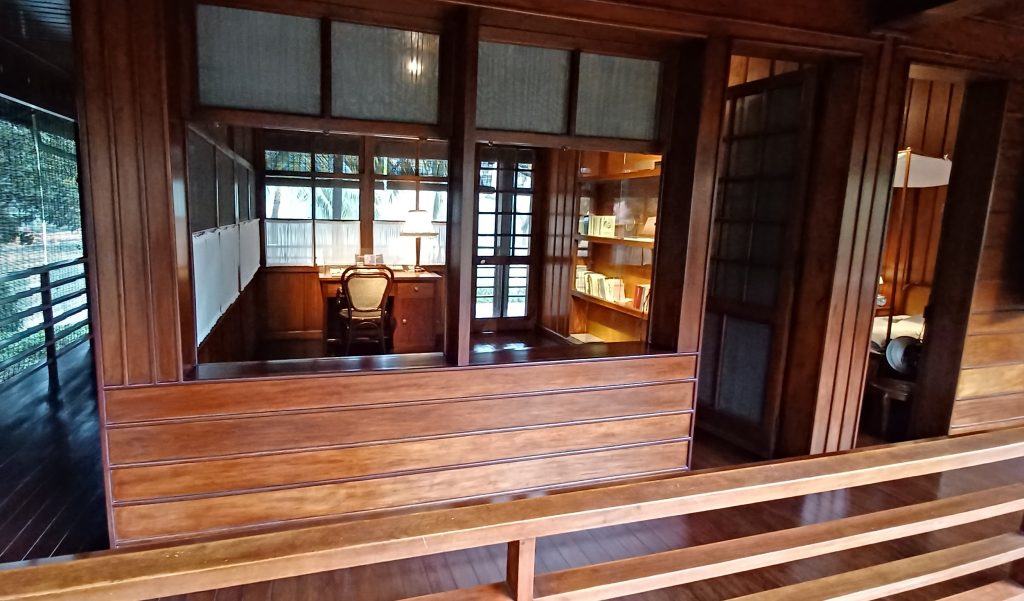
We peruse the palace from the outside, now the official home of the Vietnamese president, I understand. Are then led past House 54 and, what has since been known as, Uncle Ho’s fishpond in front of the house. Along the fishpond’s edges, bordering with Mango Road, are cypress tree stumps and ancient mango trees. Uncle Ho used to stroll to his stilt house along this road. We follow in his footsteps, arriving at the stilt house, underneath which a smart soldier in pure white uniform stands on guard with his rifle. Tourists are allowed in. We all clamber up one staircase, peep through the window into Uncle Ho’s office with its modest desk and chair and books in a glass case. Then peer into his bedroom next door before climbing down another staircase to exit.
A museum soon greets us. It contains all sorts of info about the beloved leader’s life ‒ from his revolutionary beginnings to his pivotal role as leader. Plus shop. The shop is advertised in much bigger letters than the museum, I notice. Lot of T shirts and baseball caps and umbrellas and tourist trinkets on offer.
One Pillar Pagoda
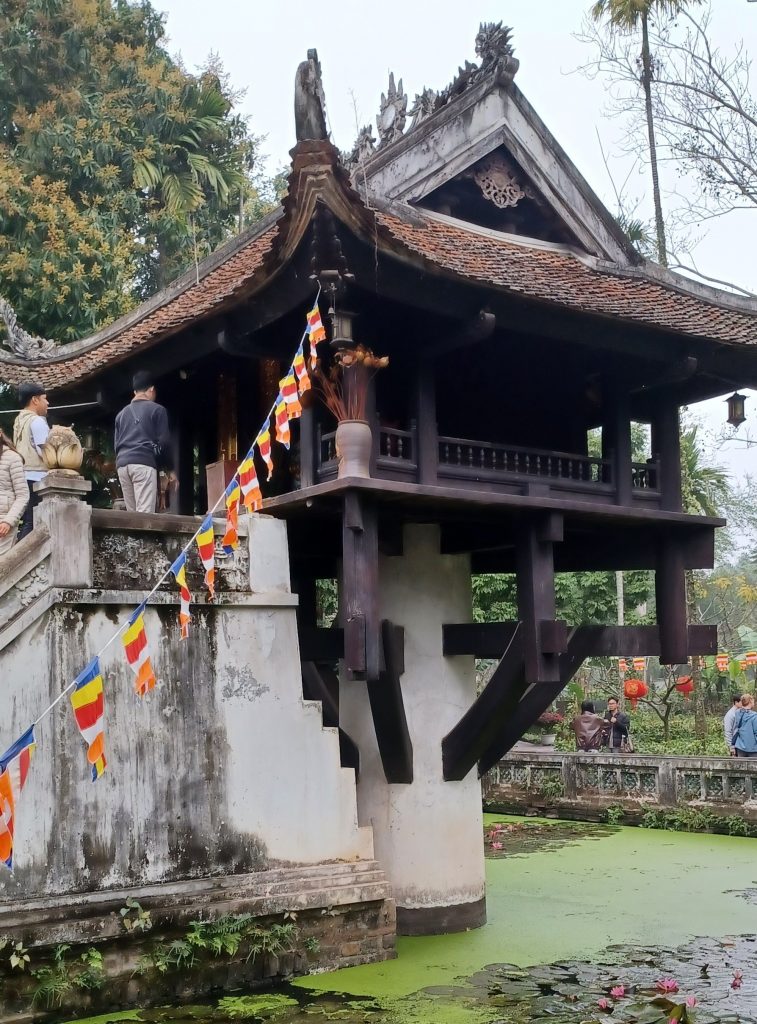
A short stroll from here, still within the Ho Chi Minh complex, is the One Pillar Pagoda, built in the shape of a lotus flower, in a pond. The lotus is a symbol of purity. The pagoda was built by Emperor Ly Thai Tong in the 11th century. A unique structure it is, balancing gracefully atop a single large cylindrical white stone pillar, otherwise known as the ‘lotus pedestal’. A Buddhist shrine is located within. Adorning the pond’s surface are pink lotus flowers. Bunting flutters in front of the stairway and is tied to a corner of the curving pagoda roof. Ascending the steps are people, waiting to worship the Buddha inside. The temple was restored in 1955 after being dynamited.
Leave the site now and the tour continues. We wend our way towards the old quarter and the centre of Hanoi where lies the Hoan Kiem lake. Longish way with plenty of busy roads to cross. The guide instructs us as to how we must cross Vietnamese roads with their crazy traffic: ‘Just keep walking and wave your hand’. Yikes. Ok. Motor bikes and rickshaws and cars and coaches and shoppers and hawkers and tourists all over the place.
Flag Tower of Thang Long Citadel
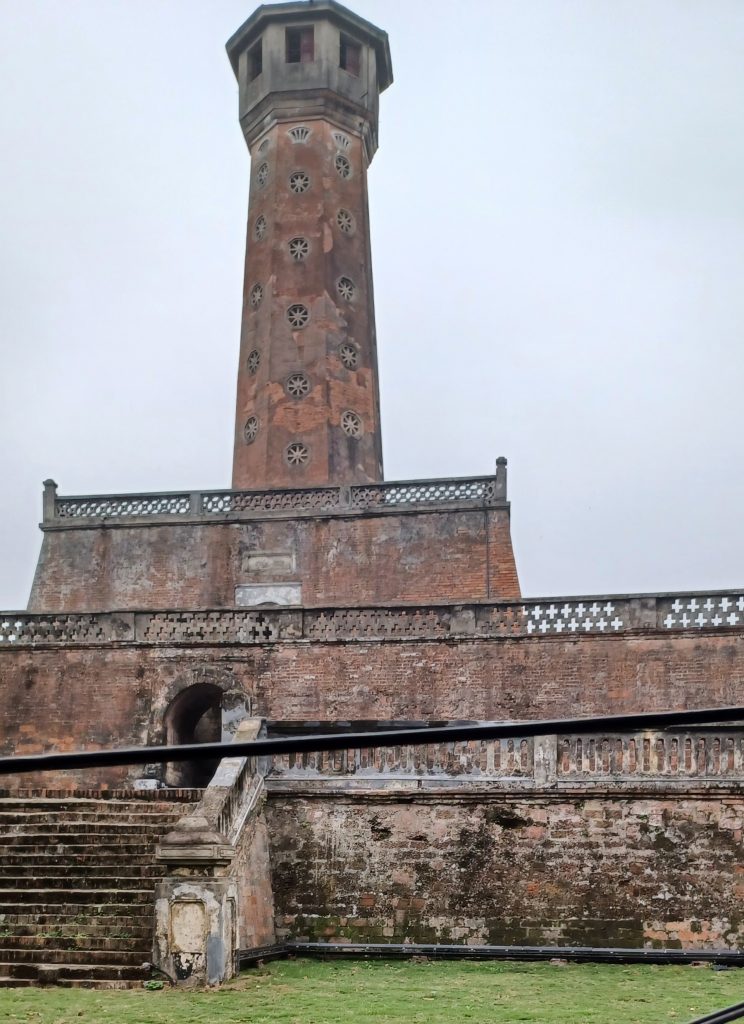
We pass by the Imperial Citadel of Thang Long, once the seat of the Vietnamese Court from the 7th to 19th century. It became the Ministry of Defence and HQ of the Army when the Vietnamese took back Hanoi from the French in 1954. There is not much left of the original citadel, as the French destroyed most of it. However they left the 33 metre tall Flag Tower intact, which had been spared, apparently, due to its suitability as a military post. I manage to photograph it through a gap in the wall surrounding it. The north gate also still stands. Shame not to have time to venture in. Lots of archaeological remains to peruse.
Old Quarter, Hanoi
We wander down through Hanoi’s old quarter with its maze of alleyways, shops each side, selling anything from street food to plastic bowls. Competing with a dense squash of tuk-tuks and scooters and pedestrians. And the tracks of the railway where the train passes between the rows of shops. Seen this on a TV documentary. Said train is not due to pass through right now. So people are treading on the tracks, one lady sporting traditional conical hat carrying a bamboo pole over her shoulder balanced on each side by large platters of fruit. Others cross over the tracks by rickshaw. I suppose the train will announce its presence so they will all scarper off the rails when the time comes.
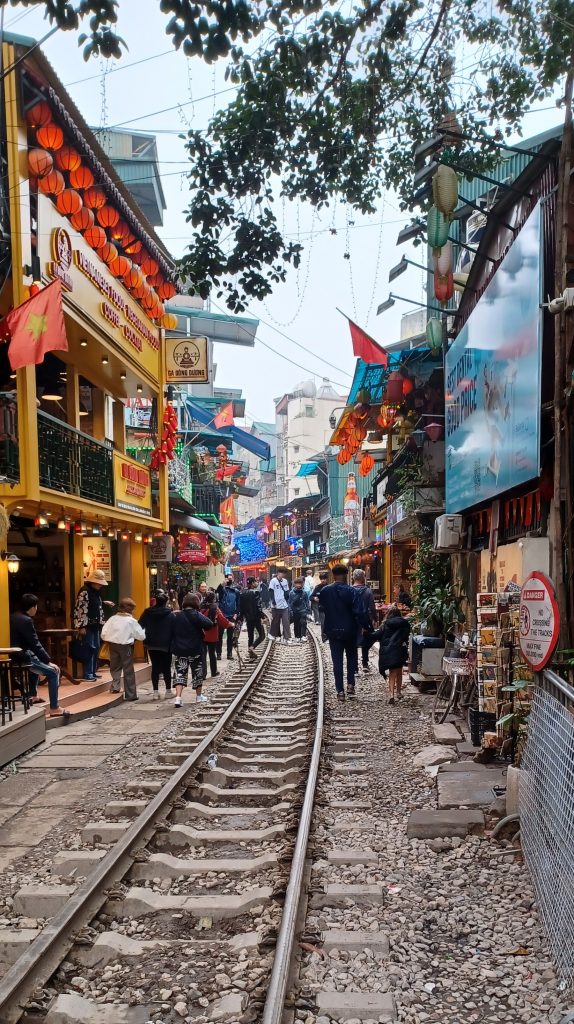
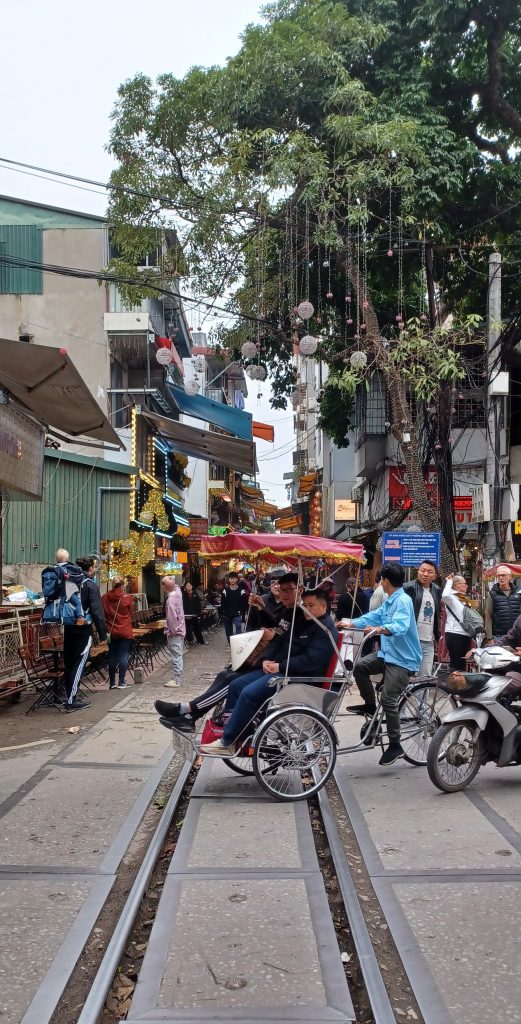
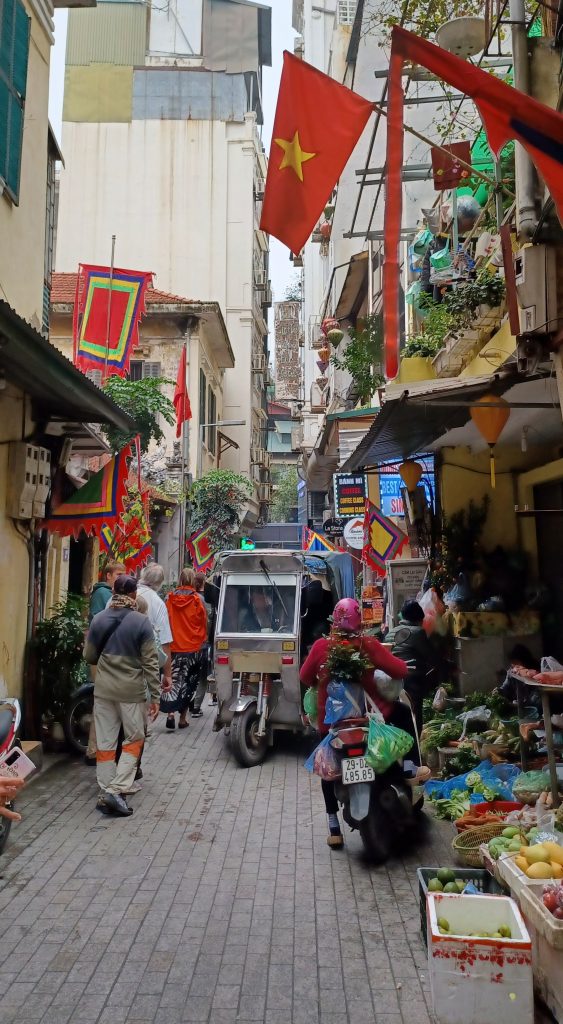
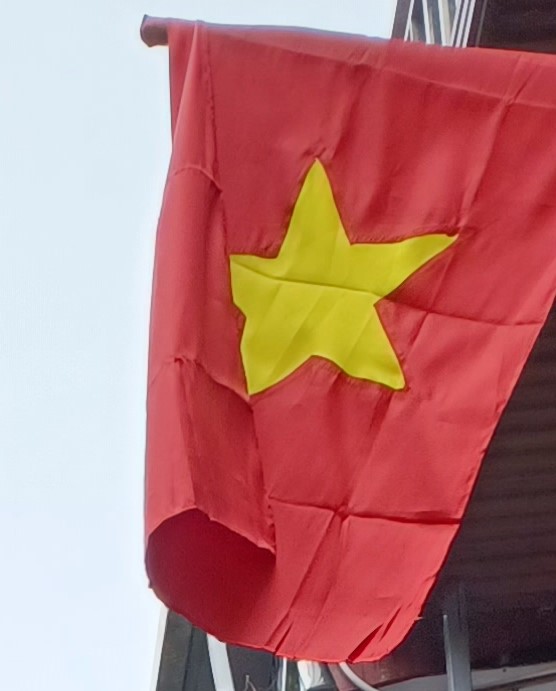
Multi-coloured banners and balloons and flags wave along the streets. The flag is highly symbolic. The red stands for the sacrifices made by the people throughout history, especially their revolutionary spirit during their struggle for independence. It also represents communism. The five pointed star represents the five classes of people: intellectuals, farmers, soldiers, workers and merchants. All contributing to Vietnam’s bright future (the yellow), apparently. Adopted in 1945.
Hoan Kiem Lake
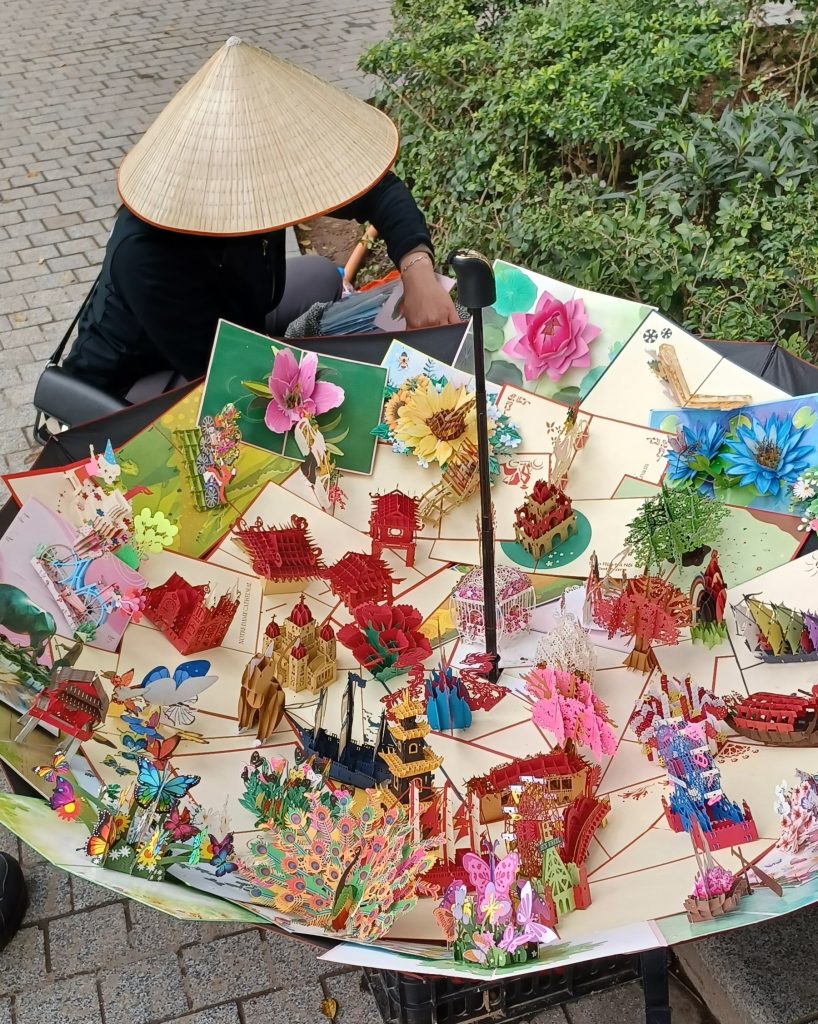
Aching feet now. Been plodding about for well over three hours. Arrive at Hoan Kiem Lake, a fresh water lake in the centre of the old quarter. A lady squats here wearing one of those traditional hats. These are made from various leaves, such as coconut or banana, attached to bamboo frames, and have become a bit of a cultural icon. Mostly worn by women. This lady has paper decorations to sell, displayed on the underside of a spacious parasol. Flowers of many colours, buildings, butterflies and boats. Clever.
Cau The Huc Bridge
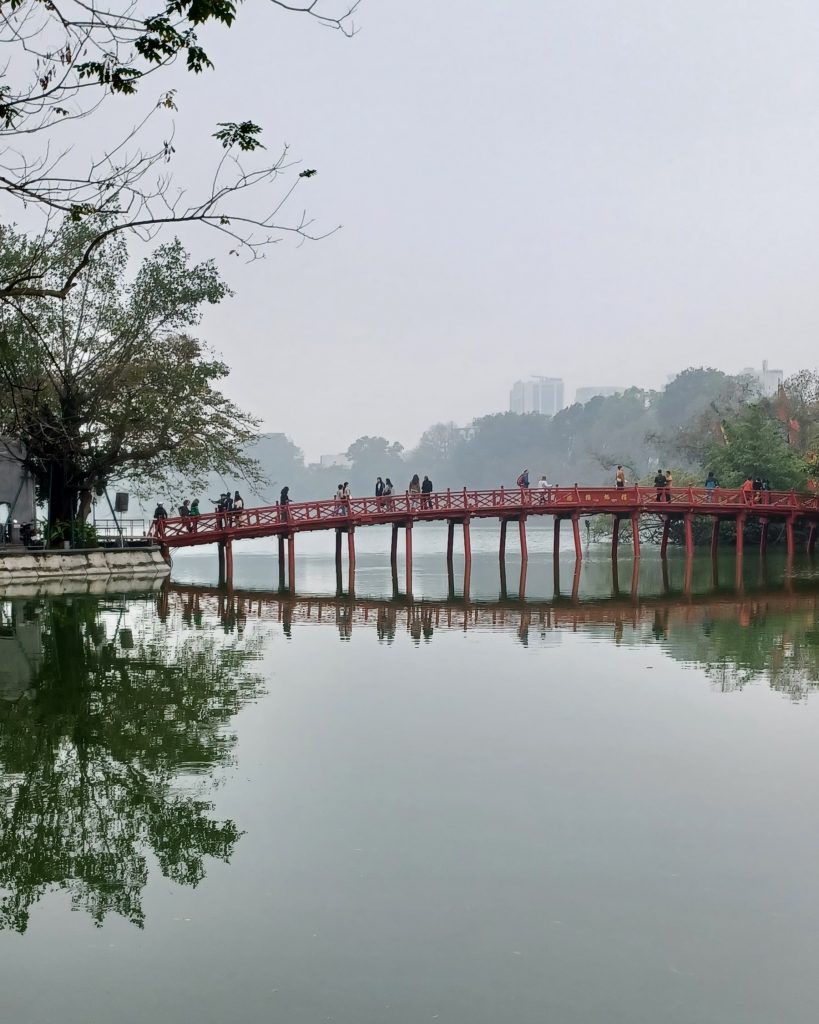
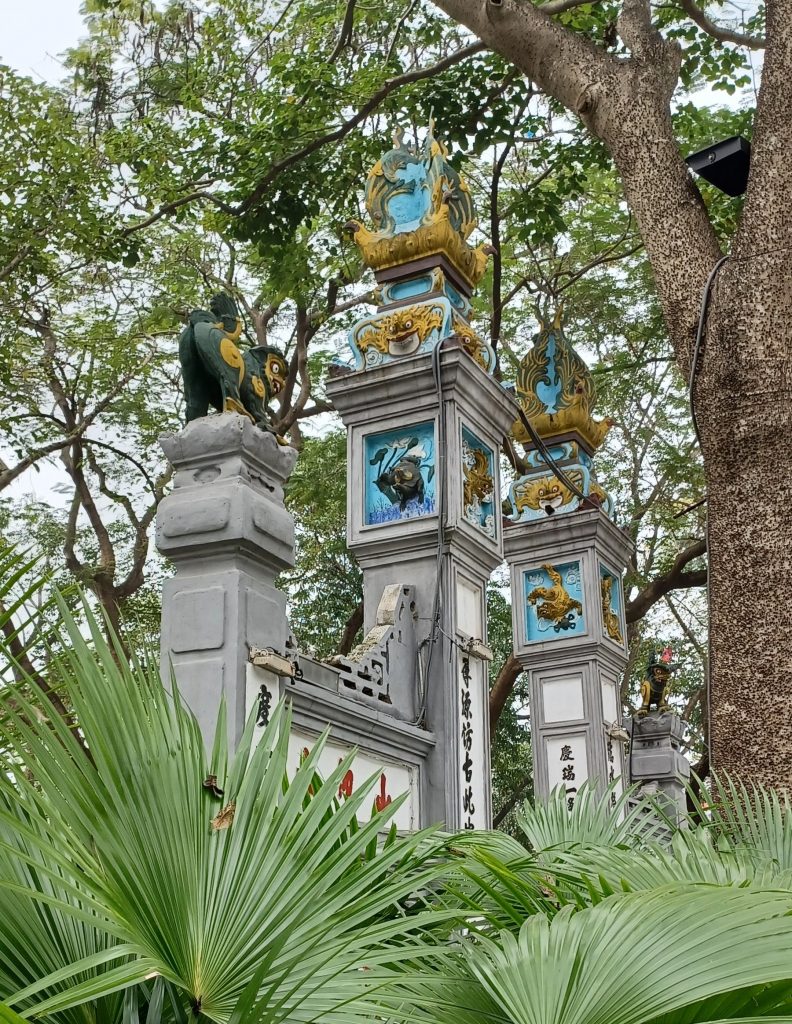
The tour group splits now. Some hie for lunch. Too early for me. I wander slowly to the Cau The Huc or Bridge of the Rising Sun, an elegant red arched bridge on the lake, which hovers dreamily in the mist. Reflected with perfect symmetry in the waters. The lake is serene and smooth and still. Somewhat soothing after the hectic buzz of the old quarter alleyways. I spot a heron of some sort in a tree and observe it a while. Visitors are wandering over the red wooden bridge to the 18th century Ngoc Son Temple, or Temple of the Jade Mountain, built on Jade Island in the lake. I make my way to its gateway, an elaborate structure with gold painted dragons on the pillars.
Martyrs’ Monument
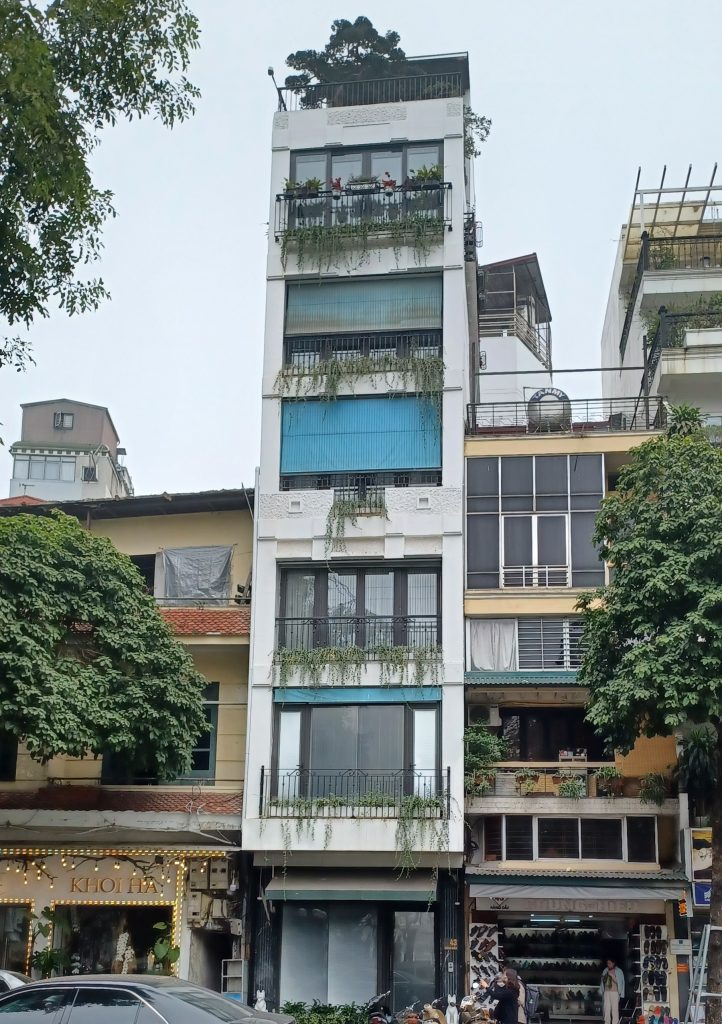
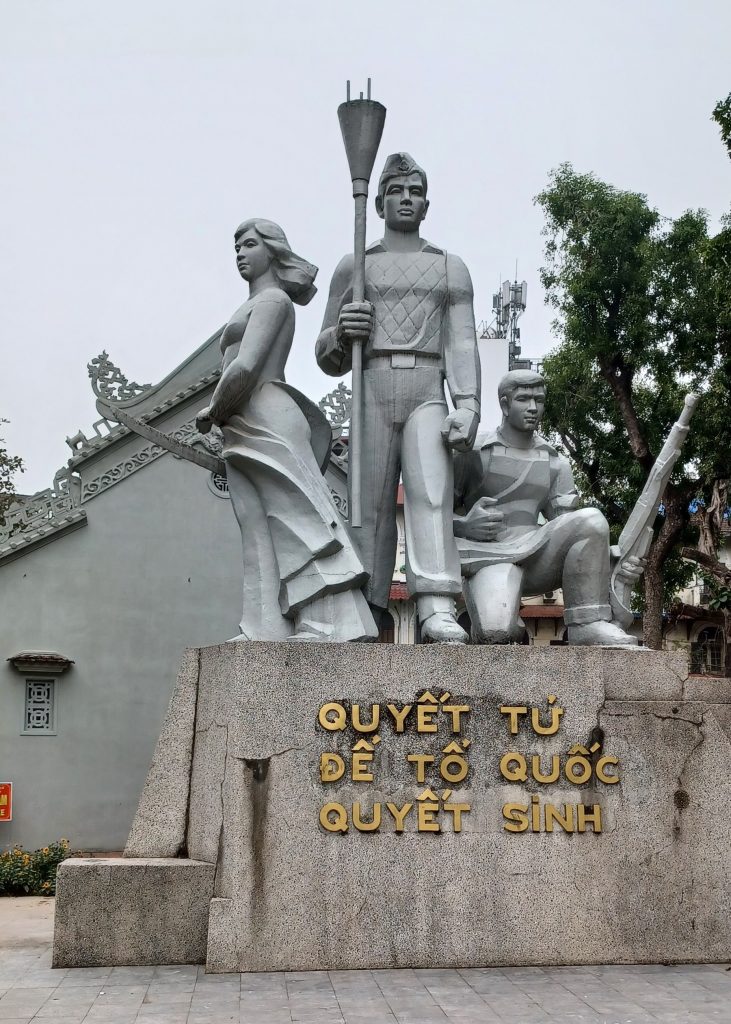
Thence, I wander close by to see the Martyrs Monument dedicated to all the Vietnamese people who lost their lives fighting for independence. Sculpted from white marble and depicting two men with a torch and a rifle respectively and a woman with a sword. Meaningful spot. Quietish. Rustling trees. Lot of interesting old buildings around and about, tall and narrow with plants and bill boards on balconies. Venturing further, I see one which appears to be a hotel. It has an enticing eatery on its 7th floor. In need of sustenance so ascend in the lift to the restaurant. I order spring rolls accompanied by honey and ginger tea to wash them down with. Hmm this is alright. Pleasant view from my table by the window, homely atmosphere, chatty waitress. Linger.
Opera House
Afterwards, I wander some way further into what must be the old French quarter and come across the opera house, built by the French in the early 1900s. Splendid pile with columns and domes, with traffic crawling around in front of it. Trang Trien Street, or Rue Paul Bert, as it was known in the French colonial period, leads straight from the opera house’s façade to the south side of Hoan Kiem Lake. Make my way along it.
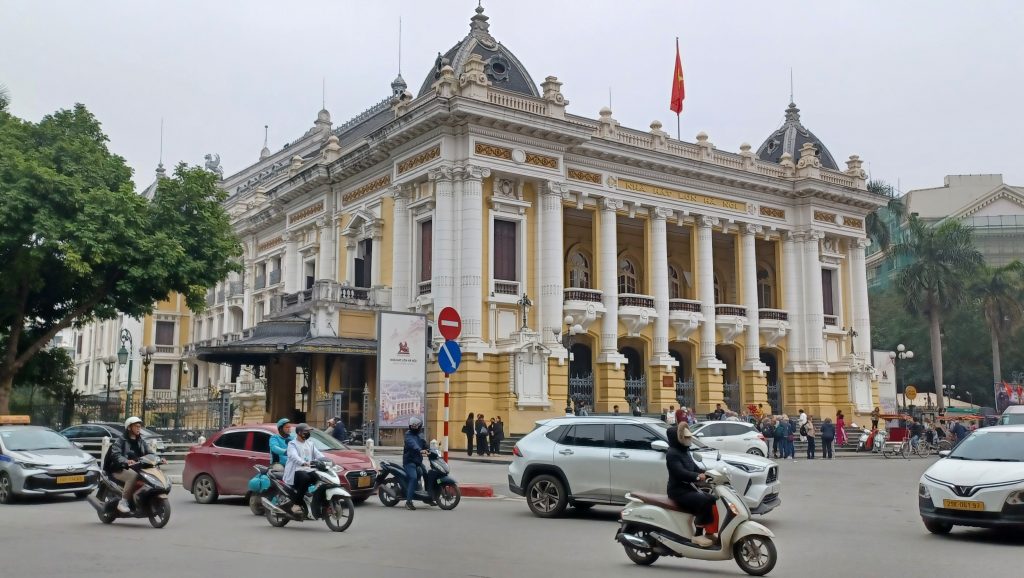
This was the first 18 metre wide paved street, according to a notice. Reminiscent of French boulevards. The area was the heart of intellectual and cultural life. Probably still is. Here various embassies are located. High status place.
An expensive street too with top range hotels and department stores emanating luxury. My hotel is not located here. Anyway, this artery soon takes me back to the Lake. It is an appealing lake and just the right sort of size to ramble round in the hazy sunshine.
Turtle Tower
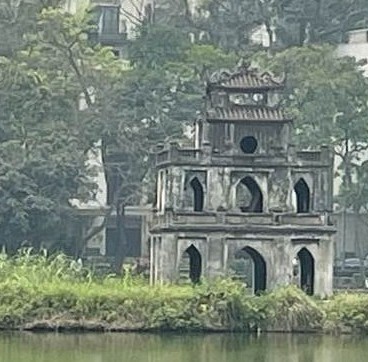
Some people are practising Tai Chi, their graceful slow movements suitable to the serenity. A few artists are painting their impressions and a couple of stalls are selling drinks. I observe a greyish tower on another small island within the lake here. Wonder what this signifies. I sit quietly in contemplation on a lakeside bench beneath the trees to observe it. A couple of students hail me, disturbing my reverie. Would I take part in their survey?
OK. Lot of questions. Delighted, they are, to find that I was once a teacher of EAP (English for Academic Purposes) at various universities. They are keen to practise their English on me. Converse awhile. I ask them about the grey tower. Ah, it is named the Turtle Tower, I am informed, because in Vietnamese myth, the then 15th century emperor, Le Loi, had been given a magic sword by a turtle in the lake. With this sword he achieved victory in his battles against the Chinese Ming dynasty. Upon being approached by the turtle once again, he returned the sword to it. Said turtle disappeared with it into the depths, which is why the lake is also known as The Lake of the Restored Sword. Turtle Tower was built of stone in 1886 with a mix of French arches and Vietnamese rooves. A cultural symbol. The students wander off. Pleasant and enlightening encounter.
Anyway, I make my way along the west side of the lake now, to rendezvous with the tour group near the lovely red bridge. We are attending the early evening water puppet show being held in the Thang Long Theatre across the road from the lake. We enter in and take our seats high up looking down upon a model of an ancient temple with water frontage.
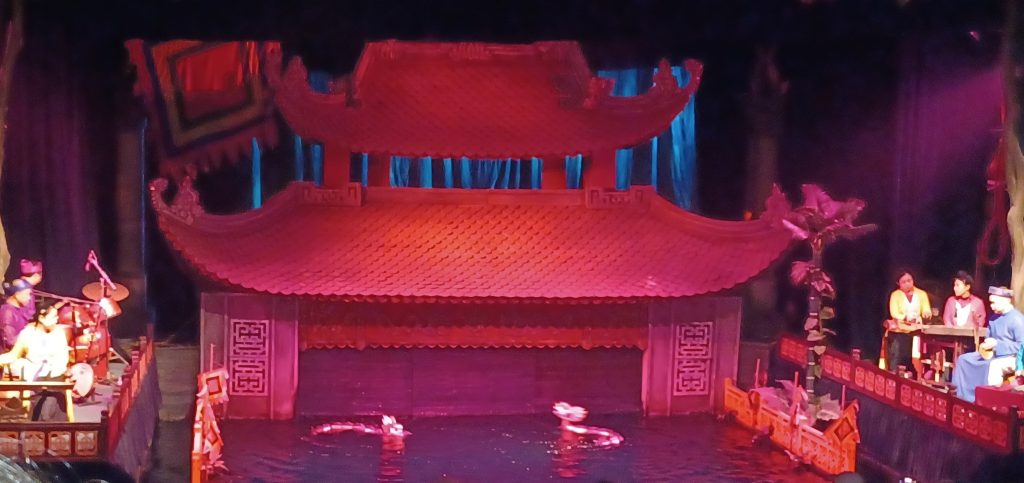
This should be fun. It is. Much music and singing by traditionally dressed musicians with flutes, bells and cymbals to accompany swimming dragons, fish, snakes, ducks and people. The stage is bathed in purple light. Much applause.
Hire a rickshaw, or cyclo, back to the hotel, which is a longish way from the lake. Like a large tricycle, pedalled by an elderly gent, with a comfy seat on the front. Eyefuls of sights and earfuls of sounds on the way back. Beats walking. Decline to join the group for a meal this evening. Just as well as it turns out. The general consensus was that the victuals, comprising luke warm soggy noodles, were ‘awful’.
And that is it for Hanoi, a brief flavour. Much more to see in this vibrant bustling capital.
Halong Bay
Fruit and Danish pastries and baguettes for breakfast. Hooray. Bit of French influence. Starts the day well. I take my leave of the tour group. Goodbyes all round. Time to undertake a bit of independent travel, so I am off today to Halong Bay. For a boat trip. Have to head to some obscure pickup point somewhere, which I somehow manage to find, and join a coachload of adventurers.
Once out of Hanoi, there is a good highway to the bay, which is in the Gulf of Tonkin. Takes well over two hours to get here. But we duly arrive at the dock, which is full of quayside hawkers selling, among other things, waterproof mobile phone pouches on lanyards, which should protect one’s device from any spray. Buy a yellow one. Put round neck. Then board our vessel for the cruise.
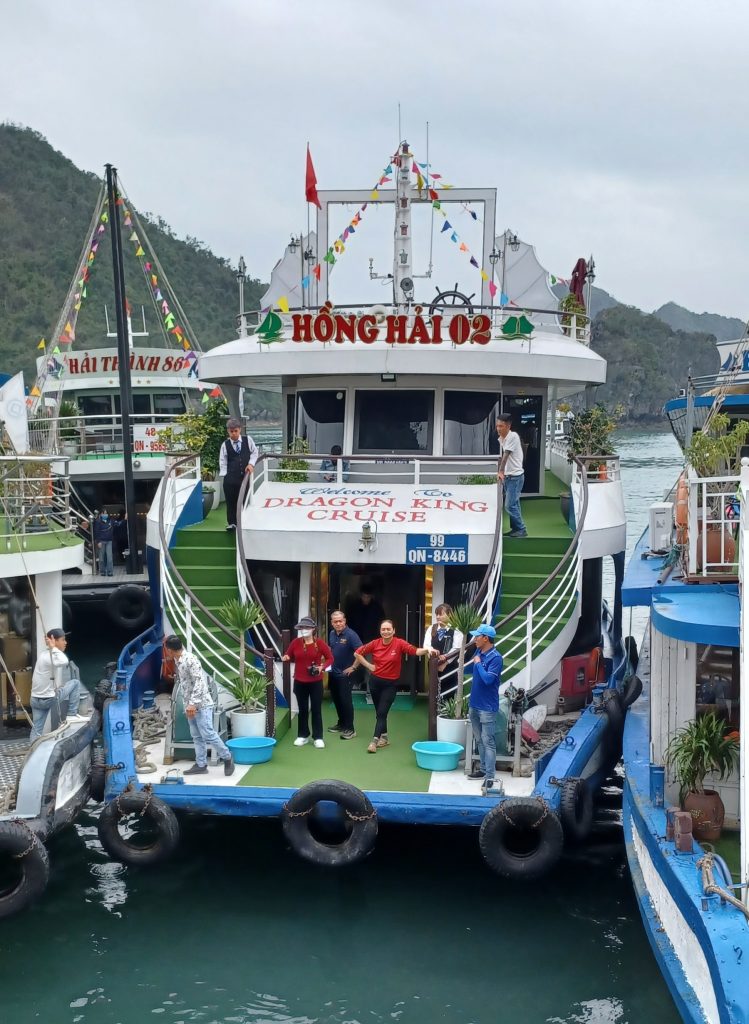
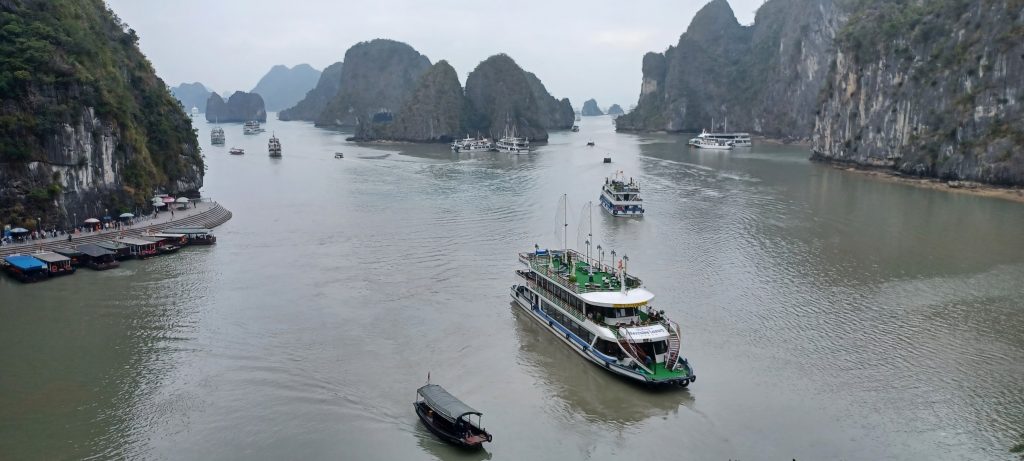
Halong Bay, or ‘Bay of the Descending Dragon’, has been made famous by Top Gear and other intrepid travellers of various sorts doing various idiotic things on it and around its rocky outcrops. Which is why, I suppose, that the multitudes head here. It is a UNESCO World Heritage site. The gulf is full of boats all much the same with two or three decks with seating and a restaurant area for the included lunch. Bunting and flags and brightly painted signs are everywhere, even a few plants, along with enthusiastic crew members and enthusiastic tourists determined to enjoy themselves. We do.
Oyster Farm, Halong Bay
We are not long aboard before arriving at our first stop, an oyster farm. Because of the calm conditions within the bay, it is ideal for cultivating oysters for pearls here. Oh. That is a plus. Have not seen an oyster farm before. Many of the oyster farm employees live in floating villages round about, I gather. We disembark to file into the large modern sheds, where much information on the farming of oysters is assembled. I read that ‘cultured pearls are created by stimulating the secretion of mollusks by implanting a small nucleus into the body of an oyster’. The oyster then covers this with layers of proteins and natural minerals, which forms the pearl.
I watch as masked ladies at separate tables split oysters in order to insert a ‘nucleus’. With the tools of their trade on the table: pincers and cutters and pluckers and scissors, they appear absorbed in their work. And oysters wait idly by in tanks of water.
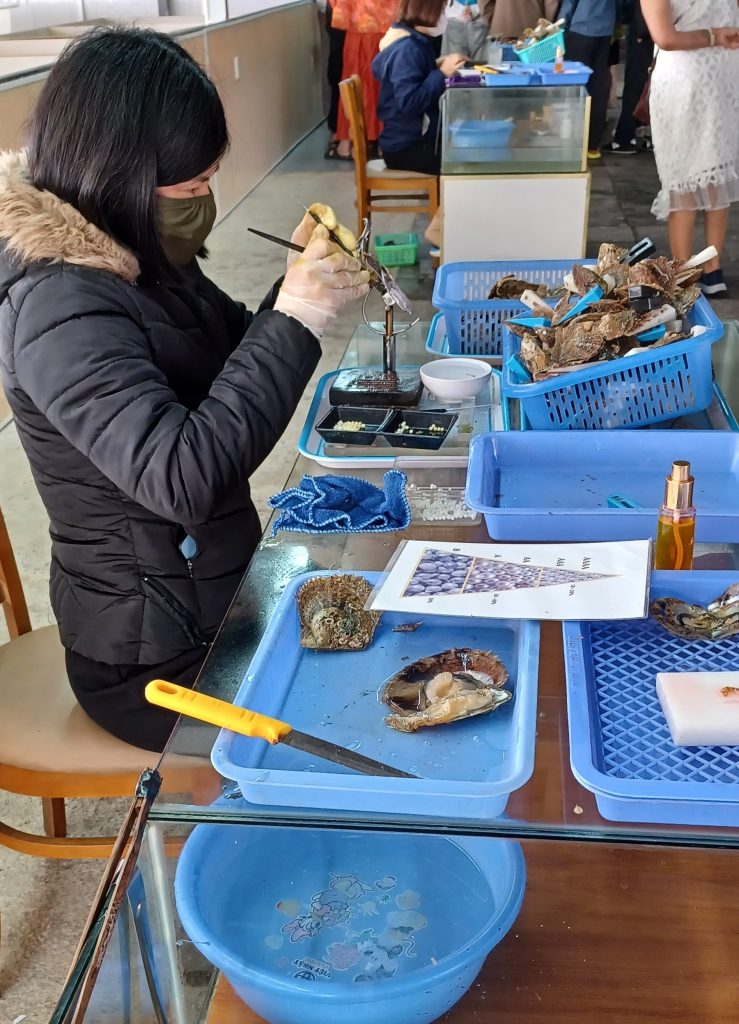
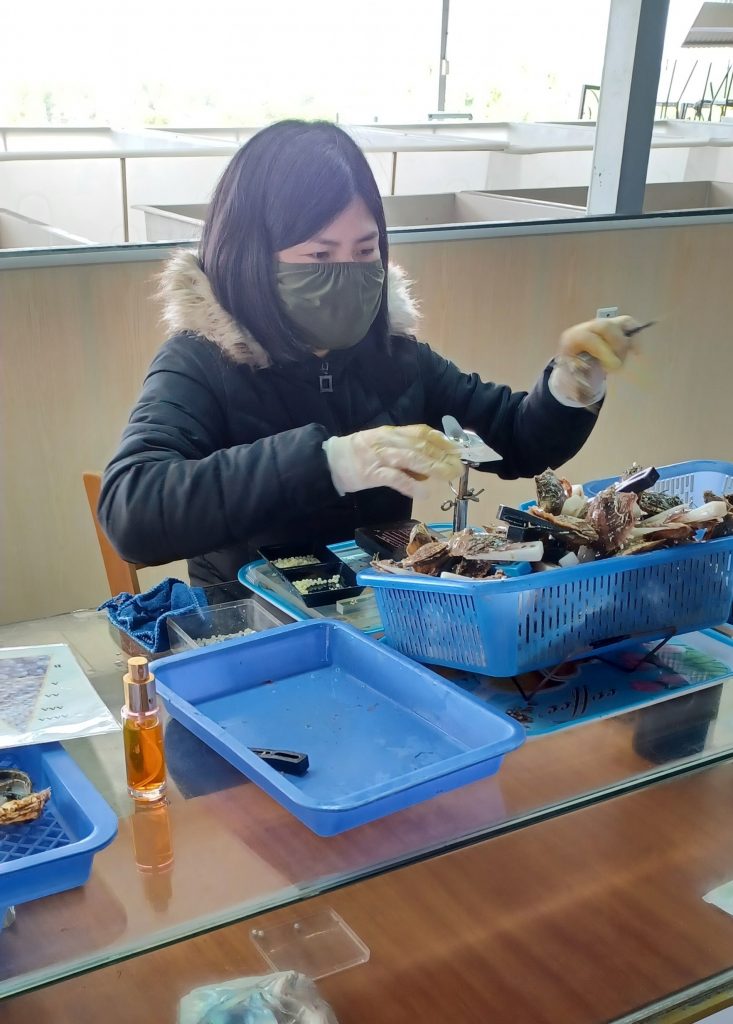
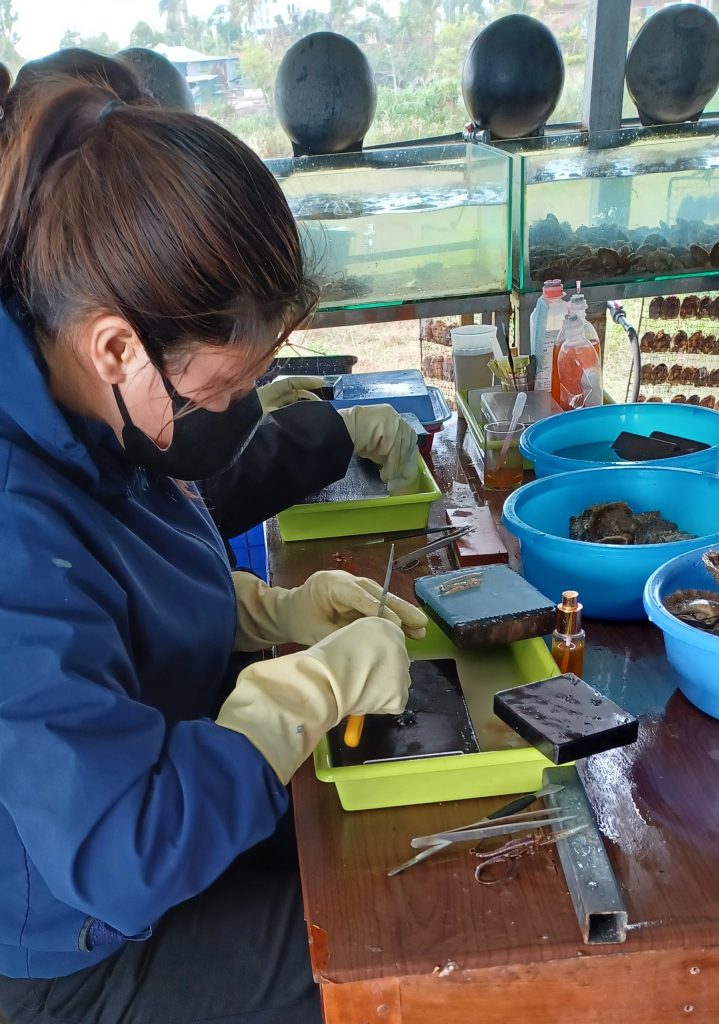
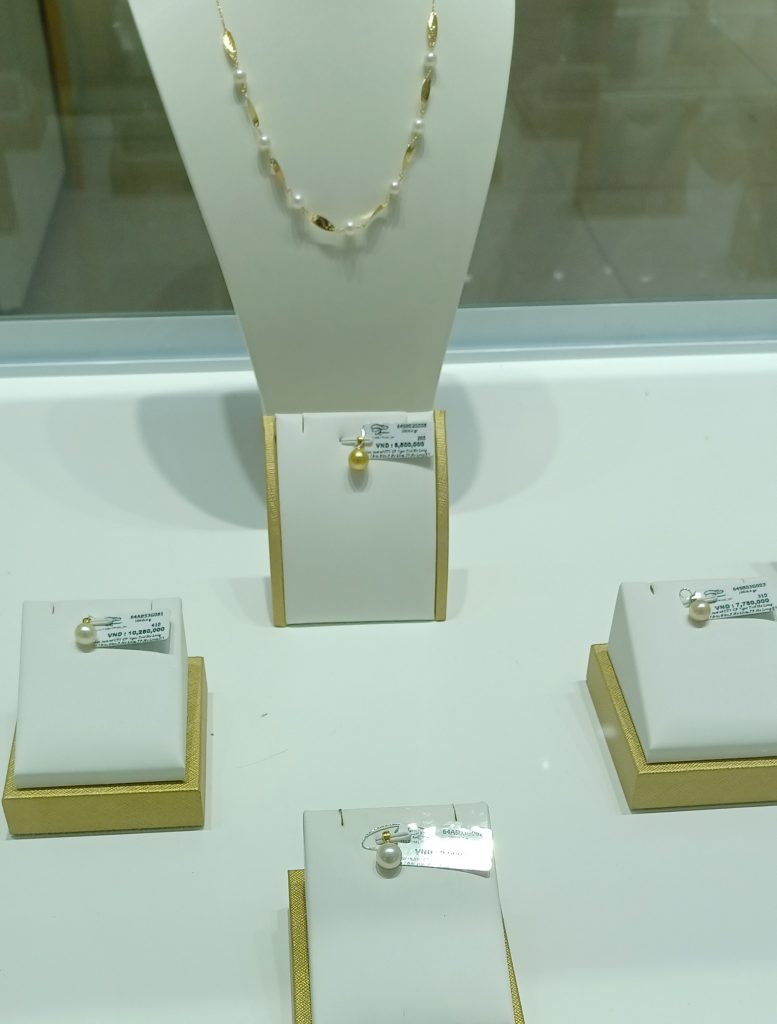
There is much info to read here about categories of pearls, AAAA being the finest with extremely high lustre and virtually flawless. Some for sale, beautifully displayed around artificial necks in glass cabinets. I don’t succumb. The world’s first cultured pearls, apparently, were produced in 1893 by Kokichi Mikimoto, a Japanese pearl farmer, who inserted mother-of-pearl beads into the oysters to act as the stimuli. The Vietnamese then introduced these pearl cultivation techniques here. ‘Pearls are the only precious jewels produced by a living organism,’ I read. Those oysters that do not produce pearls make good eating. Fascinating stuff.
Anyway, we head back to the boat now to continue our boat trip.
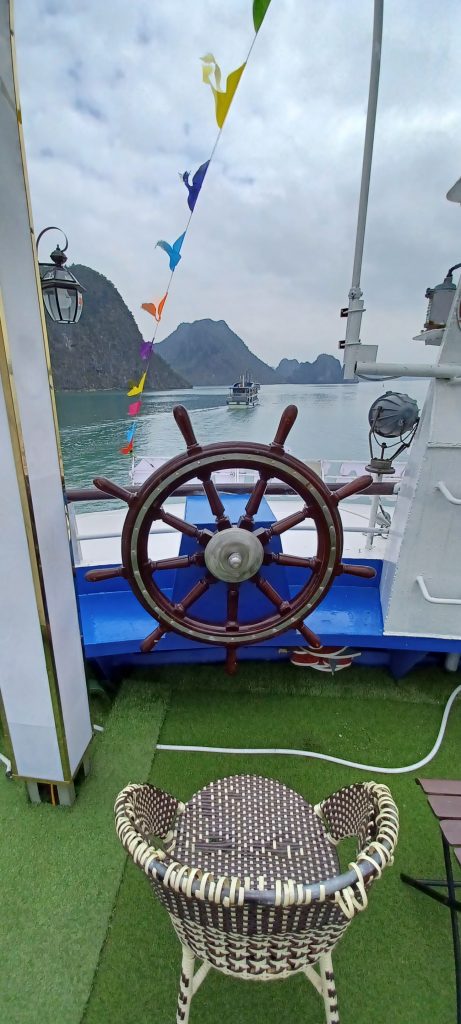
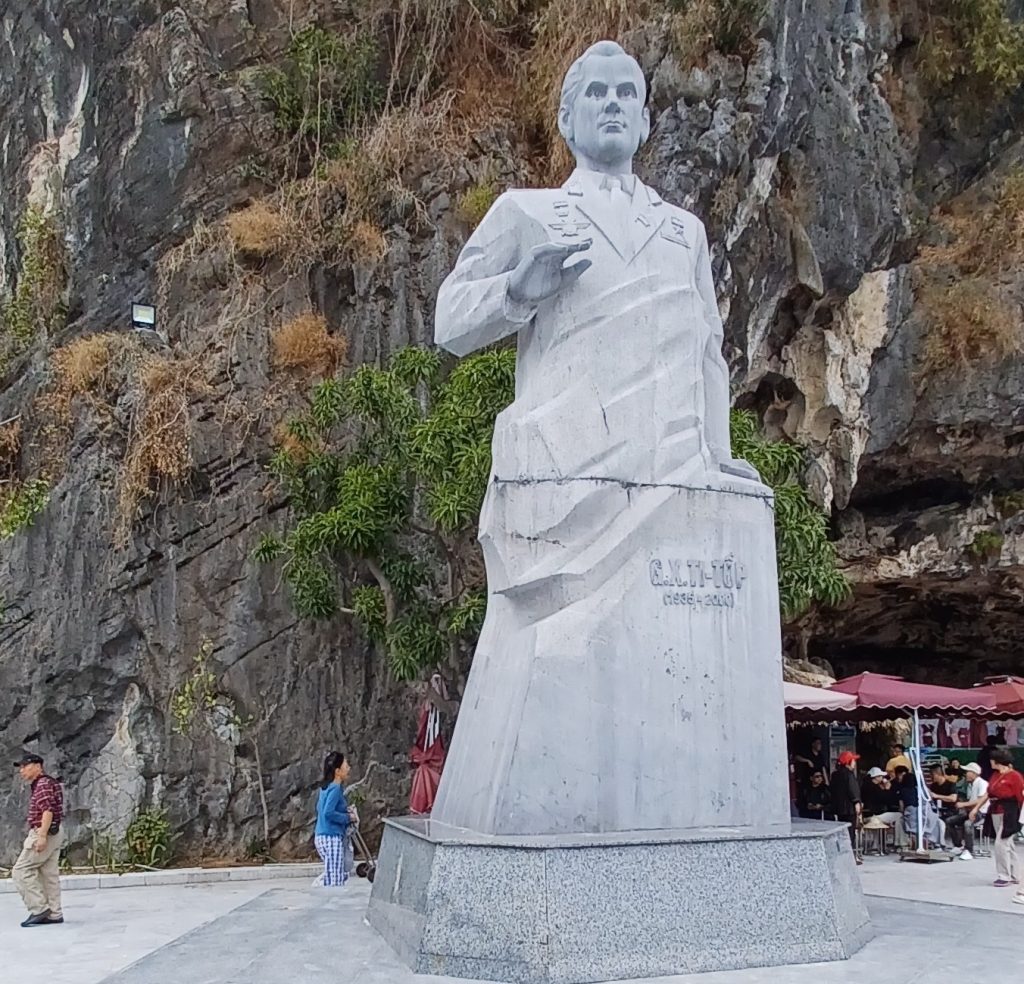
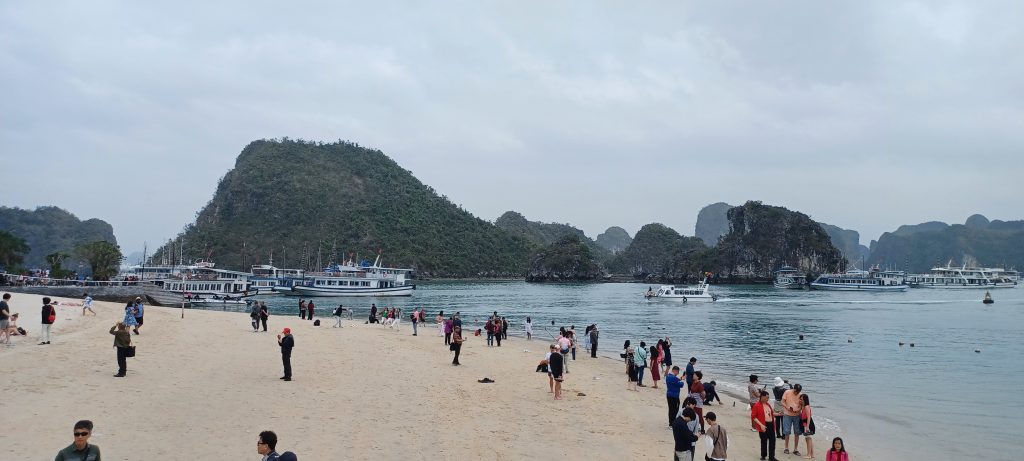
Our highly enthusiastic guide rallies us round to entertain us with some history and info about the natural wonders of the area. Little chap, endowed with a very very loud, very very piercing voice of a high pitched quality some decibels above my tolerance level. After being regaled for some while, I make haste for the top deck, and grab a seat on the bow in front of the wheel (for show I think). There to enjoy a splendid meander around the limestone karst outcrops of the bay. Hundreds of them. Some of these outcrops are bare and sheer sided, other more gentle with tree covering. Chug chug. Many many other boats with their loads of visitors. Mistyish sort of day, which is perfect as not too hot. The boat then prepares to moor up on a pontoon off the beach of Titop island. Named after a Russian cosmonaut, Gherman Stepanovich Titov, who visited here with Uncle Ho in 1962. Much manoeuvring back and forth to squeeze into a gap between boats.
Titop Island, Halong Bay
Every boat stops at Titop Island, it seems, and every passenger disembarks for a visit. There is a large statue of Titov amongst the stalls in front of a giant karst hill. Free time now to bask on the beach and generally loaf about before boarding once again.
Surprising Cave, Halong Bay
Next up is a visit to a three chambered cave with stalactites and stalagmites. This was named by the French as ‘Grotte des Surprises’, the ‘Surprising Cave,’ in 1901. Bit of a clamber it is following our leader up steepish steps to the entrance. Worth the effort. It is all very cool in both senses. Long winding stairs inside with lights illuminating all sorts of stalagmites and tites, pointed out with alacrity by our guide, one here with a horse shape, another there shaped like an elephant. OK. Marvellous panorama from the top of the steps over the bay as we descend. Magical spot.
Bamboo boat, Halong Bay
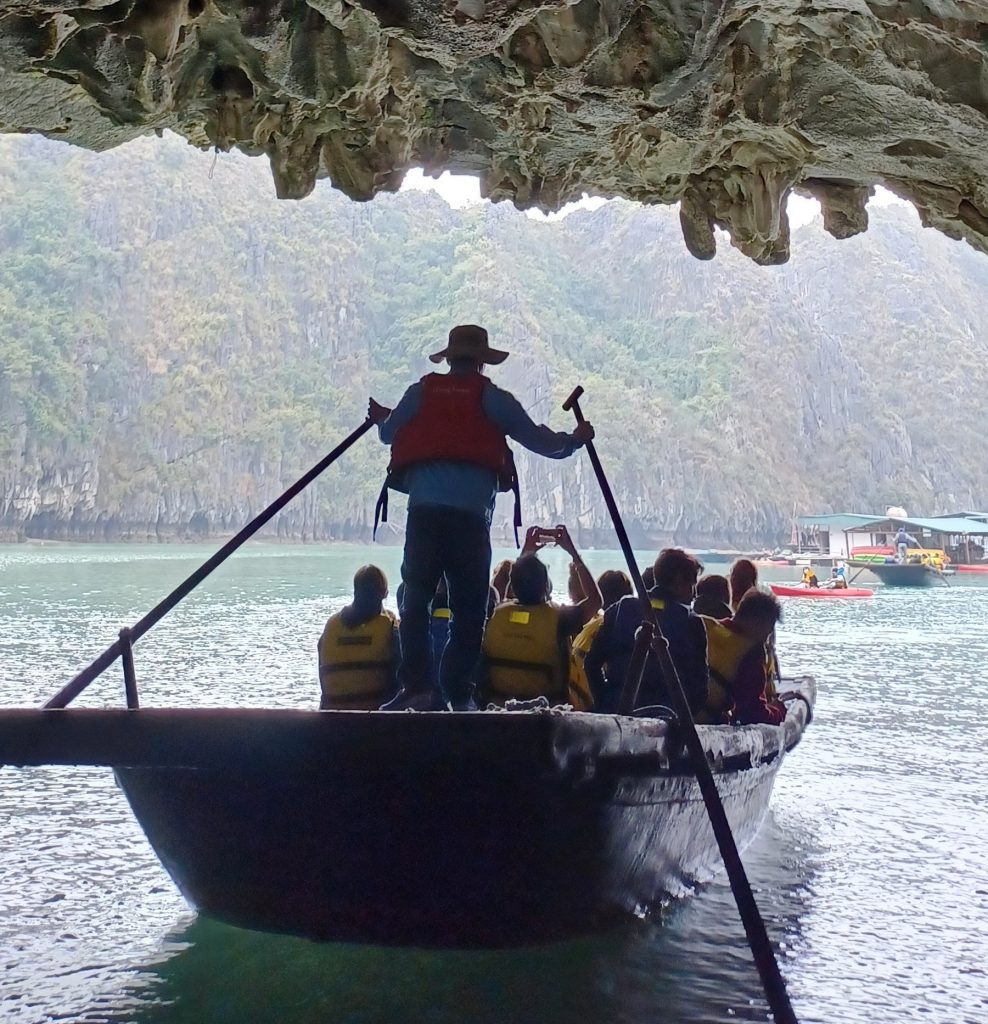
Thence, we motor to busy pontoons from which we disembark the bigger boat to board smallish ‘bamboo’ boats for a paddle under a rock archway into a small enclosed bay. Some of the group choose to view the scenery by self propelled kayak, others by speed boat, but I prefer to be sedately rowed by a skilled oarsman standing on the stern rowing forwards. All rather idyllic. Even with all the others. No need for the mobile phone waterproof pouch though. No spray emanating from the oars of this sturdy boat.
It has been an awesome day. Back to the coach now and the busy capital. More adventures to come.
Leave a Reply