
We are swapping Tbilisi and its traffic clogged roads for green and mountainous pastures now. In the suburbs of the capital, the Bank of Georgia appears. It looks like a pile of white lego blocks poking out from a central pillar and facing in different directions. Built in 1975, a fine example of Soviet architecture, apparently. Not my dream building, I have to say. All a matter of taste. Heading west.
Jvari Church
One soon realises that churches are all over prominent places in Georgia, and our first stop today is Jvari church of the Holy Cross, once a great centre of pilgrimage for Caucasus Christians. The church was built on the site where St Nino and her husband, King Mirian, the first Christian Georgian King, erected a wooden cross on the hill in the 4th century. We wander upwards from the carpark, through which a skewbald horse trots his merry way, along the paved path, passing dopey dogs to the top.
The church itself was built of sandstone by a prince of Iberia (West Georgia) in the 6th/7th centuries. The décor consists of several reliefs over the doors and window, one of which, the tympanum of the south façade, portrays the Ascension of the Cross. The church is a UNESCO World Heritage Site.
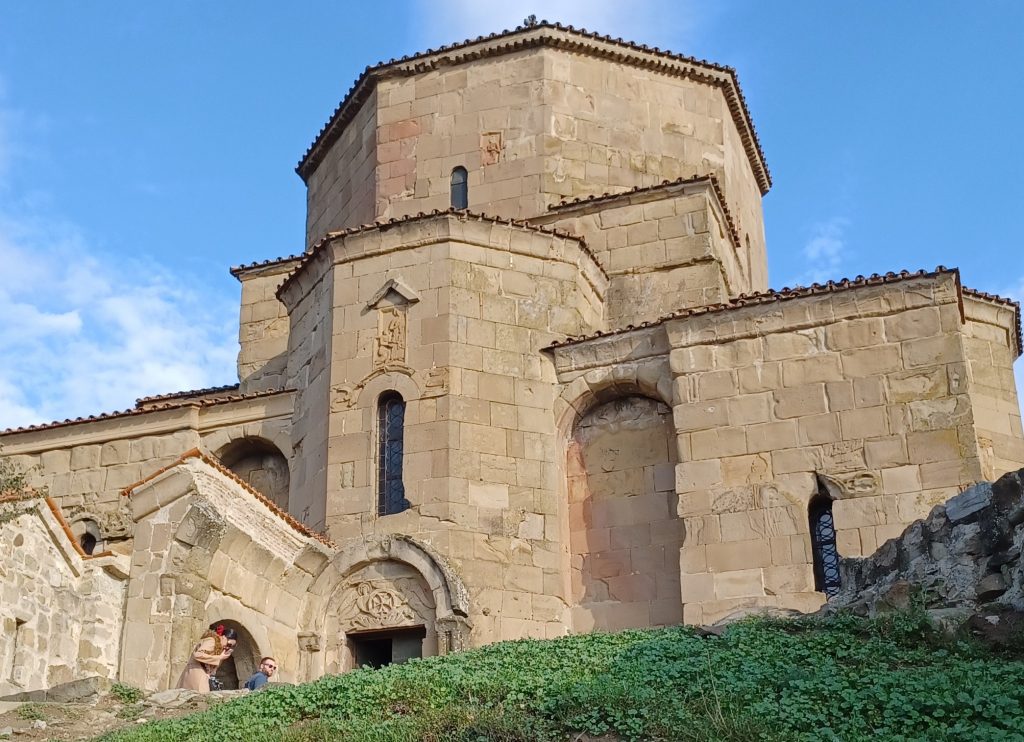
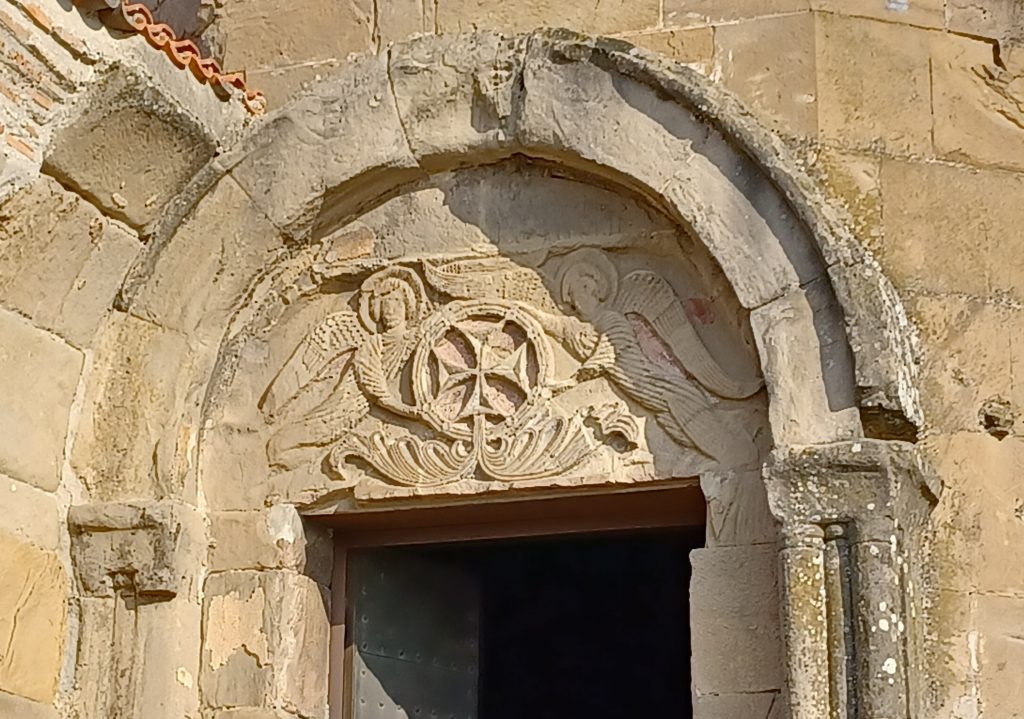
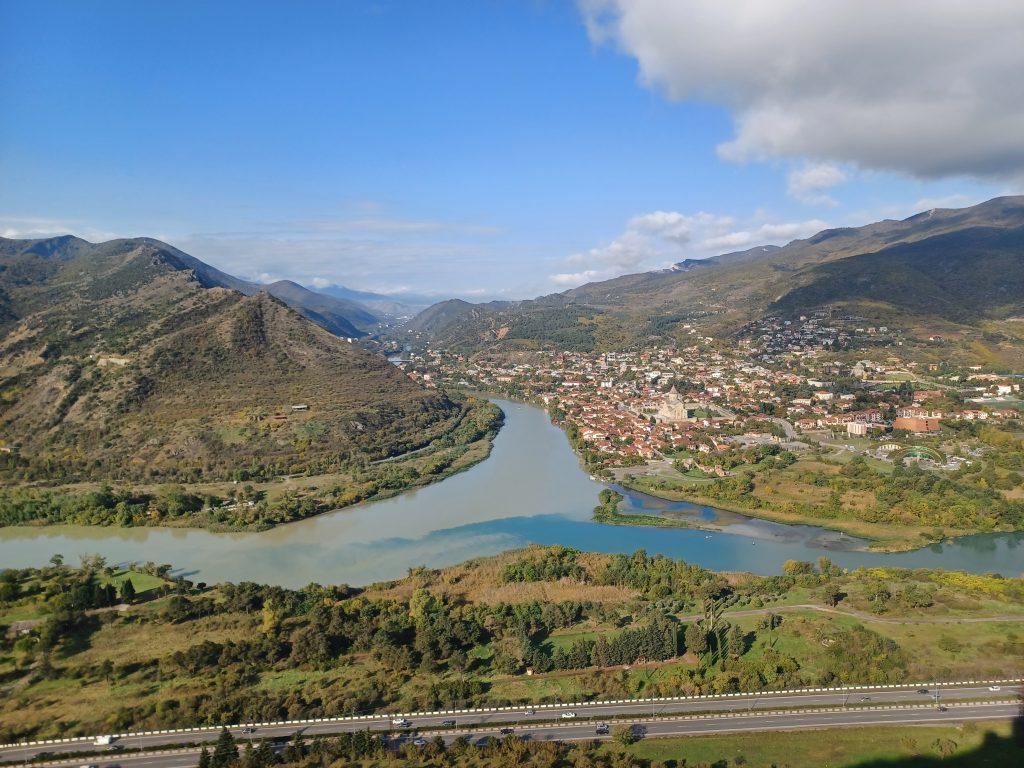
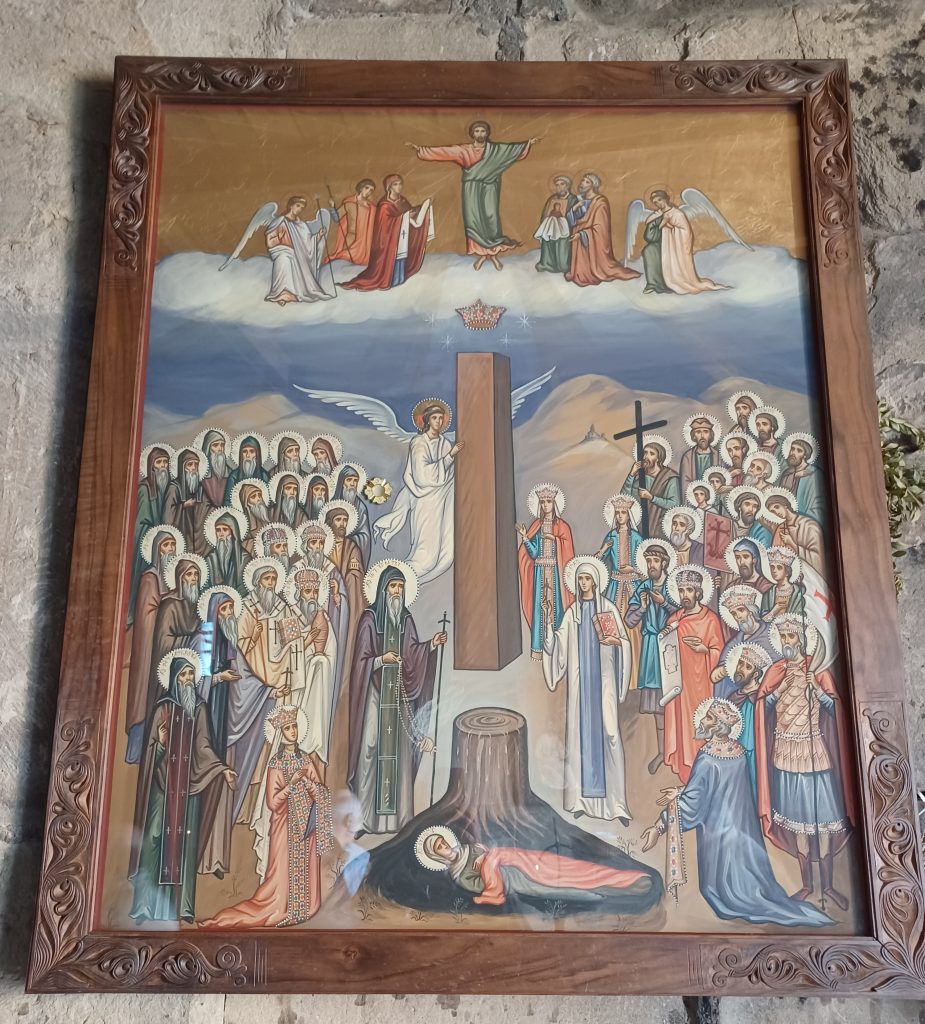
The church overlooks the confluence of two rivers, the Aragvi and Mtkvari, on a stunning site, looking down upon the Svetitskhoveli Cathedral of the Twelve Apostles in the valley below. Three bells hang strangely outside on a metal bar, along with the remains of a defensive wall, while inside the church are frescos and paintings, one depicting the legend of the ‘living pillar’ (see below under ‘Svetitskhoveli Cathedral’).
Uplistsikhe
Descend from Jvari Church to our coach and continue westwards through Gori, the town of Stalin’s birth, to the next remarkable site: Uplistsikhe, a cave town carved from the sandstone rock, and built in the first millennium. Scattered over the hill are relics of the daily lives of the inhabitants: a onetime wine cellar; a wine press where they used their feet to press the grapes; an apothecary where herbs were kept, and pits all over the place for fires and gullies for draughts. Dogs. Another structure, the largest cave on the site, was once a hall to Queen Tamar, King David (IV) the Builder’s granddaughter, who reigned during Georgia’s Golden Age between 1184 and 1213. She was the first female ruler of Georgia. There is a stone seat within the hall. And a three naved basilica – really just a central nave with two aisles built in the 10th century, probably over a previous pagan temple to the sun goddess.
A church, a more recent basilica, stands at the highest point with its frescos and paintings within. The ceiling is in need of restoration and there is a large area in the middle with a cross and iconostasis with a door on one side. Outside the church is a wine vessel or qvevri, a smaller version of the ones we saw being made by the master in the Kakheti region.
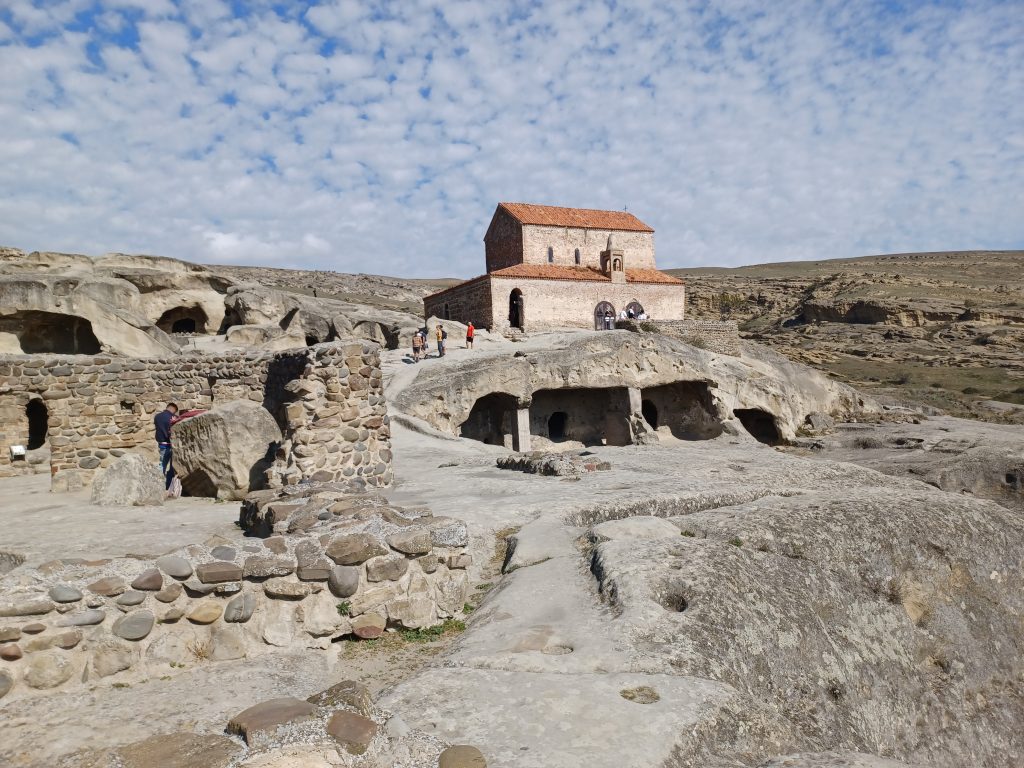
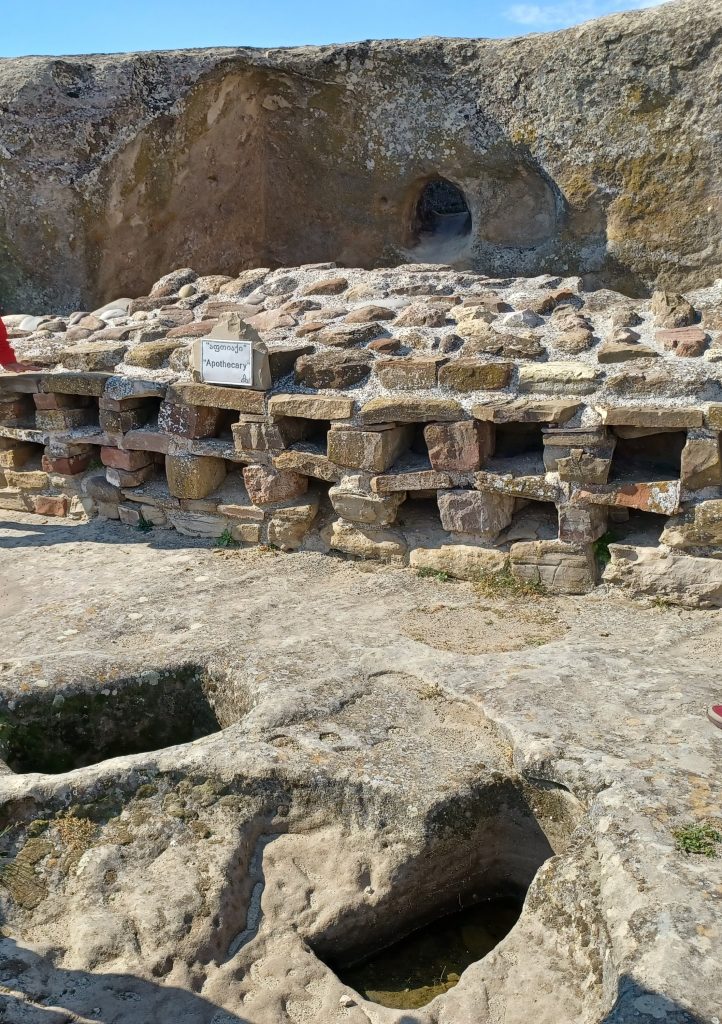
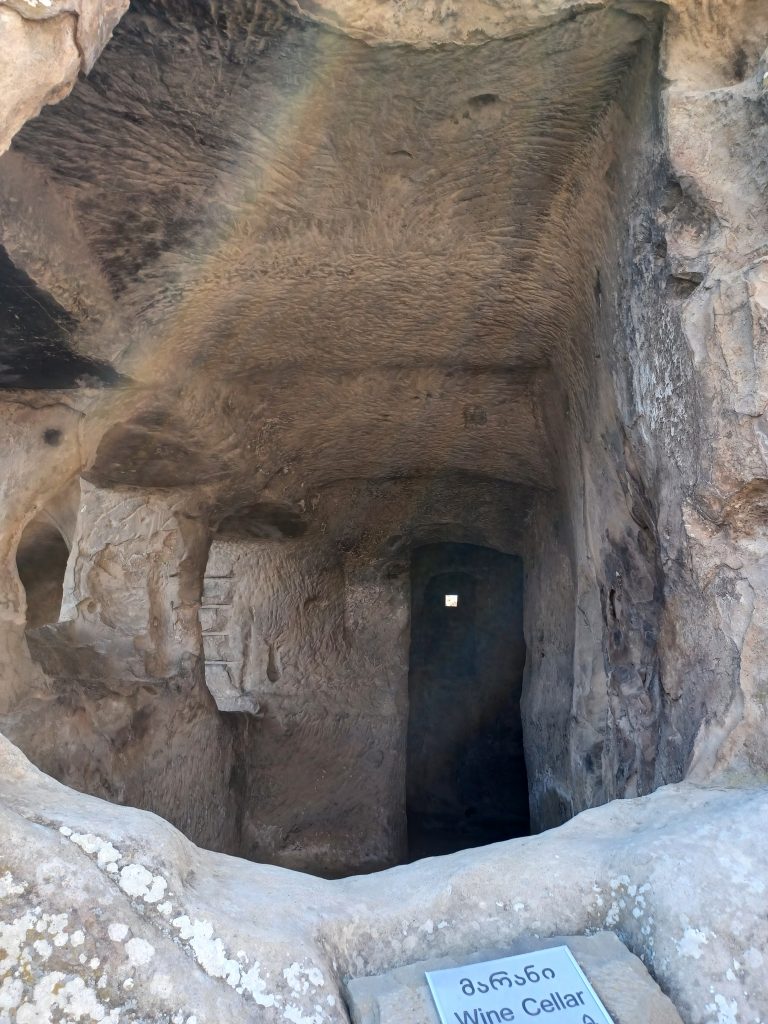
The cave town overlooks the Mtkvari river beside which are ruins of houses. Our guide tells us cheerfully that the previous occupants left the area after finding a cemetery underneath the village. Understandably, they moved elsewhere. We exit the cave town via secret steep steps, which may have been used for bringing water up when the town was under siege.
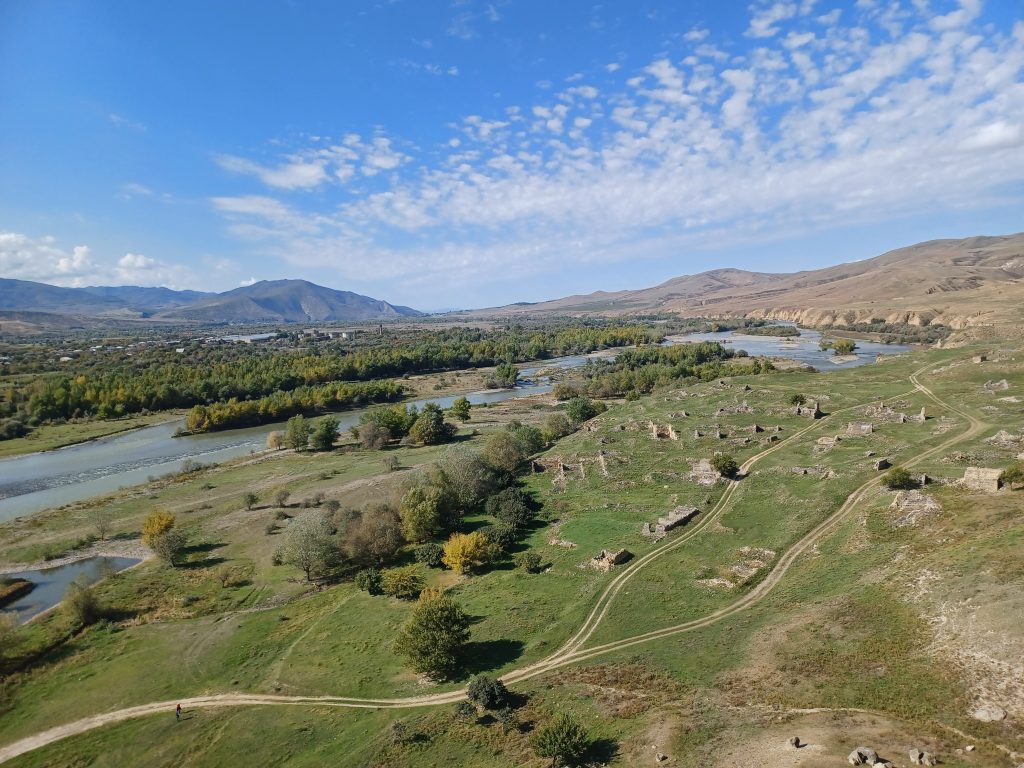
Anyway Georgia’s Golden Age came to an end with the destruction of Uplistsikhe by the Mongols in 1240, not long after Queen Tamar’s death.
Gori
We had passed Gori on the way to the cave town and now retrace our steps as it were. A visitor to this region cannot miss out the town of Stalin’s birth, and the Joseph Stalin Museum, I dare say.
Stalin was born in Gori in 1878 and brought up in a small rented house in the town. Georgia was incorporated into the Soviet Union in 1921 and, as with Azerbaijan, the country only had a short time, in this case three years, of independence. Stalin, meaning man of steel, not his real name, rose up through the ranks along with Trotsky and Lenin. His museum is built in the neo-classical style which he admired. Strange it is to see such a huge, plush be-marbled museum dedicated to a murderer of thousands. Inside, posing atop the first broad staircase, is a statue of the dictator below a stained glass window.
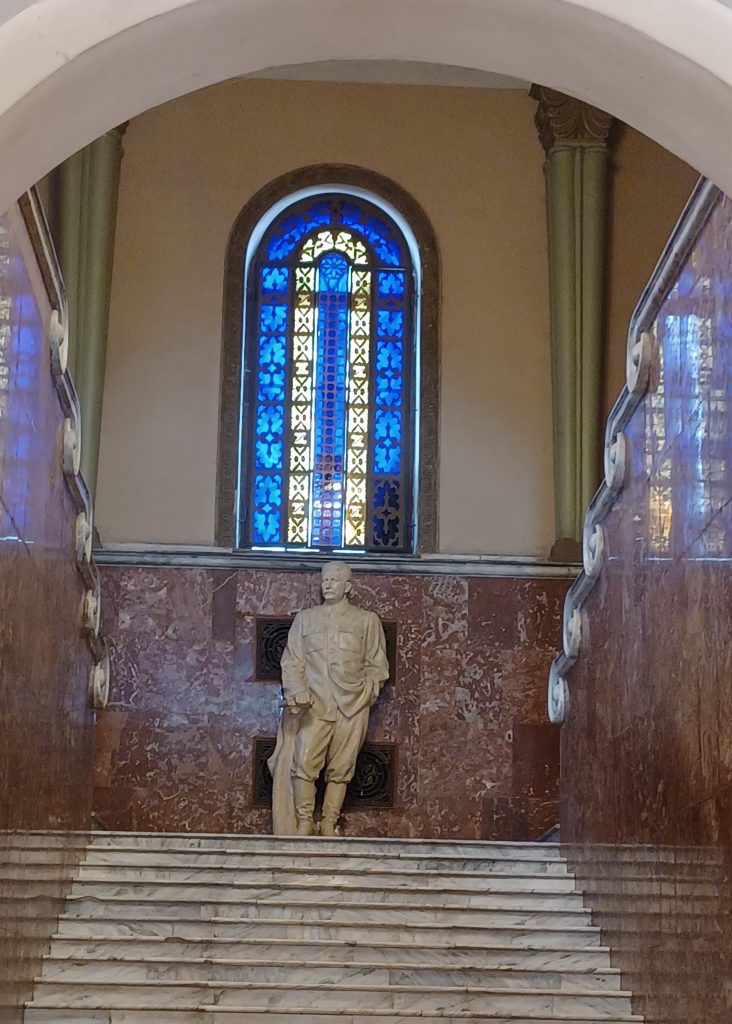
We are led through the rooms, which explore Stalin’s rise to power, the extermination of his rivals and the annihilation of thousands of Georgians including intellectuals, artists, writers. Our guide is less than happy about the fact that Georgian children come to the museum to contemplate the ‘great’ man. He is of course portrayed in the famous meeting with Churchill and Roosevelt at Yalta in February, 1945, which aimed to shape a post-war peace, and in other significant meetings. Many gifts are on display, such as silverware, pottery, and a bayan accordion given by the Moscow Bayan Factory in 1949. His name is inscribed over the treble keys. Not sure he ever actually played. His pipes also feature amongst the exhibits. Part of his persona. And finally a bronze replica of his funeral mask on a white stone cushion.
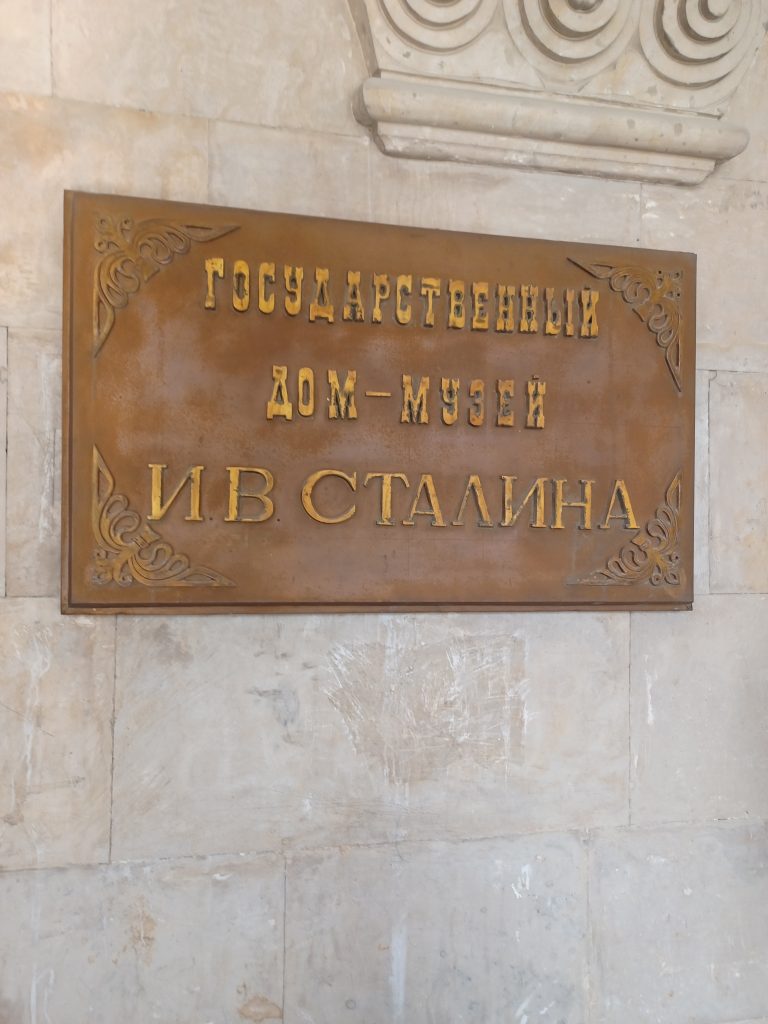
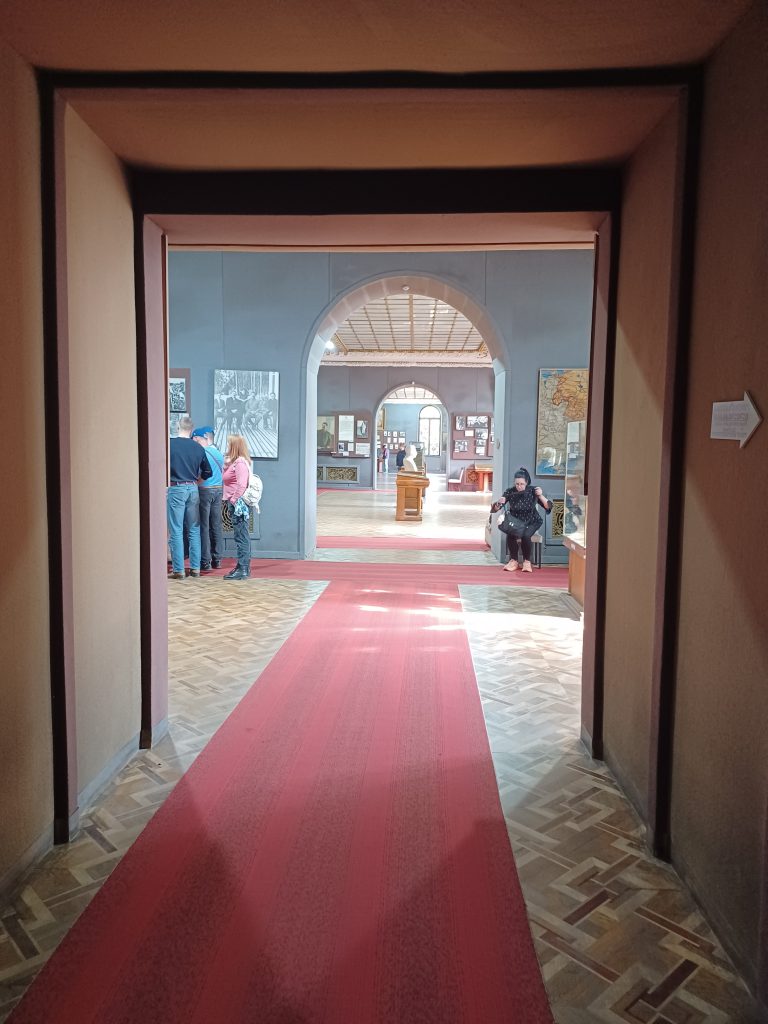
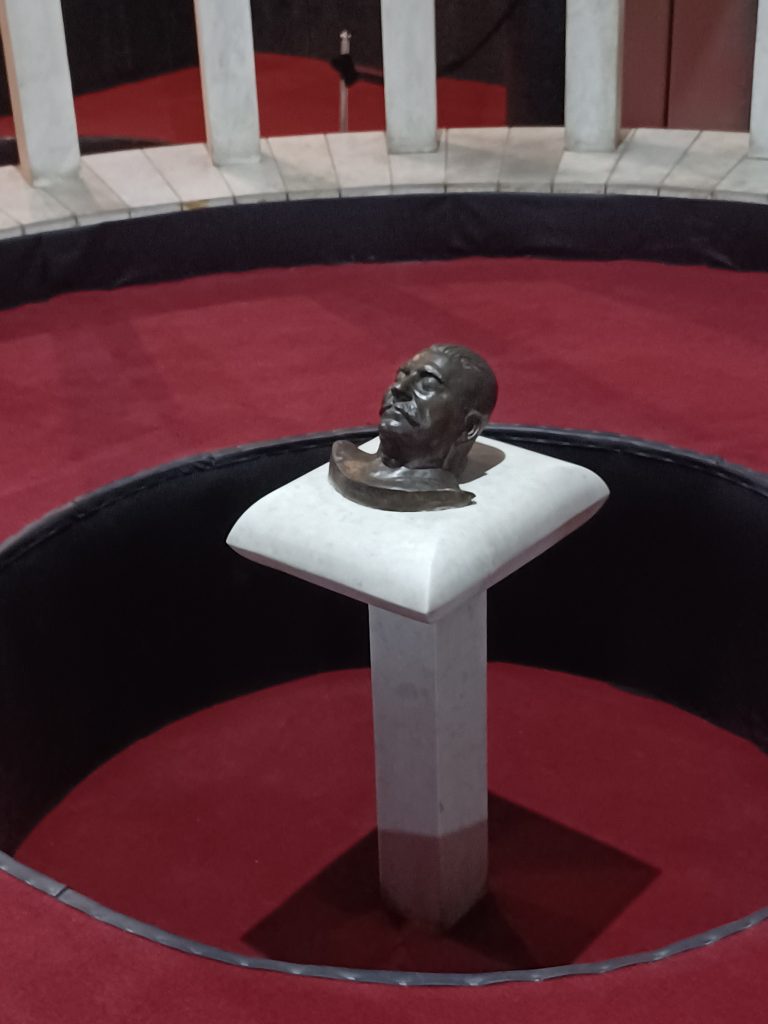
Outside is the green bulletproof train upon which he travelled to the Yalta conference and other meetings. He was averse to flying. We board via one set of stairs and observe a few bunks in one carriage, his toilet with wooden seat and bath tub in another. Not exactly luxurious. And in the end carriage a table with chairs on a red carpet where meetings took place.
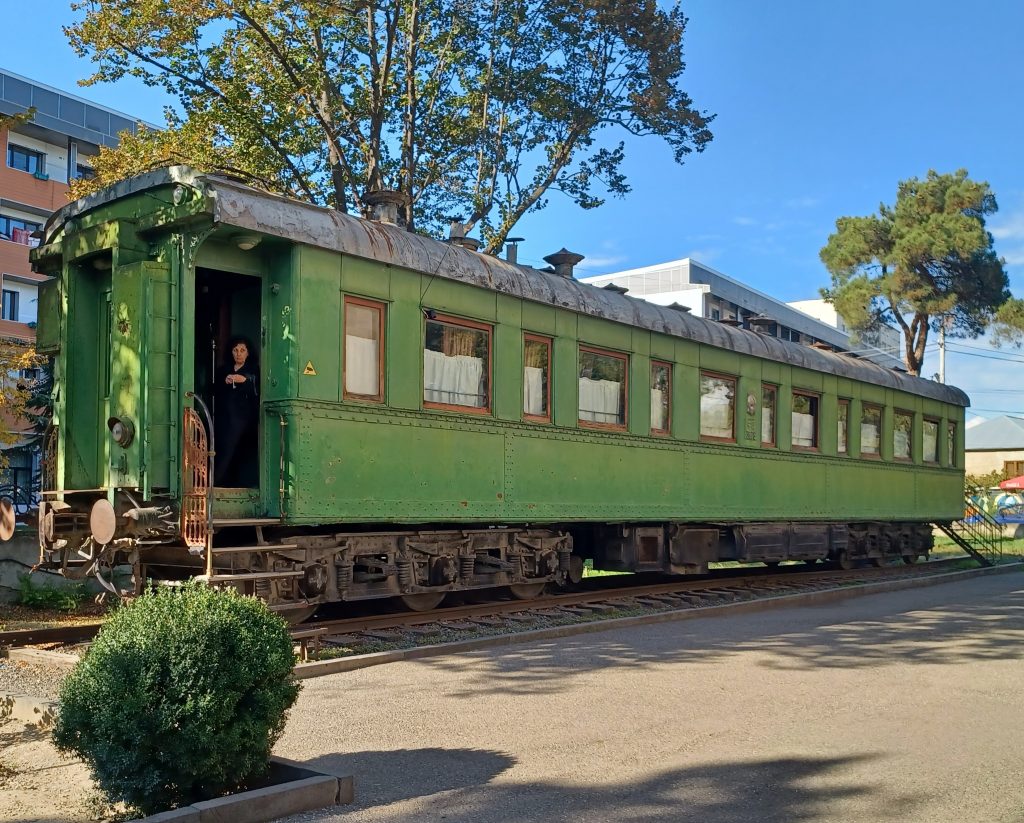
Exit via another set of stairs. I observe the number on the train, which has two Cyrillic letters фд, FD, and the numbers 3878. Not that that means much to me but it might to a keen train spotter.
Stepantsminda and Kazbegi mountain
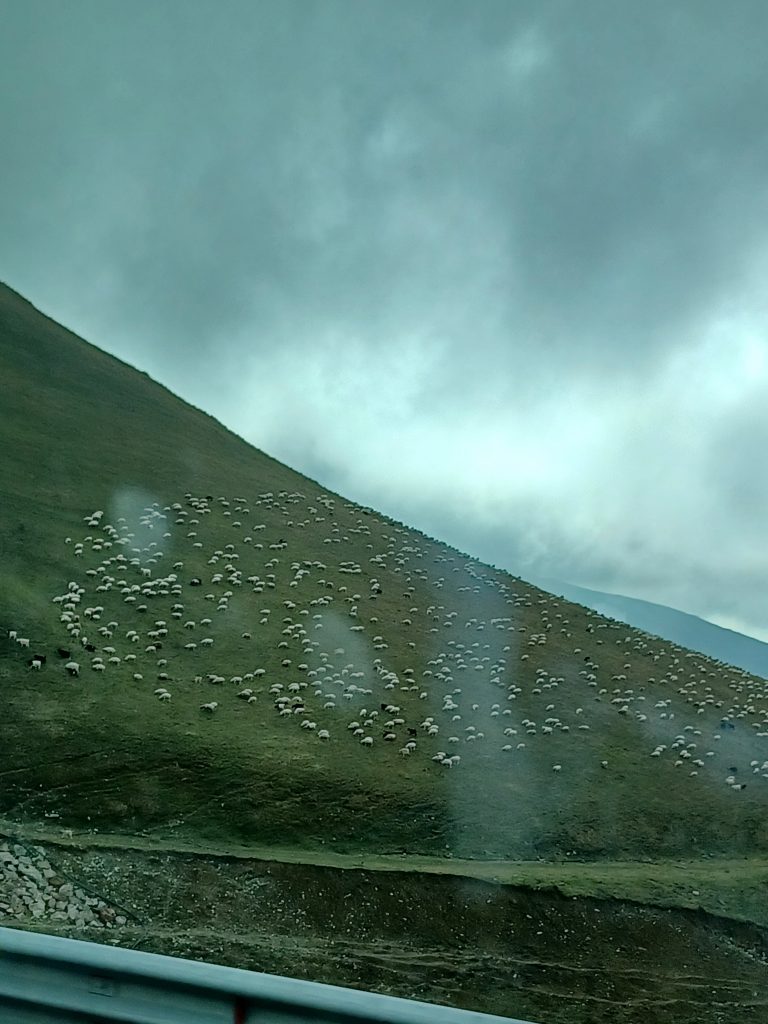
Resume our journey now heading northwards towards the Russian border on the Georgian Military Highway. It is a spectacular drive upwards on sinuous roads. Rather devoid of military personnel, but plenty of sheep. Sheep are currently descending from the high summer pastures and we see many of them on the lower foothills. A few are footling about by the roadside. The digital thermometer on the coach displays the temperature, which gradually decreases from 20 degrees to 7 degrees Celsius as we climb.
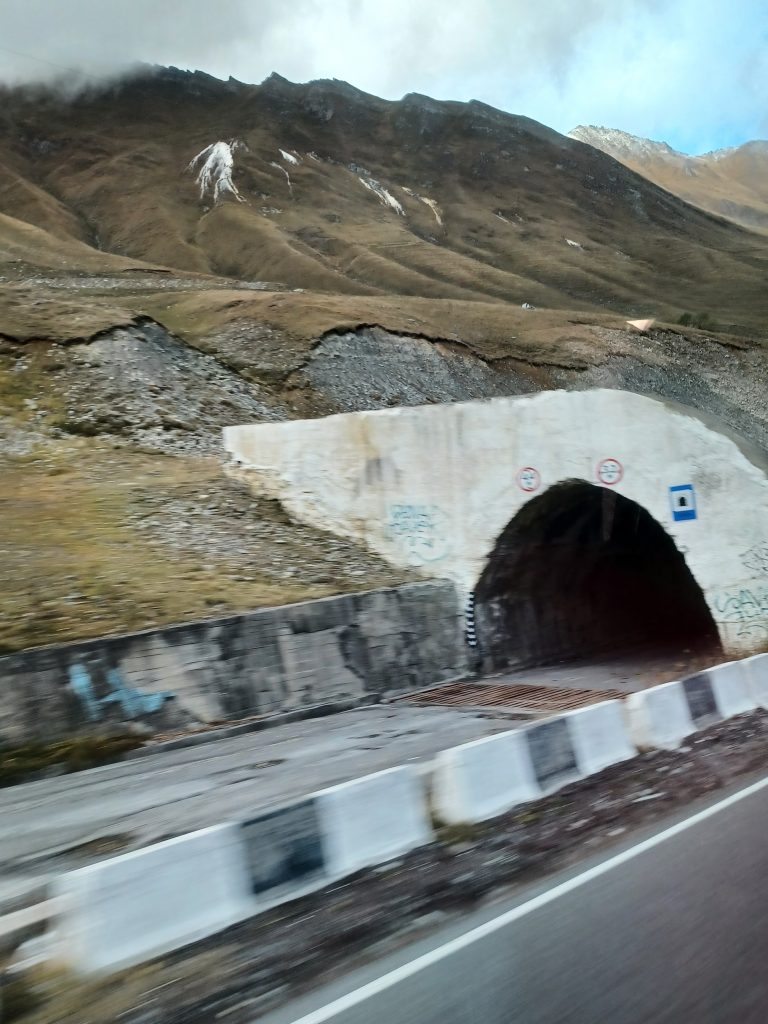
Shepherds’ huts and a few horses and their riders appear. And a few cattle crossing the roads. Have to brake for one of them. A mad driver endeavours to overtake the coach on a hairpin bend. Death wish maybe. Sheer drops as we follow the river Gudauri amidst the high mountains of the Caucasus, the largest mountain range in Europe, incidentally. We pass several tunnel entrances by the sides of the road for vehicles to pass through in the winter. Built for protection against avalanches. Large gaping holes. Not enticing.
In the distance we note the Kazbegi mountain, 5033 metres high. The mountain is associated with the myth of Prometheus, he who stole fire from the gods to give to mere mortals. He was chained to the mountain as punishment. Slip through a pass in the mountains. Almost touch the clouds but don’t. Magnificent up here. The Soviets designated the area a nature reserve in 1979. We pass through the Gudauri resort where adventurous Georgians climb the mountains and hike and ski and snowboard. Nice chalet type hotels and ski lifts all over the place.
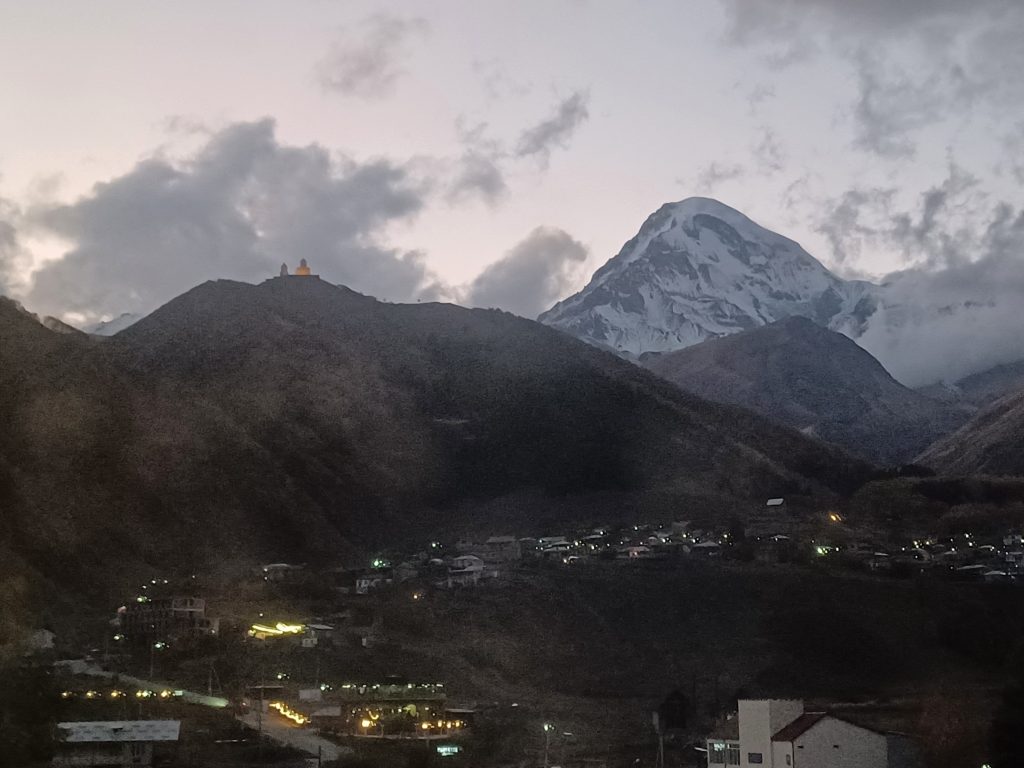
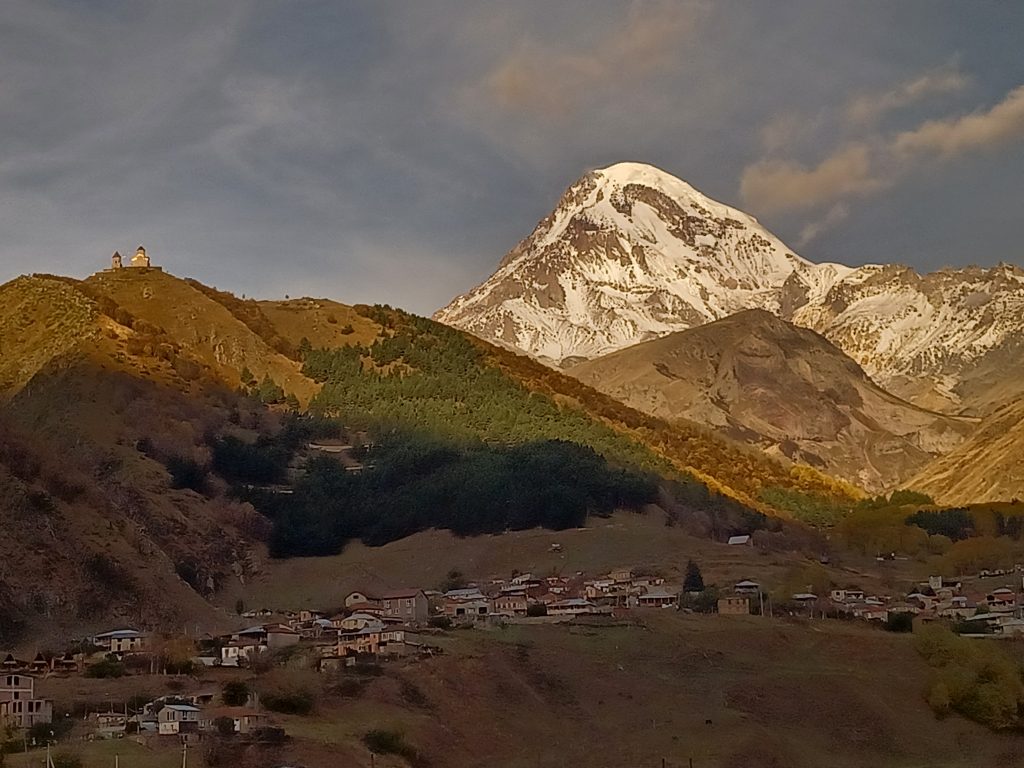
Reach our hotel in Stepantsminda as lights twinkle in the twilight. I have a large be-windowed room overlooking the awesome Kazbegi mountain and Gergeti Trinity Church perched on a lower hill adjacent. I put a brew on, then dress for dinner, and afterwards to slumber. And in the morning I wake up to view the sunrise on the snowy mountain and the sun glittering off the church roof.
Gergeti Trinity Church
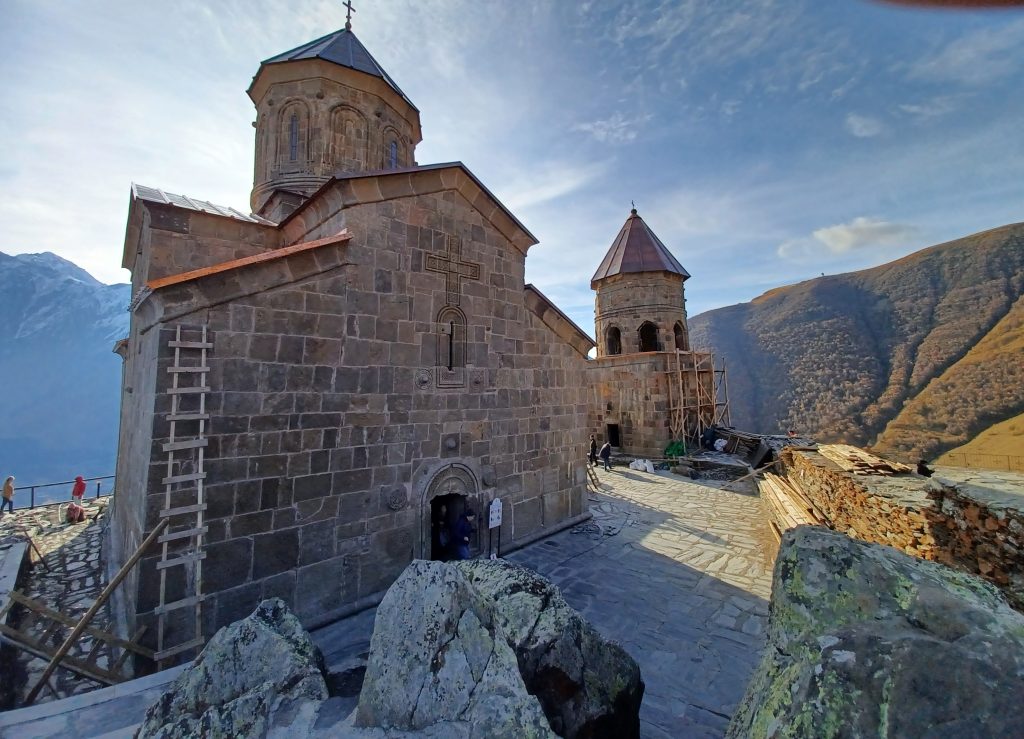
The coach, being unable to handle the hairpin bends of the route up to Gergeti Trinity Church, is usurped by several 4×4 vehicles, which we pile into in order to make the ascent. It is around 2200 metres above sea level here. Workmen are carrying out some essential maintenance on the building as we wander round the outside. Carvings feature around the doors and windows and a large cross on one wall. It is 14th century with a separate bell tower built a bit later, I gather. Our guide tells us that St Nino’s relics were brought here at times to keep them safe from marauders.
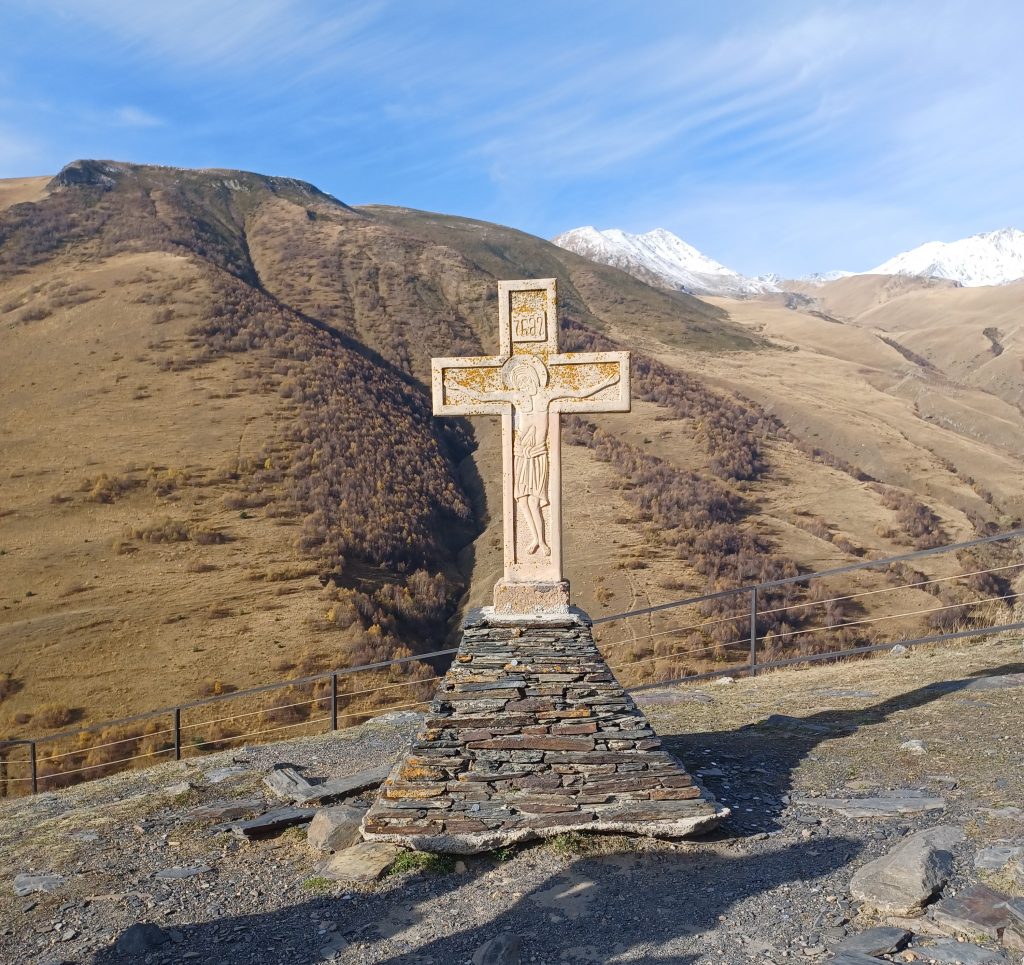
Enthusiastic pilgrims hike to the church from the village and gain just reward for their efforts. We see some of them, woolly hatted with glowing faces. Would have done that myself for choice, if time. A cold but exhilarating trek that would be. Not too far. Maybe an hour’s walk max. Instead, a couple of us meander down to a lower path where a cross perches prominently overlooking the hills. Aura of sanctity.
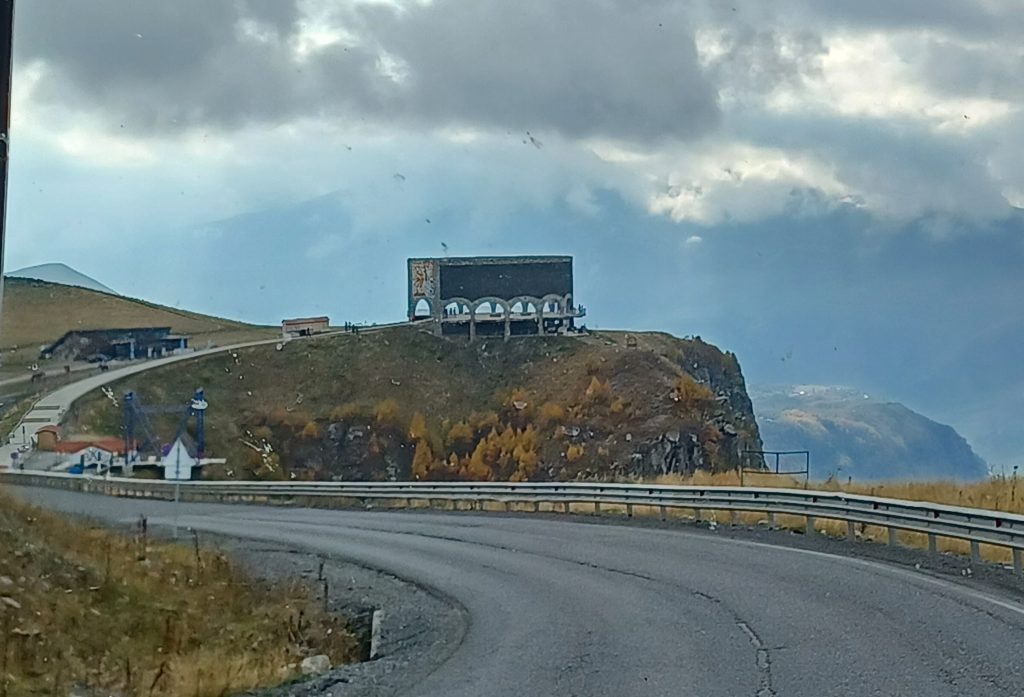
Sated with splendour and slight exposure, we begin our journey back south, back through the ski resort, passing the sheep infested slopes, following large trucks and tankers through the golden hued trees and past the huge Soviet-Georgian Friendship memorial poised visibly atop a precipice near Gudauri. Bit concrete and weird from the road but one can glimpse colourful murals within.
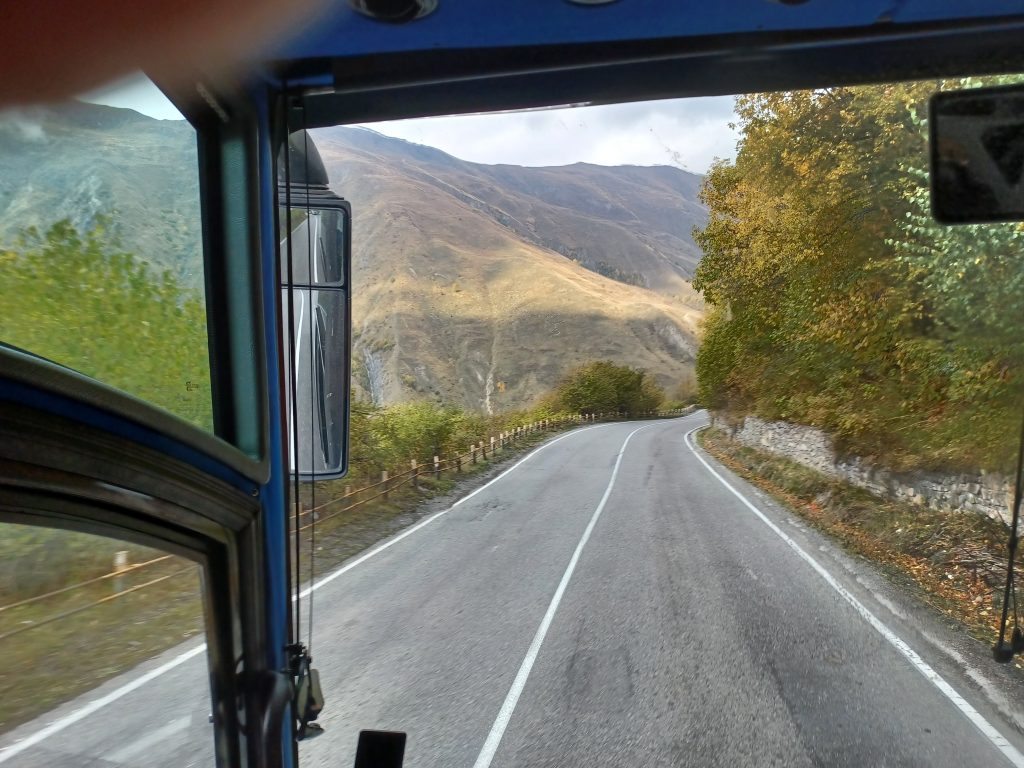
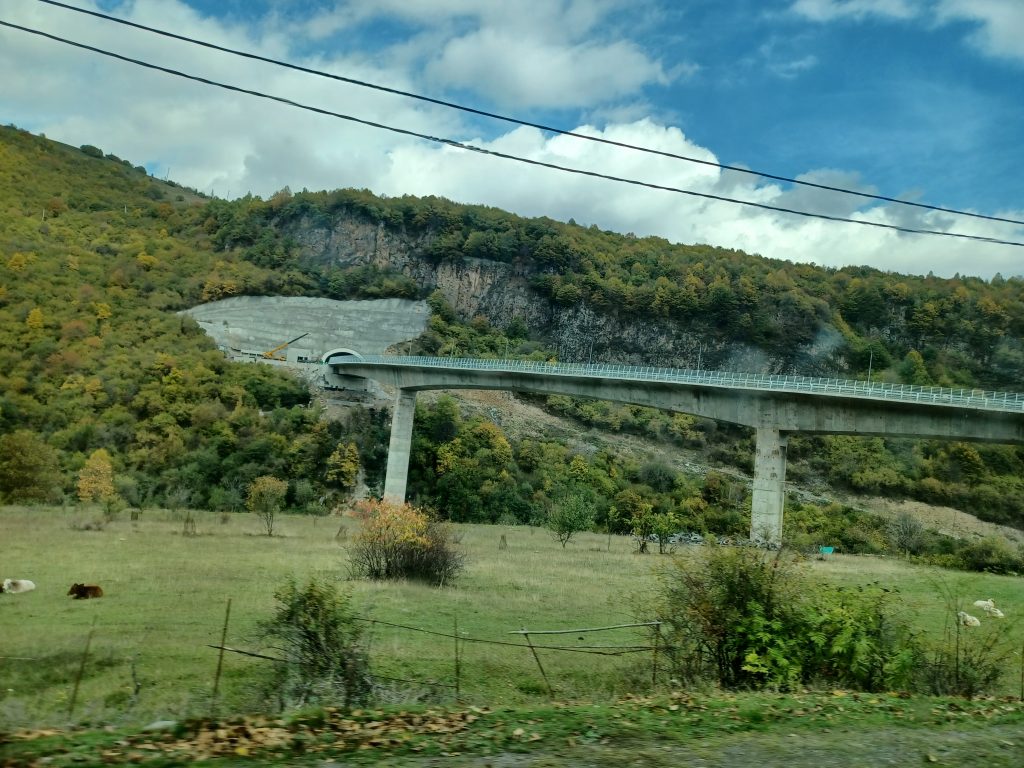
We follow the river beds, first one side of the coach and then the other, and drive through a village on the Aragvi river where white water rafting is offered and inflatable boats dot the verges. Not enough water to raft in the stony river bed today though. Must be the dry season. We observe pipes laid, we are told, to supply natural gas to the area. The Chinese are building a large bridge and tunnel to bypass a section of winding, bumpy and queasy inducing road. Good job we have a careful driver. Sheer drops one side and fragile looking wooden fencing in places. Bit hairy watching the road from my position in the front seat today. The coach seems to veer awfully close to oncoming lorries.
Zhinvali Reservoir and Ananuri Fortress
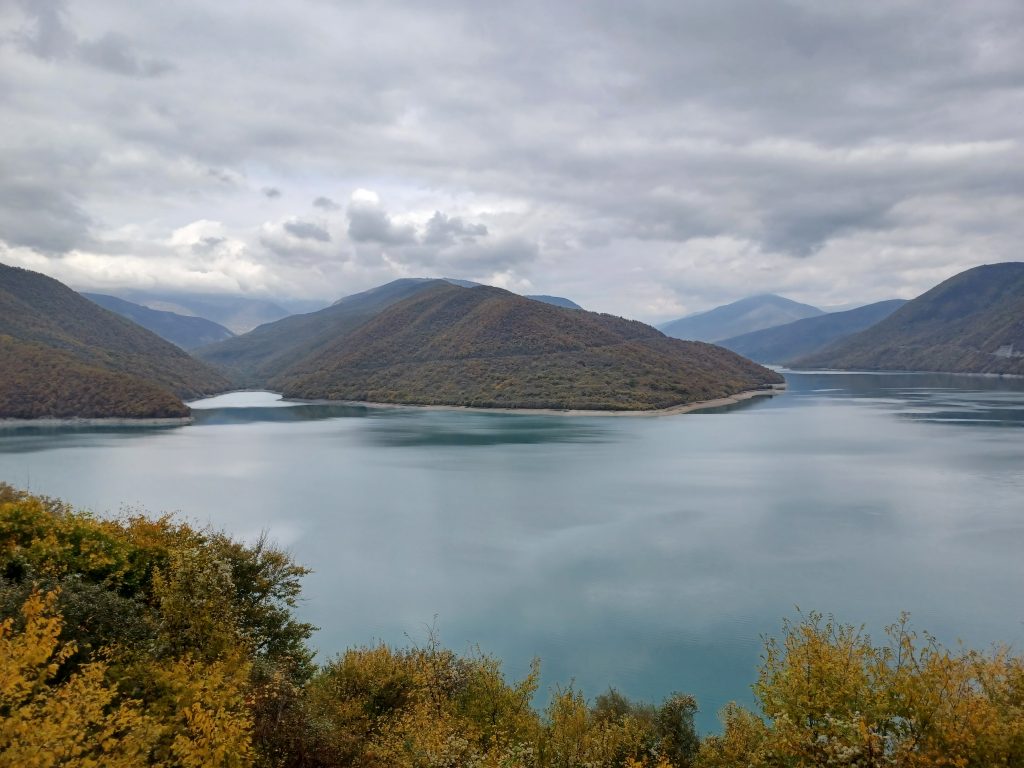
After a two hour slog teetering on the edges we stop at the Zhinvali reservoir beside which is the Ananuri fortress. The dam here was constructed in 1986 to enable the reservoir and a hydro-electric power station to be built in the Aragvi river. Thus is Tbilisi supplied with drinking water and power. In order to build the dam, however, a whole village was submerged. Including a 12th century church. “When the water level dips, you can see the ruins of the church”, says our guide matter of factly.
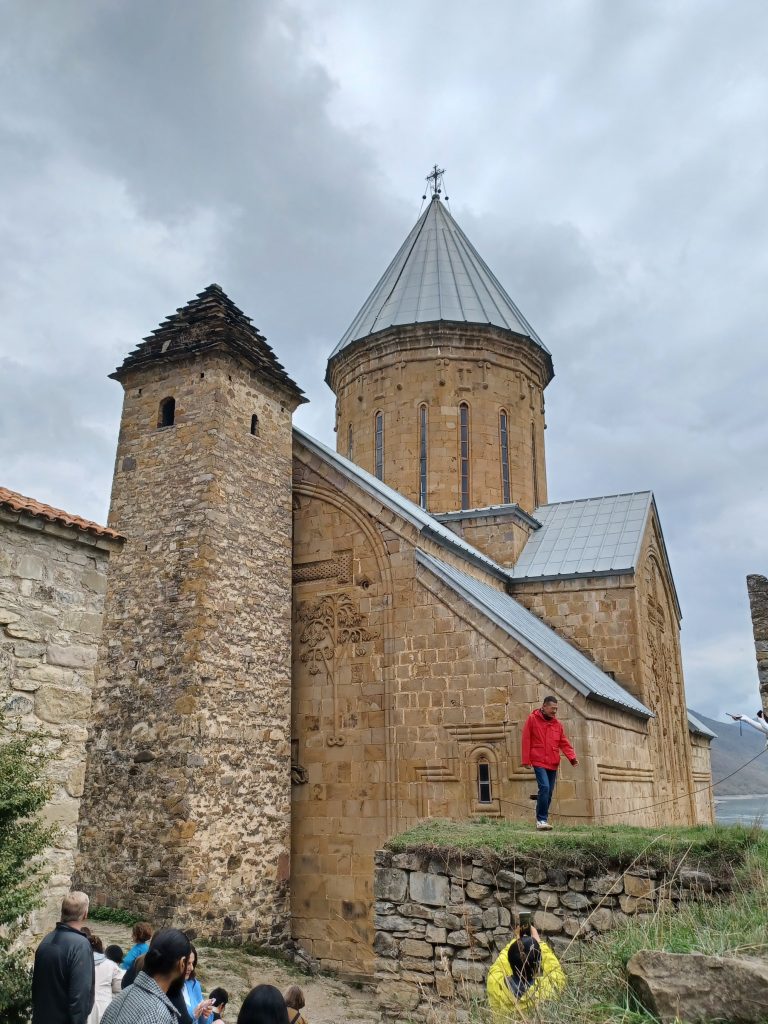
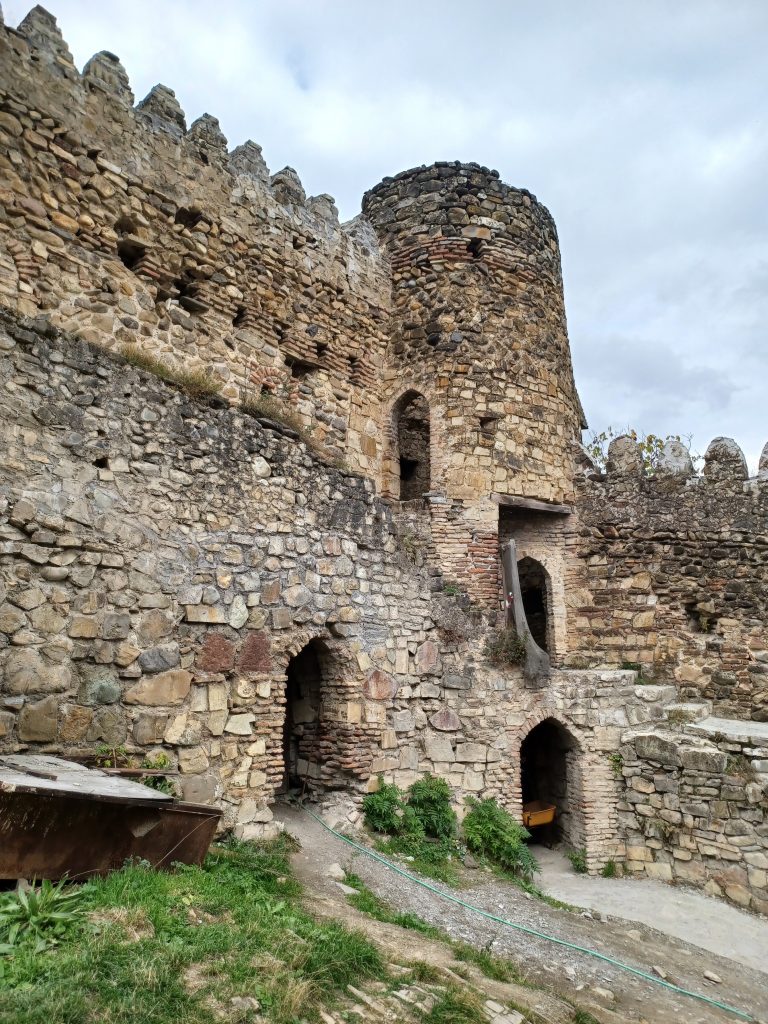
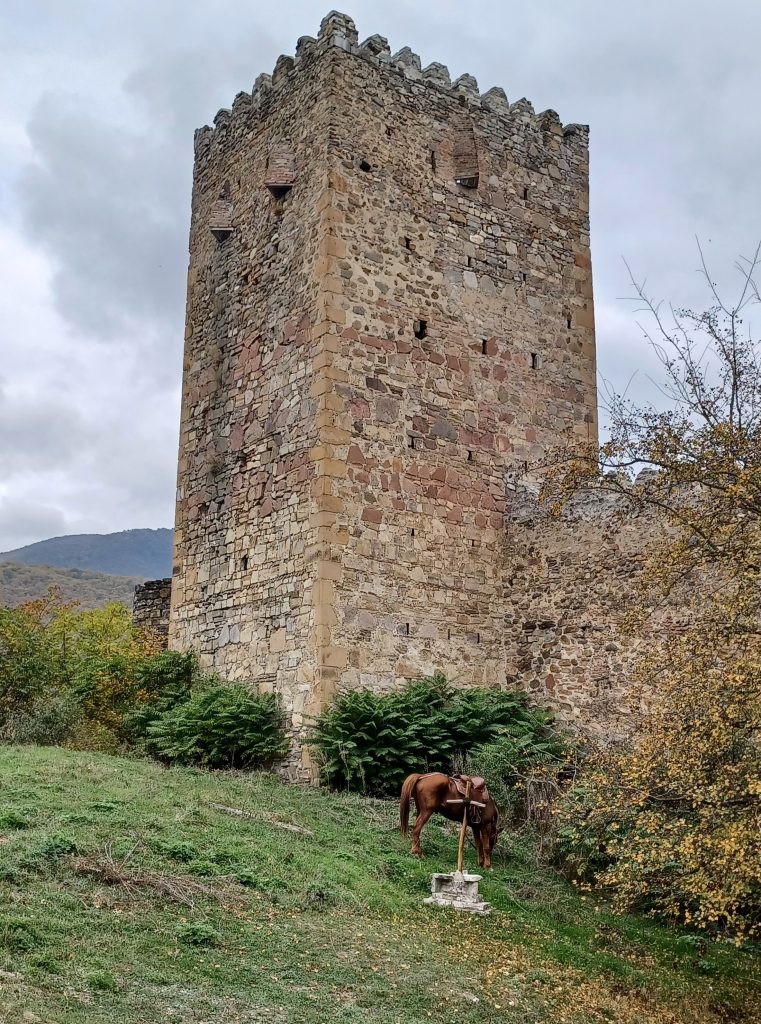
We stop. The bus park is full and sits beside souvenir stalls of all sorts. Grab a coffee whilst our guide, sporting a thick red hoodie today, rounds us all up to begin his oration before we all wander off at will, cameras clicking. Wonderful old place with two churches inside the fortress with stone carvings on walls and around doorways and frescos within. The fortress has oval shaped crenelations all around and is built of brick and stone. The odd horse grazes on the short grass.
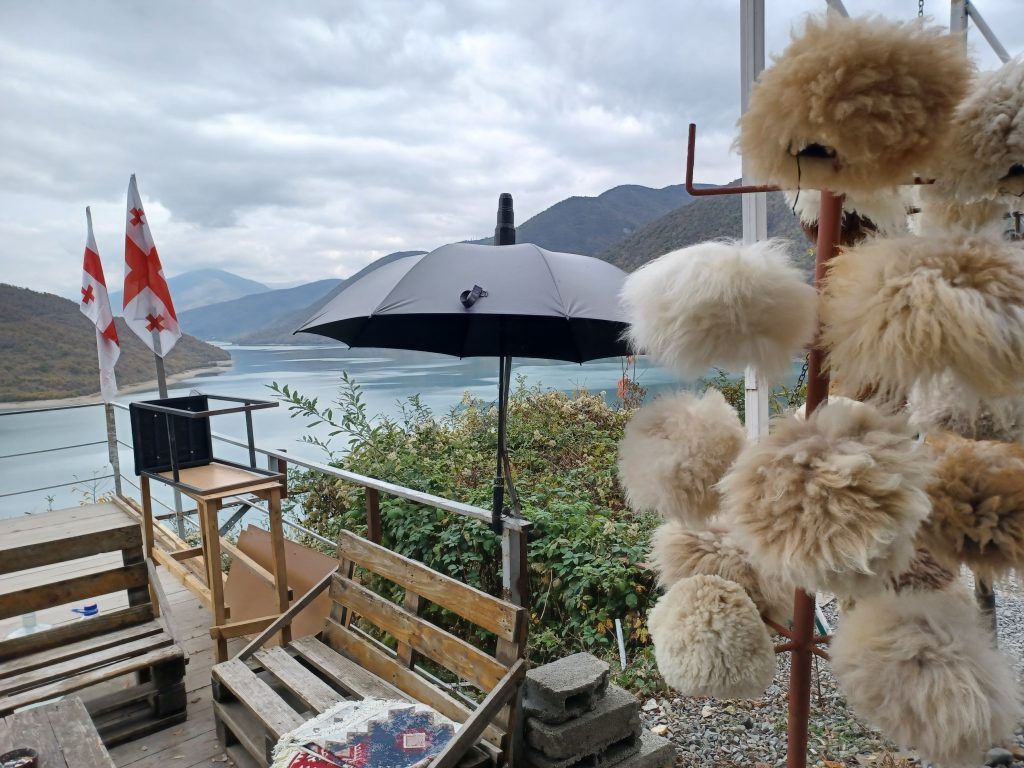
A little further on, following the reservoir and driving past a few quad bikes squatting by the roadside, we halt at a viewpoint. More souvenirs are here arrayed in the form of wool hats and scarves, rugs and felt slippers. Georgian flags fly and dogs snooze on wooden boards. Gaze at the view awhile. It is a pretty place overlooking the tranquil waters of the reservoir and the forested hills.
Mtskheta
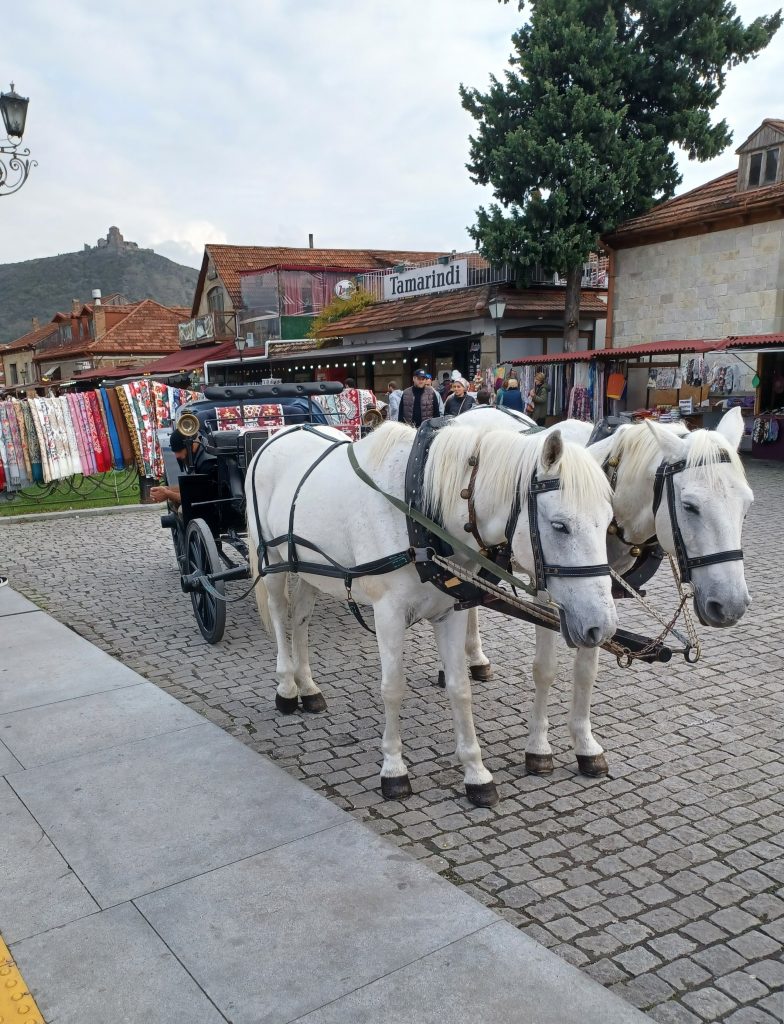
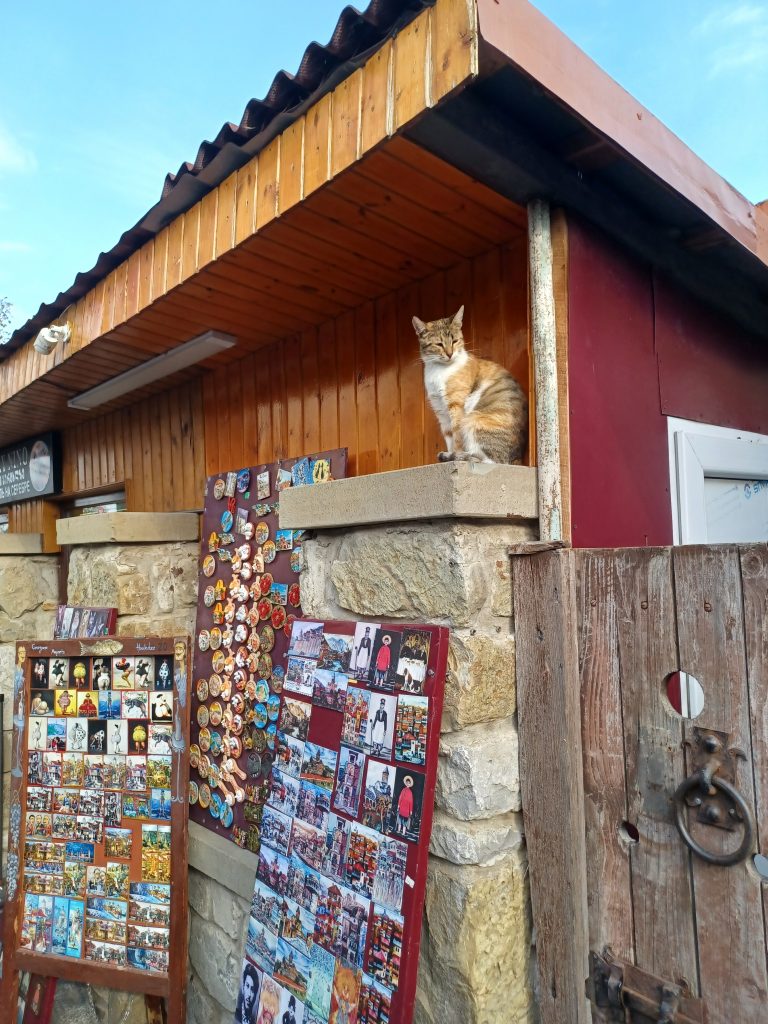
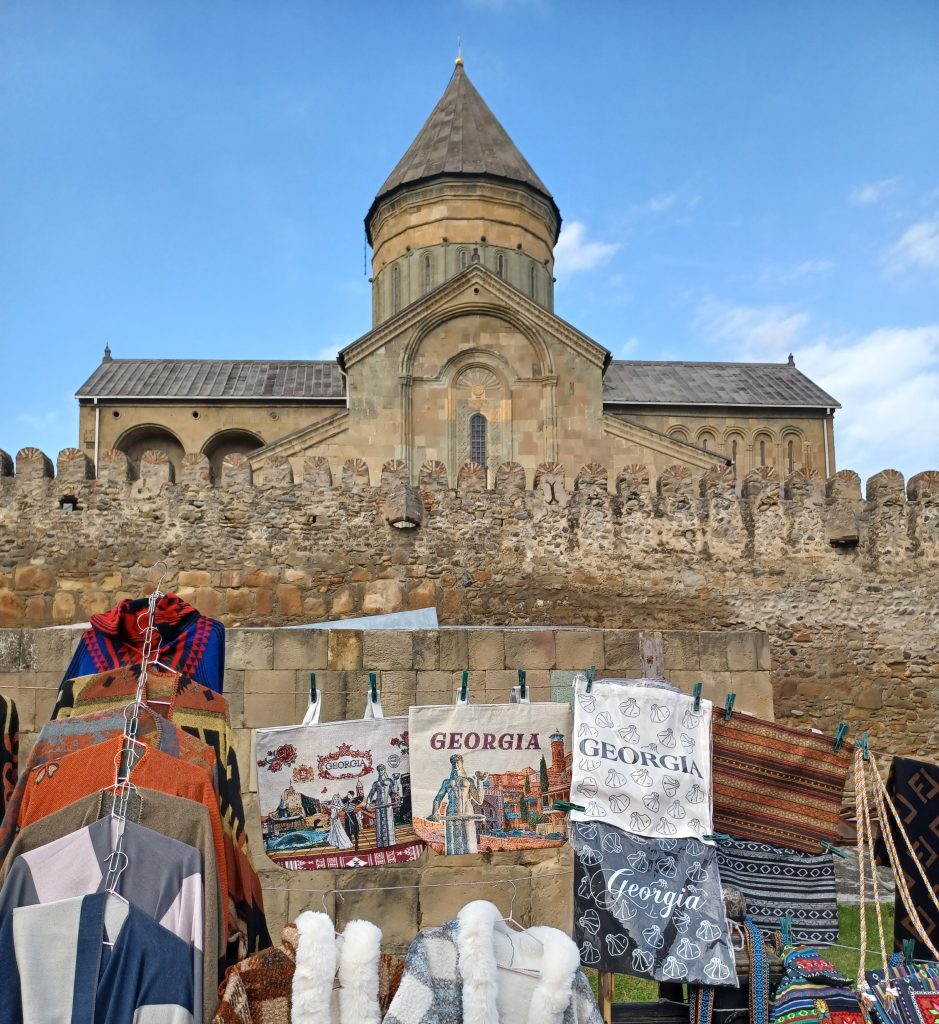
The final stop of the day is the captivating cathedral that we saw from Jvari church on the hilltop. This is the eleventh century Svetitskhoveli Cathedral of the Twelve Apostles in the onetime capital of Georgia, Mtskheta. We make our way from the busy carpark past stalls, with cats silently watching, selling post cards and fridge magnets. Eventually assemble in a large square outside the Cathedral’s defensive wall, built by King Erekle II in 1787. In the square await white horses and carriages, more souvenirs and all sorts of colourful items to attract tourists.
Svetitskhoveli Cathedral
Svetitskhoveli Cathedral is the second largest cathedral in Georgia after the new Holy Trinity Cathedral in Tbilisi and is the main place of worship for the Georgian Orthodox community. It is on UNESCO’s World Heritage List. The present structure dates from the 11th century and is the site of coronations of kings as well as their burial places. King Erekle II’s tomb is here, as well as that of Vakhtang Gorgasali, whose equestrian statue we saw in Tbilisi. The architecture is known as crossed-dome, i.e. church in the shape of a cross in a square with dome on top.
Apparently, this site on the confluence of the Aragvi and Mtkvari rivers was chosen by St Nino to build the first fourth century wooden church. Our guide tells us that the sacred robe of Christ was brought here by a man called Elioz/Elias from Golgotha and when his sister, Sidonia, touched it, she was overpowered with emotion and died. She did not let it go and thus was buried with it. A tree grew on her grave. Hence the name of the cathedral means ‘life-giving pillar’, because the main pillar for the wooden church was hewn from this holy tree. A painting of this scene is displayed in Jvari Church (outlined above).
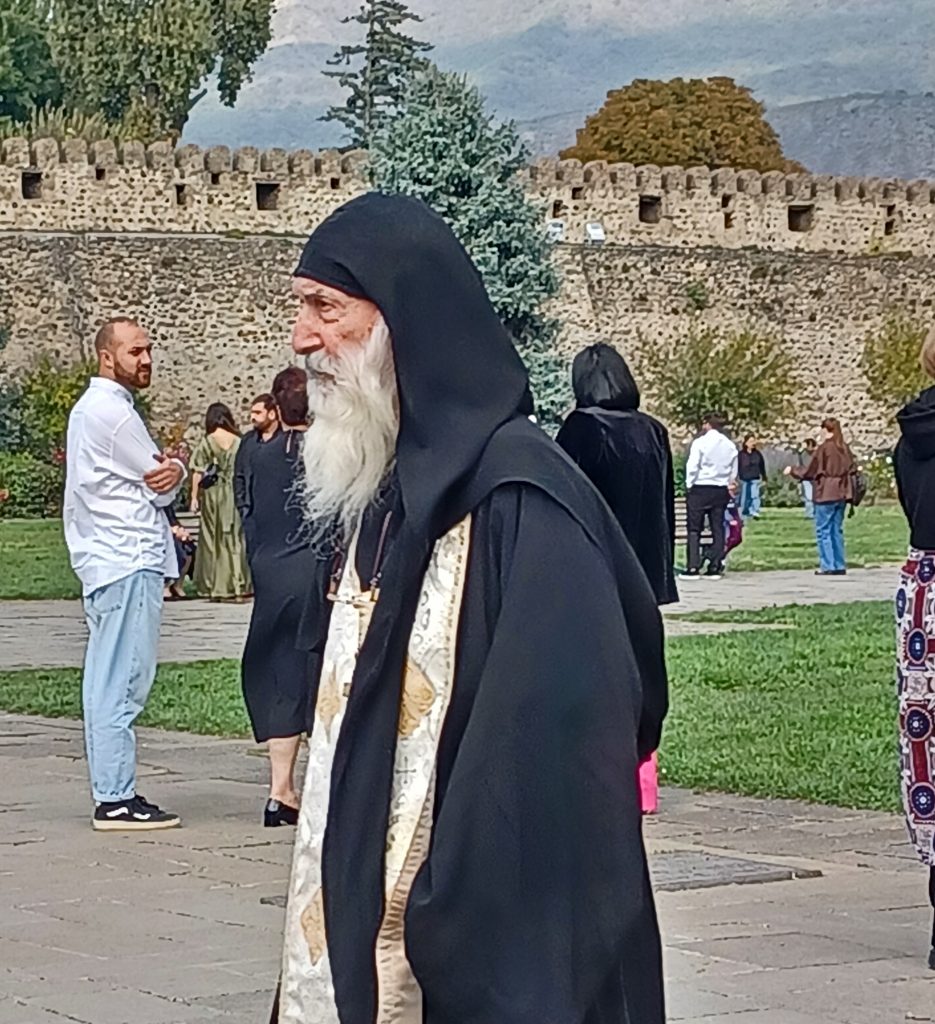
We wander across lawns within the walls with their eight towers. A group of Georgians is dancing in a circle. There is a wedding going on in the Cathedral today and dancing forms part of the festivities. An elderly Orthodox priest with long shaggy beard and black cassock wanders by. Solemn and pious demeanour. In the background on the hill is the lovely Jvari Church, which we explored a few days ago, looking down upon this Cathedral and the confluence of the two rivers.
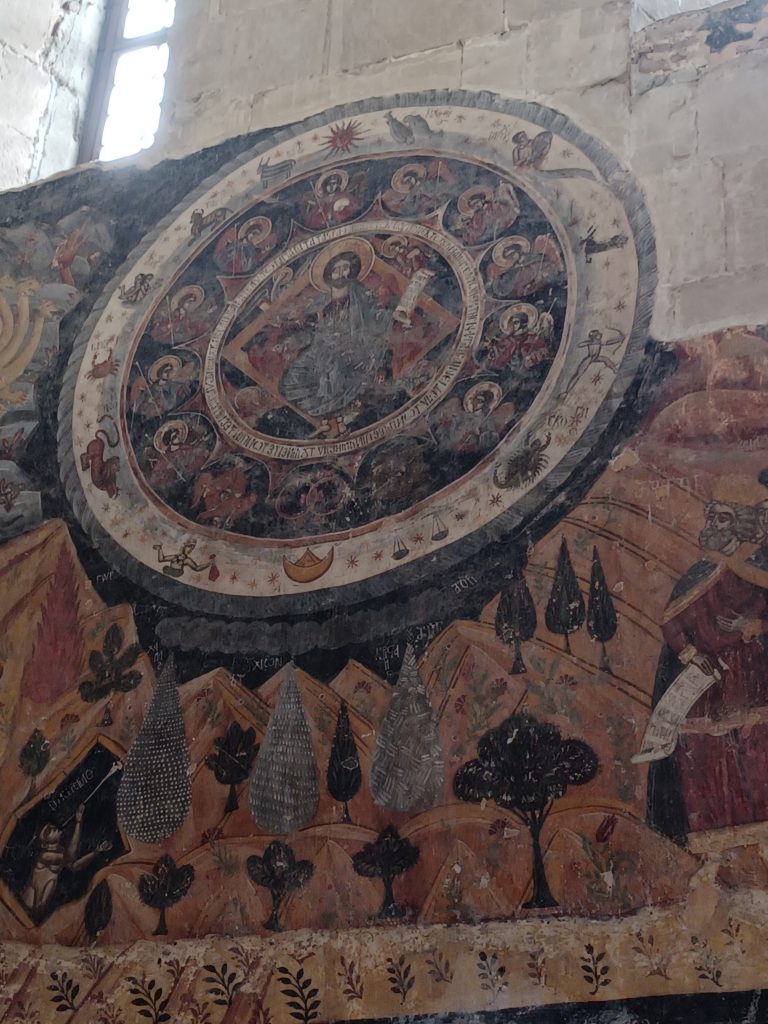
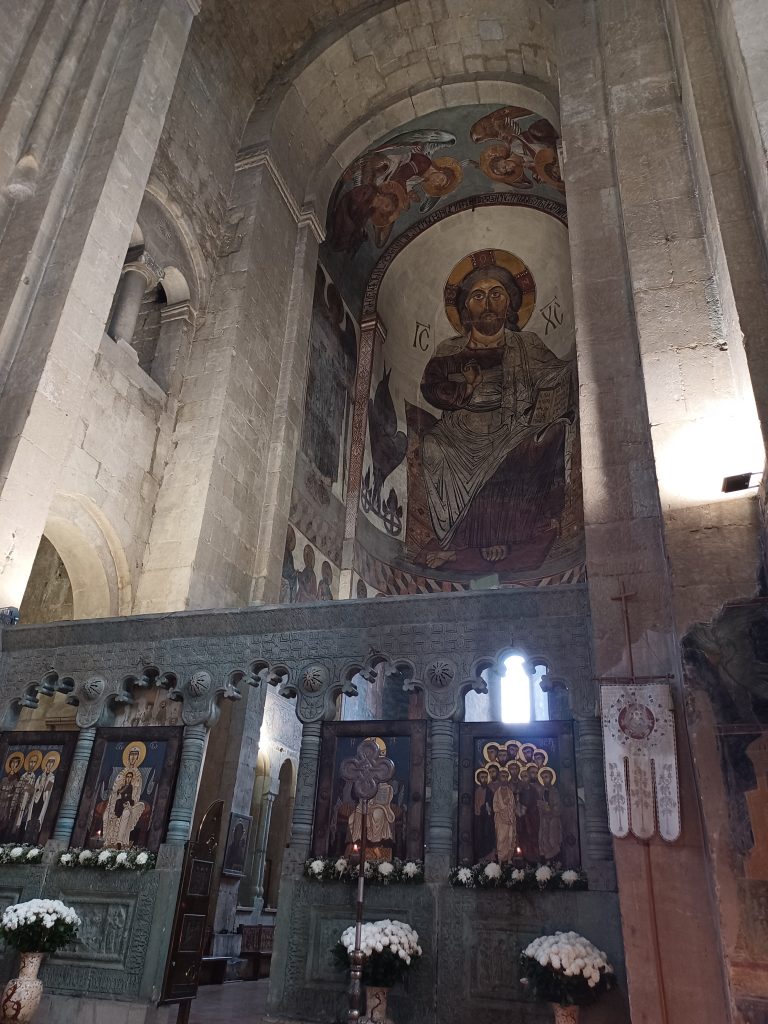
This Cathedral itself has been damaged by several invasions in the past including the Russians and, latterly the Soviets, as well as earthquakes. It has undergone several renovations in its history but needs further restoration. We venture inside. The wedding is in full swing, which rather prevents us observing everything. However, I do see an extraordinary 13th century fresco depicting the signs of the zodiac. “Unusual”, according to the guide. There are many beautiful frescos here. Much damage has been done to these, for example, the Russian imperialists whitewashed them in the 19th century.
Interesting, busy and beautiful spot. Could have lingered longer. But time to head to Tbilisi now. Not far away from the old capital. And at the entrance to the city an equestrian statue of King David the Builder welcomes travellers. One night more here before our journey continues to the Armenian border.


Leave a Reply