
I am currently on a jaunt in Azerbaijan. Having tasted the delights of bold and busy Baku, the group is now heading into its hinterlands, there to savour things natural.
Ateshgah Temple
Our penultimate stop today is on the Absheron peninsula, the eagle’s beak, to the east of the capital, to view the Ateshgah Temple of the eternal flame. It is near the town of Surakhani, where there is a significant onshore oil field. Oil and gas exports account for most of Azerbaijan’s revenue, our guide informs us as we drive along. Italy apparently buys most of Azerbaijan’s oil – 40% of it, and also the majority of its natural gas. Two pipe lines exist, one of which is an oil pipeline 1,768 km long passing through Tbilisi, Georgia, and ending at Ceyhan, a port in south-east Turkey. This line would have been shorter, had the political situation with Armenia been rosier and thus installed via that country. The other pipeline is about twice as long carrying gas to Greece and the Adriatic and onward to Italy. So reducing their reliance on Russian gas.
The next most important industry is tomatoes “and other fruit and vegetables, but mostly tomatoes”, of which the Russians buy the most. When tensions are running between the two countries, Russia threatens to cease its fruity purchases. The third most important industry is tourism. We are doing our bit then.
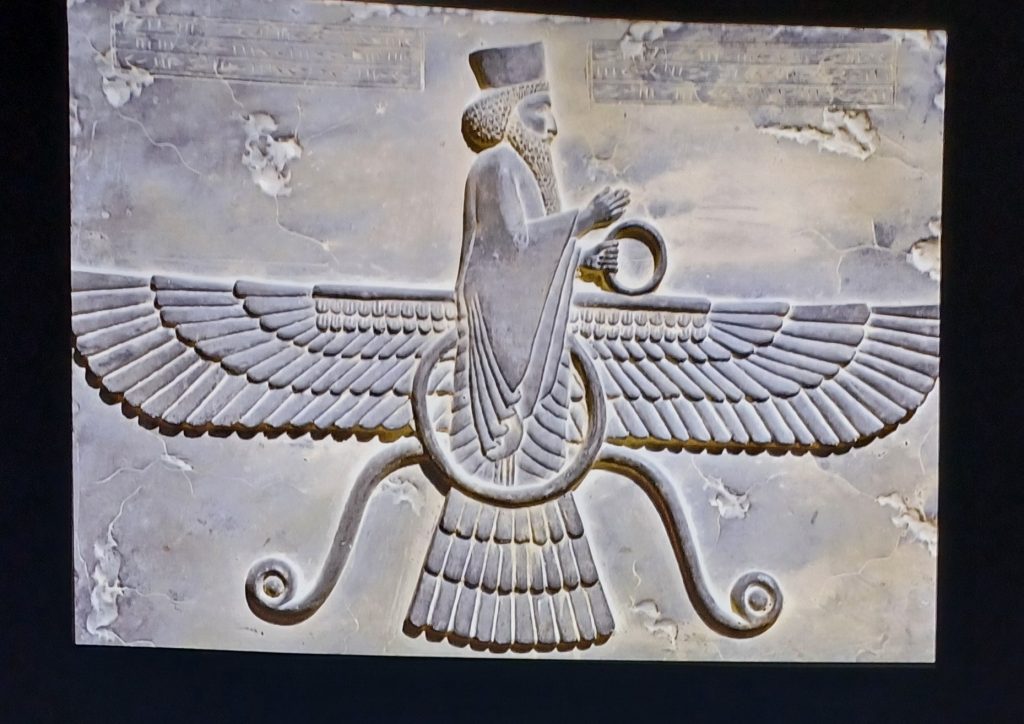
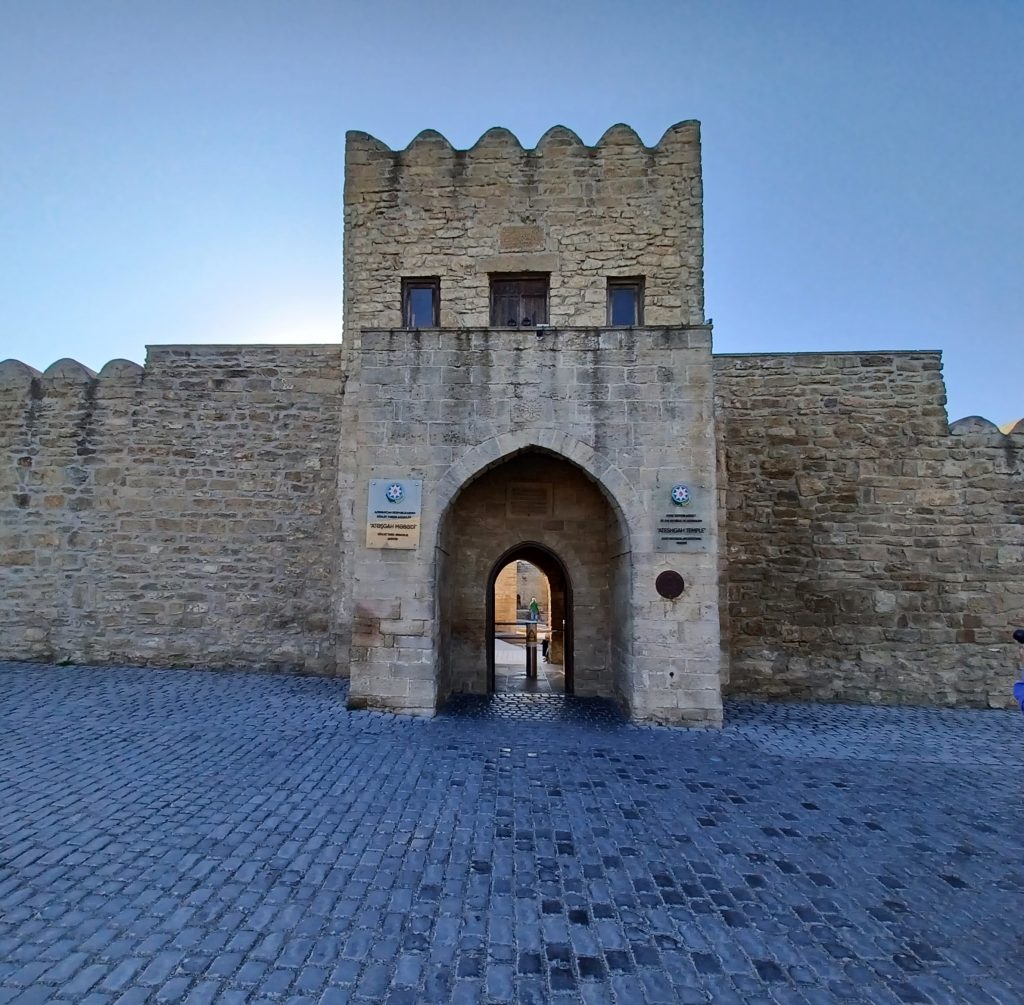
Thus entertained, we arrive at Ateshgah Temple. The temple used to be a focus for Zoroastrian fire-worship as far back as the second millennium BC, we are told. Its symbol was the sun disc, as has been the case in other ancient religions, e.g. Egyptian. Popular myth proclaims that the prophet, Zoroaster, or Zarathustra, came from what is now Azerbaijan. “Zoroastrianism was a major influence on Azerbaijani culture”, our guide informs us. For example, the Zoroastrian New Year festival of Novruz is still celebrated. They no longer expose the bodies of the dead though, as was Zoroastrian custom. “The birds came and ate the flesh”, says he, “and all that was left was the bones”.
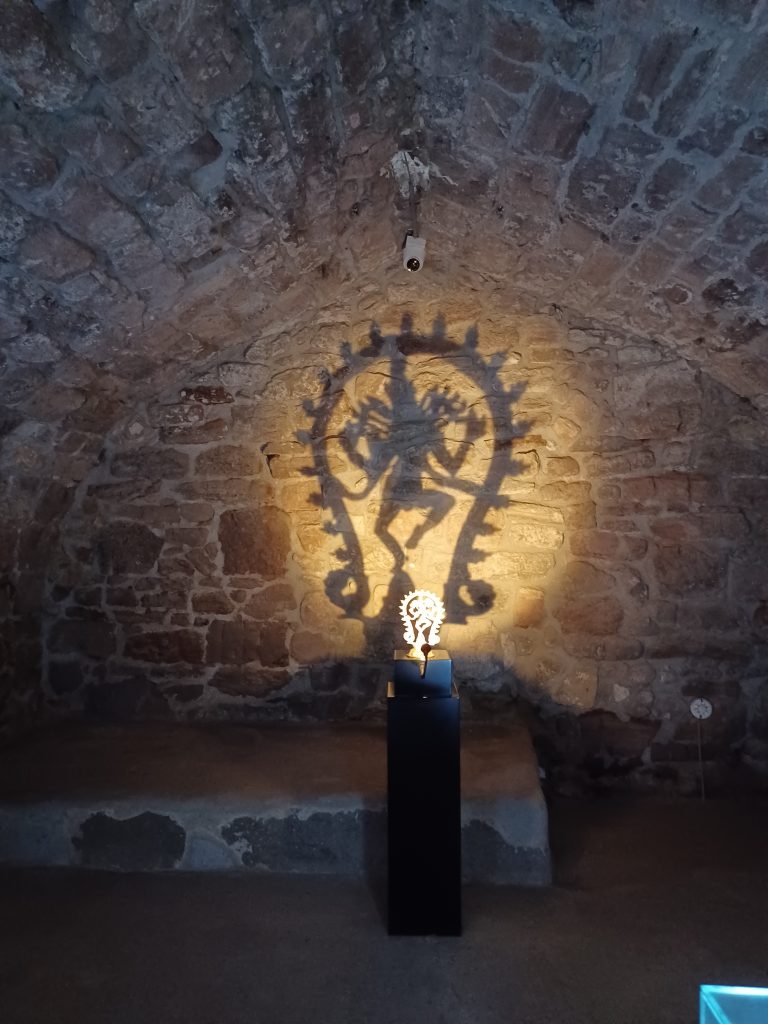
Anyway, later on, it seems that Hindu worshippers came here with their deities, Shiva and Ganesha, having heard about the eternal flame from the silk road traders. The present 17th century temple was re-built by the Indians and fire-worshippers from different countries, according to the information provided. Sikhs, Persians and Zoroastrians are also recorded by 18th and 19th century visitors as living here or visiting the temple. The complex is pentagonal shaped with thick walls and, placed around a courtyard, are 24 rooms/cells for residents and visiting pilgrims. We wander through the rooms. No windows. Some rooms have inscriptions in Sanskrit or Persian on the walls. The fire temple itself is in the centre of the courtyard.
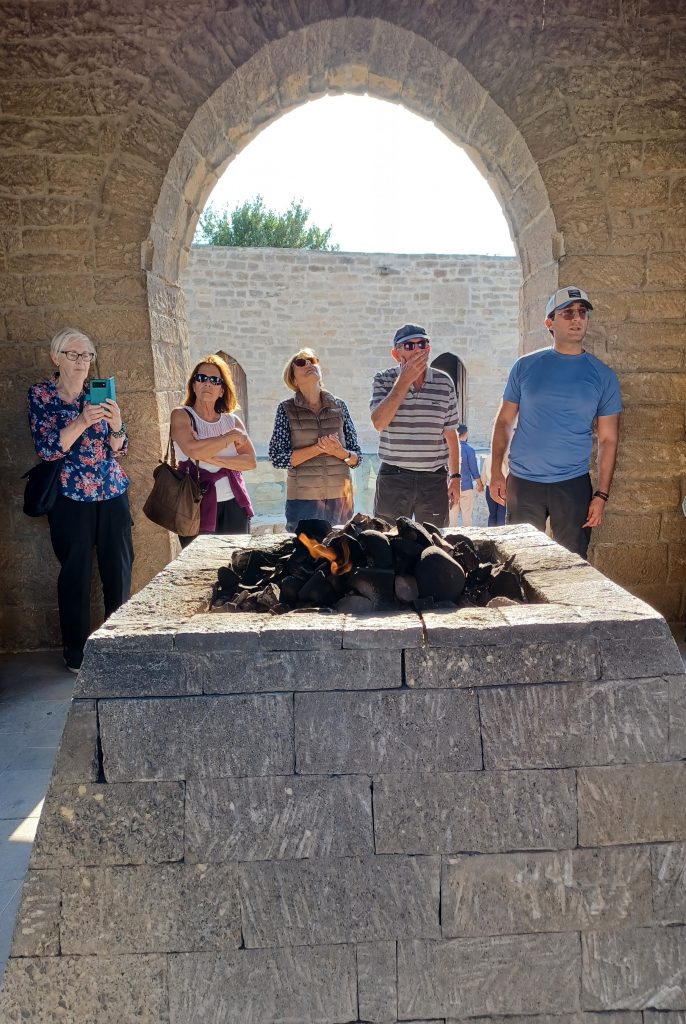
A flame burns within the temple. We stand round it for a while, as our guide delivers chapter and verse. The flame used to be natural but now, “let me tell you, it is powered by natural gas via a pipeline”. A somewhat unromantic surprise. The oil industry has succeeded in destroying many of the natural flames and this one went out, he explains. Right-ho. Still symbolic though. In fact, he informs us that the flame for the Olympic Games 2015 was taken from here to the stadium in Baku for the start of the games.
Yanardag
But now to a site of actual natural eternal flames. From Ateshgah the big red coach takes us to Yanardag, meaning ‘burning mountain’, where a mountain does in fact perpetually burn. This phenomenon is due to hydrocarbon gases seeping out of the sandstone rocks. We step down the seats of the amphitheatre which surround the flames and cluster around the rockface. Not exactly a burning mountain, but a burning hill, a site sacred to Zoroastrians who regarded fire as a symbol of purity.
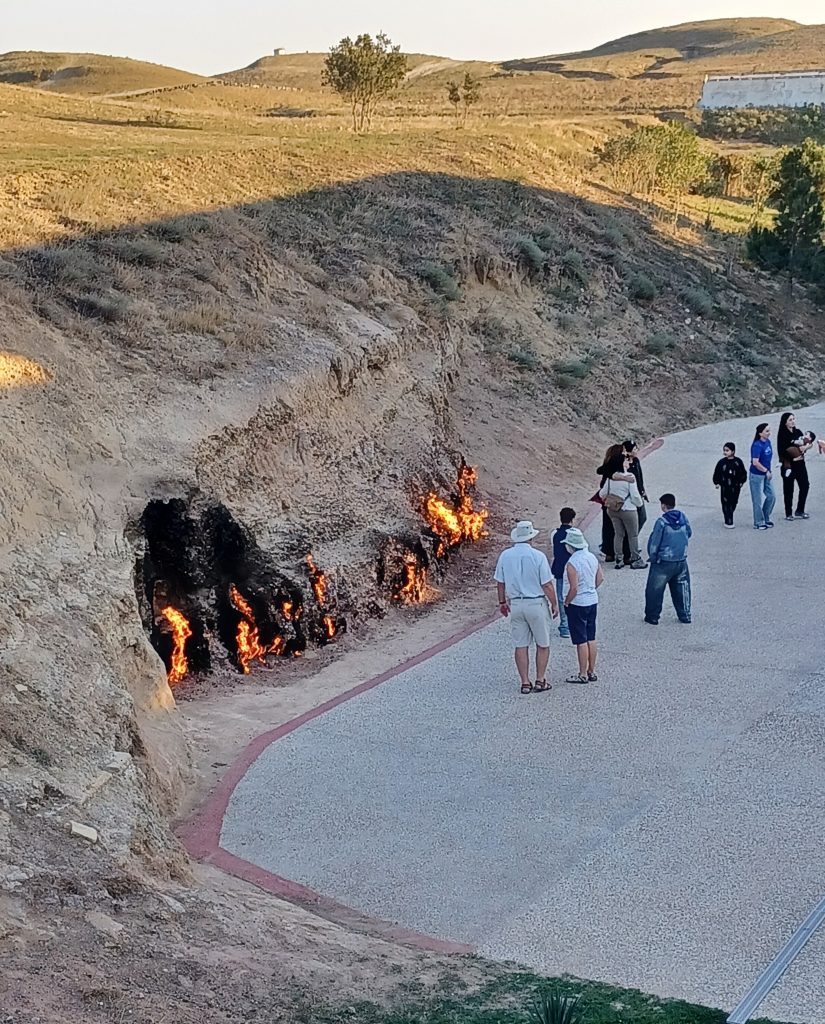
Beyond the burning hill, one can walk up some steps and along the hill top to survey the surrounds. I do. Escape humanity for the open spaces for a few seconds and gaze into the greyish distance. Soon join the group again and move off to survey the souvenirs for sale and a little museum. Thence, back to Baku for the final night’s sojourn in the city.
Diri Baba Mausoleum
We leave Baku today travelling westwards, observing the four lanes of traffic going in the opposite direction. Smug. It is rush hour. We drive through an arid bleakish landscape, which gradually permutates to a light grass covering on low hills. Wonder what is on the festive bill for today. It is all detailed in the tour outline but things are a bit fast paced and I didn’t have time to peruse it beforehand. Turns out that a couple of mausoleums are coming up.
The first stop is at the Diri Baba Mausoleum, a significant monument to Sufiism, we learn. First we head down a wide pathway. A dog lolls in the centre of it and a signpost warns travellers of ‘snakes and scorpions in the area’. Good to know. At the bottom of the pathway, we assemble in front of the steps below this rather picturesque limestone edifice and listen to the history earnestly expounded by our guide. The mausoleum was built in 1402 on the old silk road route in the Shirvan region. Built under the order of one of the Shirvanshah dynasty, in this case Shirvanshah Ibrahim, who was the ruler of the state at this time. Diri Baba himself was a Sufi mystic whose body, legend has it, did not perish after death. Hence this place becoming a site for pilgrims and inquisitive travellers. The mausoleum is unique in being embedded into the rocks. And in the rocks around about are nine caves with interconnecting passages where Sufis might meditate. There is also an ancient cemetery on top of the hill opposite.
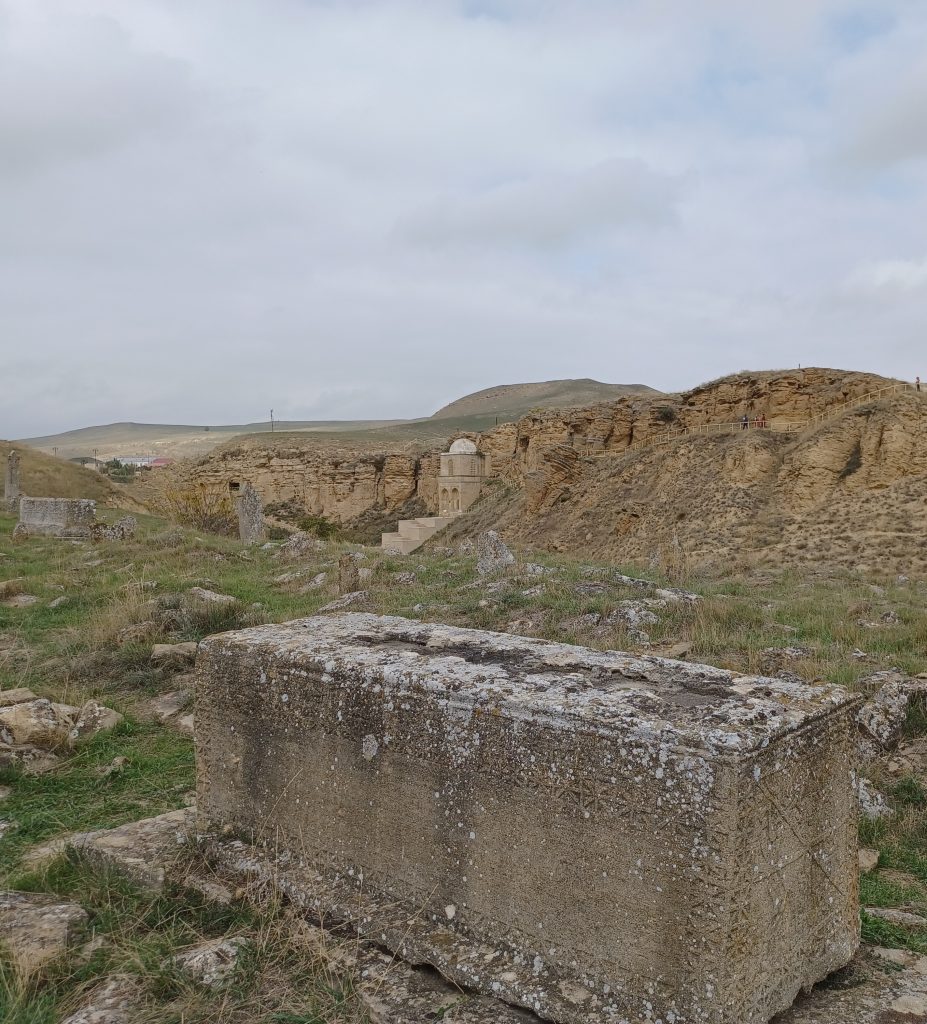
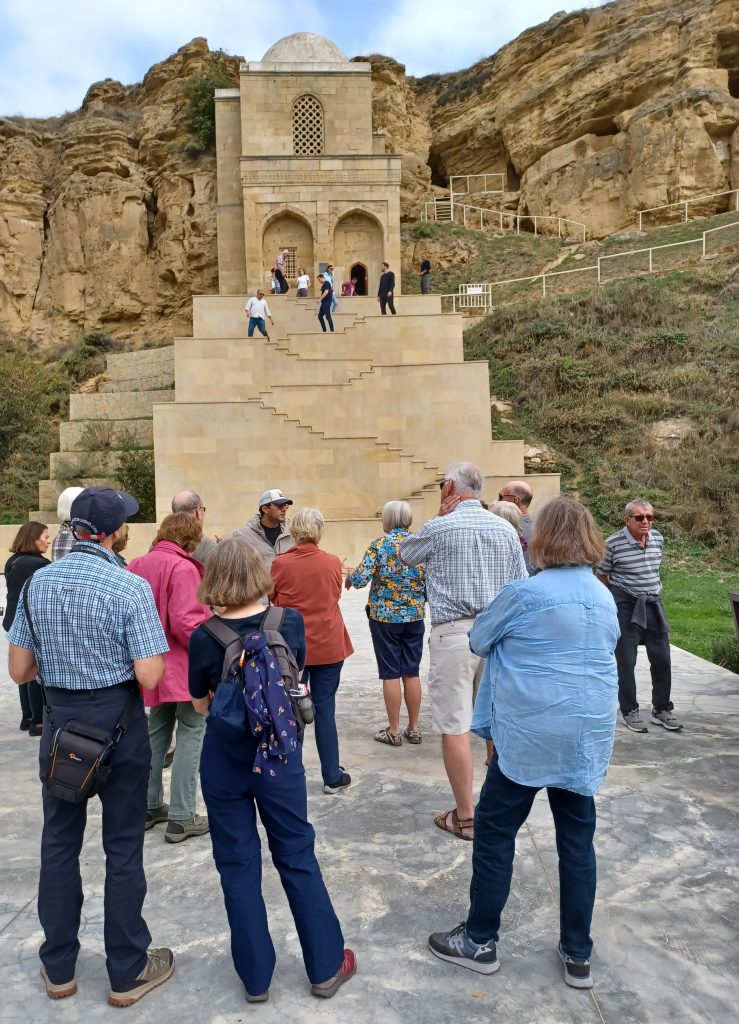
Having zig-zagged up gentle sloping steps with no rails, we venture inside onto the first floor, there to climb steep winding uneven stairs in the darkness. Magical mystery tour. Emerge into a small room with window and thence into a tiny room where a Koran lies on top of Diri Baba’s tomb stone. A place in which Azerbaijanis may find spiritual enlightenment, no doubt. Not, perhaps, the myriad tourists all trotting up to peek in, then buzzing off again after a swift glance, with little knowledge or empathy. But it adds to one’s awareness of the country’s history and culture, I suppose. And, anyway, it is on the tour itinerary. Good view from up here.
Yeddi Gumbaz
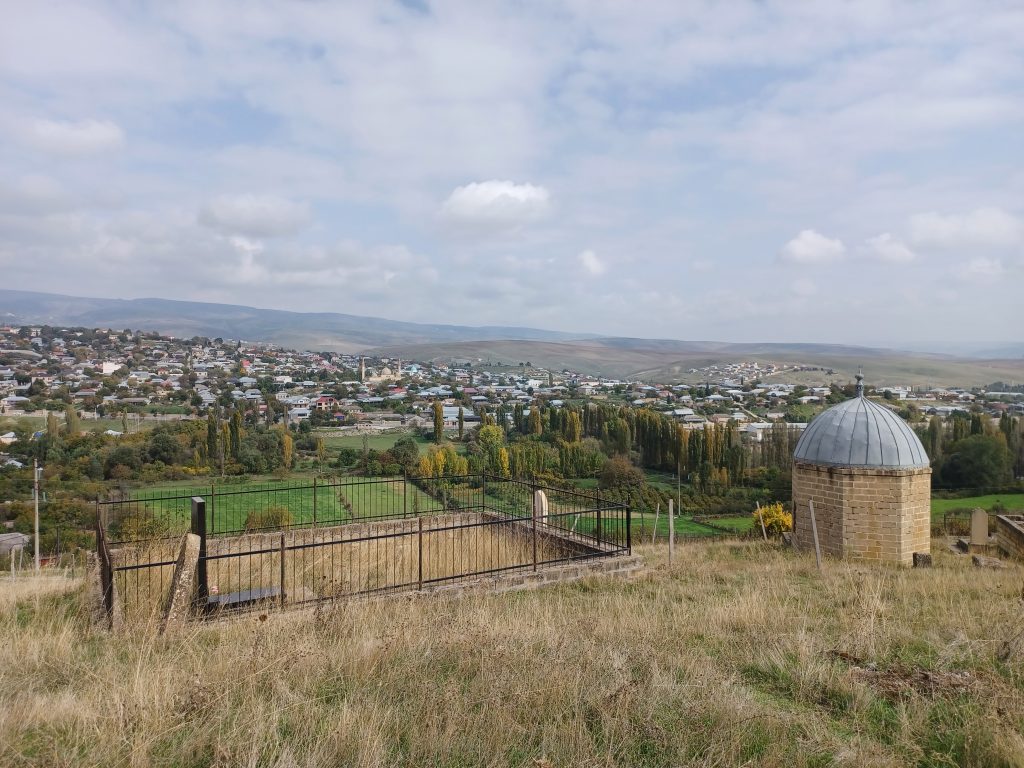
Thence further west along the old silk road to the Yeddi Gumbaz (this means seven domes) mausoleum in Shamakhi. The cemetery here was also built during the reign of the Shirvanshahs. Shamakhi was their capital city between the 8th and 15th centuries and was a significant trading area for the silk road merchants. Unfortunately, Shamakhi, being located in an area where three tectonic plates meet, has been decimated by many earthquakes, particularly those of 1192, 1667 and 1859. The Mongols and other invaders also did their bit to contribute to its destruction. The capital moved from Shamakhi to Baku twice apparently. But this cemetery on the hill is still in place.
“Ladies and Gentlemen, I want to speak about the tombs,” our guide begins. The seven domes themselves were built in the 18th/19th centuries for Khan Mustafa, the last Khan of Shamakhi, and his family. Three of the seven tombs are still intact and we are invited to wander about and look inside them. We scuffle about the area poking heads into these brick built structures with their corbelled ceilings, which are reminiscent of the Treasury of Atreus or Agamemnon’s tomb in Mycenae (see Greece, Part 2), though smaller. Within are decorated stelae and gravestones carved with Arabic inscriptions, and scallop carvings on walls.

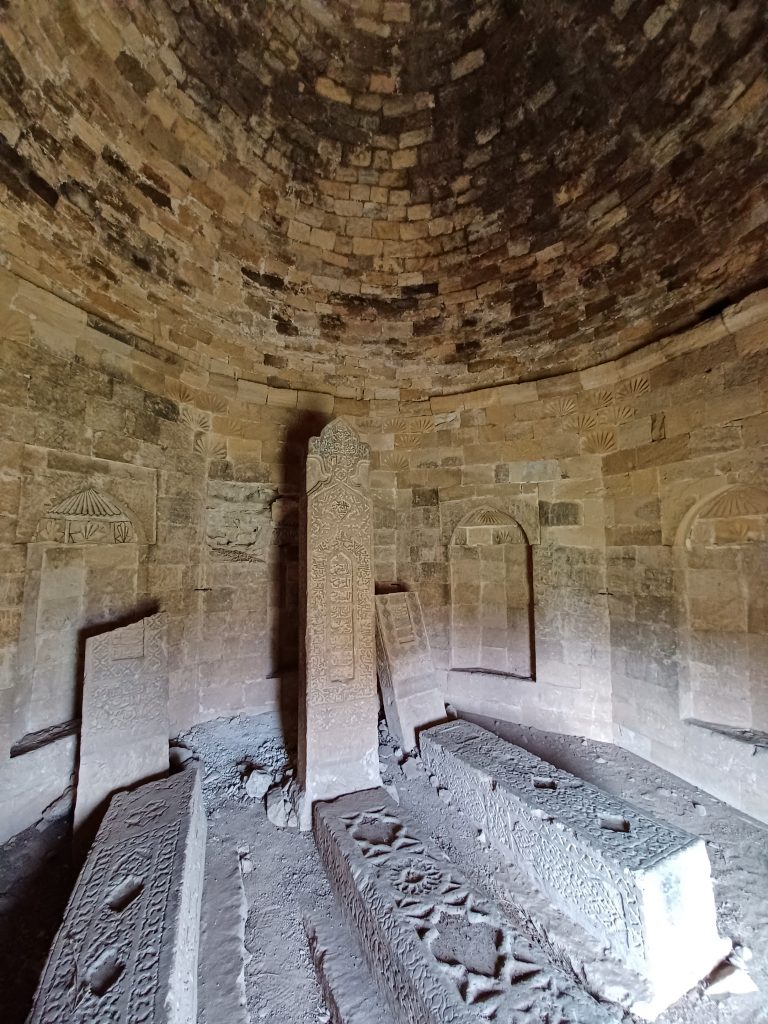
I keep a good look out for snakes and other nasties. Adjacent to this cemetery is a more modern one, bearing photos of the dead on the gravestones. This was a Soviet tradition apparently, which is dying out now, as a more Islamic tradition takes over. There is a pleasant panorama from here over the current town, now the regional capital of Shirvan, and its Juma mosque.
On the Road to Sheki
Back on the red coach now for a two hour slog to Sheki in western Azerbaijan. The guide chooses this time to refresh our knowledge about the Nagorno-Karabakh wars with Armenia. Longish monologue ensues, too detailed to relate here. Bit poignant. Pours out his soul a bit. Suffice to say that horrors were inflicted by both sides but, despite it all, our guide wishes us to pass a message of “peace” to the Armenians when we get there. Azerbaijan has now taken over the Nagorno-Karabakh enclave anyhow (in 2023), and no doubt wishes to retain it.
It is all green up here on the lowish hills, and we pass some Holstein dairy farms, there being plenty of lush grass for cattle to chomp. Also many sheep. And a farm of llamas to attract tourists. As we pursue our way up into the Greater Caucasus, the grassy lowlands are replaced by steepening mountainsides felted with forests. Bit cloudy up here. And the heavens decide to open at this point. The red coach gets a chance to use its windscreen wipers as it wends its way on winding roads. A new road is being built to Sheki, we are told, to replace this one, and we see the beginnings of a bridge and a tunnel to be drilled through the mountain to make for a straighter, wider road.
Caucasian Albanian church, Kish
Still raining. Big drops. Compensates for the lack of rain in the east perhaps. We cross the river, with a few dribbles of water in its wide pebbly bottom, to arrive in Kish, one of Azerbaijan’s oldest villages. We are 1000 metres high here. Lowering black clouds. Here we disembark from the coach and are split into groups of three to ride in cars up and down narrow cobbled streets where the red coach cannot go. There is a first century Albanian (not the Albania in the Balkans) temple in the village. Rain stops as we get out of the cars, pass through the turnstile, manned by an uninterested looking guard, and dash up some stone steps, with a fleeting glimpse at the pretty gardens each side, into the temple. Built of stone, quite small and cold within.
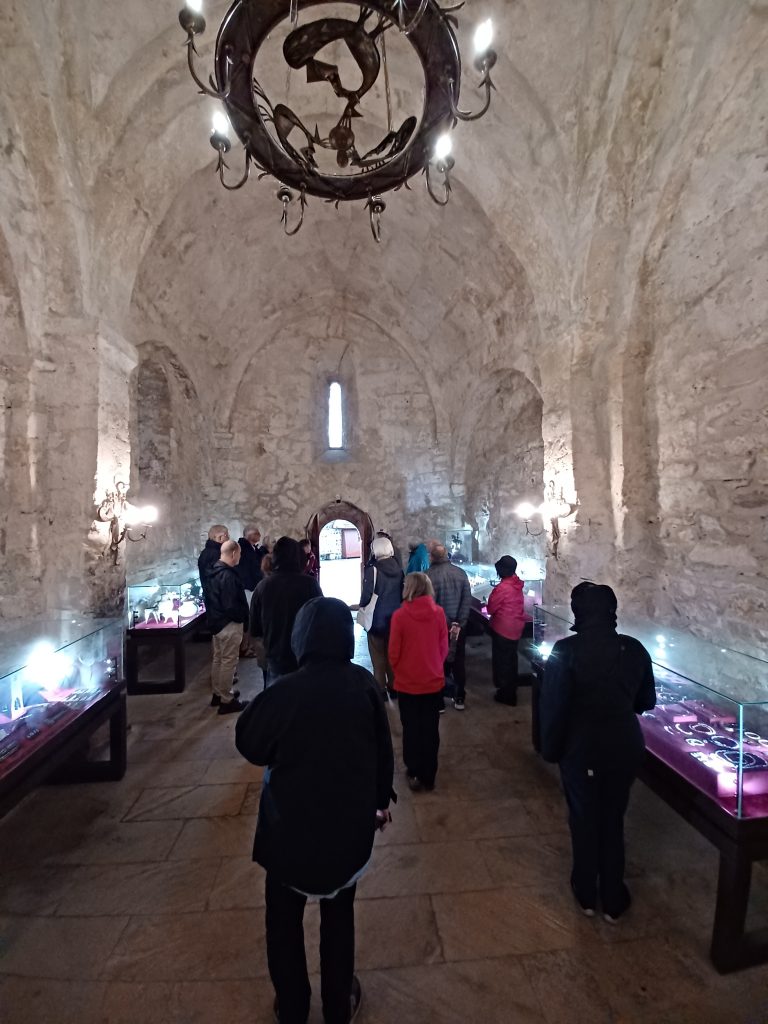
The temple is claimed to be ‘the mother of Christian temples in Eastern countries’, according to a signboard. Saint Thaddeus it was who sent his own disciple, St Elisaeus, here to lay the foundations for the temple in the 1st century. Cannot quite work out its history really. Seems that it functioned at one time as a Georgian Orthodox church, which later became a Caucasian Albanian church and at some point an Armenian Apostolic church, not necessarily in that order. Anyway, it was a place of pilgrimage due to its association with the saint. The existing church dates to the 12th century. But an ancient site has been found during archaeological
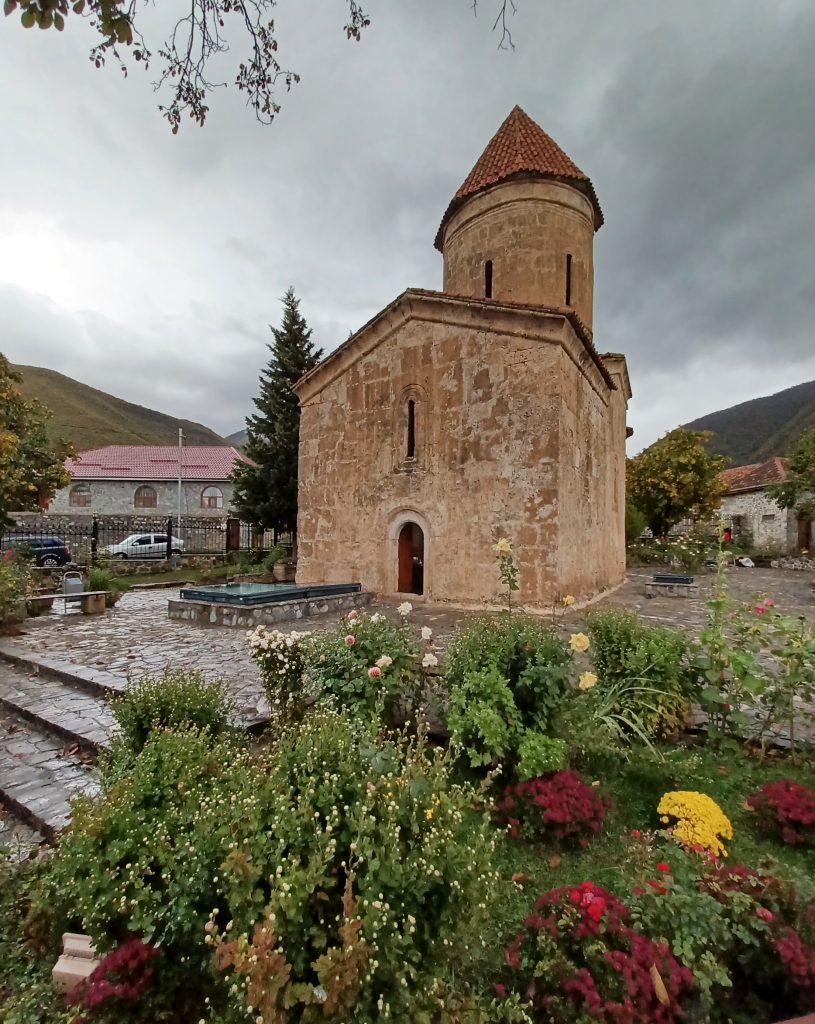
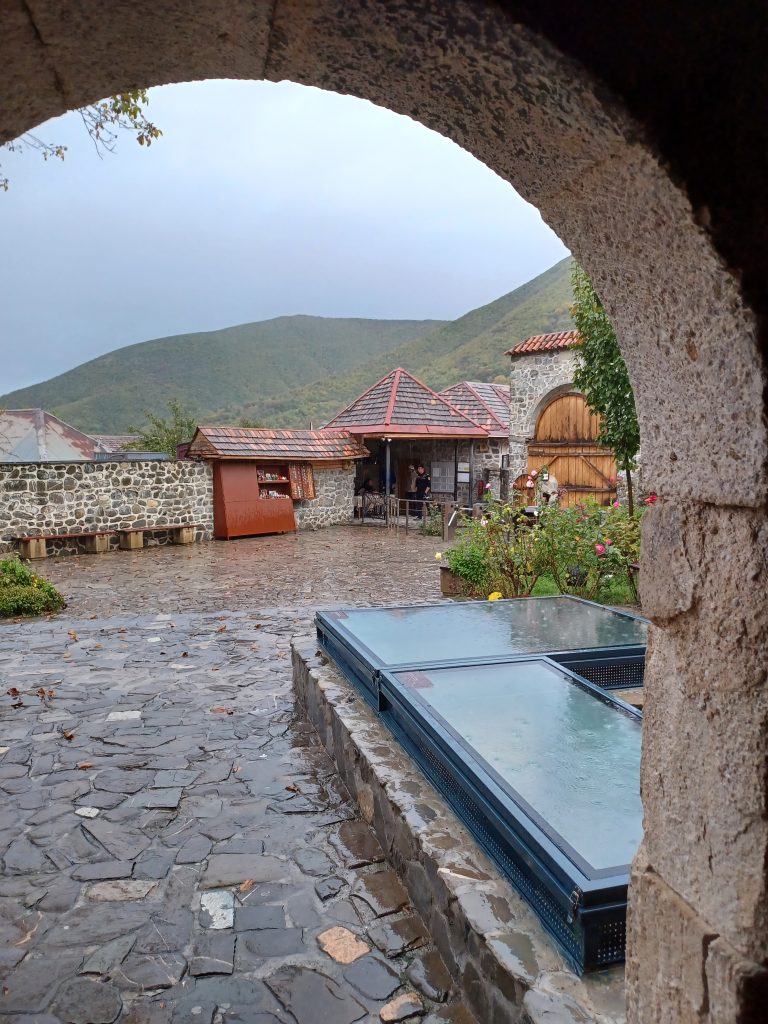
excavations, dating to 3000 BC. Some graves were found during these excavations, one of which contains the skeleton of a Caucasian man 2.5 metres tall, whom we are able to view through a transparent plastic cover. And some archaeological finds, including bronze age pottery, are laid around in display cases for visitors to peer at. Thor Heyerdahl, the Norwegian explorer of Kon Tiki fame, came here in the year 2000 and, with a team of Norwegians and Azerbaijanis, helped restore the church. His bust stands in the precincts. We exit slowly via the gardens. Persimmons and rose bushes are growing here and a quince tree. This is the season for quince. And by the walls sit two wet benches, some little souvenir stalls with wet tiled rooves, and puddles on the paving stones.
Sheki
Descend the hills a bit to the next stop, Sheki, a fabled town on a strategic site on the silk road in medieval times and an independent khanate in the 18th century. Sheki was famous for silk weaving and sericulture (silk worm breeding and production of silk). Forested mountains surround the town and the Gurjana river flows through the middle of it. There is more water in this river than in the Kish and other watercourses that we have passed, I notice.
Upper Caravanserai
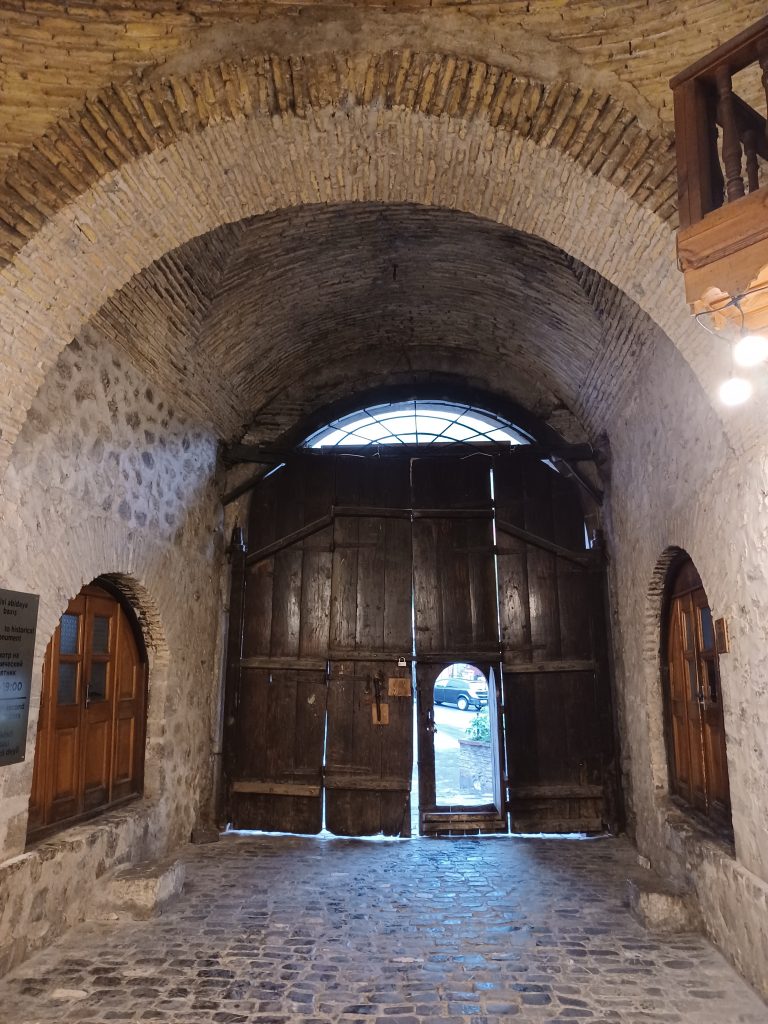
It is late afternoon. Time to squeeze in a visit to the largest caravanserai in Azerbaijan, indeed in the whole of the Caucasus. There are two caravanserai here and this one is the Upper one as opposed to the Lower one. It has over three hundred rooms, in which the travellers slept, and courtyards in which trading took place of goods such as expensive silks and exotic jewels. The whole place is built like a fortress with thick stone walls and gates. There are three gates: two were used by humans and one used by the camels, we are informed. The gates were closed at night time to protect the traders from bandits. This old caravanserai is now a hotel. Enticing café here. It is still raining. Could do with a hot cup of tea. Not forthcoming. No time to indulge in such time-wasting pastimes as relaxation.
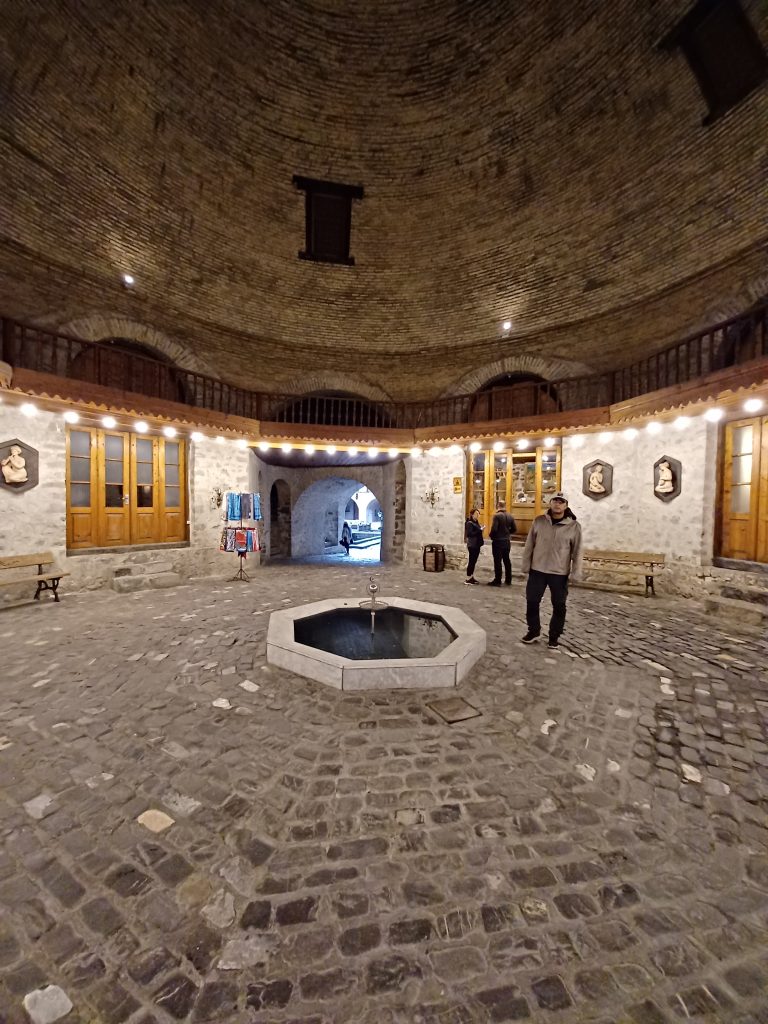
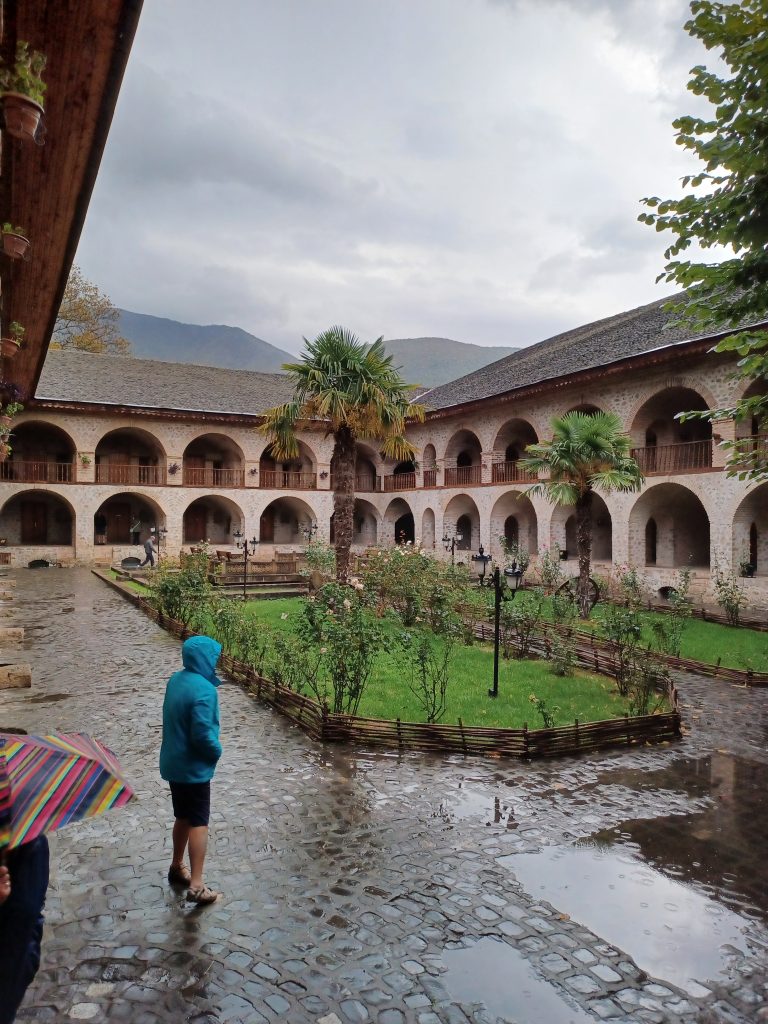
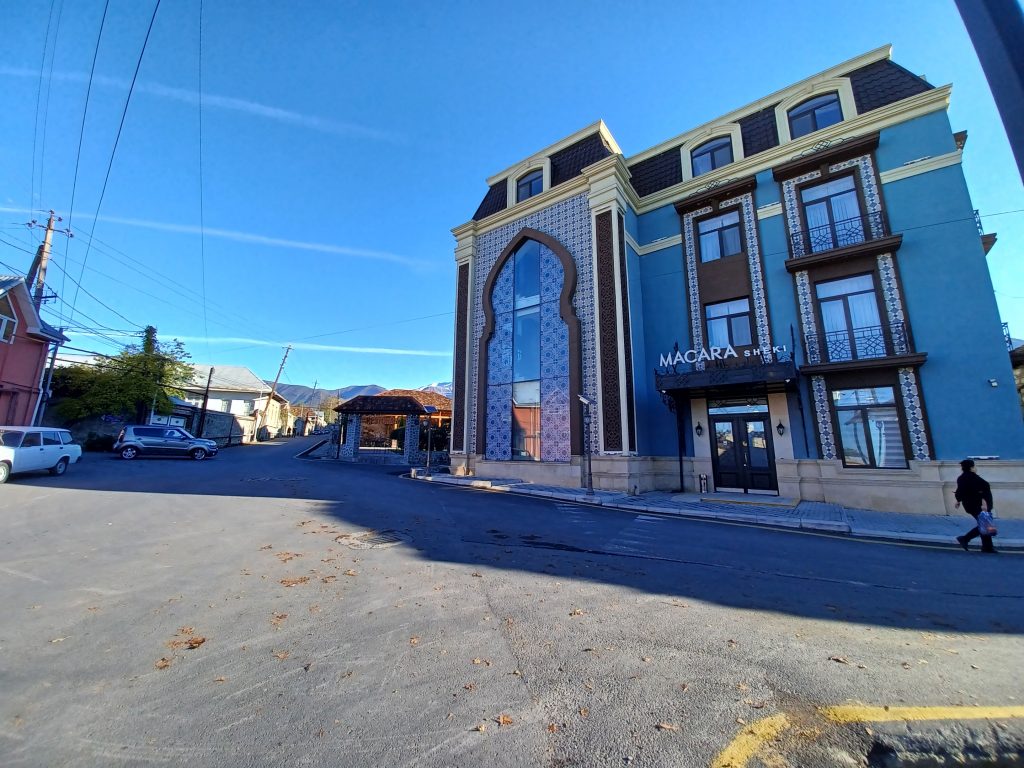
Smashing meal in Sheki this evening is some recompense, however. Red roses on plates – a nice touch – and piles of meats and fried vegetables served from large platters. We are staying in the lovely Macara Hotel with blue and white tiles around the windows. Cold in town. Snow on the hills. But cosy inside.
Palace of the Sheki Khans
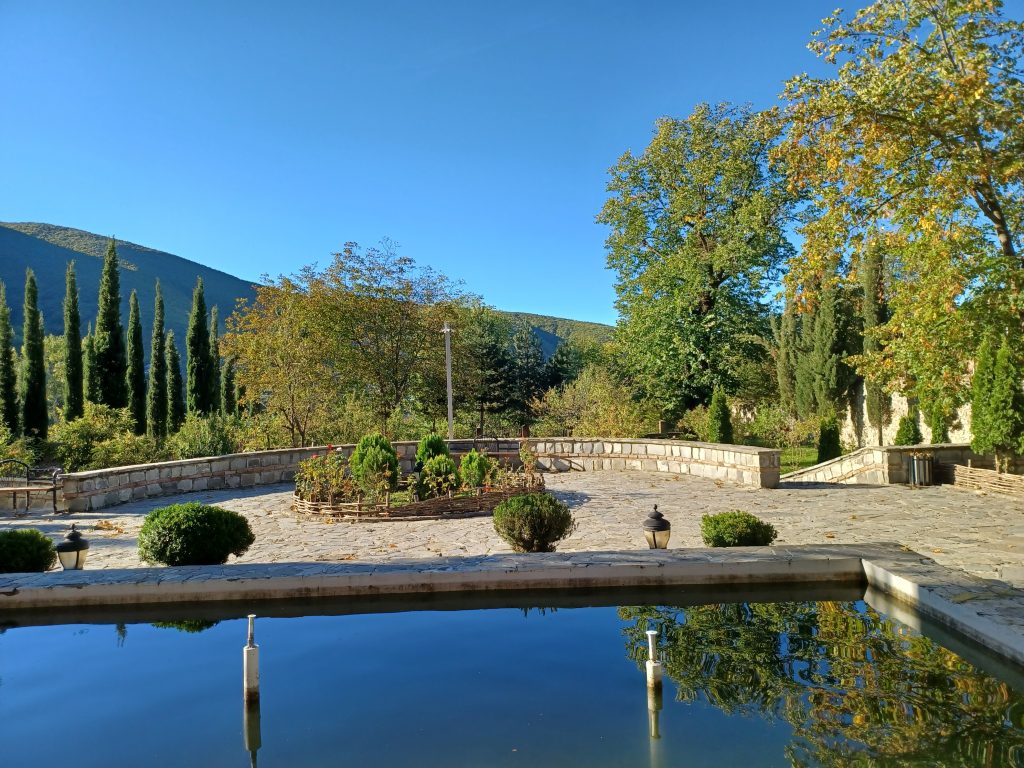
The main attraction today is the Palace of the Sheki Khans. We leave the hotel and drive through the twisty lanes of Sheki to reach the palace, which was built on a good defensive site as Muhammed Khan’s summer house in 1762. Both the town and the palace were designated UNESCO heritage sites in 2019. The sun shineth. Somewhat of a contrast to yesterday. In buoyant mood. We enter by a side gate, behind which rises a plane tree. There are two giant plane trees in fact stretching upwards in front of the palace, apparently to stabilise the building. And a square pond with slender cypress trees and forested slopes beyond it, standing sharp against the clear blue sky.

The palace is gorgeous, full of colour, with special ‘shabaka’ windows of glass and wood made by interlocking small pieces together with no glue or nails. We saw one of these windows exhibited in the Palace of the Shirvanshahs in Baku. “The glass is from Murano”, the local guide informs us.
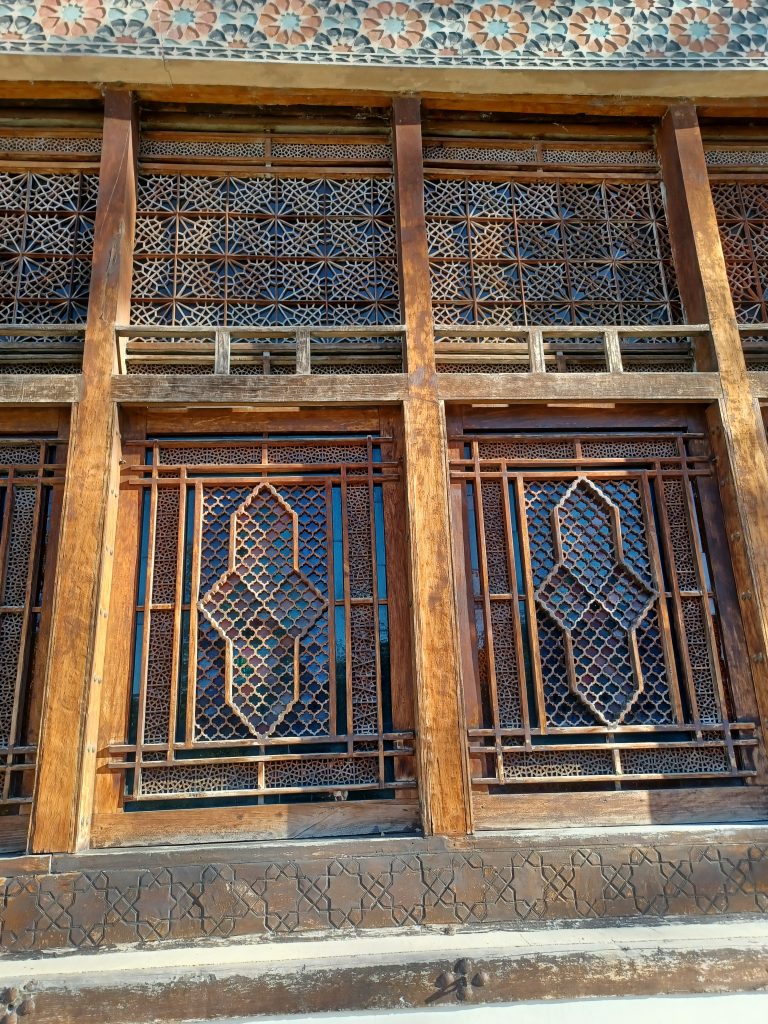

Some restored sections are factory made in Russia though. Back in the day, the glass was exchanged for Sheki silk. The walls and ceilings of the palace’s six rooms and corridors are smothered with frescoes featuring hunting scenes; battle scenes with cannon and soldiers and horses; one reddish room built for the wife of the Khan, “whom the khan loved very much”, as a ladies’ room. The ceilings are wavy like carpets with the same pattern on them as the carpets that would have lain on the floors. These have been lost, probably pinched by the Russians who finished off the Khanate in 1819 when the area came under Tsarist rule.
The décor features peacocks, symbolising humanity’s flawed nature, since peacocks are beautiful but have a mighty unpleasant squawk, we are informed; and blue irisis, symbolising Turkishness (as with the blue of the flag); and pomegranates. There is a natural ‘crown’ on the head of the pomegranate, which apparently signifies royalty. The fruit is also a symbol of fertility, presumably due to the myriad seeds inside it, between 200 and 400! The pomegranate doesn’t require too much water to grow either, a useful attribute in desert regions (See Hashemite Kingdom of Jordan, Part 1). Native birds and animals as well as mythical dragons and unicorns also appear. One dragon is depicted breathing flowers, not flames. The local guide explains that this is because the monarch is powerful but merciful. OK. Allegory aside, the whole building is stunning from top to bottom. No photos allowed inside. A trifle overwhelmed. Exit into the soothing natural greens and blues outside.
As we slither over the cobbles outside the palace towards the old fortress gate, we detour into a craftsman’s workshop where stained ‘shabaka’ glass is being made in the same traditional way as those in the palace. Beautiful objects, such as crosses, mirror surrounds and decorative wall panels are here displayed. No doubt the craftsman would appreciate buyers of his artworks but no time has been allocated to spend upon shopping. Need to hasten to the coach to make for the Georgian border.
The day continues sunny. The rays sparkle on the trickles of water in wide river beds and the Greater Caucasus mountains are glazed with snow. Trees are beginning to change colour with autumnal hues of reds and golds. More sheep and more placards sporting the face of Heydar Aliyev are much in evidence as we arrive in the border town.
Here we take leave of our guide, splendidly erudite, and driver, who has navigated the sinuous roads with some panache. Both receive tips in abundance.
Georgian pastures await.


Leave a Reply